Henkhisesui and the east wind of the Book of the Dead
By Ralf Ittermann · last reviewed on
Henkhisesui is a god of the Egyptian tradition.
The winged east wind, breath of life for the dead.
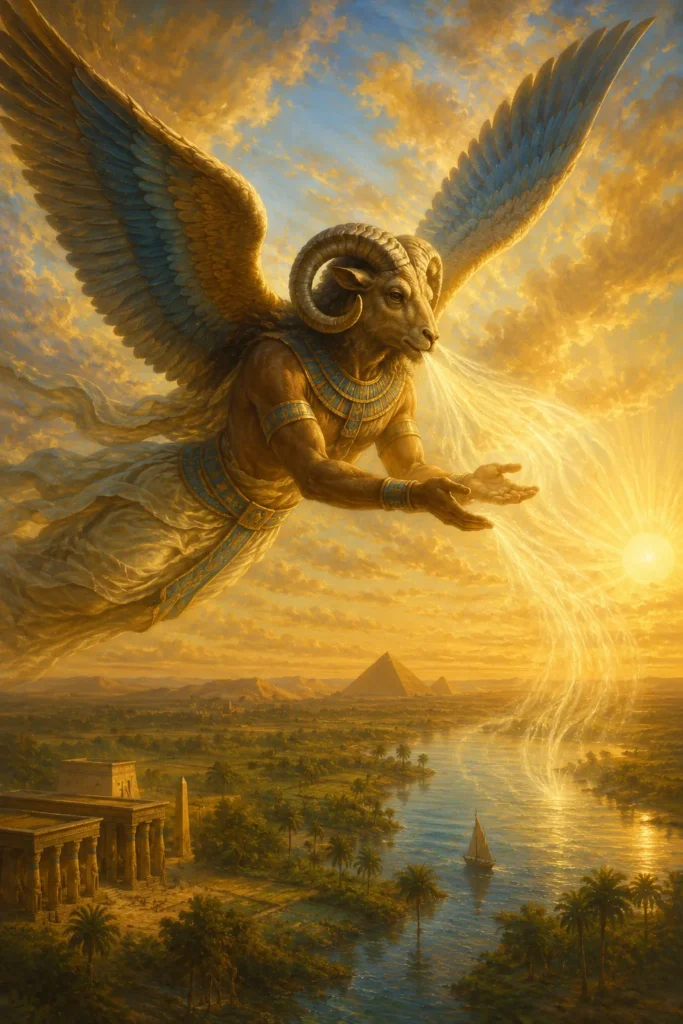
Henkhisesui, also Henkhiseswi, is the Egyptian god of the east wind and one of the four directional wind gods. He is depicted as a winged, often ram-headed figure and belongs to the life-giving four-winds system of temple theology and the funerary texts.
Unlike his better-known brother Qebui, he never developed a distinctive iconographic trademark of his own: his ram-headed, winged scarab form is closely related to Chnum and Chnubis, and even his name form is difficult to transcribe with certainty.
Type: God of the east wind, one of the four directional wind gods
Origin: four-winds system of temple theology and the funerary texts
Texts: Dendera reliefs, Book of the Dead (especially Spell 161)
Period: Graeco-Roman temple texts, Book of the Dead tradition
Appearance: winged man with a ram’s head, or a ram-headed scarab
Source context
Period of the Texts
Graeco-Roman temple texts and the Book of the Dead tradition carry the tradition; earlier textual layers do not name the east wind god independently.
Area of Diffusion
Egypt, especially Dendera; beyond that, Henkhisesui lives on mainly in funerary literature.
Sources
Thin: the name form and iconography are uncertain, and the evidence is spread across reliefs and the Book of the Dead.
Name and variants
Egyptian: The name form is difficult to transcribe with certainty, as is its meaning; alongside Henkhisesui, the spelling Henkhiseswi also occurs. In this he differs from Qebui, whose name clearly derives from the root qbb, to be cool.
Description
Appearance
In the common tradition, Henkhisesui is a winged man with a ram’s head, or a winged, ram-headed scarab. This ram-headed, winged scarab form is iconographically closely related to Chnum and Chnubis.
Effect
Henkhisesui brings the east wind and is part of the life-giving four-winds system that supplies breath to the deceased.
Profile: Henkhisesui
The key aspects of the east wind god at a glance.
Member of the Four Winds system of Ptolemaic-Roman temple theology, alongside Qebui, Hutchai and Shehbui.
The funerary context: in Spell 161 of the Book of the Dead, the four winds bring the breath of life to the deceased through the openings of the sky.
A winged man with a ram’s head, or a winged, ram-headed scarab; the form is close to Khnum and Chnubis.
The east wind as part of the life-giving Four Winds system; no independent mythology has formed around him.
No dedicated cult is attested; no rites or offerings specifically for Henkhisesui have come down to us.
Spell 161 and the openings of the sky
Henkhisesui is one of the four winds of Ptolemaic-Roman temple theology, attested in the Dendera reliefs and in the Book of the Dead tradition. Central to this is Spell 161: there, the four winds bring the deceased the breath of life through the openings of the sky, and the east wind has his fixed share in this.
The Egyptian form of the name is difficult to transcribe with certainty, as is its meaning. This is no minor detail but characteristic of the source situation as a whole: the god of the east wind is a functional figure within the system, not a god with his own narrative tradition.
A list god of specialist literature
Henkhisesui appears almost exclusively in specialist Egyptological studies; in popular sources he usually appears only as a list entry, god of the east wind.
In terms of religious studies, he belongs to the Four Winds system, whose animal-headed assignment, here east equals ram, derives from older literature, above all Budge, and is not always clearly readable in the reliefs. This uncertainty should be stated openly rather than presenting one variant as established fact.
No cult, but a task
No dedicated cult is attested for Henkhisesui; no rites or offerings have come down to us. His significance lies in the funerary-cosmological context, as breath for the deceased. The Four Winds system needed no temple: it worked wherever the funerary texts were spoken, at the transition from life to the afterlife.
Scarab, ram and the winds of the neighbours
Within Egypt, Henkhisesui shares the winged, ram-headed form with Khnum and Chnubis. More broadly, the four winds recall the winged hybrid beings of Mesopotamia; as east wind, he is typologically comparable to the Greek Euros. His closest relatives remain the sibling winds Qebui, Hutchai and Shehbui.
Frequently asked questions about Henkhisesui
Which wind is Henkhisesui?
The east wind; he is one of the four Egyptian gods of the cardinal wind directions.
What does he look like?
In the widespread tradition, as a winged man with a ram’s head, or as a ram-headed, winged scarab.
Was he worshipped?
No dedicated cult is attested; his role lies in the funerary context, as breath of life for the deceased.
Further links
Further reading:
- Egypt – all beings of the Egyptian cultural sphere
- Qebui, Hutchai, Shehbui – the three sibling winds
- Euros – the Greek east wind as typological counterpart
- Protective candle, smoke cleansing, amulet – traditional protective means
- Protection Compass – protective means at a glance
Literature (selection)
Further standard works in the bibliography.
As the Egyptian east wind, Henkhisesui belongs among the quiet helpers of funerary belief: a winged wind god who is defined less by myths than by his one task, to bring breath to the deceased.