Ra, god of the Egyptian tradition
By Ralf Ittermann · last reviewed on
Ra is a god of the Egyptian tradition.
Egyptian sun god and supreme deity, creator of order and daily renewer of the world. Ra stands at the centre of Egyptian religion and mythology as the highest figure of the cosmos.
He embodies the power of the sun, cyclical renewal, and the eternal struggle between light and chaos. His name is synonymous with divine power and the guarantee that day follows night and that good triumphs over evil.
As the Egyptian sun god, Ra is both creator and sustainer of the world.
Ra
Overview: Ra
Type: Supreme deity, sun god, creator god
Pantheon: Egypt
Function: Creator of order, daily renewal of the world, struggle against chaos
Principal attributes: solar disk, uraeus serpent, falcon head, scarab
Principal cult sites: Heliopolis (On), Thebes (Karnak-Luxor / Amun-Ra), Abu Gurob
Roman counterpart: Sol Invictus, Helios (Greece)
Context
The tradition concerning Ra reaches from the Old Kingdom (ca. 2700 to 2200 BCE), where he is already venerated as a supreme deity in the Pyramid Texts, through the Middle and New Kingdoms into the Ptolemaic-Roman period.
The most important literary witnesses are the Pyramid Texts (Old Kingdom), the Coffin Texts (Middle Kingdom), the Egyptian Book of the Dead as well as the underworld books of the New Kingdom (particularly the Book of the Day and the Book of the Night), and the solar hymns from the temples.
The syncretistic fusions with Atum and Amun emerge more strongly in the New Kingdom and remain established into Roman times.
Mythological context
Ra, the sun god, is the formative cosmic principle of the Egyptian universe and the daily manifestation of creative power.
He travels each day in his solar barque across the sky, sets in the evening, and crosses the underworld (Duat) at night in an epic battle against the serpent Apophis, who attempts to devour him each day.
Ra embodies the cyclical nature of life, death, and rebirth. He merges with other gods (Amun-Ra, Ra-Horakhty) and thus forms a multifaceted manifestation of universal power.
Ra was venerated throughout ancient Egypt, with principal centres in Heliopolis (Iunu, Egyptian On), the oldest solar cult site, and Thebes (with the syncretistic figure Amun-Ra).
His veneration was not tied to a single city but pervaded religious practice from the Delta to the Nubian border. After the conquest by Hellenistic and Roman powers, Ra was equated with the Greek Helios and the Roman Sol Invictus.
The core of the tradition consists of the Pyramid Texts from Saqqara near Memphis (5th and 6th Dynasties), which already present Ra as a god of the sky and creation. The Coffin Texts of the Middle Kingdom extend the myths to include cosmic cycles.
The Egyptian Book of the Dead (ca. 1550 to 1070 BCE) describes Ra’s nocturnal journey through the underworld in rich pictorial language. Temple inscriptions, tomb paintings, and priestly commentaries in temple libraries (for example Edfu, Dendera) elucidate the syncretisms and the ritual daily routine.
Designation and Spellings
Egyptian: Ra (also Re, Egyptian Rʿ or Raʿ), determinative: solar disk. The root points to “sun”. Variant spellings: Re (Latin transliteration, common in older scholarly works), Ra (modern convention), Pre (a reading from the hieroglyphs, rarer).
Syncretistic names: Atum-Ra (fusion with the creator god Atum of Heliopolis, especially the evening form), Amun-Ra (fusion with the supreme god Amun of Thebes, dominant in the New Kingdom), Ra-Horakhty (Horus in the horizon, the unified figure of the rising Horus and the sun god), Khnum-Ra (fusion with the ram-headed creator god Khnum on the southern frontier).
Epithets: Khepri (morning form as scarab, “the becoming one”), Atum (evening form as an aged man or ram), Khenti-Amenti (Lord of the West, in the underworld), Neb-Tawy (Lord of the Two Lands, of the cosmos). Hieroglyphic representation: the solar disk (Aten), often with a dot or circle beneath it.
Description
Appearance
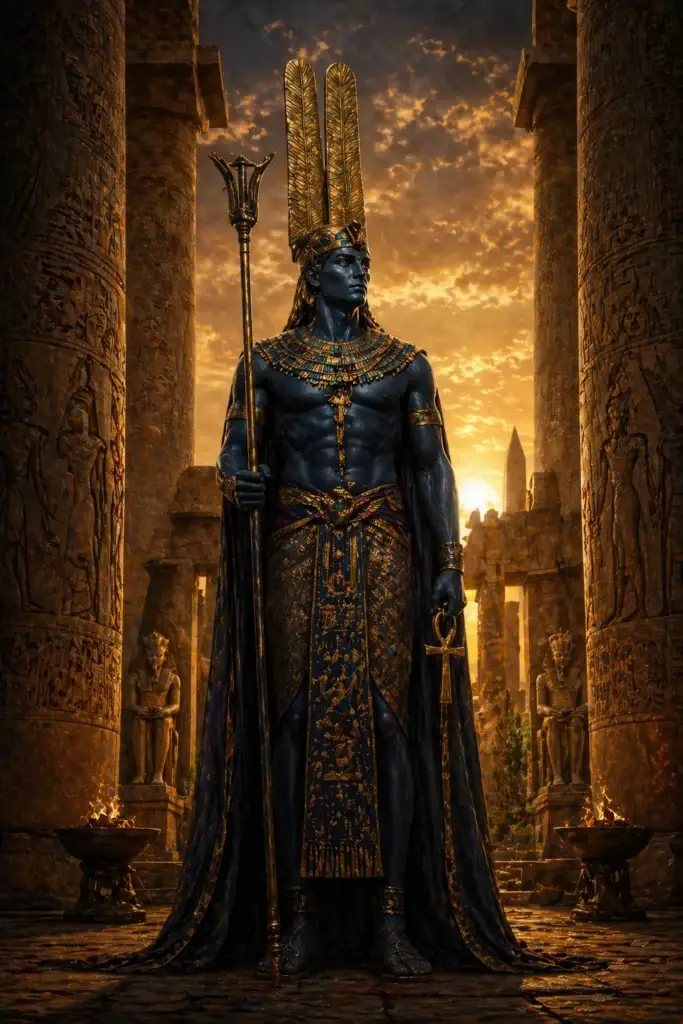
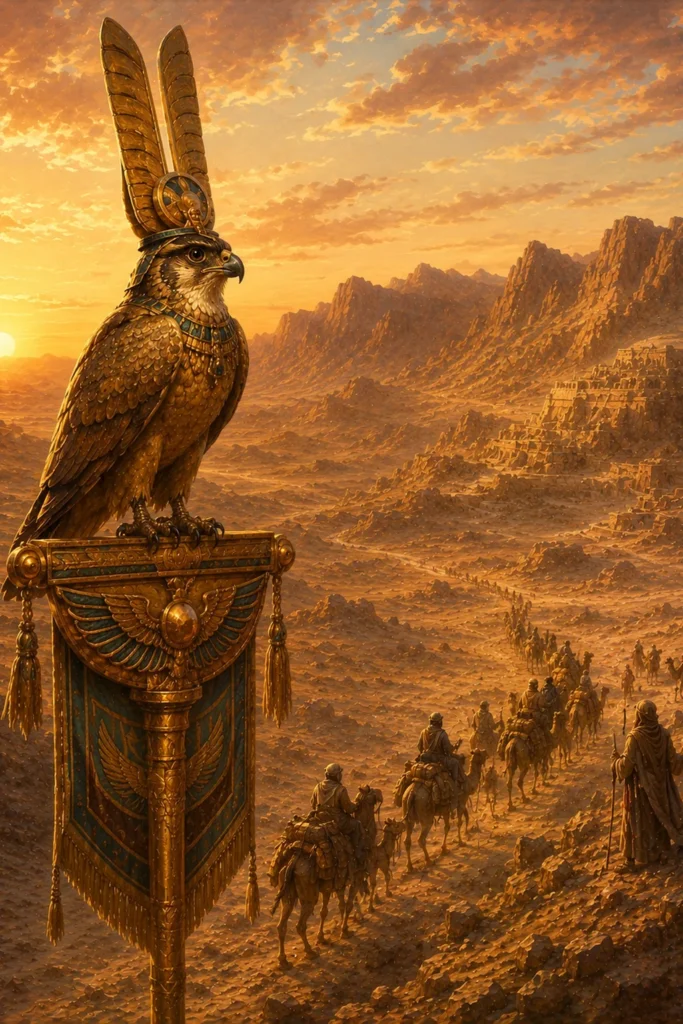
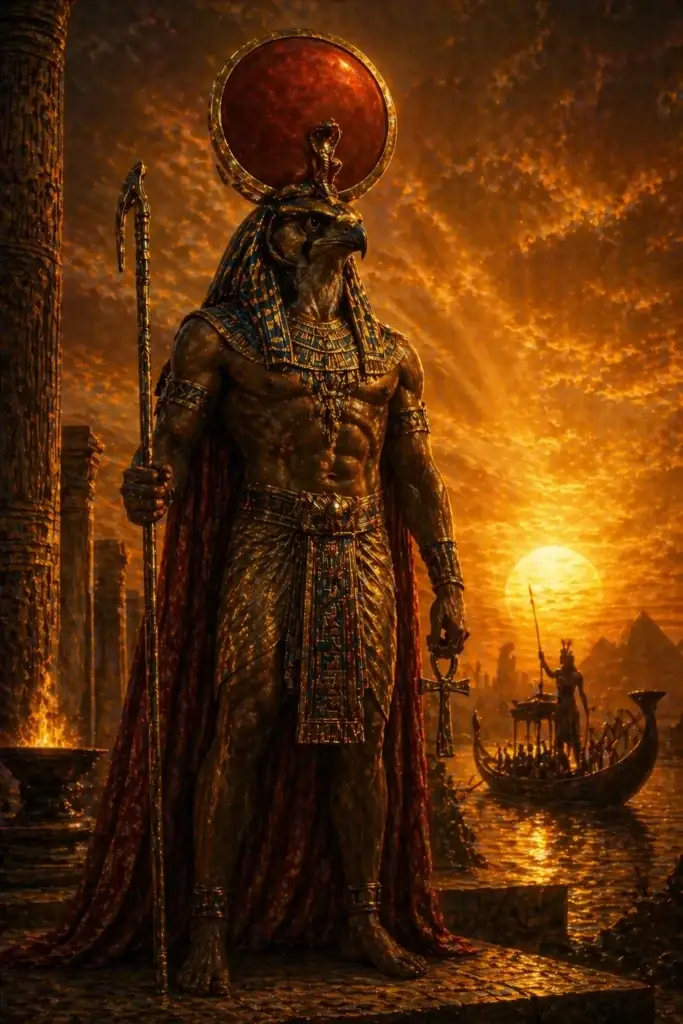
Ra is typically depicted as a man with a falcon’s head, on the crown of which sits the luminous solar disk.
Around the solar disk coils the uraeus serpent (Egyptian wadjet), the symbol of royal power and protection. In early depictions (Old Kingdom), Ra sits in a barque (boat) and is drawn by other gods.
Later representations show him in part as a scarab (Khepri, the morning form, a dung beetle figure) who rolls the solar ball through the entire night until he expels it again in the morning and the sun arises anew.
In the evening form he appears as an aged, elderly man or as a ram (Atum form).
Nature and Activity
Ra is not merely the god of the sun in the sky, but the power of creation and renewal itself. According to Egyptian cosmology, he creates the day by his daily journey across the sky in the day barque Mandjet and orders the world.
At night he travels in the night barque Mesektet through the underworld (Duat), where he encounters the chaos demon Apophis, an enormous serpent who threatens to devour him.
Every night Ra battles Apophis; every night he triumphs, and so the world is renewed. This cosmic battle is synonymous with the victory of order (Ma’at) over chaos (Isfet).
Appearance and Symbolism
Ra is depicted as a man with a falcon’s head and the solar disk, adorned with the uraei, the sacred serpent of the pharaohs. He wears ornaments of gold and carries the sceptre of the sky.
In his daily phases he changes form: as Khepri (scarab) at dawn, as Ra at midday, as Atum in the evening, and as Auf at night in the underworld. The solar disk is his most dominant symbol, representing life, warming power, and conscious intelligence.
Profile: Ra
The most important aspects of Ra at a glance. The table summarises origin, function, appearance, veneration, symbols, and parallels.
Ra emerges as a self-creator, or he is created by Atum (the myths vary). In some versions he is the son of Atum and the sky goddess Nut.
In Heliopolis (On), the oldest cult site, he is venerated as a direct manifestation of solar energy. From the 5th Dynasty onward (ca. 2500 BCE), the pharaohs call themselves “Son of Ra” (Sa Ra), thus legitimising their rule as the earthly reflection of cosmic order.
Supreme deity and guarantor of cosmic order (Ma’at). Creator and daily renewer of the world. Leader of the struggle against chaos and darkness. Protector of the pharaohs and of the Egyptian people. His function is not moral in the personal sense, but cosmic: he represents the necessary return of the good and of the light.
Man with a falcon’s head, solar disk, and uraeus serpent on the brow. Scarab form (Khepri) as morning manifestation. Aged ram (Atum) as evening manifestation. Seated in a barque (Mandjet or Mesektet), drawn by other gods or animals.
Ra's Veneration
Principal cult sites: Heliopolis (On, the oldest and most important solar temple, destroyed but widely attested in literature), Thebes (Karnak and Luxor with the Amun-Ra sanctuary), Abu Gurob (solar sanctuary of the 5th Dynasty, the location of daily rituals).
Priestly officials: priests at Heliopolis led the daily solar hymns. The pharaohs themselves served as the earthly representatives of Ra. Private veneration: scarab amulets as personal protective amulets, sunrise invocations at the peaks of life.
Ra's Symbols
Veneration in Everyday Life
Ra was not a god of personal promises of salvation or of mysteries, but the guarantor of order. His veneration unfolded on two levels:
Priestly and state: pharaohs and priests carried out daily rituals in the temples of Heliopolis, Karnak, and other cult sites. In the morning hymns were sung to support Ra in his ascent; in the evening protective spells and battle chants were intoned against Apophis.
These rituals were not regarded as private devotion, but as cosmic labour that guaranteed the very existence of the world.
Personal and lay: private persons wore scarab amulets with Ra symbols or Ra names in order to secure daily protection. At sunrise short prayers or invocations were offered. Particularly under the pharaohs of the 5th Dynasty, solar sanctuaries were erected as funerary monuments, in order to integrate the pharaoh into Ra’s cosmic orbit.
In personal names: the name Ra itself carried great power. Compound names such as Si-Ra (Son of Ra) or Ra-Hotep (Ra is content) were widely used in Egyptian families, especially among the elite.
Ra: Parallels in Other Cultures
Greece and Rome
Helios bears all the attributes of Ra: sun god, daily journey across the sky in a quadriga (chariot), lamp-bearer of the world. In the later Roman period, Ra is fused with Sol Invictus (the Unconquered Sun), especially under the emperor Aurelian (270 to 275 CE), who established Sol Invictus as the supreme god. The parallel extends into early Christianity, which symbolically links the resurrection of Christ with the sunrise.Vedic and Hindu Tradition
Surya (the sun god) and Savitar (the awakener, the impeller) share with Ra the function of daily renewal. The Rigveda (ca. 1500 BCE) describes Surya’s journey across the sky in a golden quadriga. In contrast to Ra, who remains a supreme deity, Surya is later overlaid in Hinduism by Brahma, Vishnu, and Shiva as the supreme Trimurti.Mesopotamia
Shamash is the Mesopotamian sun god and judge. Unlike Ra, however, Shamash is not the cosmic supreme deity but an aspect-god among many. Marduk assumes in Babylon the role of world-creator and chaos-vanquisher (battle against Tiamat), which is functionally similar to Ra but not confined to the sun.Germanic Tradition
The sun (Sol, Sunna) is represented in Germanic mythology by a goddess who likewise travels across the sky in a horse-drawn chariot, pursued by the wolf Sköll. The function is similar (daily renewal), but the gender and the symbolism differ.
The Solar Barque and the Journey Through the Twelve Hours of the Night
The central theological image of Ra is his daily journey. By day the sun god crosses the sky in the day barque; in the evening he boards the night barque and travels through the underworld, the Duat.
This nocturnal journey is described in detail in dedicated texts, above all in the Amduat, literally “that which is in the underworld”, and in the Book of Gates.
Both belong to the Books of the Underworld that were painted on the walls of the royal tombs in the Valley of the Kings during the New Kingdom.
The Amduat divides the night into twelve hours, each of which presents its own region with its own beings. In the middle hour, often the sixth, the decisive event takes place: the sun god unites with the corpse of Osiris, and from this union he draws the power for rebirth.
Research, for example by Erik Hornung, who has comprehensively edited and translated the Books of the Underworld, sees in this the core of the Egyptian conception of cosmic renewal.
The journey is not without peril. In every hour obstacles arise: gates must be passed, harmful beings warded off. The greatest enemy is the serpent Apophis, who seeks to halt the barque. Companions such as other deities and the blessed dead who dwell in the beyond support the god.
At the end of the twelfth hour, Ra is reborn as a scarab or as a child and rises on the eastern horizon. This narrative structure gave the Egyptians a model that allowed them to grasp the daily course of the sun, death, and the hope of rebirth within a single image.
Apophis: The Daily Struggle for World Order
Ra’s antagonist is Apophis, in Egyptian pronunciation Apep, an immense serpent who threatens the solar barque on its nocturnal journey.
Apophis does not embody a single enemy but chaos itself, the unordered, which threatens day by day to devour the created world. Unlike the gods, Apophis is never born and never finally killed; he is a permanent threat.
In the Books of the Underworld and in dedicated ritual texts the struggle against Apophis is described. The serpent attempts to swallow the water on which the barque travels, or to block its path.
Gods such as Seth, who stands at the prow of the barque, or the goddess Selket bind and pierce the beast. The most important text on this is the so-called Book of Apophis, preserved in the late-period manuscript of the Papyrus Bremner-Rhind. It contains spells and instructions for binding, dismembering, and burning Apophis.
These texts were enacted ritually in the temple. Priests fashioned figures of the serpent from wax or drew them on papyrus, in order then to trample, pierce, and burn them: a form of ritual destruction of chaos.
From the standpoint of religious studies this finding is significant, for it shows that Egyptian religion did not regard the persistence of the world order as self-evident.
Ma’at, the right order, had to be defended each day, in the myth by the sun god and in the cult by the priesthood. Sunrise was therefore each morning a victory won, not an automatism.
Heliopolis and the Theology of the Ennead
The principal centre of the cult of Ra was Heliopolis, the City of the Sun, in Egyptian Iunu, situated in what is today the northern part of Cairo.
From here comes one of the most important Egyptian creation systems. At its centre stands the creator god, who in different texts is called Atum, Ra, or the combination Ra-Atum.
He arises from the primaeval waters of Nun and brings forth from himself the first pair of gods, Shu (air) and Tefnut (moisture). From these proceed Geb (earth) and Nut (sky), and from these in turn Osiris, Isis, Seth, and Nephthys.
This series of nine deities is called the Ennead of Heliopolis. It orders the most important gods of the myth within a genealogical structure and makes Ra-Atum the origin of all things.
The Heliopolitan priest was in the Old Kingdom one of the most influential religious functionaries, and the solar cult shaped royal ideology: already in the Old Kingdom kings adopted the title “Son of Ra”, and the Pyramid Texts, the oldest religious texts of Egypt, are strongly imprinted with solar theology.
The visible sign of the Heliopolitan cult was the Benben, a sacred stone pillar associated with the first land that emerged from the primaeval water, as well as the obelisk, whose tip was meant to capture the rays of the sun.
The solar sanctuaries of the 5th Dynasty, such as that of Niuserre at Abu Gurob, were independent edifices dedicated to solar theology. Heliopolis itself is today almost entirely built over, yet textual finds, obelisks, and the reports of ancient authors allow the central position of this site for Egyptian religion to be recognised.
The Myth of the Revolt of Humanity
A rarely told but theologically weighty myth is the destruction of humanity, preserved in the text of the Heavenly Cow, which is recorded in several royal tombs of the New Kingdom.
It tells of a time when Ra still ruled as king over human beings and gods on the earth. The sun god has grown old, his body of gold, silver, and lapis lazuli, and humans plan a revolt against him.
Ra summons the gods to council. At their decision he sends out his own eye in the form of the goddess Hathor or Sakhmet to punish the rebels. The goddess falls into a frenzy of blood and threatens to exterminate the whole of humanity.
Ra, who does not wish to destroy humanity entirely, has vast quantities of beer dyed red and poured over the land. The goddess takes it for blood, drinks it, becomes drunk, and ceases her killing.
The myth ends with Ra’s withdrawal. Weary of the world, he has himself borne up on the back of the heavenly cow and ascends into the sky; immediate royal rule on earth thereby comes to an end and is transferred to other gods and finally to the pharaohs.
From the standpoint of religious studies, the text contains several explanations: for the separation of sky and earth, for the distance between the highest god and human beings, for certain festival customs involving red beer, and for the dangerous double nature of the solar eye, which can protect and destroy.
It shows Ra at once as a powerful ruler and as an ageing figure distanced from the world.
Fusions: Amun-Ra, Aten, and the Legacy of the Solar Cult
Ra remained present for three millennia, but seldom in unaltered form. Characteristic of Egyptian religion is the fusion of deities, and Ra was particularly disposed to such combinations. Already early on, Ra-Atum appears, the combination with the Heliopolitan creator god.
With the rise of Thebes in the New Kingdom, Ra merged with the local imperial god Amun to form Amun-Ra, who was at once the hidden god and the visible sun. Ra-Horakhty, the combination with Horus in the horizon, is likewise a frequent iconographic type, depicted as a falcon-headed god with the solar disk.
The most radical intervention was the religious policy of Akhenaten in the 14th century BCE. Akhenaten elevated the Aten, the visible solar disk itself, to the sole venerated deity and moved against the cult of Amun.
The Aten is from the standpoint of religious history a special case, because it was venerated without any anthropomorphic or zoomorphic image, represented solely as a disk with rays terminating in hands. After Akhenaten’s death this reform was reversed and the traditional pantheon, including Amun-Ra, was restored.
This history of fusions is for research a key to understanding Egyptian theology. Hornung and others have shown that the Egyptians did not conceive deities as mutually exclusive individuals, but were able to recognise aspects of one deity in another, without the individual gods thereby disappearing.
Ra is in this respect less a fixed figure than a theological principle: the principle of the sun as origin, sustainer, and daily renewed guarantor of the world order, which could be combined with numerous local and supra-regional deities.
Further Links
- Atum, Egypt
- Amun, Egypt
- Apophis, Egypt
- Helios, Greece
- Sol Invictus, Rome
- Surya, Hinduism
- Supreme Deities, Subcategory
- Gods, Class Overview
Scholarly Literature
Further standard works in the literature index.
Frequently Asked Questions about Ra
Who was Ra in Egyptian mythology?
Ra (also Re, Egyptian Rʿ, “the sun”) is the highest sun god of the Egyptian pantheon and, in many periods, the imperial god. His veneration was particularly intense in the Old Kingdom at Heliopolis (Egyptian Iunu, “city of the pillar”).
Ra travels daily in his solar barque across the sky: in the morning as Khepri (scarab), at midday as Ra (falcon), in the evening as Atum (an aged man). At night he crosses the twelve hours of the underworld, where he battles the chaos serpent Apophis.
How are Ra, Amun, and the Aten related?
In the course of Egyptian history, various conceptions of the sun god converged. Ra was the original sun god of Heliopolis. In the Middle Kingdom, Amun of Thebes was fused with Ra to form Amun-Ra, the imperial god of the New Kingdom.
Akhenaten (1351 to 1334 BCE) attempted in his Aten reform to replace all the gods with the abstract solar aspect Aten: the only known monotheistic reform of Egyptian religious history, which was however quickly reversed after his death.