Bes, God of the Egyptian Tradition
By Ralf Ittermann · last reviewed on
Bes is a god of the Egyptian tradition.
Protective deity of house, birth, and sleep, the friendly grotesque face of Egypt.
Bes
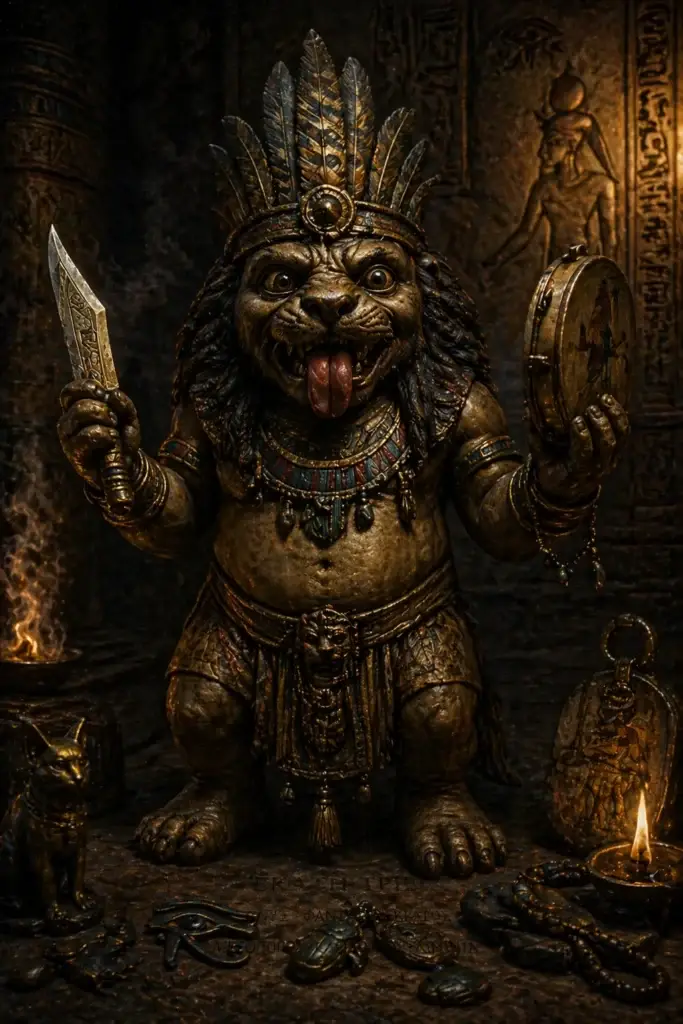
Bes is one of the most popular protective beings of the ancient world. As a small, stocky hybrid figure with a lion’s mane, protruding tongue, and feather crown, he appears in Egyptian religion from the Middle Kingdom (ca. 2000 BCE) onward and remains active well into the Roman Imperial period.
Unlike the high gods, Bes is not a temple deity but a household god of the common people: he protects pregnant women, mothers in childbed, infants, and family life.
Bes at a Glance
Type: Protective demon / dwarf god
Origin: Uncertain, possibly Nubian or East African, adopted early into Egypt
Texts: Magical papyri, temple inscriptions, amulet inscriptions
Period: Middle Kingdom to Late Antiquity
Distribution: The entire Egyptian cultural sphere, later reaching into the Hellenistic world
Use: Bes amulets, household altars, wall paintings, magical knives
Context
Bes appears first in the Middle Kingdom, gains wide distribution during the New Kingdom, and remains one of the most popular protective figures well into the Roman period. In Ptolemaic times he becomes part of Hellenistic household piety and spreads far beyond Egypt.
Mythological Classification
Bes is an Egyptian deity, a dwarf with leonine features and a god of pleasure, dance, music, birth, and good fortune. Despite his dwarf-like form Bes is powerful, acting especially as a protector of children, women, and the household. He is rooted in popular devotion and present throughout everyday life.
The core region is Egypt, with a particularly dense tradition in Deir el-Medina, Thebes, and the Delta. Bes amulets are found from the Levant through Cyprus to Carthage and in Hellenistic settlements throughout the eastern Mediterranean. His origin is sometimes thought to lie in Nubia or further south.
Unlike Apophis or Ammit, the textual tradition is sparse; Bes appears primarily in material evidence: amulets in clay, faience, and bronze, household altars, and wall paintings. The magical papyri and late-antique spell books mention him regularly without building a dedicated corpus of Bes texts.
Name and Variants
Egyptian: bs, pronounced roughly “bes”; occasionally referring to a group of figures (“the Bes figures”).
Greek: Βῆς → Bes; also transmitted as Bisu.
Related forms: Beset (female companion with similar functions), and in some cases Aha, an earlier protective figure who later merges with Bes.
The name bs is probably connected to the Egyptian word for “protect” and “initiate”. Bes is therefore also etymologically a protective being. He appears in texts without a divine determinative, as a figure between god, demon, and protective spirit.
Characteristics
Appearance
Bes is small, stocky, and dwarf-like. He has a large head with a prominent lion’s mane, a protruding tongue, a broad nose, and large eyes. On his head he wears a feather crown typically consisting of five tall feathers.
His body is squat, often depicted with an animal tail and short, bowed legs. This conspicuously ugly appearance is apotropaic: it is meant to frighten away evil powers.
Behaviour
Bes is the friendly-fierce protector of the household. He dances, laughs, beats drums and tambourines, and brandishes knives against invisible enemies. His noise drives away nocturnal demons, protects against venomous animals (snakes, scorpions), and stands at the bedside of the woman in labour. Despite his threatening appearance he is well disposed toward people.
Domain
Pregnancy and birth, infant protection, family, the bedroom, sexuality, dance, and music. Also protection on journeys, against venomous animals, and in unfamiliar surroundings. In the popular religion of the Late Period, Bes takes over functions of other protective gods and becomes a quasi-universal protective figure.
Appearance and Symbolism
Bes is depicted as dwarf-like with a powerful body, often with a lion’s head and large ears. He wears a feather crown, sometimes jewellery. A broad grin is typical. Percussion instruments, especially the tambourine, are his attributes. Red, gold, and blue are his colours.
Profile: Bes
The most important aspects of Bes at a glance. Detailed treatment of name, description, use, and parallels can be found in the following sections.
Uncertain; Nubian or further southern origins are hypothesised. He has no divine genealogy, making him one of the few Egyptian figures without family ties.
Pregnant women and mothers in childbed, infants and young children, the entire family unit. Secondarily, dancers and musicians (Bes is also a protective god of cheerful domestic celebrations); travellers; women wishing to conceive.
A small, stocky dwarf figure with a lion’s mane, protruding tongue, and frontal face. Often depicted with a drum, knives, or snakes.
Drives away evil through fright, noise, and visible action. Protects through aggression rather than restraint.
Not warding off Bes but deploying him: Bes-head amulets worn at the neck, statuettes placed at the bed, wall paintings in sleeping quarters, depictions on magical knives made of hippopotamus ivory.
Functionally related to Pazuzu as an ambivalent protective figure; to Taweret as a hippopotamus-shaped guardian of pregnancy; and to the Roman Lares as household deities.
In Phoenicia Bes is adopted as Mlk; in the Greco-Roman world he appears on amulets from Spain to India. Chinese temple guardians (Menshen) and Japanese Nio statues share the motif of the ugly-fierce but benevolent guardian.
Use in Everyday Life
Rituals of Invocation
Bes is not warded off but invited. At births, Bes statuettes were placed in the delivery room; for infants, in the cot. His mere presence was considered protection; no documented multi-stage ritual cycles exist for him.
Conjurations
In the magical papyri, Bes is occasionally invoked in protective formulas, often together with Taweret. There he is the “noisy” component that drives away evil, while Taweret represents the “sheltering” component.
Amulets and Protective Symbols
The material evidence is extensive: Bes-head amulets in faience, full-body Bes amulets in bronze or bone, Bes figures in wood. In addition, magical knives of hippopotamus ivory display rows of apotropaic beings, with Bes nearly always among them.
Bes: Parallels in Other Cultures
Mesopotamia
Pazuzu shares the profile of the ugly-fierce protective being, but with the paradox of a protective demon who is himself dangerous. The child-threatening Lamashtu on the opposing side shows the close connection between protection and threat.
Greco-Roman world: Eileithyia as birth goddess and the Lares as household gods share functions with Bes, but without his demonic-fierce profile. The Hellenistic-Roman Bes cult spread throughout the Mediterranean world.
Christian reception: In Coptic Late Antiquity, some Bes functions passed partly into Marian devotion; iconographic echoes persisted in Coptic popular piety.
Modern reception: Bes appears today in popular-cultural Egyptomania, as a character in genre fiction (Riordan’s Kane Chronicles), and in tattoo and esoteric culture.
The Household Protective God: Bes in Everyday Egyptian Life
Bes occupies a special position in the Egyptian pantheon because his veneration was less bound to temples and priesthoods than to the everyday life of the people.
He was a protective god of the house, the family, pregnant women, women giving birth, and children. His presence extends from the early periods of Egyptian history well into Greco-Roman times and beyond.
Unlike the great state gods, Bes did not possess a significant independent temple cult with major sanctuaries. His veneration took place in the domestic sphere. His image appears on countless objects of daily use: amulets, mirror handles, cosmetic vessels, headrests, furniture, and wall paintings in dwellings.
In settlements such as the workers’ village of Deir el-Medina, Bes depictions are frequent. This broad presence in material culture makes him one of the most tangible deities of Egyptian everyday life.
From the perspective of religious studies, Bes is of particular interest because he opens a window onto that layer of Egyptian religion that hardly appears in the official temple texts: the concerns of birth, childhood, sleep, and the protection of the home.
Bes was a deity whom people approached directly, without the mediation of a priesthood. His popularity endured across millennia and even outlasted the decline of the Egyptian temple cult, distinguishing him from many other deities.
A Deity Against the Pictorial Rule: the Frontal View and the Dwarf Form
Bes is iconographically an exceptional figure in Egyptian art. While the Egyptian pictorial tradition depicts gods and humans almost exclusively in profile, Bes is shown nearly always from the front, with his face turned directly toward the viewer.
This deviation from the basic rule of Egyptian visual art is striking and is interpreted in scholarship as a deliberate characteristic: the frontal face has an immediate effect, gazing at the beholder and thereby unfolding a warding, protective power.
The body form of Bes likewise departs from the Egyptian ideal of beauty. He is depicted as a dwarf, with short bowed legs, a heavy belly, a broad face, often with a protruding tongue, mane-like hair or beard, and sometimes leonine features.
He frequently wears a tall feather crown. In some depictions he is armed, brandishing knives or snakes; in others he plays a tambourine or dances. This mixture of intimidation and cheerfulness is characteristic of Bes.
Scholarship interprets this deliberately ugly, norm-defying appearance as functional: a protective being intended to drive away dangerous powers and harmful spirits had to look frightening and unusual itself.
The laughter and music attributed to Bes also belong to this warding function; noise and cheerfulness were considered effective in driving away threats and securing the dangerous situation of childbirth. Bes is thus an example of Egyptian art breaking its own rules when the function of a deity demanded it.
Bes, Beset, and the Circle of Birth Deities
Bes is not strictly a single god but rather the principal representative of an entire group of related protective beings, sometimes referred to collectively in scholarship as the Bes deities. By his side stands a female counterpart, Beset, who fulfils similar protective functions in the sphere of women and children.
Bes is closely associated with other deities of birth and domestic protection, particularly with Taweret, the hippopotamus-shaped goddess of pregnancy and birth.
Bes and Taweret frequently appear together on the so-called birth statues, on magical knives, and on the walls of the birth houses, the Mammisi, which were added to larger temples from the Late Period onward.
In these birth houses the mythic birth of a divine child was celebrated, and Bes was among the beings who attended and protected that birth.
His origins remain disputed in scholarship. For a long time an extra-Egyptian, African or Nubian provenance was considered, but the earlier attestation within Egypt itself points more toward indigenous development; the question remains open.
The later history of Bes is well documented: in Greco-Roman times he remained extraordinarily popular, his image spreading beyond Egypt throughout the entire Mediterranean world, and Bes amulets were widely traded.
From a religious-studies perspective, Bes is thus a rare example of a deity whose popularity did not depend on state patronage but grew from the need of broad segments of the population for concrete, everyday protection. Related household protective beings in other cultures include the Slavic Kikimora in her benevolent form.
Further Links
Further reading:
- Egypt (parent cultural page)
- Taweret (frequent partner in protective amulets)
- Apotropaic symbols and masks worldwide
- Gorgoneion (Greco-Roman parallel)
Research Literature
Further standard works in the literature index.
Frequently Asked Questions about Bes
Who was the god Bes in Egypt?
Bes was one of the most popular folk gods of Egypt, a dwarf-like deity always depicted from the front (an extremely rare iconography in Egypt) with a beard, a protruding tongue, and often a feather crown.
Bes was a protective god of the family, motherhood, birth, and defence against evil spirits. Unlike most Egyptian gods, he had no great temple; his cult took place in the home, and his image appeared on amulets, furniture, women’s cosmetic boxes, and bedroom doorposts.
Why is Bes always depicted frontally?
The frontal depiction of Bes is an iconographic singularity of Egyptian art; almost all other Egyptian gods are shown in the classical profile view. The frontal pose has a functional reason: Bes was a protective god intended to ward off negative forces.
His direct gaze out from the image acts actively against every evil spirit threatening the family. This iconography proved so effective that Bes continued to be used as a protective image in the Roman and Byzantine Late Antiquity.