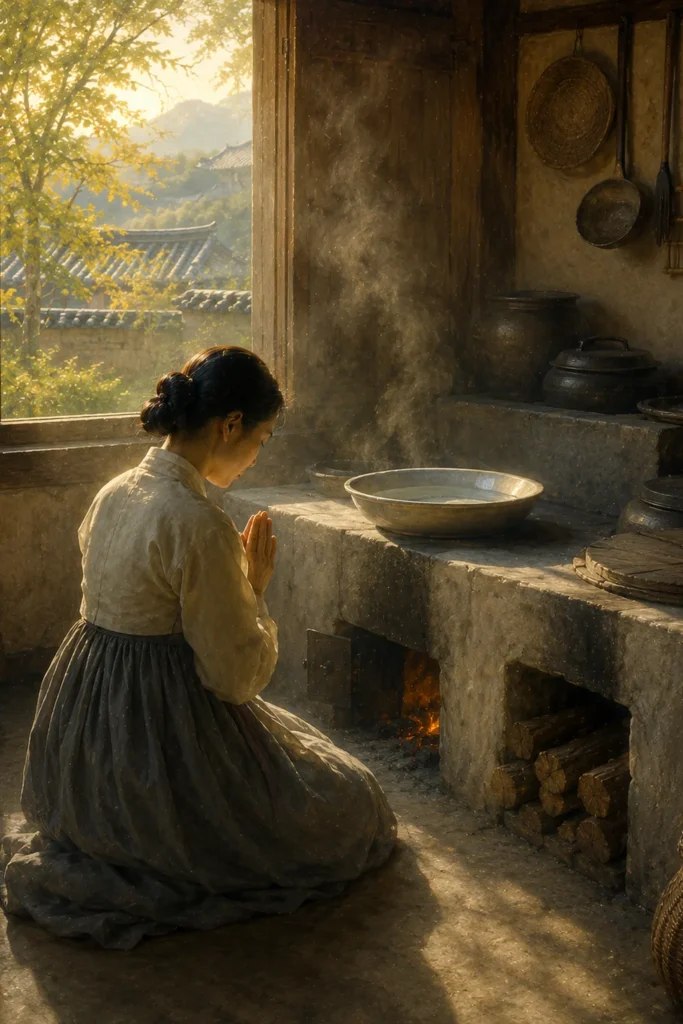
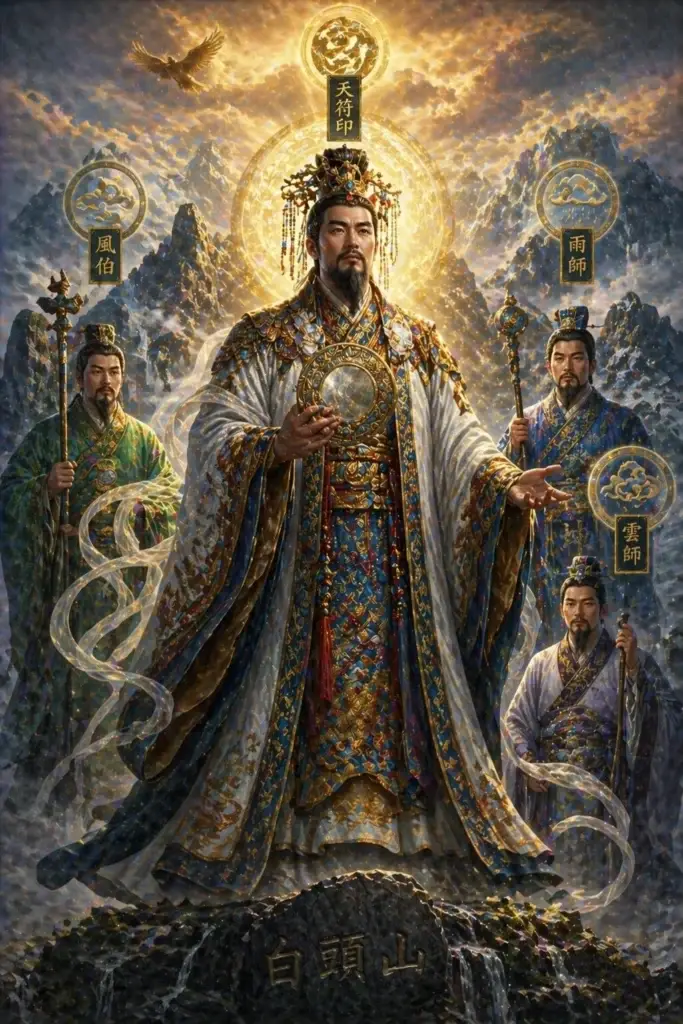
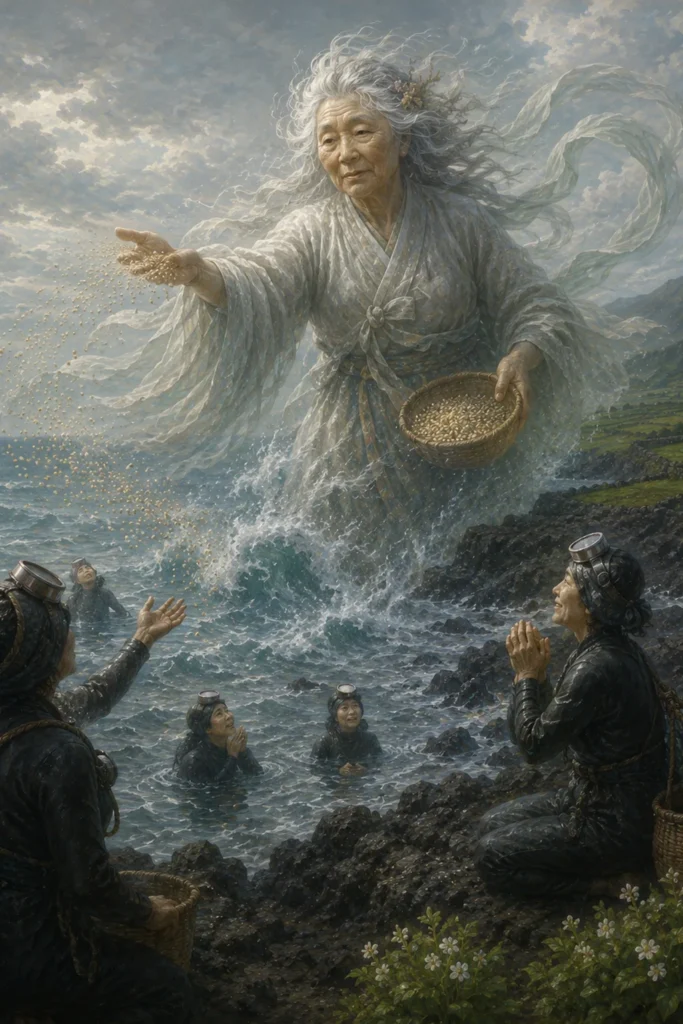
Hananim, supreme god of Korean shamanism
By Ralf Ittermann · last reviewed on
Hananim (Korean 하나님) is the modern Korean term for the “Lord of Heaven” or “supreme god”. Unlike Hwanin, who is a mythologically anchored figure of the foundation myth, Hananim is a term attested in folk usage as early as the 17th or 18th century, used today above all in Christian, new-religious and folk-spiritual contexts.
Its rise to a central name for God is part of the religious transformation of Korea in its encounter with Western Christianity and with its own religious reform movements.

Profile: Hananim
Hananim: the most important aspects at a glance.
Korean term for the “Lord of Heaven” or supreme god, attested in folk usage since the 17th or 18th century. It is composed of “haneul” (heaven) and the honorific suffix “nim.” Today it is used above all in Christian, new-religious and folk-spiritual contexts.
Hananim stood at the upper edge of the religious hierarchy without having any direct ritual significance in everyday life. Shamans invoked him as a distant, scarcely intervening power, while local spirits and mountain deities performed the concrete healing work. Today he is the standard term for the Christian God in the Korean Protestant tradition.
Farmers called on Hananim before sowing, shamans mentioned him in prayers of lament, and parents addressed him at birth and death. The Donghak movement, founded in 1860 by Choe Je-u, venerated the variant Hannolnim as the heaven present in every person.
Catholics today use Hanŭnim and the older term Cheonju (“Lord of Heaven”), a Chinese-influenced designation. The missionaries considered Sanonim, Shinjeo and Sangje as alternatives. A connection to the North Asian tradition around Tengri is discussed, but a direct line cannot be established.
Etymology and Word History
The term Hananim is composed of the Korean “haneul” (heaven) and the honorific suffix “-nim”, which literally means “the honorable heaven” or “Lord of Heaven”. In its older form it was Hanunim or Hanonim and goes back to the folk practice of addressing heaven as a personal power.
In “Korean Spirituality” (2008), Don Baker showed that the word form is attested in folk practice since the 17th and 18th centuries, though without this having been formulated as a coherent doctrine of God.
In “Korea: A Religious History” (1989), James Grayson pointed out that the term in its modern form, Hananim, only found its firm place in the 19th century among the early Korean converts to Catholicism and above all among the Protestant missionaries of the late 19th century.
The Scottish missionaries John Ross and John MacIntyre, who produced the first Korean Bible translation in Mukden in 1882, chose Hananim as the translation of the Hebrew-Greek name for God. This choice had a lasting influence on the later Protestant tradition of Korea.
Hananim in the Folk-Religious Tradition
Before the Christian missionaries adopted the term, Hananim or Hanunim was a form of address to heaven in numerous Korean folk rites.
Farmers invoked him before sowing, shamans mentioned him in lament prayers, and parents addressed him at birth and death. This worship was not organized in a closed pantheon, but appeared alongside Buddhist, Confucian and shamanic religiosity as an additional layer.
In his works on Korean shamanism, Boudewijn Walraven pointed out that the shamans (“mudang”) frequently invoked the Lord of Heaven as a distant power that rarely intervened, while they performed the concrete healing work through local spirits and mountain deities.
Hananim stood at the upper edge of the religious hierarchy without having a direct ritual significance in everyday life. According to Mircea Eliade, this “Deus otiosus” structure is typical of North Asian forms of sky belief.
Christian Appropriation in the 19th Century
The choice of Hananim as the translation of the biblical name for God was a deliberate decision of the Protestant mission. The alternatives included Sanonim (Mountain Lord), Shinjeo (divine power) and Sangje (supreme ruler, a Confucian term).
John Ross and his circle decided against Sangje because it was too strongly tied to the Confucian court cult, and against Shinjeo because it could be understood polytheistically or pantheistically. Hananim had the advantage of already being established in folk belief as a personal, unique power.
A second wave of Protestant missionaries, above all Methodists and Presbyterians from the USA, adopted the choice in the 1880s and 1890s. Horace Underwood and Henry Appenzeller, who arrived in Seoul in 1885, used Hananim in their Bible translation and in liturgical practice.
By 1900 the term was thus firmly anchored in the Korean Bible, a finding that has no comparable indigenous prehistory in any other East Asian tradition (China, Japan).
Hananim and the Catholic Tradition
The older Catholic tradition of Korea, which had been imported from China in the late 18th century, initially used the Chinese-influenced term Cheonju (“Lord of Heaven”), which had been introduced by Matteo Ricci.
This term was retained for a long time in the Korean Catholic liturgy. There is thus a denominational separation of the designation for God within Korean Christianity: Protestants call him Hananim, Catholics today Hanŭnim (하느님); Cheonju is the older Catholic designation. Both terms are firmly anchored in everyday language use.
This split in the designation for God is remarkable in the history of religion and has led to ecumenical discussions in recent decades.
Don Baker pointed out that the choice of different names for God is more than a mere question of translation; it marks different theological connections: Cheonju connects with the hierarchical-Confucian tradition, Hananim with folk-religious sky piety.
New Religious Movements
Hananim also plays a central role in the Korean new religious movements of the late Joseon period and the colonial era.
The Donghak movement, founded in 1860 by Choe Je-u, worshipped Hannolnim, a variant of Hananim, as personified heaven present in every human being (in the famous phrase “innaecheon”, “man is heaven”). This movement led to the great Donghak uprising in 1894 and was later institutionalized as Cheondogyo.
Daejonggyo, too, which systematically formulated the Dangun-Hwanin tradition in 1909, uses Hananim as the designation for the supreme god of the holy trinity. The later Sun Myung Moon movement (Unification Church) adopted the term from the Korean Christian tradition.
This diversity shows how open Hananim is as a religious linguistic form and how various currents have made it usable for different theological programs.
Hananim and Cheonju Compared
The choice between Hananim and Cheonju can be described not only in denominational but also in linguistic-historical terms. Hananim is a purely Korean term, Cheonju a Sino-Korean formation. These linguistic differences are reflected in the perception of believers.
While Hananim is experienced as familiar, popular and personal, Cheonju is regarded as more formal, dignified and literary. The two terms thus have different connotations, without there being a theologically clear hierarchy between them.
In her works on Korean religious language, Antonetta Bruno has proposed understanding the distinction as a deliberately preserved multilingualism within Korean religiosity. She shows how a language can hold two different words for the same basic theological category without this leading to confusion.
Use Today
Today Hananim is the standard term for the Christian God in the Korean Protestant tradition. With over ten million Protestants in South Korea and a strong presence of Korean churches abroad, the term has a very wide circulation.
At the same time, it is used in literary and non-religious contexts as a general designation for God, for example in poems, in everyday exclamations and in philosophical language.
The preservation of the term in the modern Korean vocabulary is a remarkable example of the historical-religious effectiveness of an originally folk-religious form of address that, through missionary adoption, became the main theological category.
James Grayson assessed this process as “relatively unique in the worldwide history of Christian mission”, because in most other languages the Bible translators had either to coin a new term or to redefine an existing term substantially.
In the Korean case the existing term largely retained its meaning and was only theologically sharpened by Christian use.
State of Research
Hananim research is carried above all by James Grayson, Don Baker, Boudewijn Walraven and Antonetta Bruno. Over the past three decades they have worked out the historical depth and the religious-historical significance of the term.
A systematic word history with all relevant evidence from folk-religious, Christian and new-religious texts has, however, not yet been fully presented. In several essays on Korean religious history, Maurizio Riotto has discussed the connection to the North Asian Tengri tradition, with the cautious finding that a direct line cannot be established.
In the broader religious-studies framework, Hananim is an example of the theoretical discussion about the “question of an original god”, which Mircea Eliade and Wilhelm Schmidt placed at the center in the first half of the 20th century.
The thesis of an original high god who is subsequently overlaid by other deities has met with criticism in modern religious research, but remains relevant as a framework for discussing the Korean findings.
Hananim shows how a folk-religious high-god concept can be present over centuries without being embedded in a coherent theology, and how it can be reactivated through external theological programs.
Donghak, Choe Je-u and Hannolnim Theology
The most important independent Korean theology of the 19th century ties in with Hananim. Choe Je-u (1824 to 1864), the founder of the Donghak movement (“Eastern Learning”), reported a mystical encounter in the year 1860, in which the Lord of Heaven Hannolnim imparted to him the teaching of the inner heaven.
His texts, collected in the “Donggyeong daejeon” (1880) and “Yongdam yusa” (1881), formulate the basic teaching that man and heaven are not separate.
The central phrase “si cheonju” (“to bear the Lord of Heaven within oneself”) developed under his successor Choe Si-hyeong, and above all under Son Byong-hi, into the more radical formula “innaecheon” (“man is heaven”).
This theological position was connected with a socially critical practice that cost Choe Je-u his life in 1864; he was executed for heresy and rebellion. The movement led to the great Donghak peasant uprising in 1894, which initially achieved regional successes but was then put down militarily by Japanese and Confucian-Korean troops.
In their works on the Donghak movement, Don Baker and Susan Shin have shown that the Hananim theology of the Donghak represents an independent Korean attempt to formulate a modern religion without subordinating itself to Western Christianity or the Confucian court cult.
Son Byong-hi institutionalized the movement in 1905 as Cheondogyo (“Religion of the Heavenly Way”), which played an important role in the independence movement during the colonial period, for example in the March First Movement of 1919.
The Korean Term Question
The Protestant missionaries’ decision in favor of Hananim is, as the “Korean Term Question”, part of a broader East Asian discussion. In China the parallel question between Shen, Shangdi and Tianzhu led to centuries-long controversies ever since Matteo Ricci’s attempts at adaptation.
In Japan the missionaries in the 19th century chose Kami as the translation word, with considerable losses of meaning. In the Korean case the question proceeded comparatively quickly and amicably, which Don Baker attributes to the structural closeness of the folk-religious Hananim to a personal high god.
John Ross published the “Corean Primer” in 1877 and the first Bible translations from the Greek New Testament in 1882. His circle of collaborators consisted of the early Korean converts Seo Sang-ryun and Baek Hong-jun.
Ross justified the choice of Hananim on the grounds that the Korean population “already knew the supreme god under this name”, a finding that later research regards as accurate but theologically overstated.
The Canadian missionary James Scarth Gale expanded the literary transmission of Hananim into the English-speaking world in his works “Korean Sketches” (1898) and “The Cloud Dream of the Nine” (1922).
Hananim in Modern Theology and Culture
In the 20th and 21st centuries, Hananim has undergone several theological elaborations.
Korean Minjung theology, a liberation theology of the 1970s and 1980s around Suh Nam-dong and Ahn Byung-mu, identified Hananim with the God of the abused and oppressed and connected him with the Han experience, the collective suffering of the Korean population under colonialism, war and dictatorship.
This theological connection of Hananim with social suffering has shaped Korean Protestant identity to this day.
Standing in contrast is the theology of the Korean Pentecostal churches, especially Cho Yonggi’s Yoido Full Gospel Church (1936 to 2021), which addressed Hananim as a blessing giver of material and spiritual goods.
Both interpretations, the social and the prosperity-theological, have anchored Hananim deeply as a Korean name for God in the modern religious consciousness. Sebastian Kim, James Grayson and Robert Buswell have documented the complexity of these Hananim appropriations in their works on modern Korean religiosity.
Sources and Literature
Primary sources: Choe Je-u, “Donggyeong daejeon” (posthumously 1880) and “Yongdam yusa” (posthumously 1881); John Ross, “History of Corea, Ancient and Modern” (Paisley 1879) and “Corean Primer” (Shanghai 1877); James Scarth Gale, “Korean Sketches” (New York 1898); Horace G. Underwood, “The Religions of Eastern Asia” (New York 1910). Secondary literature: James H. Grayson, “Korea: A Religious History” (Oxford 1989; London 2002) and “Early Buddhism and Christianity in Korea” (Leiden 1985); Don Baker, “Korean Spirituality” (Honolulu 2008) and “Catholics and Anti-Catholicism in Choson Korea” (Honolulu 2017); Boudewijn Walraven, “Songs of the Shaman” (London 1994); Susan Shin, “Tonghak Thought: The Roots of Revolution”, in “Korea Journal” 19 (1979); George Paik, “The History of Protestant Missions in Korea 1832-1910” (Pyongyang 1929, repr. Seoul 1980). On the Term Question see Sung-Deuk Oak, “The Making of Korean Christianity” (Waco 2013).