iWell Guard

Yeongdeung Halmang, visitor of the second lunar month

Yeongdeung Halmang is a goddess of Korean tradition.

The grandmother who comes from the sea in the second lunar month.

GoddessKorea

Table of Contents

Yeongdeung Halmang, the wind goddess of Jeju
Yeongdeung Halmang

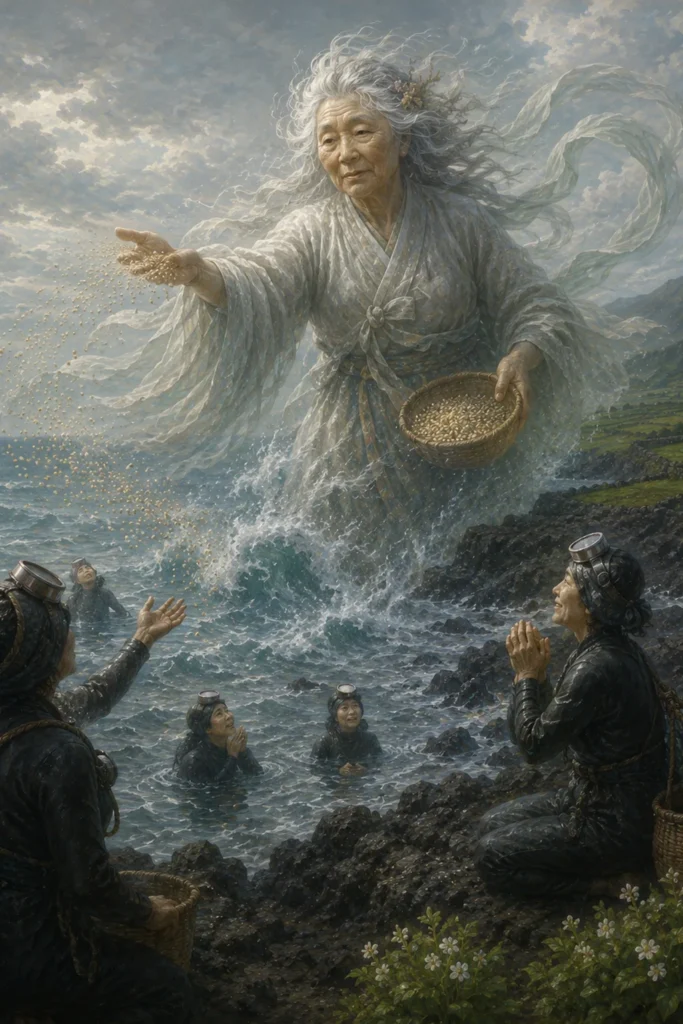
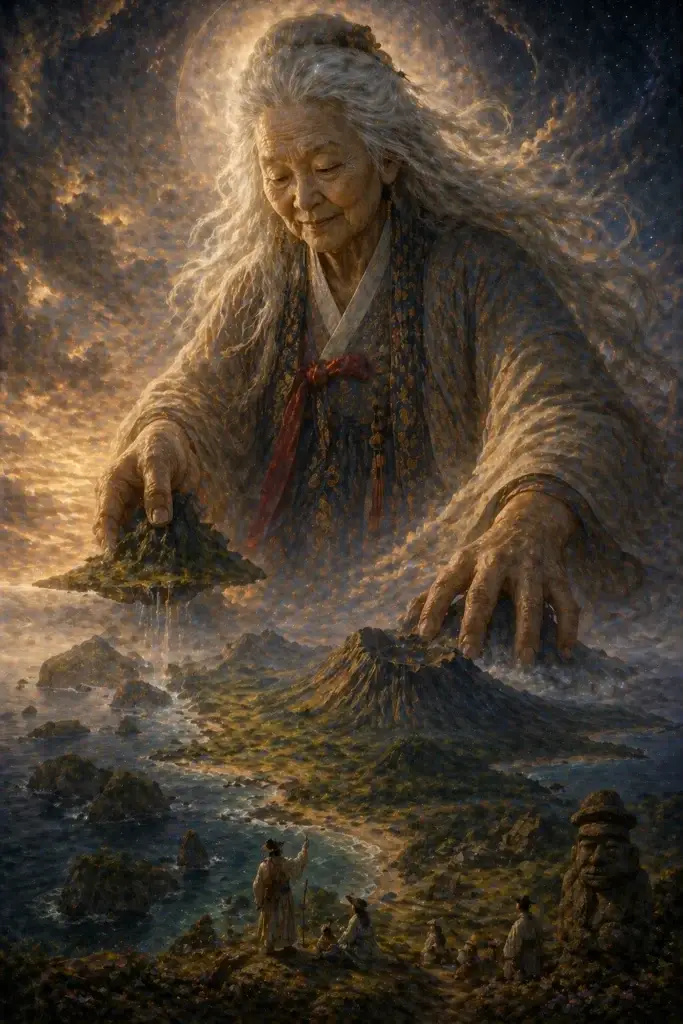
Yeongdeung Halmang, also known as Yeondeung Halmoni, is the Korean wind and sea goddess, particularly venerated on the island of Jeju. As a grandmother or ancestral mother, she comes from the sea in the second lunar month, scatters the seed of seafood and fields, and departs again after about two weeks.

She brings fertility from sea and field, but can also raise wind and waves, which is a matter of safety for coastal residents. Her central ritual, the Yeongdeung-gut, has been part of UNESCO’s Intangible Cultural Heritage in its Jeju form since 2009.

At a glance: Yeongdeung Halmang

Type: Wind and sea goddess, grandmother or ancestral mother
Origin: Korean folk religion and Musok
Texts: Encyclopedia of Korean Culture, UNESCO dossier, living ritual practice
Period: ancient folk belief, still practised today
Appearance: ancestral mother or grandmother, sometimes gigantic, without fixed iconography

Context of tradition

Period of the Texts

The goddess belongs to Korean folk religion and to Musok; her ritual practice remains alive today and has been documented by UNESCO since 2009.

Area of Diffusion

Korea, especially the island of Jeju; on the mainland, she corresponds to the Yeongdeung-halmeoni with her own weather-oracle customs.

Sources

Well documented: the Encyclopedia of Korean Culture, the UNESCO nomination dossier of 2009 and folkloristic studies of Jeju shamanism.

Name and variants

Korean: Yeongdeung denotes the deity and, at the same time, the period of the second lunar month; the word’s origin itself is uncertain. Halmang is the Jeju dialect form of halmeoni, grandmother or ancestral mother; in Jeju myths a halmang is often more a mythical primordial ancestral mother than a frail old woman.

Appearance

Appearance

Yeongdeung Halmang appears as an ancestral mother or grandmother, sometimes gigantic; a fixed iconography is lacking, she lives on in ritual. In the second lunar month she comes from the sea or from the east.

Effect

She scatters the seed of seafood and fields and brings fertility from sea and field. Unappeased, she can raise wind and waves, which is why her visit matters for the safety of fishermen and female divers.

Profile: Yeongdeung Halmang

The key aspects of the wind and sea goddess at a glance.

Cultural Context

Goddess of Korean folk religion and Musok, on Jeju closely connected with the community of the Haenyeo, the female divers.

Relates To

Coastal residents, fishermen and female divers: her visit determines calm seas, harvest and catch.

Depiction

Ancestral mother or grandmother, sometimes imagined as gigantic; without fixed iconography, tangible only in the ritual of the second lunar month.

Sphere of Influence

Fertility from sea and field; unappeased, she raises wind and high waves.

Cult

The Yeongdeung-gut in the second lunar month: welcome and farewell ritual, reception of the dragon king Yongwang, a millet-grain oracle and a straw boat.

Parallels

The mainland Yeongdeung-halmeoni with weather oracles; as a wind grandmother, she is closely related to Feng Po Po and other wind grandmothers.

The goddess of the second lunar month

Yeongdeung denotes the deity and, at the same time, the period of the second lunar month in which she is expected; the word’s origin is uncertain. Halmang is the Jeju dialect form of halmeoni, grandmother or ancestral mother; in the myths of Jeju a halmang is often more a mythical primordial ancestral mother than a frail old woman.

As a deity of Korean folk religion and Musok, Yeongdeung Halmang is documented in the Encyclopedia of Korean Culture and by UNESCO. Her calendar is fixed: she comes from the sea or the east in the second lunar month, scatters the seed of seafood and fields, and departs again after about two weeks.

UNESCO heritage and classification

Since UNESCO recognition in 2009, Yeongdeung Halmang has gained considerable significance and become identity-forming for Jeju and the ageing community of the Haenyeo.

In religious studies, she is fundamentally a benevolent bringer of blessings who, unappeased, can send storms and high waves. Three clarifications are important: Halmang is Jeju dialect and means more precisely a primordial mother or ancestral mother. She is a wind goddess as well as a sea and fertility goddess. And UNESCO protection specifically covers the Chilmeoridang Yeongdeunggut, not every Yeongdeung-gut in general.

The Yeongdeung-gut of the Haenyeo

The central ritual is the Yeongdeung-gut in the second lunar month, a plea for calm seas, harvest and catch. The Jeju Chilmeoridang Yeongdeunggut was inscribed on UNESCO’s Representative List of the Intangible Cultural Heritage of Humanity in 2009; it comprises a welcome ritual and, two weeks later, a farewell ritual, the reception of the dragon king Yongwang, a millet-grain oracle and the setting adrift of a straw boat. The ritual’s main practitioners are the Haenyeo, the female divers of Jeju.

Wind grandmothers and sea powers compared

On the Korean mainland there is the Yeongdeung-halmeoni with weather-oracle customs; in the Jeju context, the goddess is closely linked to the dragon king Yongwang, who is specially received during the Yeongdeung-gut. As a wind and sea grandmother, she is close to the wind grandmothers of other cultures, such as the Chinese Feng Po Po; from the Pacific region, a comparison can be drawn with the Samoan wind guardian Fisaga.

Frequently asked questions about Yeongdeung Halmang

Who is Yeongdeung Halmang?

The wind and sea goddess of Jeju, a grandmother or ancestral mother who brings fertility from sea and field in the second lunar month.

What is the Yeongdeung-gut?

Her central ritual in the second lunar month, a plea for calm seas, harvest and catch; the Jeju form is UNESCO-protected.

Who carries out the ritual?

Mainly the Haenyeo, the female divers of Jeju, for whose community the goddess is identity-forming.

Further links

Recommended internal links:

Literature (selection)

A selection of key sources and studies:
  • Hyun Yong-jun: Wörterbuch der schamanischen Materialien Jejus. Seoul 1980.
  • UNESCO: Jeju Chilmeoridang Yeongdeunggut. Nomination file RL 00187. 2009.
  • Academy of Korean Studies: Encyclopedia of Korean Culture, entry Yeongdeung-halmeoni.

Further standard works in the bibliography.

As the Korean wind goddess and grandmother wind of Jeju, Yeongdeung Halmang connects weather, sea and community: her annual visit in the second lunar month still gives the island a ritual rhythm today.

Classification & Protection

IILEVEL
The Protection Compass assigns this being to influence level II, Noticeable influence.

Against its influence, cross-cultural tradition names these protective means:

Compare in the Protection Compass →

Recommended protective means

iWell Guard

The simplest protective means in this collection: 41 layers of fine gold 999, platinum, silver and silicon, manufactured in Ruhla, Thuringia. It requires no activation, is bound to no person, and is effective within a radius of around 50 meters, even without being worn.

All protective means at a glance →