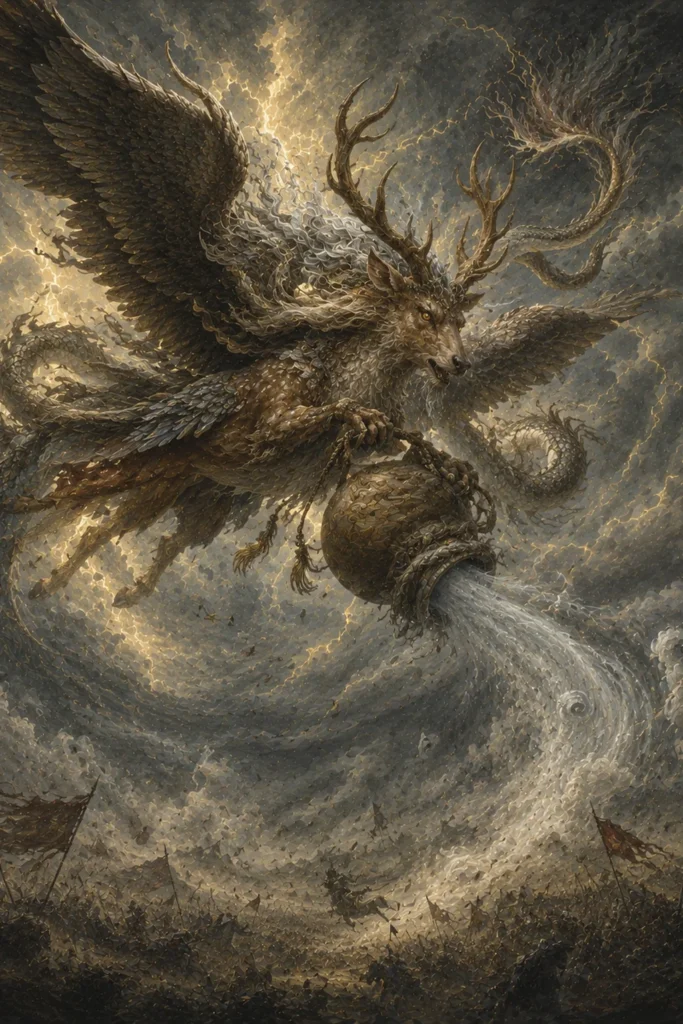
Feng Po Po, Madame Wind on the Tiger
By Ralf Ittermann · last reviewed on
Feng Po Po is a goddess of Chinese tradition.
Madame Wind, who releases the winds from her sack. Feng Po Po carries the name of China’s wind grandmother, and the sections here explain how she is understood among the wind figures.
Feng Po Po, the Wind Grandmother or Madame Wind, is a Chinese wind figure: in popular depictions an old woman who rides a tiger through the clouds and releases the winds from a bulging sack.
An important point of classification: this tiger-riding Madame Wind is a late compilation, mostly transmitted through Western sources. Alongside her exists a genuine folk-religious Wind Grandmother, attested in the folk belief of the Tujia, where a spring scale hung outside the house is meant to curb harmful wind.
Type: wind figure, Wind Grandmother or Madame Wind
Origin: China, genuine within Tujia folk belief
Texts: folk-religious tradition, modern popular compilation
Period: folk-religious, the popular figure is modern
Appearance: old woman on a tiger with a windbag, or an old woman blowing wind

Source context
Period of the Texts
The folk-religious Wind Grandmother belongs to traditional folk belief; the popular tiger-riding compilation, by contrast, is modern.
Area of Diffusion
China; as a genuine folk belief the Wind Grandmother is especially attested among the Tujia.
Sources
Mixed: genuine folk belief stands alongside popular embellishment, whose chain of evidence is almost entirely popular and neopagan.
Name and variants
Chinese: Feng Pópo means little Wind Grandmother or Wind Old Woman. The description of her riding a tiger through the clouds appears specifically in the Britannica article on Lei Gong; it does not originate from Werner’s Myths and Legends of China of 1922, since Werner there describes only the male Feng Bo and, in passing, a mother of the winds.
Appearance and behaviour
Appearance
In popular depictions, Feng Po Po is an old, wrinkled woman who rides a tiger and carries a bulging windbag; in folklore, she is an old woman who blows the wind from her mouth.
Effect
Feng Po Po releases the winds from the sack; in a bad mood, she sends storms. The interpretation linking her to the seasons and agriculture, however, is mainly neopagan embellishment.
Profile: Feng Po Po
The key aspects of the Wind Grandmother at a glance.
A dual figure: the popular, Western-mediated Madame Wind on one hand, the genuine folk-religious Wind Grandmother of the Tujia on the other.
Household and weather: the Tujia custom guards against harmful wind at the house, while the popular figure rules over breezes and storms.
An old, wrinkled woman on a tiger with a bulging windbag; in folklore, an old woman who blows the wind from her mouth.
She releases the winds from the sack and sends storms when in a bad mood; she is mostly regarded as benevolent and motherly.
Only the local Tujia custom is attested: hanging a spring scale outside the house to hook the Wind Grandmother’s mouth shut.
Two Figures: Compilation and Folk Belief
The name Feng Pópo means little Wind Grandmother or Wind Old Woman. The well-known description of her riding a tiger through the clouds appears specifically in the Britannica article on Lei Gong, but it does not come from Werner’s Myths and Legends of China of 1922: there, Werner describes only the male Feng Bo and, in passing, a mother of the winds. The chain of evidence in the relevant Wikipedia entry is almost entirely popular and neopagan.
Alongside this exists genuine folk belief: among the Tujia, the Wind Grandmother is still alive, including the custom of hanging a spring scale outside the house. The two figures must be kept distinct, the popular Madame Wind and the folk-religious Wind Grandmother.
Modern Reception and Classification
Feng Po Po has a strong presence in the neopagan goddess milieu, for instance in oracle cards and blogs, which explains the gap between her popularity and the thin classical evidence.
From a religious-studies perspective, Feng Po Po is not as well attested as Feng Bo. Three clarifications matter: the tiger-riding Madame Wind does not originate from Werner 1922. A role in Journey to the West is unattested. And the popular Madame Wind must be distinguished from the genuine folk-religious Wind Grandmother.
The Spring Scale at the House
No attested overregional temple or state cult exists for Feng Po Po. Only the local Tujia custom is documented: a spring scale is hung outside the house to hook the Wind Grandmother’s mouth shut and curb harmful wind. This unassuming household custom is, in fact, the most reliable piece of tradition this wind figure possesses.
Windlord and Wind Grandmothers Compared
Feng Po Po is a female counterpart to, or successor of, Feng Bo, that is, the windlord Fei Lian: he is the old wind god, secured by the Chuci and the state cult, while she is the folk-religious, popular successor without a temple cult. The motif of the old woman with a windbag is also found worldwide, as with the Sámi and Greek wind-keeping traditions; typologically close is also the Hungarian Wind Mother Szélanya.
Frequently Asked Questions about Feng Po Po
Who is Feng Po Po?
The Chinese Wind Grandmother: popularly a tiger-riding Madame Wind with a wind bag, in folk tradition an old woman who blows the wind from her mouth.
Does she originate from Werner 1922?
No. Werner describes only the male Feng Bo and, in passing, a mother of the winds; the tiger-riding figure is absent from his account.
Is she dangerous?
She is generally regarded as benevolent and motherly; she sends storms only when in a bad mood.
Further links
Further reading:
- China – all beings of the Chinese world of belief
- Fei Lian – the wind lord Feng Bo as the male counterpart
- Szélanya – the Hungarian wind mother
- Amulet, Salt, Protective candle – traditional protective means
- Protection Compass – protective means at a glance
Literature (selection)
Further standard works in the bibliography.
As the Chinese wind goddess, Feng Po Po lives in two worlds at once: as the popular Madame Wind riding a tiger, and as the genuine Wind Grandmother of folk belief, whose mouth is said to tame a steelyard scale on the house.