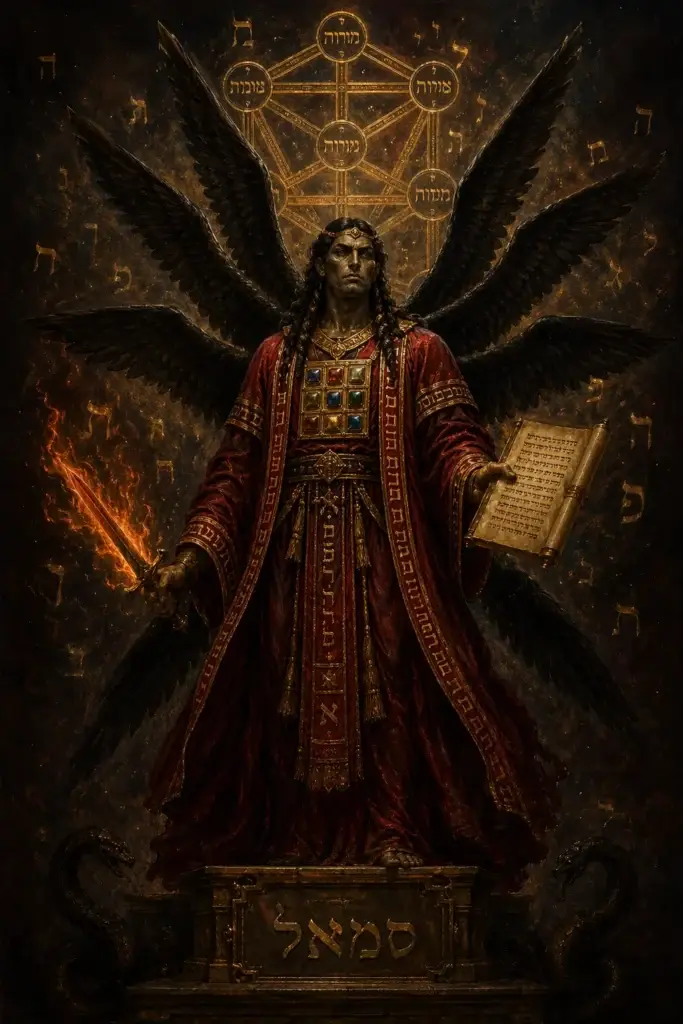
Dybbuk, a Spirit of the Jewish Tradition
By Ralf Ittermann · last reviewed on
The Dybbuk is a spirit of the Jewish tradition.
The clinging spirit, possession in Lurianic Kabbalah.
Dybbuk
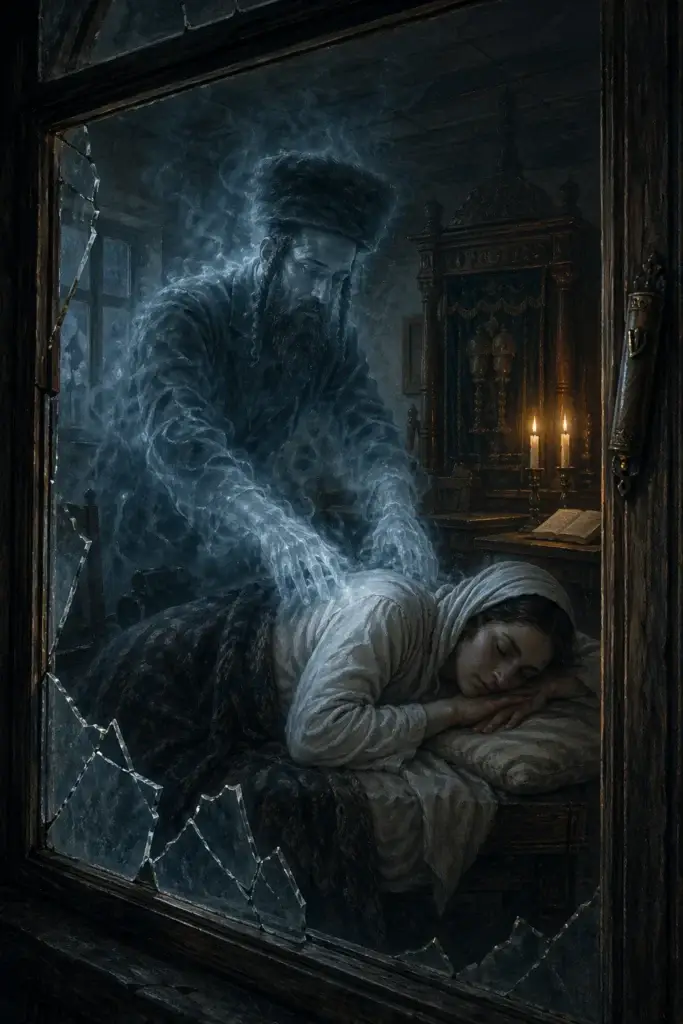
The Dybbuk is the characteristic conception of possession in early modern Judaism. Unlike Asmodeus or Lilith, it is not a created demonic being but the soul of a deceased person that finds no rest and slips into a living human (it “clings”, Hebrew dawak).
The possessed person speaks with the voice of the intruder; their personality is overlaid; their health suffers.
The concept appears in full form with the Lurianic Kabbalah of the sixteenth century. The transmigration of souls (gilgul) and incomplete rebirth form the background: a Dybbuk is a soul whose earthly task remained unfinished or whose sins deny it the regular onward passage.
The Hasidic rebbe or learned kabbalist drives it out through ritual exorcism. S. An-ski’s stage play “The Dybbuk” (1920) made the motif known worldwide.
At a Glance: Dybbuk
Type: Possessing spirit (soul of a deceased person)
Origin: The unredeemed deceased; souls with unfinished tasks or grave guilt
Texts: Lurianic Kabbalah; Shivchei ha-Ari; Hasidic tales; An-ski’s drama
Period: Sixteenth century to the present
Distribution: Palestine, Eastern European Jewish tradition, worldwide reception
Defense: exorcism (tikkun) by a rebbe or kabbalist; name magic; prayer rituals
Classification
Early references to possession appear in rabbinic literature, but the term Dybbuk in its specific meaning becomes established only in the seventeenth and eighteenth centuries.
The school of Isaac Luria in Safed (Tzfat) develops the theory; Hasidic courts from the eighteenth century onward carry it forward in the Eastern European tradition. Shmuel An-ski’s stage play “The Dybbuk, or Between Two Worlds” (1920) brings the motif into world literature.
Core region: Palestine (Safed) and Eastern European Jewry (Galicia, Lithuania, Poland, Ukraine). Further distribution in North African Sephardic circles. Through literature and film in the twentieth century, worldwide reception, often as a representative image of Jewish mysticism.
Central texts: Shivchei ha-Ari (Praises of Isaac Luria), Sefer ha-Gilgulim (Chaim Vital), Hasidic collections (Shivchei ha-Besht). Records of exorcisms from various rabbinic courts. In literature above all An-ski’s drama, the tales of Isaac Bashevis Singer, anthologies of Jewish folk literature.
Name and Variants
Hebrew: Dibbuk (דִּבּוּק), from davak “to cling, to adhere”.
Full form: dibbuk me-ruach ra’ah, “the clinging of an evil spirit”.
Related terms: gilgul (transmigration of souls), ibbur (“impregnation”, a positive form of soul-cohabitation).
The distinction between ibbur and dibbuk is important: both denote the cohabitation of a foreign soul within a living person. Ibbur is voluntary and beneficial, a higher soul supports a living person. Dibbuk is involuntary and harmful, a restless soul uses the person as a place of refuge.
Characteristics
Appearance
No independent pictorial tradition. The Dybbuk becomes visible through the body of the possessed: a change of voice (often deeper, foreign), altered speech (sometimes in another language or dialect), physical symptoms (convulsions, fainting, unusual strength).
Behavior
The Dybbuk uses the host’s body to speak. It tells its story, complains, demands. In many transmitted cases these are embittered spirits with unresolved guilt; the exorcism becomes pastoral care for the dead as much as protection of the living.
Sphere of Effect
Individual possession; reported especially often in people in liminal situations, before a wedding, during the year of mourning, in religious crisis. The Dybbuk does not choose at random but according to the inner weakness or guilt of the host.
Mythological Origin
Embedded in kabbalistic doctrine within the teaching of the transmigration of souls. The soul seeks purification (tikkun) through rebirth; if this fails, it takes refuge in a living body. The aim of the exorcism is the liberation of the host and, at the same time, the redemption of the Dybbuk itself.
Profile: Dybbuk
The most important aspects of the Dybbuk at a glance. You will find the detailed treatment of name, description, defense, and parallels in the following sections.
From the soul of a deceased person who finds no rest. Not a created demonic being, but an unredeemed human.
Living people in inner crisis or moral guilt. Reported especially often in young, unmarried persons or those in mourning.
No iconography of its own. Visible only through the body of the possessed: a change of voice, foreign speech, physical symptoms.
Possession, collapse of health, radical change of personality. Lasting from days to years, depending on the case.
Exorcism by a rebbe or kabbalist: invocation of the Dybbuk by its full name, negotiation, act of atonement, expulsion through the little toe. Accompanied by prayer, the tikkun ritual, and purification.
Christian demonic possession, Edimmu (restless dead), hungry ghosts, Islamic jinn possession, modern psychiatric interpretations of dissociative states.
Defense and Exorcism
Rituals of Defense
Exorcism follows a fixed pattern: invocation of the Dybbuk by name, interrogation (who it was, how it died, what binds it), a ritual act of atonement for the dead, and finally the command to depart. Exit typically takes place through the little toe, usually with a physically perceptible sign (a drop of blood, dizziness).
Conjurations
The formulas are kabbalistically constructed, with divine names, angelic names, and Torah quotations. They first bind the Dybbuk, then question it, and finally release it under threat of harsher punishment. Prayer horns (shofar) are often used to reinforce the ritual presence.
Amulets and Protective Symbols
Specific Dybbuk amulets are rare; the motif is acute, not prophylactic. General Jewish means of protection (mezuzah, tefillin, Psalm 91) work indirectly. After a successful exorcism, the host is often provided with a protective amulet so that they do not become susceptible again.
Parallels and Afterlife
Related Traditions
Christian demonic possession and exorcism follow a structurally similar pattern. Islamic traditions know possession by jinn. The Mesopotamian Edimmu motif is a distant but structurally comparable forerunner.
An-ski’s Dybbuk: Shmuel An-ski’s stage play “The Dybbuk” (1920) has become the cultural signature work of Jewish mysticism. The 1937 film and numerous adaptations to the present day keep the motif present worldwide.
Modern Reception: Horror films, series, and literature take up the Dybbuk motif (among others “The Dybbuk Box”, “A Serious Man”). In present-day Israel the tradition is partly linked with psychiatric and psychotherapeutic interpretations, the Dybbuk as a metaphor for unprocessed trauma.
The Emergence of the Conception in Lurianic Kabbalah
The Dybbuk in its developed form is not an old biblical conception but emerges in the religious thought of the early modern period. Decisive here is the Kabbalah of Safed in the sixteenth century, above all the teachings of Isaac Luria and his circle.
Central became the doctrine of gilgul, the transmigration of souls, and of ibbur, the temporary embodiment of a foreign soul within a living person.
The ibbur is at first conceived positively: the soul of a righteous person can attach itself to a living being in order to help that person or to fulfill a commandment still outstanding for itself.
The Dybbuk is, as it were, the dark reverse side of this conception. It is the soul of a deceased person who, on account of grave sins, can reach neither a new rebirth nor rest, and who therefore forcibly enters the body of a living person.
The word Dybbuk derives from the Hebrew root dbq, which means to cling, to adhere, to fasten oneself. The expression is a shortening of the older phrase dibbuk me-ruach raah, roughly the clinging of an evil spirit.
As a fixed term, Dybbuk becomes established only in the seventeenth and eighteenth centuries; older texts speak of an evil spirit or simply of a ruach.
Scholarship, such as the works of Gershom Scholem and later of Yoram Bilu and J. H. Chajes, has shown that the Dybbuk conception stands at the intersection of popular belief and learned Kabbalah. It combines older notions of the restless dead with the elaborate kabbalistic system of sin, punishment, and soul repair.
The Exorcism: Procedure and Participants
For the expulsion of a Dybbuk, the Jewish tradition knows a relatively fixed procedure that is transmitted in numerous reports from the sixteenth to the nineteenth century.
It was carried out not by just anyone but by a Baal Shem, a master of the divine name, or by a respected rabbi with kabbalistic learning, supported by a group of at least ten men known as a minyan.
The first step was the interrogation. The exorcist questioned the spirit through the mouth of the possessed about its identity, its name, its origin, and above all about the sins that prevented it from finding rest.
This questioning served to clarify the case, for a Dybbuk could not simply be driven away; one had to understand why the soul was stuck.
There followed conjurations with the invocation of divine names, the recitation of particular psalms, above all Psalm 91, and the use of ritual means such as the shofar, the ram’s horn, whose sound was meant to shake the spirit.
Frequently the spirit was threatened with the ban, the cherem. The aim was to make the Dybbuk leave the body, and preferably through a precisely determined spot, often the little toe, so that the departure would not injure the possessed.
Reports note that at the place of exit a bloody spot or a shattered window was sometimes found. Not infrequently the Dybbuk was at the same time offered a tikkun, a measure of restitution and soul repair, so that it might find rest after leaving.
The exorcism was thus not only the liberation of the living but also a pastoral act toward the dead.
The Transmission of Sources: Maaseh Books and Case Collections
What we know about the Dybbuk derives in large part from a distinct genre of texts, the reports of actual or supposedly actual cases of possession. These maasim, that is, narratives of events, were collected, copied, and printed, and circulated in the Ashkenazic as well as the Sephardic world.
An early and influential collection comes from the circle around the Lurianic school in Safed. The most famous individual case is the possession that Chaim Vital, Luria’s most important pupil, documented.
Later collections, such as the material circulating in the seventeenth century and the storybooks printed in Eastern Europe in the nineteenth century, often give the place, year, and names of those involved, which lends the reports the character of records.
The historians who analyze these texts treat them not as factual reports about spirits but as sources for mentality, piety, and social conflict. J. H. Chajes has shown in his study Between Worlds that many cases concern young women and that possession gave them a voice otherwise denied them.
The person speaking through the Dybbuk could say things, make accusations, and raise claims that would not have been granted to the possessed person herself.
The reports are also instructive for the history of religion because they often relate which sin held the dead person fast.
Frequently these are grave transgressions such as unkept oaths, fornication, or, in the case of some stories, conversion to Christianity. The Dybbuk thus becomes a narrative device through which the moral order of the community can be portrayed.
The Dybbuk on Stage: An-ski's Drama and Its Effect
The wide familiarity of the term outside the Jewish world goes back to a single work: the stage play The Dybbuk, or Between Two Worlds by the writer and ethnographer S. An-ski, whose civil name was Shloyme Zanvl Rappoport.
Between 1912 and 1914 An-ski had undertaken ethnographic expeditions through the Jewish settlement areas of Volhynia and Podolia, gathering popular belief, songs, and tales, among them material about possession.
The play was originally written in Russian, then translated by An-ski himself into Yiddish, and after his death in 1920 was premiered in Warsaw by the Yiddish theater company the Vilna Troupe.
A Hebrew translation by the poet Chaim Nachman Bialik also made the work known in Palestine; the production by the Habima Theater, directed by Yevgeny Vakhtangov in Moscow in 1922, is regarded as a milestone of the modern Hebrew stage.
An-ski’s plot links the Dybbuk conception with a love story: the young Talmud student Khonen dies when his beloved Leah is promised to another, and returns as a Dybbuk into her body.
The exorcism by a rabbi forms the dramatic center. In 1937 the material was filmed in Poland as a Yiddish-language picture, a work regarded today as an important document of the vanished Eastern European Jewish culture.
Through An-ski the Dybbuk became a cultural cipher.
In the second half of the twentieth century the figure appears in literature, film, and the visual arts often detached from its religious background, as a symbol of an unresolved past, of the lingering effect of the dead, and after 1945 also of the unmastered burden of destruction.
Further Links
Sources and Literature
Related Protective Symbols
The protective practice described here is a religious-studies classification of historical traditions. iWell Guard ties in with this cultural-historical line of wearable protective objects and represents a contemporary form of it. More about the iWell Guard →