Samael, Angelic Prince of the Jewish Tradition
By Ralf Ittermann · last reviewed on
Samael is the archangel figure of the Jewish Kabbalah tradition, an ambivalent force between punishment and protection. His significance for religious studies lies in his embodiment of divine severity (Gevurah), in the demonic half of the Sefirot-tree mysticism, and in the complex theology of wrath as a spiritual instrument.
Samael
Samael functions as a punishing angel and sometimes as a prince of demons. His attributes include punishment and wrath, but also justice.
Central myths are: Samael’s seduction of Eve (pseudepigraphic Haggadot), his role as accuser at the throne (Zohar), the mystical journey through the Hekhalot (Hekhalot literature), and his ambivalent status both as an angel and as a king of demons (Samael as king of the demons, Zohar I:19a).
Samael derives from Jewish apocryphal and kabbalistic sources: the Sefer ha-Razim (3rd to 4th century), the Hekhalot literature (5th to 6th century, Hebrew), and especially the Zohar (13th century).
The broad attribution falls into late antiquity, with reinforcement in the Kabbalah. The state of research (Scholem, Karppe, Wolfson) shows Samael as a syncretistic figure, shaped by dualistic Gnosticism and Zoroastrian influence.
Context
The figure of Samael can be traced in the sources over roughly a millennium and a half, from mentions in early apocalyptic literature through the Talmud and the midrash to the Zohar and Lurianic Kabbalah. In the process the emphases shifted: the accuser and angel of death of the rabbinic texts became, in Kabbalah, the prince of the demonic counter-world. The name also continues to appear in modern esotericism and popular culture, mostly in reliance on these older layers.
Samael was not confined to a particular region or set of locations, but was universally known throughout the Jewish world and respectfully feared.
Samael was a figure of learned Jewish literature rather than of popular devotion. He appears in the Talmud and the midrashim, texts studied by rabbinic scholars, and later in the Zohar and the writings of the kabbalists, who assigned him a defined place in their system of the Sitra Achra. There is no evidence of a folk cult around him; ordinary worshippers encountered him at most indirectly, through prayers and customs concerning the angel of death that rabbinic authorities had shaped and approved. His profile was thus formed and maintained by scholars across the communities of the diaspora.
Samael was not a locally confined folk belief but part of the learned literature of Judaism, which was read in all the communities of the diaspora. With the Talmud, the midrash, and later the Zohar, the ideas about the accuser and angel of death traveled from Babylonia and the Land of Israel to Spain, Provence, Italy, and Eastern Europe. Because the communities relied on the same texts, the image of Samael remained remarkably consistent across great distances.
Primary sources are the Sefer ha-Razim (Hebrew, 3rd to 4th century), the Hekhalot Rabbati (Hebrew, 5th to 6th century), the Zohar I:19a, b, 55a (Aramaic, 13th century, Moses de León), and Pirke de-Rabbi Eliezer 13 (10th century). On the secondary side, Scholem (Jewish Mysticism, 1941; Kabbalah, 1974), Karppe (Étude sur les origines et la nature du Zohar, French, 1901), Wolfson (Through a Speculum That Shines, 1994) and Abrams (Kabbalistic Imagery) analyzed Samael’s syncretic origins in Gnosticism, Zoroastrianism and early Jewish demonology.
Name and Variants
Across the various sources and artistic traditions, Samael is depicted with certain recurring iconographic elements that remain relatively constant over decades and across different geographic areas. These elements are not purely decorative or chosen at random, but are deeply encoded symbolically and carry great meaning.
Samael is described in the sources less through images than through functions, since Jewish tradition has hardly any figural representations. His identifying marks are offices and motifs: the accuser before the heavenly court, the angel of death with the sword from whose tip hangs the drop of gall, the rider of the serpent in the midrash on the Fall, and in Kabbalah the prince of the Sitra Achra and companion of Lilith. Anyone familiar with rabbinic and kabbalistic literature can determine Samael’s rank and area of responsibility precisely from these attributions.
The overall system works like a sacred text or a coded image: it allows initiates or the culturally educated to grasp and correctly understand the essential, deeper meaning. Colours, sacred objects or weapons, physical attributes, specific accessories: everything is significant and handed down by tradition.
Description
In Jewish tradition, dealing with Samael was a matter for scholars, not for popular piety. The Talmud and the midrash treat him within a regulated tradition of interpretation, and the kabbalists assigned him a place in their system of the Sitra Achra, the other side. The protective practices against the angel of death, such as certain prayers and protective formulas, likewise followed transmitted rules and were passed on and reviewed by rabbinic authorities.
That the tradition about Samael continued from the Talmud into Kabbalah was due to its practical usefulness for teaching. The figure fulfilled several functions: as accuser, it explained where temptation and trial come from without making God himself responsible for them. As angel of death, it gave dying a nameable form against which protective prayers could be directed. In Kabbalah, finally, Samael served to conceive evil as a sphere of its own within the order of creation.
Profile: Samael
The Profile captures Samael across six dimensions: his complex origin in Gnosticism and the Kabbalah, his target group among mystical kabbalists with an interest in demonic magic, his iconographic depiction as a punishing angel or king of demons, his functional ambivalence between punishment and teaching, comparisons with other demonic archangels (Uriel, Raguel), and his contemplative role in Hekhalot mysticism.
Samael originates in antiquity, with a kabbalistic fixation in the 13th century (Zohar). The geographic origin lies in Judea and in the later centres of the Kabbalah (Provence, Spain, Safed).
The dating of the first mention goes back to early apocalyptic literature (Apocalypse of Isaiah and 3 Baruch, 1st to 3rd century). The theological framing as king of the demons appears only in the Zohar (13th century), a late effect of Gnostic-dualistic thinking.
Samael addressed primarily mystically advanced kabbalists. The target group consists of mystics with an interest in demonic magic, conjuration and Gnostic insight.
The occasions are mystical visions (Hekhalot journeys), acts of penance (penitence as contact with Samael), magical practices (Yichudim) and the confrontation with inner demons. The invocation takes place in private mysticism rather than in public cult.
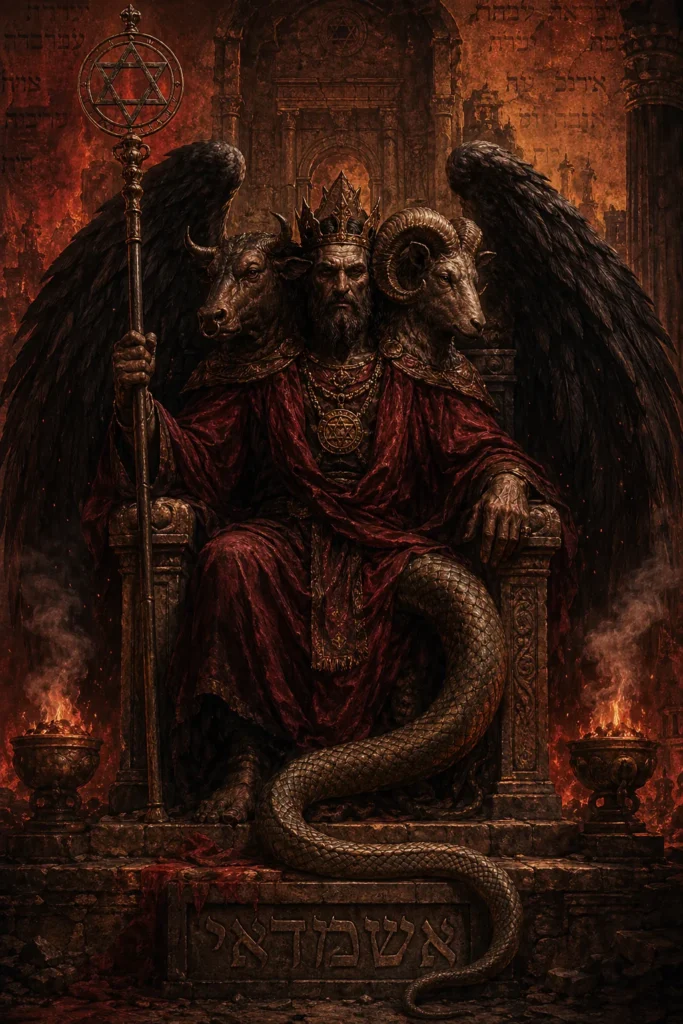
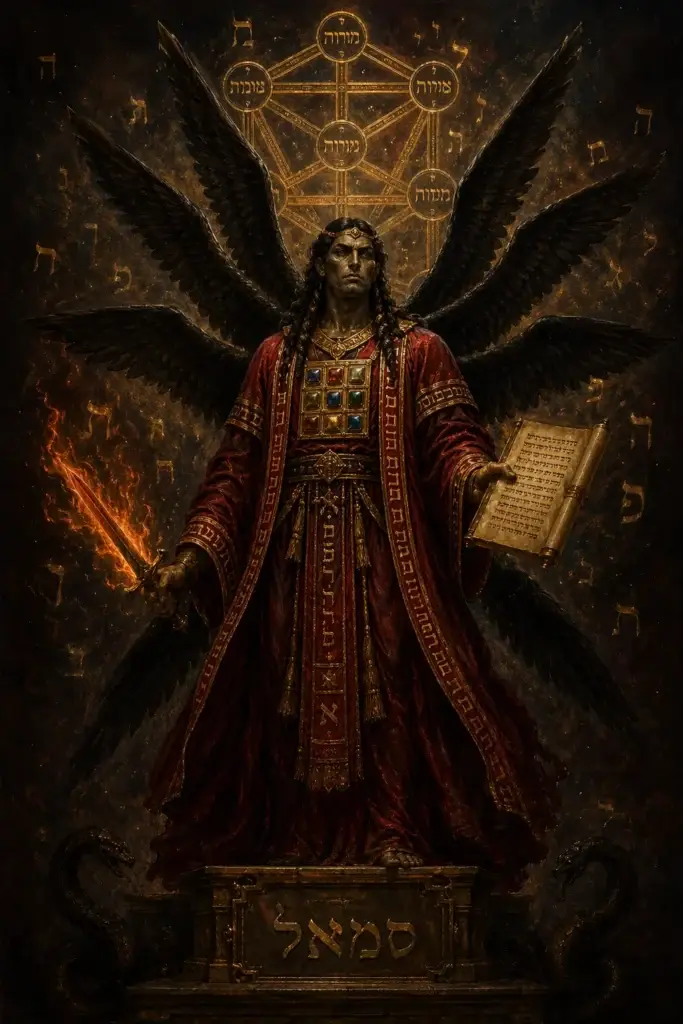
Samael iconographically: a male or androgynous figure with black or red wings and a stern or wrathful physiognomy. His attributes are a sword or spear (punishment), fire, and sometimes a serpent (seducer aspect).
In the Zohar and in Luria: Samael wears a crown of the shell (Qelippa, the evil sphere) and is dreadful to behold. The iconography varies between punishing angel and king of demons.
Sphere of effect: Samael (סמאל, “poison of God”) appears in rabbinic and kabbalistic writings as the archangel of death, as the embodiment of punishing divine justice (Middat ha-Din), and in later reception as the leader of the fallen angels.
In the Talmud Yerushalmi (Sanhedrin 24a) he is the guardian angel of Esau; in the Targum Pseudo-Jonathan on Gen 3 he acts as the serpent in paradise.
The Zohar (II, 35a) systematizes him as the consort of Lilith and head of the Sitra Achra (the “other side”, the demonic counterpole to the world of the ten Sefirot).
His activity encompasses illness, temptation and death; he is the executor of divine judgment, not a rebel like the Christian Satan, but a commissioned enforcer. In the Lurianic Kabbalah, his fall is connected with the “breaking of the vessels” (Shevirat ha-Kelim).
Samael was regarded as dangerous and ambivalent, not purely evil or good. The practices of invocation were rare and highly risky. In Hekhalot texts, conjurations were carried out under strict ritual safeguards.
Protective practices included purification, invocation of God, and the use of protective talismans bearing holy names. Respect for Samael was expressed as fear and caution, not veneration.
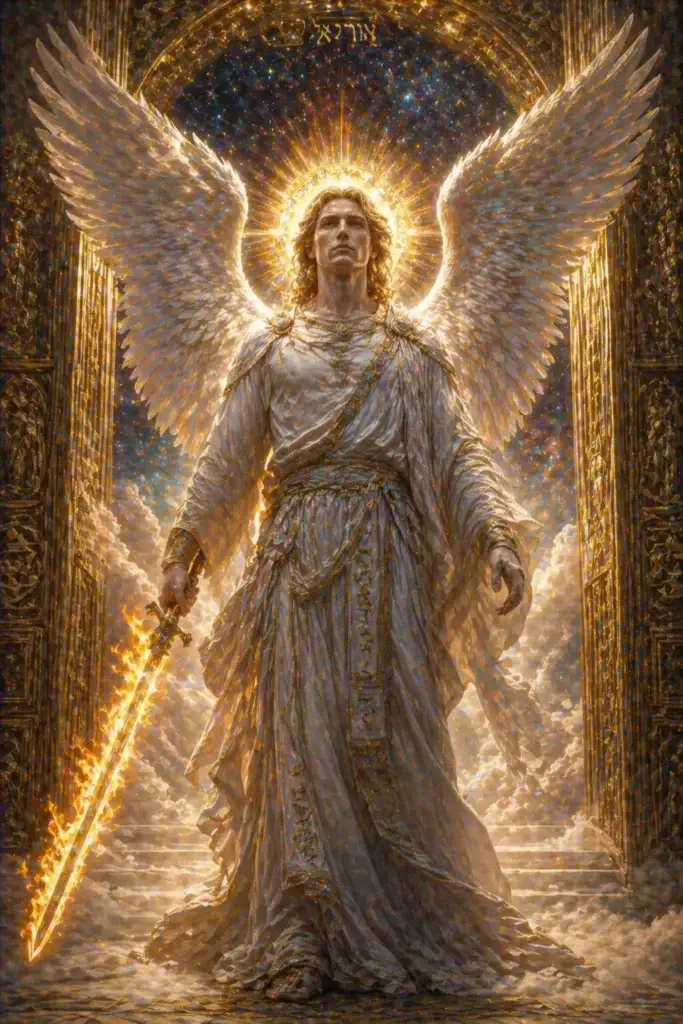
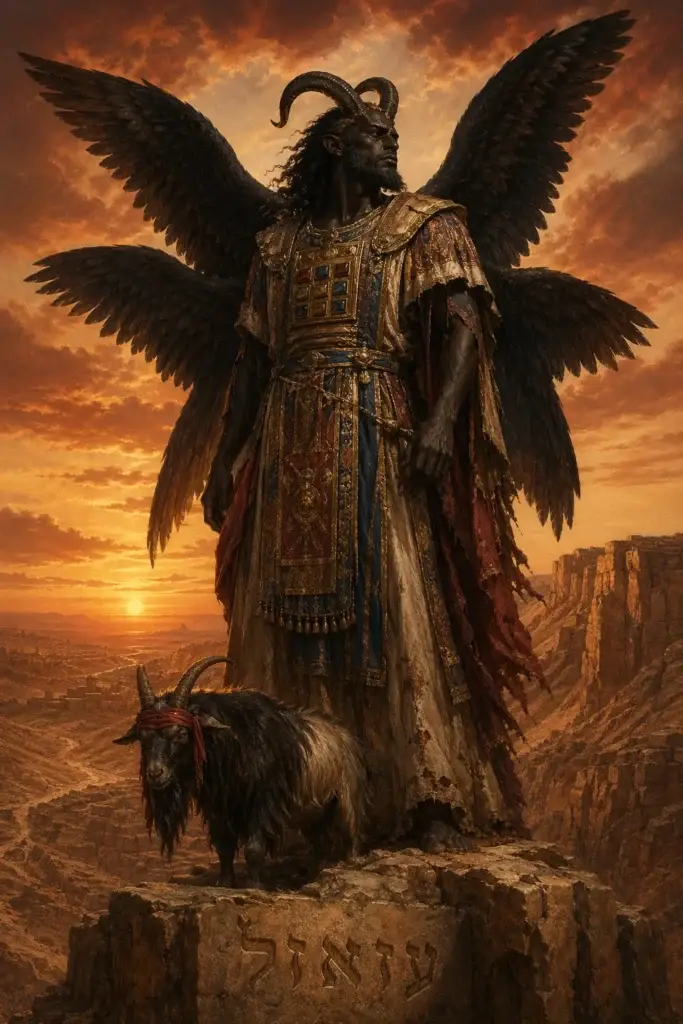
Comparable figures: Uriel (the fire angel of punishment, but not demonic), Raguel (cosmic justice), Chamuel (God’s severity, often a Samael equivalent). Outside Judaism: Ahriman (the Zoroastrian adversary, dualism), Azazel (a prince of demons, but not an archangel). The ambivalence of punishment and protection is Samael’s distinctive trait.
Warding off in Everyday Life
Apotropaic Rituals
Jewish mysticism traditionally knows no direct veneration of Samael, but rather his warding off. The eve of the Sabbath (Erev Shabbat) is regarded as a time of particular vulnerability: lighting the Sabbath candles, covering the table with a white cloth and keeping silence before the Kiddush are apotropaic acts.
The Zohar recommends reciting Psalm 91 before sleep as protection against the “plagues of the night”.
Conjurations and ban Formulas
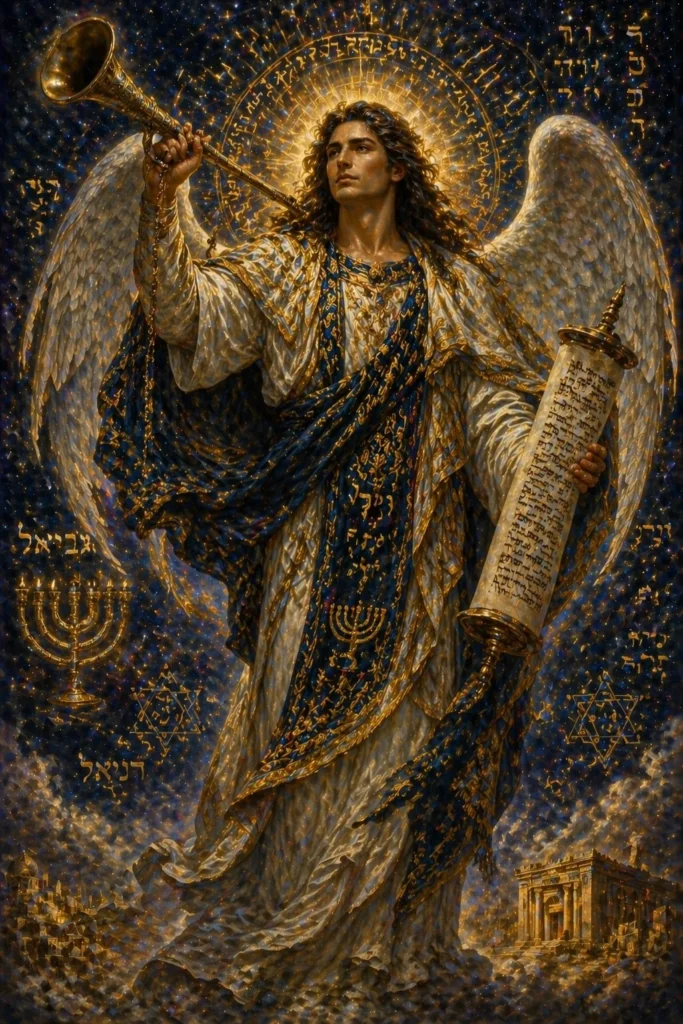
Medieval Ashkenazi manuscripts (such as the Sefer Raziel ha-Malakh) transmit ban formulas against Samael, which mostly operate with the invocation of the Tetragrammaton and of the archangels Michael, Gabriel, Uriel and Raphael.
The kabbalistic Pulsa de-Nura was later repurposed in a ritual context against him. The formula “Mi ka-El, mi ka-Adonai” (Who is like God?) is regarded as a direct invocation of Michael against Samael.
Amulets and Protective Symbols
The Mezuzah on the doorpost (Deut 6:9, 11:20) is traditionally interpreted as a bulwark against Samael and his host (cf. Menachot 33b). Protective amulets with the six-pointed star (Magen David) or the 72-letter name of God (Shem ha-Mephorash) are found in the Kabbalah practica.
The daily wearing of the Tefillin (Ex 13:16) is regarded as continuous protection; in Yemenite communities the winding text is applied specifically against the Sitra Achra.
Samael, Parallels in Other Cultures
Jewish tradition: Samael stands in competition with Uriel and Chamuel (both also punishing angels). The difference: Samael is demonized, whereas Uriel and Chamuel remain ambivalent but not demonic. The Zohar texts present Samael as the other side of punishment, fallen into dualism. Azazel (the scapegoat demon) is a parallel figure without archangel status.
Greco-Roman world: No direct parallels. Distantly related: Helios or Apollo as judge, or the Erinyes and Eumenides as punishing demons. The demonic function of judgment connects them. Hades (king of the underworld) also bears demonic traits.
Mesopotamia: The Mesopotamian counterpart: Nergal (god of war and plague, ruler of the underworld, ambivalent). Samael and Nergal share the combination of divine authority and demonic character. Kingu (a chaos demon, adversary of Marduk) also has a similar demonic function.
India and Asia: The Indian counterpart: Rudra (god of wrath, destruction, but also protection, Hindu). Samael and Rudra share their ambivalent nature. A Buddhist parallel: Mahakala (a dark protective god). Both are stern and dangerous, but not purely demonic.
Samael in Rabbinic Literature and in the Midrash
Samael (Hebrew roughly Sammael) is one of the most important demonic and angelic figures of the Jewish tradition, yet he does not appear in the Hebrew Bible itself, but only in post-biblical literature. His detailed elaboration is found in the Midrash, in the aggadic tradition and in apocryphal writings of the post-Christian centuries.
In this literature, Samael is a many-layered figure. He is frequently described as a high-ranking angel, but at the same time as an accuser and adversary who merges with the role of the heavenly accuser, Satan.
In several Midrashim, Samael is the angel who steers the story of the Fall in the background; one tradition makes him the actual author of the temptation in the Garden of Eden, who makes use of the serpent or is bound up with it. Other texts connect Samael with the attempt to prevent or thwart Abraham’s sacrifice of Isaac, or with the testing of Job.
One particularly well-known tradition makes Samael the angel of death, the being that takes the soul from human beings. In this function he is not simply evil, but an executor within the order established by God.
From the perspective of religious studies, this ambiguity is characteristic: in rabbinic thought, Samael is not a counter-god directed against God, but a dangerous, accusing, death-bringing being that nonetheless remains part of the heavenly hierarchy. The sharp separation between angel and devil, as known to later conceptions, has not yet been carried out here.
The Name and the Question of Its Meaning
The etymology of the name Samael has long been a subject of interpretation, without any fully secure explanation being available.
The second component, -el, is unambiguous: it is the Hebrew word for God, which appears in numerous angel names such as Michael or Gabriel. It marks Samael as a being that originally belonged to the angelic sphere.
The first component, sam-, is interpreted in different ways. A widespread explanation connects it with the Hebrew word sam, meaning poison; according to this, Samael would be the poison of God or the poisonous one of God, which would fit well with his role as angel of death and seducer.
This interpretation is old and is represented in the tradition itself.
Other proposals assume a root meaning blindness, in which case Samael would be the blind one of God or the one who makes blind; this interpretation was taken up in the kabbalistic literature and connected with the idea that evil is a kind of blinding.
Scholarship emphasizes that such interpretations of names are often later readings that say more about the understanding of the figure in a particular epoch than about the actual linguistic origin. Only the reference to God in the ending is certain.
The uncertainty about the first syllable is itself revealing: it shows that the Jewish tradition already felt the name to be in need of interpretation and connected it with whatever were, in each case, the central characteristics of Samael: poison, death, blinding.
Samael in the Kabbalah and as Consort of Lilith
In the medieval Kabbalah, especially in the literature around the Zohar and in the later kabbalistic systems, Samael receives a systematic place within the teaching about evil.
Here he is the head of the Sitra Achra, the other side, that is, the counter-divine sphere conceived as the dark counterpart to the world of the divine emanations. In this system Samael stands at the top of the impure powers, just as on the holy side a highest angel stands.
Closely connected with this is the conception of Samael as the consort of Lilith. The pair Samael and Lilith forms, in kabbalistic mythology, the dark counterpart to a holy pair and is regarded as the origin of further demonic beings.
Their union is interpreted as the source of the spread of evil in the world. This conception of the pair is a specifically kabbalistic elaboration that is not yet present in this form in the older rabbinic literature.
From the perspective of religious studies, the kabbalistic Samael doctrine is an impressive example of the systematization of evil within a monotheistic framework.
The Sitra Achra is not an independent counter-god, but remains dependent on the divine order and is ultimately conceived as subordinate to it. In this system Samael embodies the possibility of evil without abandoning monotheism.
Later esoteric and occultist currents of the modern era detached Samael from this theological context and in part made him into an independent figure, which, however, misses the kabbalistic point that the other side too is part of a single whole determined by God.
Samael, the Guardian Angel of Esau and Rome
A separate strand of tradition connects Samael with the conception of the heavenly guardian angels of the peoples. According to a view widespread in rabbinic literature, every people has a heavenly prince or angel who represents it and intercedes for it. Within this framework Samael becomes the heavenly prince of Esau and thus of Rome.
This attribution is to be understood historically. Esau is regarded in Jewish interpretation as the ancestor of Edom, and Edom became, in post-biblical times, the cipher for Rome and later for Christian power, that is, for the great power under whose rule the Jewish people lived and suffered.
By making Samael, the accuser and adversary, the heavenly representative of this hostile power, the historical experience of foreign rule and oppression receives a cosmic interpretation. The struggle between Jacob and Esau, between Israel and Edom, is mirrored in the heavenly conflict between the guardian angel of Israel and Samael.
A well-known aggadic narrative even interprets Jacob’s nocturnal wrestling match at the river Jabbok, which the Book of Genesis reports, as Jacob’s struggle with Samael, the angelic prince of Esau. From the perspective of religious studies, this strand of tradition shows how a demonic figure could become the bearer of a historical-theological interpretation.
Here Samael is not only the seducer in the Garden of Eden or the angel of death, but the personified hostile power of history. This linking of demonology and the interpretation of history is an important feature of Jewish thought and distinguishes the Samael figure from a merely individual tempter.