Uriel, Archangel of the Jewish Tradition
By Ralf Ittermann · last reviewed on
Uriel is the archangel figure of the Jewish tradition, an embodiment of divine fire and righteous judgment. His significance for religious studies lies in the representation of God’s wrath, the eschatological execution of judgment, and in mysticism and theology as a fire angel and throne guardian of the Most High.
Uriel
Uriel functions as a fire angel and executor of judgment. His attributes include wrath, wisdom and unrelenting justice.
Central myths are: the warning of Noah before the Flood (1 Enoch 10:1–3), the expulsion of Adam from Paradise (Pirke de-Rabbi Eliezer), the eschatological destruction of the wicked (Apocalypse), and Kabbalistic-mystical roles as the angel of contemplation and of the fire throne.
At a Glance: Uriel
Uriel derives mainly from apocryphal sources: 1 Enoch (20:2, 21:5, 6, Aramaic, 3rd century BC), Pirke de-Rabbi Eliezer (8th to 9th century, Hebrew), and Kabbalistic writings (Sefer ha-Bahir, Zohar).
A marginal mention appears in 4 Ezra 4:1, which does not belong to the biblical canon. The state of research (Scholem, Bietenhard, Karppe) shows Uriel as an apocryphal new development of the Hellenistic period, not as biblically original.
Classification
The tradition about Uriel extends from the Book of Enoch of the 3rd to 1st century BC, through the Fourth Book of Ezra, into the Byzantine and Ethiopian traditions, where he is venerated to this day. In the Western church, by contrast, his cult was rejected in 745 under Pope Zachary, since his name does not appear in the canonical scriptures. Nevertheless Uriel remained present in art, Anglican tradition and esotericism, in altered form but under the same name and with the same association with light.
Uriel was not confined to a particular region or set of locations, but was known and venerated, or respectfully feared, universally throughout the world of Judaism.
Uriel’s reception remained largely a matter of textual scholarship. His name rests on apocalyptic writings such as the Enoch literature and the Fourth Book of Ezra, texts read in priestly and learned circles of ancient Judaism and later preserved chiefly by Eastern churches, above all in Ethiopia, where Enoch remained canonical. In the Western church his standing was contested: a synod under Pope Zachary in 745 rejected the veneration of angels not named in Scripture, which kept Uriel out of official Latin liturgy. He persisted instead in Ethiopian and other Eastern traditions, in esoteric literature, and in occasional artistic depictions.
This points clearly to a central role in the self-understanding of the whole people. Trade, migration and cultural exchange contributed to the geographical spread and to the stable uniformity of the veneration.
Primary sources are 1 Enoch 20:2, 3 (Aramaic, 3rd century BC, “God is my fire”), 3 Enoch / Sefer Hekhalot (Hebrew, 5th to 6th century), Pirke de-Rabbi Eliezer 13 (8th to 9th century), as well as Kabbalistic material (Sefer ha-Bahir, 12th century; Zohar Bereishit, 13th century). On the secondary level, Scholem (Jewish Mysticism, 1941), Bietenhard (Die himmlische Welt im Urchristentum und Spätjudentum, 1951), Karppe and McLeod (Judeo-Islamic Angelology) analyzed Uriel’s development as a late development of the Jewish archangel canon with Persian-Zoroastrian influence.
Name
Uriel is depicted in the various sources and artistic traditions with certain recurring iconographic elements that remain relatively constant across decades and across different geographical regions.
These elements are not purely decorative or chosen at random, but are deeply coded with symbolism and carry great meaning. They convey, in a central way, the functions, sources of power, sphere of responsibility and cosmic role of the being.
The whole system is like a sacred text or a coded image: it allows the initiated or the culturally educated to grasp and correctly understand the essential deeper meaning. Colors, sacred objects or weapons, physical attributes, specific accessories, all of it is significant and handed down by tradition.
Characteristics
Uriel was central to the religious practice, the everyday rituals and the daily understanding of Judaism. In critical or particular life situations or at certain ritual times of the year, people turned to this entity.
Dealing with Uriel was bound to scribal tradition: the Enoch literature and the Fourth Book of Ezra arose in priestly and apocalyptic circles of ancient Judaism that carefully ordered the names and functions of angels. Whoever invoked Uriel or wrote about him moved within this regulated framework, not in free invention.
That these practices were handed down across so many generations shows how effective and necessary people considered them. Their functions ranged from prevention, which was meant to ward off looming misfortune, through healing in illness and suffering, to accompaniment through the transitions between stages of life.
Profile: Uriel
The profile captures Uriel across six dimensions: his origin in apocryphal traditions of the Hellenistic period, his target audience among pious and mystical Jews, iconographic fire features, his function as an angel of judgment, comparisons with parallel cultural demons of judgment, and his Kabbalistic-mystical role as a focus of contemplation.
Uriel stems from the apocryphal Enochic literature of the Hellenistic period (3rd to 1st century BC). The geographical origin lies in Judea and Babylonia (exile traditions).
The first mention dates to the 3rd century BC in 1 Enoch. The development is more mystical and literary than biblically original. Later Kabbalistic fixation took place in the 12th to 13th century.
Uriel was directed primarily at pious Jews with an interest in eschatology and mystical knowledge. The social target audience consists of priests, mystics, Kabbalists, apocalyptists and Gnostics.
The occasions are times of oppression, persecution, hope for judgment over enemies and the mystical internalization of justice. The invocation takes place in dark night, in mourning rituals and mystical visions.
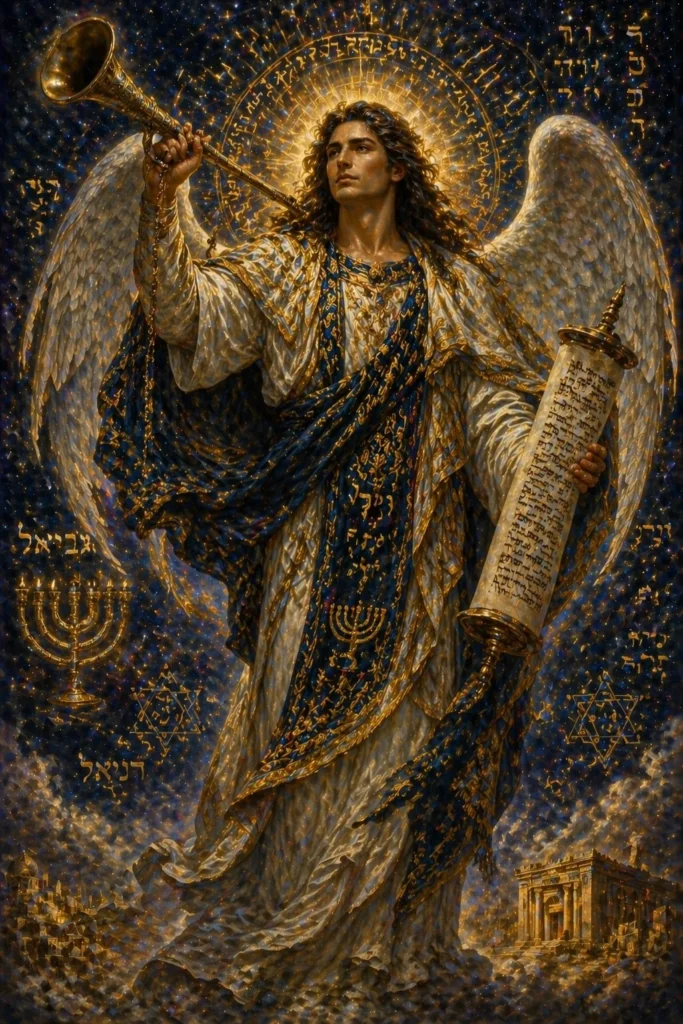
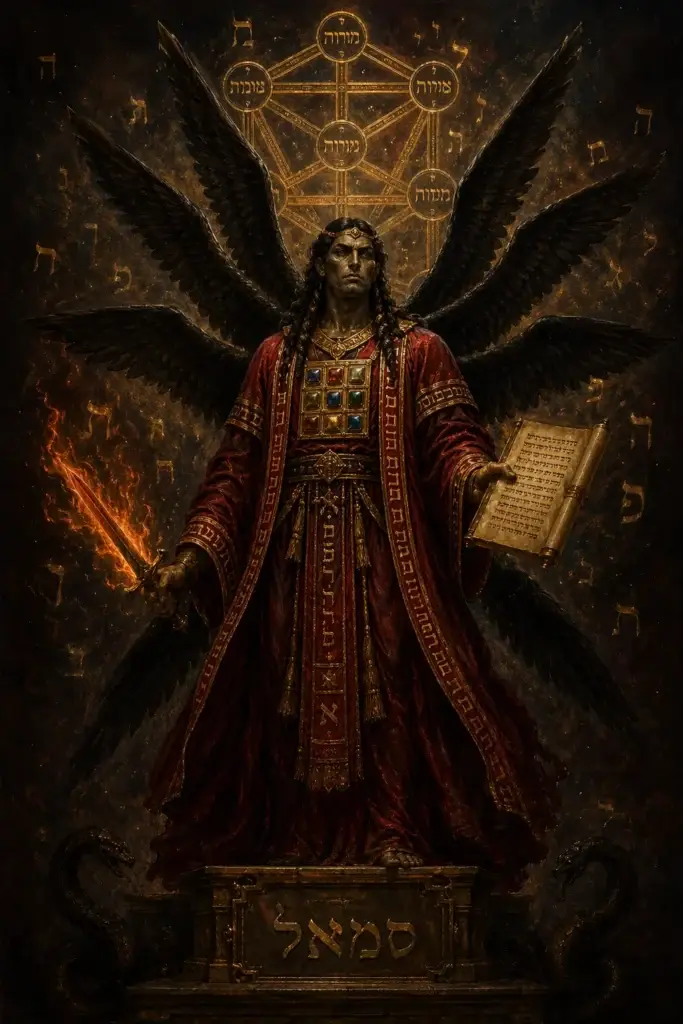
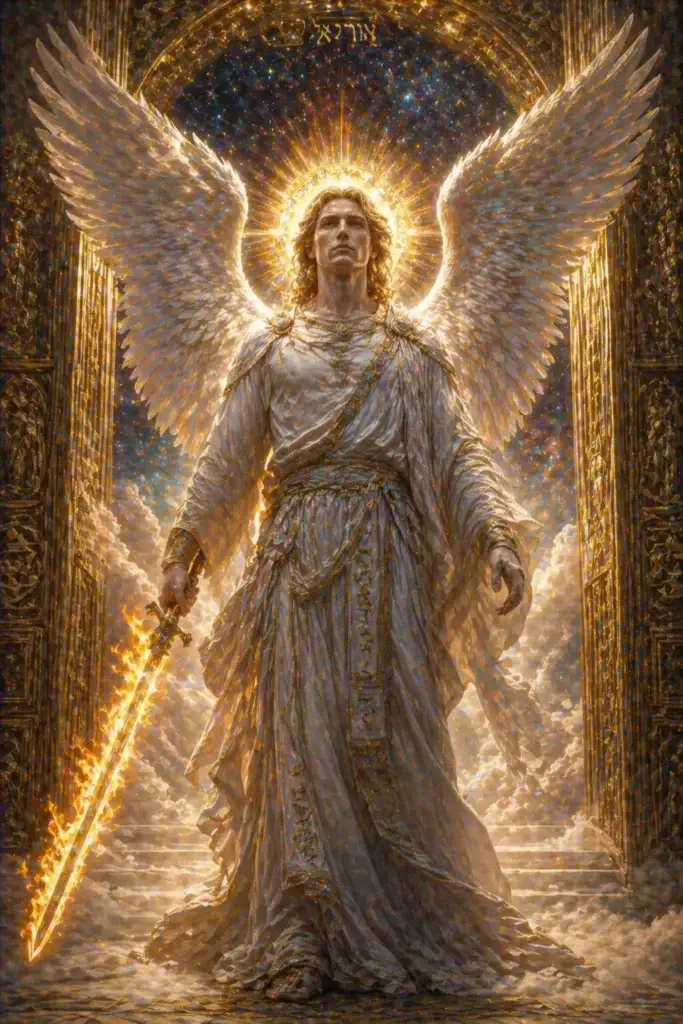
Uriel iconographically: a male figure with fire attributes, glowing wings, a sword in flames or a lightning staff. The colors are red, gold, orange (fire). In Jewish-mystical depictions Uriel wears a diadem, armor and a fire crown.
The attributes are flame, sword, scales, sometimes a book of judgment. The iconography refers to prophets such as Elijah (ascent to heaven in fire) and eschatological scenes of destruction.
Uriel (Ūrīʾēl, “God is my light”) is an archangel who appears mainly in apocryphal texts: 4 Esra, 1 Enoch, the Secret Book of John.
Uriel was regarded as a stern, righteous protective angel with feared power. The practices of invocation included prayers for divine protection and righteous judgment over persecutors.
In the Kabbalah, meditative contemplations on Uriel’s fire were practiced (Yichudim) in order to attain mystical knowledge and purification. Respect for Uriel was expressed in awe of his unrelenting nature and in pleas for mercy.
Comparable figures: Michael (warrior angel, vanquisher of demons, strength in the Kabbalah), Raguel (justice, Kabbalah), Chamuel (God’s severity). Outside Judaism: Raguel in Islam (no direct equivalent), the Christian Uriel (medieval angelology), the Zoroastrian fire Yazata of Ahura Mazda (heavenly fire).
Warding Off in Everyday Life
Contemplative practices for enlightenment
Uriel is not invoked directly, but called upon through contemplative meditation.
Apocalyptic revelations and interpretation
In 4 Esra, Uriel reveals hidden secrets to the seer about cosmology and the end of the world.
Protective amulets and symbols of knowledge
Uriel’s central symbol is fire or the flame, a sign of the divine presence and of purification.
Uriel, Parallels in Other Cultures
Jewish tradition: Uriel is one of four principal archangels (with Michael, Gabriel and Raphael). Parallels are Chamuel (God’s severity, often identified with Uriel), Raguel (cosmic justice). In Sefer ha-Bahir and the Zohar, Uriel is the throne guardian of the Sephira Chokmah (wisdom), primary fire.
Greco-Roman world: No direct parallels in classical mythology. Distantly related: Helios or Hyperion (fire gods), the Erinyes (demons of judgment), or Hephaestus (god of fire, punishment). Uriel shares the function of judgment with the Erinyes.
Mesopotamia: Mesopotamian equivalent: Shamash (sun god, judgment and justice, Akkadian). The fire iconography and the role of judgment connect Uriel and Shamash. Adad too (weather god, punishment) carries a similar functionality.
India / Asia: Indian counterpart: Agni (fire god, sacrifice and purification, Hindu). Uriel and Agni share the embodiment of fire and the function of mystical purification. Buddhist parallel: a fire god in the combating of demons.
Uriel in the Apocryphal Literature
Unlike Michael and Gabriel, Uriel is not named in the Hebrew canon of the Bible. He owes his significance almost entirely to extra-canonical literature, above all the apocalyptic literature of ancient Judaism. The most important text is the Ethiopic Book of Enoch, in which Uriel appears as one of the leading angels.
There it is Uriel who guides Enoch through the cosmic world and explains to him the secrets of the celestial bodies, the seasons and the calendar. In the so-called Astronomical Book of Enoch, Uriel is expressly the angel set over the lights of heaven.
Uriel also plays a central role in the Fourth Book of Esra, a Jewish apocalypse from the first century after the turn of the era.
There he is the angel who answers the seer Esra, responding to his questions about the justice of God and the meaning of suffering with counter-questions and parables. Uriel appears here as the angel who reveals the limits of human knowledge.
The name also appears in the Prayer of Joseph and in some Qumran texts. Scholarship, for example the work on Jewish angelology by Michael Mach, therefore assigns Uriel to the group of four or seven archangels whose names and functions took shape in the period of the Second Temple.
That Uriel is not a biblical angel in the narrower sense, but a creation of the apocalyptic literature, is decisive for his classification.
The Light of God: Name and Function
The name Uriel is usually interpreted as “Light of God” or “Fire of God”. The Hebrew element ur means light or flame, the element el is the common designation for God. This etymology is comparatively transparent and is in accord with the functions ascribed to Uriel in the texts.
In the apocalyptic literature, Uriel is repeatedly connected with light, fire and heavenly knowledge. As the interpreter of the celestial bodies in the Book of Enoch, he is the angel of the cosmic light.
In other traditions he becomes the angel who guards the fire or who is depicted with a flaming sword or a torch. The later Christian iconography took up this connection and often portrayed Uriel with a flame in his open hand.
Functionally, Uriel shifts in the sources between several roles. He is the interpreter of the heavenly secrets, the teacher of the seer, the angel of the natural order, and in some lists also an angel of judgment or of the underworld.
This variety is typical of angelic figures whose profile is drawn not from a single canonical text, but from several, in part independent strands of tradition. Religious studies therefore emphasizes that there is no single Uriel, but a bundle of attributions weighted differently depending on the text and the era.
Uriel in the Ecclesiastical Tradition and His Contested Status
In Christianity, Uriel had a precarious status from the outset. While Michael, Gabriel and Raphael appear in canonical scriptures, Uriel’s renown rests solely on the apocryphal literature.
This led to a changeable history. In late antiquity and the early Middle Ages, Uriel was quite familiar as an archangel; he appears in lists of angels, in prayers and in art.
A decisive turning point was a Roman synod in the year 745 under Pope Zacharias. It opposed the veneration of angels under names that do not appear in the recognized scriptures, naming in the process a series of angel names whose cult it sought to suppress.
As a result, official veneration in the Latin Church was essentially restricted to the three archangels named in the Bible. Uriel thereby fell out of the official cult, although he remained present in popular piety, in art and in esoteric traditions.
In the Orthodox churches, especially in the Ethiopian tradition, in which the Book of Enoch is canonical, Uriel by contrast retained a firm place.
He also remained significant in Jewish liturgical texts and in the Kabbalah, for example in the night prayer arranged according to the four archangels, which assigns Michael, Gabriel, Uriel and Raphael to the four cardinal directions around the sleeper.
Uriel’s history thus shows in exemplary fashion how canonical boundary-drawing and lived piety can develop apart from one another.
Further Links
Literature (Selection)
- Loren T. Stuckenbruck: Angel Veneration and Christology. Mohr Siebeck, Tübingen, 1995.