iWell Guard

Asmodeus, demon of the Jewish tradition

Asmodeus (English: Asmodeus demon, Hebrew: Ashmedai) is a demon of the Jewish tradition.King of demons, ruler between Tobit, the Talmud and the grimoire.
DemonJudaism

Table of Contents

Asmodeus - demons from the Jewish tradition, historical and illustrative
Asmodeus

Asmodeus (Greek-Latin Asmodeus) is the most important male demon figure of the post-biblical Jewish tradition. He first appears in the Book of Tobit (3rd century BC) as an enemy of love, who kills seven of Sarah’s bridegrooms until the angel Raphael drives him away.

In the Talmud he appears as a cunning ruler of the demons, who even takes Solomon’s throne. In medieval Kabbalah and Christian grimoire literature he becomes one of the most prominent individual figures of Western demonology.

His origin points to the Zoroastrian Aēšma daēva, the “daeva of wrath” of the Persian religion. In Hellenistic-Jewish times this figure migrates into Judaism and merges with native traditions into the figure we know today: king, trickster, and demon of wrath and desire at once.

At a Glance: Asmodeus

Type: ruler demon, king of demons
Origin: Zoroastrian Aēšma daēva, taken up into Jewish tradition
Texts: Tobit, Testament of Solomon, Talmud (Gittin 68), Zohar, grimoires
Period: Hellenistic era to the present
Distribution: Jewish diaspora, Christian reception across all of Europe
Defence: the angel Raphael (in the Tobit model), name magic, kabbalistic binding

Historical Context

Period of the Texts

First attested in the Hellenistic-Jewish Book of Tobit (3rd century BC). Elaborated in the late-antique Christian Testament of Solomon and in the Babylonian Talmud. Prominent in the Middle Ages in the Zohar, Christian grimoires and Renaissance magic. Present right into modern esotericism and popular culture.

Mythological Context

Asmodeus is a powerful demon in Jewish, Islamic and Christian-occult tradition. In the Book of Tobit he kills young women. In later traditions he became king of the demons. His power is ambivalent, seducer and judge at once. He is a guardian of dangerous knowledge.

Area of Distribution

Through Tobit and later literature, spread across all Jewish and Christian traditions. Particular presence in the German, French and Italian grimoire tradition of the Middle Ages and the early modern period. Modern reception worldwide in fantasy literature.

Source Situation

Book of Tobit (canonical in the Catholic and Orthodox Bible, deuterocanonical in Jewish tradition), Talmud Gittin 68a, b with a detailed narrative, Testament of Solomon, Zohar, numerous medieval grimoires (Lemegeton, Clavicula Salomonis), Renaissance magic (Agrippa, Weyer).

Name

Hebrew: Ashmedai (אַשְׁמְדַאי).
Greek-Latin: Asmodaios, Asmodeus.
Iranian-Avestan: Aēšma daēva, “daeva of wrath”, a standard figure in Zoroastrianism.

The Iranian origin makes Asmodeus one of the rare cases in which a Jewish demon figure can be clearly traced back to a non-Jewish model. From aēšma (wrath) and daēva (demon) comes Asmodaios; the biblical naming tradition adds its own etymology, which points to shamad (“to destroy”).

Characteristics

Appearance

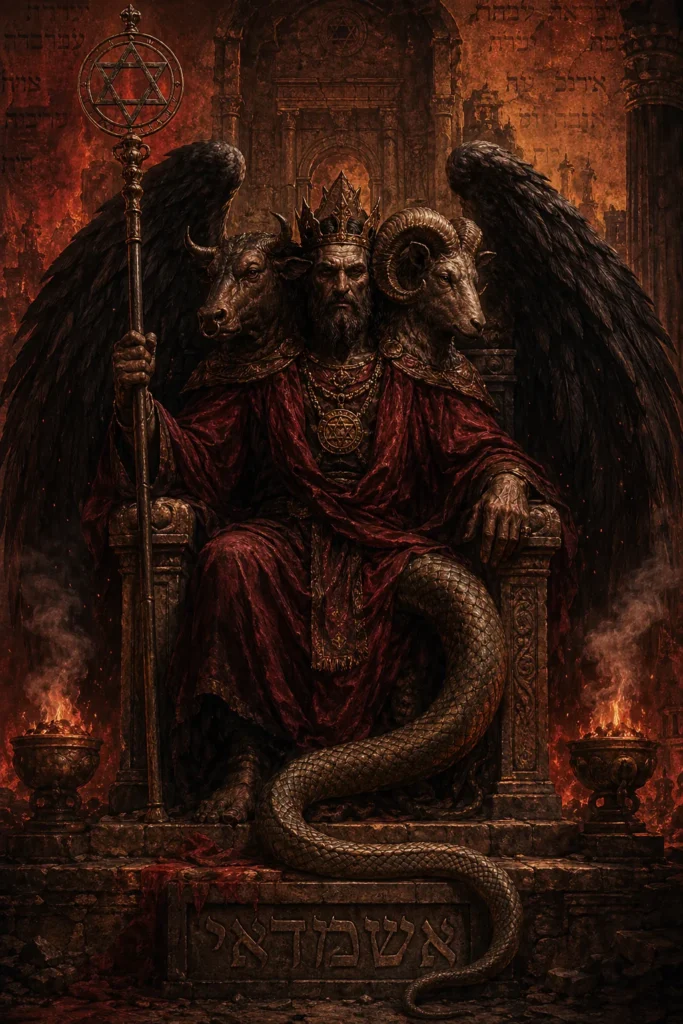
Not described in the Book of Tobit. In the Testament of Solomon, with three heads (human, ram, bull), wings and a fish tail. In later grimoires as a royal figure with a crown, often riding a dragon. Kabbalistic imagery shows him in the service of Lilith.

Behaviour

Cunning, domineering, wrathful. In the Book of Tobit he kills men who keep him from the coveted Sarah. In the Talmud he takes Solomon’s throne until the king drives him away again through cunning. He is not a dull adversary but an intellectually strong opponent.

Sphere of Influence

Marriage and desire, rule and political power, magic and secret knowledge. He is not the demon of everyday life, but of the great crisis.

Mythological Origin

Associated with fallen angels in Enochic traditions. In the Talmud expressly designated as king of the demons. In kabbalistic terms he is placed in a triadic structure together with Lilith and Samael: Samael, Lilith, Asmodeus as the demonic counterpart to the divine Shekhinah structure.

Appearance and Symbolism

Asmodeus is described as a terribly beautiful being, sometimes with three heads, flaming eyes and a tail. Others show him as a seductive demon. Sometimes he has wings. Chains and seals hold him bound. Fire and lust are his signatures.

Profile: Asmodeus

The most important aspects of Asmodeus at a glance. You will find the detailed account of name, description, defence and parallels in chapters 2, 3, 5 and 6.

Tradition

From the Iranian Aēšma daēva, daeva of wrath. Risen in Jewish reception to king of the demons, linked in kabbalistic terms with Samael and Lilith.

Related To

Married couples (Tobit motif), rulers (Solomon motif), magicians and seekers of grimoires. Acts at the great points of crisis, not in everyday life.

Depiction

In the Testament of Solomon, three-headed (human, ram, bull), winged, with a fish tail. In grimoires, royally crowned, often riding a dragon.

Function

Death of the bridegrooms, usurpation of rule, instigation of adultery and wrath. A stronger individual effect than the dispersed threat of the Shedim.

Protection

Invocation of angels (Raphael in the Book of Tobit), incense (fish heart and liver), name magic, kabbalistic binding formulas. Listed in grimoires as one of the demons to be bound.

Related Beings

Aēšma daēva (Zoroastrian, the direct model), Lucifer/Satan (Christian, later often identified with him), Ahriman (Iranian, as supreme counter-god), Iblis (Islamic).

Practice of Protection

Rituals of Defence

The Book of Tobit transmits a concrete ritual: the angel Raphael has Tobias burn fish heart and liver as incense; the smoke drives Asmodeus into the most remote desert. In later tradition the motif of the angel as vanquisher becomes important; Raphael, Michael or specific angel names are invoked.

Conjurations

The Talmud transmits a complex narrative in which Solomon binds Asmodeus by means of a magical seal. Kabbalistic and later grimoire traditions develop their own binding formulas from this. The Seal of Solomon becomes a key motif.

Amulets and Protective Symbols

Seal of Solomon (six-pointed star, later received as the Star of David). Amulets with the angel name Raphael. In kabbalistic handbooks, long protective formulas that bind Asmodeus by name.

Cult and Veneration

Asmodeus is not venerated but bound or appeased through spells. In chaos-magical practices he is invoked for knowledge of seduction. Kabbalistic and demonic systems make use of his power. Caution before his power is essential.

Parallels and Afterlife

Iranian background: Aēšma daēva is the direct source of the name. In Zoroastrianism this figure remains within the pantheon of the daevas; in Jewish adaptation it becomes a single king.

Christian and Islamic tradition: In Christianity, Asmodeus is integrated into the assignment of the seven deadly sins, mostly as the demon of lust. In Islamic tradition he is not directly adopted; his role is taken over by Iblis and the Shayatin.

Grimoire and the modern age: The Lemegeton and the Pseudomonarchia Daemonum list Asmodeus as a powerful ruler of hell with 72 legions. These lists carry over into modern role-playing games, fantasy literature and popular culture (Supernatural, Sandman).

Asmodeus in the Book of Tobit

The oldest connected text in which Asmodeus plays an active role is the Book of Tobit, a narrative that probably arose in the 3rd or 2nd century BC and that belongs to the canon in the Greek Bible as well as in the Catholic and Orthodox tradition, while in the Jewish and Protestant tradition it is counted among the Apocrypha.

Fragments of the book in Aramaic and Hebrew were found among the Dead Sea Scrolls.

In the Book of Tobit, Asmodeus, Greek Asmodaios, is an evil spirit who loves, or rather covets, the young woman Sarah. Sarah has married seven men one after another, and Asmodeus has killed each one on the wedding night before the marriage could be consummated. Sarah is therefore in despair and mocked.

The solution comes through the young Tobias, the son of Tobit, who is guided by the angel Raphael appearing as a travelling companion. Raphael instructs Tobias to keep the heart and liver of a fish.

On the wedding night Tobias burns these on the embers of the incense; the rising smell drives Asmodeus away, who flees to Upper Egypt, where Raphael binds him.

This narrative is instructive for the history of religion. It shows a demon who does not embody evil in the abstract but has a concrete function: he threatens marriage and procreation.

At the same time the text provides an early example of a regulated act of defence, an incense ritual with a precisely named substance, ordered by an angel. Scholarship sees in this evidence of the close interweaving of narrative, demonology and ritual practice in the Judaism of the Hellenistic period.

Ashmedai in the Talmud and the Building of the Temple

In rabbinic literature the figure appears under the name Ashmedai and there acquires its own elaborated form. It is regarded not simply as an ordinary demon but as king of the demons, the Shedim. The most important narrative is found in the Babylonian Talmud, in the tractate Gittin.

There it is reported how King Solomon needs Ashmedai in order to build the Temple of Jerusalem. Since the temple is to be erected without iron tools, Solomon needs the Shamir, a wondrous creature or worm that can split stone, and whose whereabouts only Ashmedai knows.

Solomon’s messenger finds the demon, who comes down daily from his mountain, and outwits him with wine poured into his water cistern, so that he can be captured while drunk.

In the further course Ashmedai is brought to the court and forced to help with the building.

Remarkable is the point of the narrative: Ashmedai finally succeeds in driving Solomon from his throne and taking on his form, so that the king wanders about for a time as a homeless beggar until he regains his rule.

The story thus combines the motif of the clever but dangerous king of the demons with a warning about the limits of royal power.

The Talmud shows Ashmedai in several passages as an ambivalent figure. He is dangerous and deceitful, but also possessed of his own wisdom and not without a certain right. This complexity clearly distinguishes the rabbinic figure from the image later reduced in Christian demonology.

Asmodeus in the Late Medieval and Early Modern Demonology

In the Christian demonology of the late Middle Ages and the early modern period, Asmodeus became a fixed item of the hierarchies of hell.

The magical handbooks and demon catalogues of that time usually assigned him to the deadly sin of lust, in keeping with his role in the Book of Tobit as enemy of marriage and seducer.

In the influential Pseudomonarchia Daemonum, which Johann Weyer published in 1577 as an appendix to his work against the witch craze, and in the Lemegeton or Goetia based upon it, Asmodeus appears, there usually written Asmoday, as a powerful king with a multitude of subordinate spirits.

He is described as a being with three heads, riding a hellish dragon, to whom knowledge of geometry, the crafts and hidden treasures is attributed.

These depictions are not ancient traditions but learned constructions of the Renaissance, which took up older names and arranged them into a systematic scheme.

Research into the history of magic, for example the studies on the transmission of the Goetia, has shown that such catalogues copied heavily from one another and in doing so recombined attributes.

A well-known literary reception comes from the 18th century: in the novel El diablo cojuelo by Luis Vélez de Guevara, and still more strongly in its French adaptation Le Diable boiteux by Alain-René Lesage, a limping devil appears who is identified with Asmodeus and who lifts the roofs off the city for his human companion in order to show the hidden vices of the inhabitants.

Through these novels the name Asmodeus also spread into secular literature.

Further Links

Recommended internal links:

  • Judaism
  • Shedim (Asmodeus as their king)
  • Lilith (kabbalistically linked)
  • Azazel (another key figure)
  • Dybbuk (possession motif)
  • Zoroastrian tradition (Aēšma daēva)
  • Grimoire literature and demon hierarchies

Literature (Selection)

A selection of central works on Asmodeus:

  • Moore, Carey A.: Tobit. A New Translation with Introduction and Commentary. New York 1996.
  • Duling, Dennis C.: “Testament of Solomon.” In: James Charlesworth (ed.): Old Testament Pseudepigrapha, vol. 1. New York 1983.
  • Scholem, Gershom: Kabbalah. Jerusalem 1974.
  • Trachtenberg, Joshua: Jewish Magic and Superstition. New York 1939.
  • Rüpke, Jörg / Spickermann, Wolfgang (eds.): Reflections on Magic. Tübingen 2012.

Related Protective Symbols

The practice of protection described here is a religious-studies classification of historical traditions. iWell Guard ties in with this cultural-historical line of wearable protective objects and represents a contemporary form of it. More about the iWell Guard →

Frequently Asked Questions about Asmodeus

Who is Asmodeus in Jewish-Christian demonology?

Asmodeus (also Ashmedai, Hebrew אַשְׁמְדַאי) is one of the most powerful demons of the Jewish and medieval Christian tradition.

He first appears in the deuterocanonical Book of Tobit as a demon who kills the brides of the young Sarah on the wedding night, until he is driven away by Tobias with the help of the archangel Raphael.

In the Babylonian Talmud, Asmodeus becomes king of the Shedim (harmful beings). In the medieval grimoire system he is one of the seven princes of hell, responsible for lust.

What role does Asmodeus play in the Solomonic tradition?

In the Testament of Solomon (a Christian-Jewish writing, 1st to 3rd century) and in the Jewish Talmud (Gittin 68a-b), Asmodeus is a central figure.

Solomon is said to have put him in chains through the archangel Michael in order to use him in building the Temple of Jerusalem; the Shamir stone, which cuts stones without iron, was part of this.

In the Lemegeton (Goetia, 17th century), Asmodeus is the 32nd spirit, a king who commands 72 legions and can give information about mathematics, astrology and mechanical art.

Classification & Protection

IVLEVEL
The Protection Compass assigns this being to influence level IV, Severe influence.

Against its influence, cross-cultural tradition names these protective means:

Compare in the Protection Compass →

Recommended protective means

iWell Guard

The simplest protective means in this collection: 41 layers of fine gold 999, platinum, silver and silicon, manufactured in Ruhla, Thuringia. It requires no activation, is bound to no person, and is effective within a radius of around 50 meters, even without being worn.

All protective means at a glance →