Azazel, Demon of Jewish Tradition
By Ralf Ittermann · last reviewed on
Azazel is a demon of Jewish tradition.
Desert demon of the scapegoat, fallen angel of the Enoch tradition.
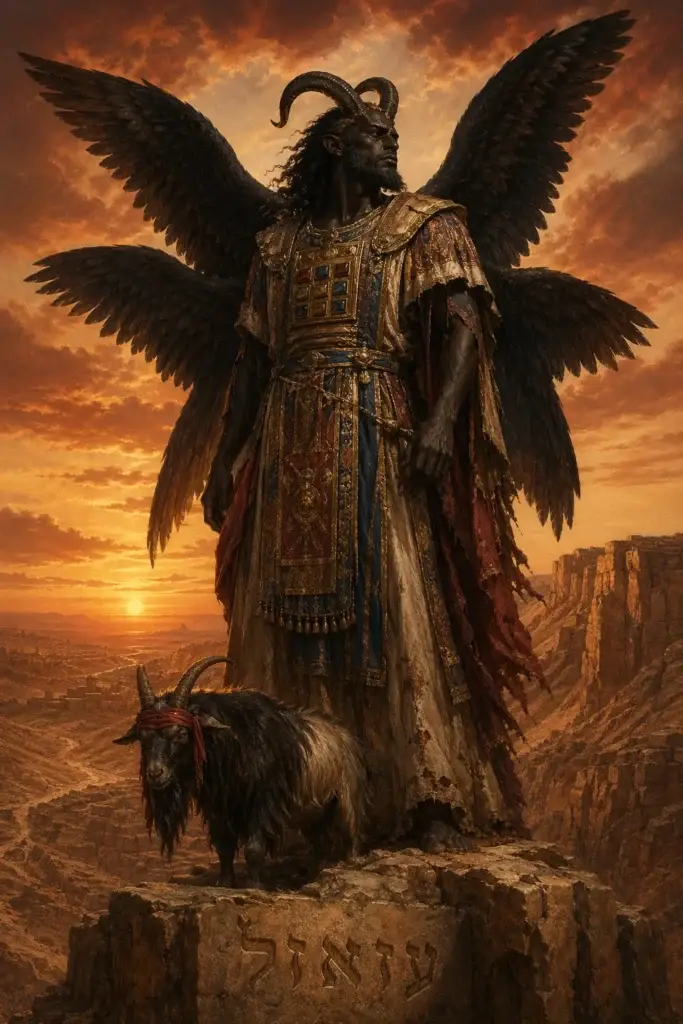
Azazel
Azazel is one of the theologically most interesting figures of Jewish demonology. In the biblical ritual of the Day of Atonement (Lev 16), a goat is sent each year into the desert „for Azazel“ and there bears the sins of the people.
What in the biblical passage may be only a local desert region or a nameless counterforce becomes, in Second Temple literature, an elaborate figure: Azazel as a fallen angel, teacher of forbidden arts, leader of the sinning Watchers.
The central textual basis for this development is the Ethiopic Book of Enoch (1 Enoch), especially the Book of the Watchers. Azazel teaches humans the forging of weapons, the use of cosmetics and adornment, that is, the arts that, from the apocalyptic point of view, corrupt humanity.
As punishment he is bound by the archangels in a desert cave, to await eternity there. The reception extends from rabbinic literature through early Christianity to modern esotericism.
At a Glance: Azazel
Type: Desert demon, fallen angel, recipient of the scapegoat
Origin: Biblical desert figure (Lev 16), developed apocalyptically into the leader of the Watcher angels
Texts: Lev 16; 1 Enoch (Book of the Watchers); rabbinic literature; Pirkei de-Rabbi Eliezer
Period: Pre-exilic to the present
Distribution: Palestine, Jewish diaspora, Christian reception
Function: Recipient of ritual transfer of sin; teacher of forbidden arts; cosmic adversary figure
Context
The biblical passage Lev 16 comes from the Priestly source (late pre-exilic). The Ethiopic Book of Enoch (especially the Book of the Watchers, 3rd to 2nd century BC) develops the Watcher narrative. Pirkei de-Rabbi Eliezer (8th/9th century) and later Kabbalah carry the image forward. Modern reception ranges from scholarly literature to ghost and fantasy genres.
Core area Palestine; the Book of Enoch is preserved as canonical in the Ethiopian Orthodox Church. Jewish reception in rabbinic literature and Kabbalah. Christian reception in patristics (Origen, Tertullian) and medieval demonology. In Islamic tradition there is contact through Iblis and Harut/Marut.
Biblical: Lev 16:8, 26 (four mentions). Apocalyptic: 1 Enoch chs. 6, 16, 54, 88, among others; Apocalypse of Abraham. Rabbinic: Talmud (Yoma), Pirkei de-Rabbi Eliezer. Kabbalah: Zohar, Sefer Raziel. Christian: patristic citations, Testament of Solomon. Modern esoteric traditions build upon this.
Name
Hebrew: Asasel / Azazel (עֲזָאזֵל).
Etymology: Disputed, „angry against God“, „hard (az) of God (El)“, a place name, or the name of a desert spirit.
Further forms: Asael (shorter form), in 1 Enoch alongside other Watcher angels.
The uncertainty of the derivation is theologically significant. Jewish translation traditions long disagreed on whether Azazel is a proper name, a place name or a descriptive term. The Vulgate translates it as caper emissarius, „dismissed goat“, from which the English „scapegoat“ and the German „Sündenbock“ derive.
Characteristics
Appearance
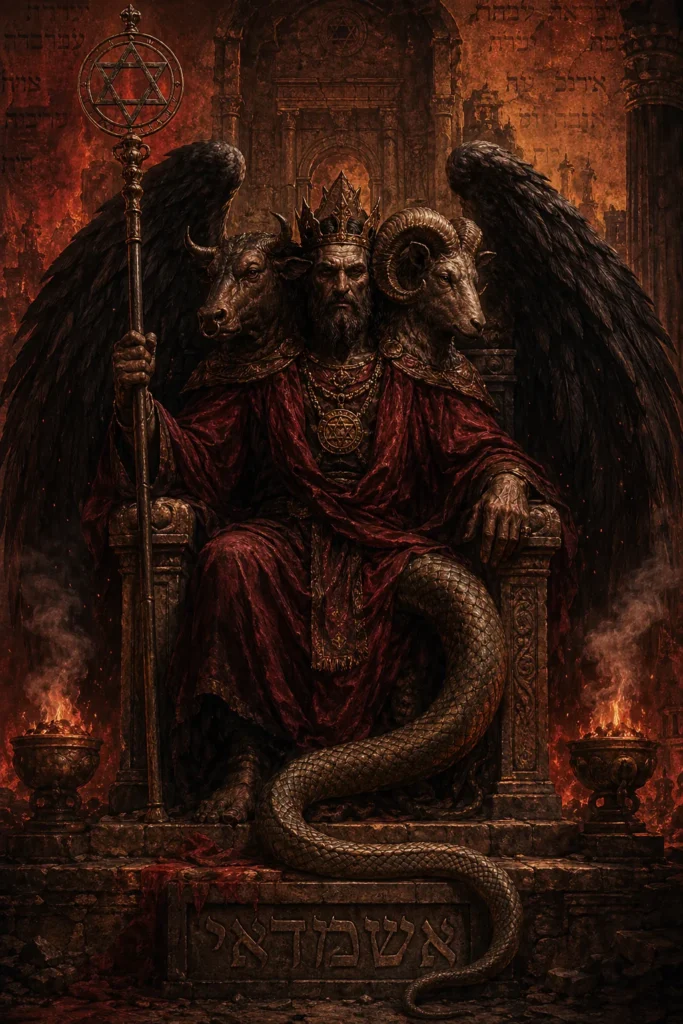
Not described in the biblical text. In 1 Enoch and later traditions he is conceived as a (fallen) angel, without a uniform iconography. In medieval demonology he appears in part with billy-goat features, through the scapegoat association.
Behavior
Passive in the biblical ritual, he receives the laden goat. Active in apocalyptic tradition: he teaches forbidden arts (the forging of weapons, cosmetics, luxury), thereby seduces humans, and shares the guilt for the antediluvian evil.
Sphere of Influence
The desert, his biblical place of reception, remains his domain to this day. In kabbalistic thought the desert becomes the Sitra Achra, the „other side“, in which Azazel is conceived as one of the leading representatives.
Mythological Origin
In 1 Enoch he is the leader of a group of Watchers who descended to the earth and joined with the daughters of men. The punishment: imprisonment in a desert cave until the judgment. This narrative shapes the model of the „fallen angel“ of the Abrahamic traditions.
Profile: Azazel
The most important aspects of Azazel at a glance. You will find the discussion of name, description, function and parallels in the following sections.
Biblical: desert figure in the Day of Atonement ritual. Apocalyptic: fallen Watcher angel. Kabbalistic: representative of the Sitra Achra.
In the biblical rite the recipient of the burden of sin. In the Enoch tradition: humanity, to whom he teaches forbidden arts. Today: metaphorically the community that offloads its guilt.
No fixed iconography. In medieval demonology in part with goat features; in apocalyptic descriptions as a fallen angel with enormous wings.
Biblically passive: carries the sins into the desert. Apocalyptically active: seduces toward armed violence, cosmetics, greed. Kabbalistically: binds cosmic negativity.
In the biblical rite the „warding off“ is already part of the ritual: the goat goes into the desert, the community is purified. In the apocalyptic narrative the archangels Raphael and Michael bind Azazel in a desert cave.
Apophis (cosmic adversary), Satan/Lucifer (fallen angel in the Christian reinterpretation), Ahriman (Zoroastrian), Iblis (Islamic), Harut and Marut (Quranic parallel).
Rite and Cosmic Role
The ritual of the Day of Atonement
Each year on Yom Kippur, two goats are determined by lot in the Temple of Jerusalem: one is sacrificed to God, the other is sent „for Azazel“ into the desert.
The high priest lays the sins of Israel upon the second goat; it is led by an appointed person out into uninhabited terrain and released there (later: thrown from a cliff to prevent its return). The ritual creates collective purification each year.
Incantations and Binding
In apocalyptic literature Azazel is not invoked but bound by the archangels Raphael and Michael. The Enoch narrative describes this as a divine sentence of punishment at the end of time. Some kabbalistic texts integrate Azazel into complex binding formulas against demonic powers.
Amulets and Protective Symbols
There are no direct Azazel amulets. The Yom Kippur ritual is the grand form of ritual purification. Private means of protection (mezuzah, psalm amulets) work in general terms, without addressing Azazel specifically.
Parallels and Reception
Zoroastrian and Quranic parallels: Ahriman in Zoroastrianism is the cosmic adversary of the good God. Iblis in Islamic tradition refuses to honor Adam and becomes the adversary. Harut and Marut of the Quran teach forbidden magical arts, a direct parallel to the Enoch narrative of Azazel.
Christian reception: Patristic authors take up Azazel in different ways: Origen equates him with the devil, Tertullian interprets the two goats typologically as the two comings of Christ. In medieval demonology he appears in various hierarchies, in part as a standard-bearer of hell.
Modern era: In esotericism, occultism and fantasy, Azazel remains popular (including „Supernatural“, „X-Men“). The concept of the scapegoat is a central notion in ethics, social psychology (René Girard) and present-day theology.
Azazel in the Ritual of the Day of Atonement
In the Hebrew biblical text, the name Azazel is firmly bound to a single, precisely described ritual context: to the ritual of the Day of Atonement, of Yom Kippur, as it is described in the 16th chapter of the Book of Leviticus.
There, two billy goats are selected, and the lot is cast over them. The one goat falls by lot to the LORD and is slaughtered as a sin offering. The other goat falls, according to the Hebrew wording, to Azazel.
Over this second goat the high priest confesses the sins of the people, lays them upon it symbolically, and the goat is led by a man into the desert and released there or, as the later tradition interprets it, cast down at an impassable place.
From this procedure comes the German expression Sündenbock (scapegoat), which entered many European languages through the Latin and Greek translations of the Bible.
What Azazel means has been disputed since antiquity. Three main interpretations stand side by side. The first understands the word as a place designation, for instance as the name of a rugged rock in the desert.
The second reads it as an abstract expression, for instance as complete removal or as an intensification of the sending away.
The third interpretation, widespread in scholarship, understands Azazel as the proper name of a desert demon or desert being, to whom the goat is symbolically handed over. This interpretation is supported by the parallel construction: one lot for the LORD, one lot for Azazel.
It is important that the biblical text does not present Azazel as a venerated power. The goat is not sacrificed to Azazel; it is sent into his domain, the uninhabitable desert, in order to carry the impurity away from the community.
Azazel in the Book of Enoch and the Fallen Watchers
Azazel takes on an entirely different, far more detailed form in early Jewish literature outside the biblical canon, above all in the Ethiopic Book of Enoch, whose older parts reach back to the 3rd to 2nd century BC. Aramaic fragments of this writing were found among the texts of Qumran.
In the so-called Book of the Watchers, Azazel, there sometimes also written Asael, is one of the leaders of the fallen angels. These Watchers descend from heaven, take human women, and beget the giants with them.
A particular guilt falls to Azazel: he teaches humans the forging of weapons, swords and shields, as well as the making of jewelry, cosmetics, and dyeing, that is, arts that the text connects with violence and seduction.
As a consequence of this forbidden instruction, war and moral corruption spread across the earth. God commands the angel Raphael to bind Azazel, to cast him into a pit in the desert, to cover it with sharp stones, and to hold him there in the darkness until the day of judgment.
The text states expressly that the whole earth has been corrupted through the work of Azazel.
This narrative connects the name Azazel with the motif of the theft of knowledge and of cultural corruption. Scholarship has pointed out that the banishment of Azazel into the desert and his binding at an impassable place echo the Leviticus ritual, in which the goat likewise goes into the desert to Azazel.
Whether the Book of Enoch here deliberately draws on the biblical ritual or reflects an independent tradition is debated.
Interpretations in Rabbinic, Christian and Gnostic Tradition
The later history of interpretation dealt with the enigmatic name Azazel in very different ways. In the rabbinic tradition the term was understood in part geographically.
The Mishnah in the tractate Yoma describes in detail how the goat on the Day of Atonement was led to a rugged rock in the desert and cast down from there backward, so that it was shattered on impact.
This practice presupposes an interpretation of Azazel as a place designation, and thus deliberately avoids the notion of a receiving being.
Other Jewish texts, above all those close to the Enoch tradition and individual midrashic passages, by contrast kept alive the notion of Azazel as a fallen angel.
Medieval biblical commentators such as Ibn Ezra suggested that a hidden meaning lay in the word, one connected with the powers of the desert, but expressed themselves with reserve.
In early Christian interpretation the Leviticus ritual was often read typologically: the slaughtered goat and the goat sent away were interpreted as referring to Christ, who is at once the sacrifice and the one who carries away the sin. Where Azazel was understood as a being, he came into proximity with the devil.
In gnostic and later in esoteric currents, finally, Azazel was developed into an independent mythical figure, often as a teacher of forbidden knowledge, following the Book of Enoch.
This later appropriation stands far from the terse biblical statements and rests on the Enoch tradition and its modern rediscovery. The religious-studies finding remains that Azazel is at its core a hard-to-interpret cipher for the realm of the impure outside the human order.
Further Links
Literature (Selection)
A selection of central works on Azazel:
- Pinker, Aron: „A Goat to Go to Azazel.“ In: Journal of Hebrew Scriptures 7 (2007).
- Nickelsburg, George W. E.: 1 Enoch. A Commentary. 2 vols. Minneapolis 2001/2012.
- Grabbe, Lester L.: „The Scapegoat Tradition.“ In: Journal for the Study of Judaism 18 (1987).
- Girard, René: The Scapegoat. Baltimore 1986 (sociology-of-religion perspective).
Standard literature (Judaism):
- Scholem, Gershom: Major Trends in Jewish Mysticism. Schocken, New York 1941.
- Hutter, Manfred: Azazel. In: Dictionary of Deities and Demons in the Bible. 2nd ed. Leiden 1999.
- Trachtenberg, Joshua: Jewish Magic and Superstition. Behrman, New York 1939.
Related Protective Symbols
The protective practice described here is a religious-studies classification of historical traditions. iWell Guard ties in with this cultural-historical line of wearable protective objects and represents a contemporary form of it. More about the iWell Guard →
Frequently Asked Questions about Azazel
Who is Azazel in Jewish tradition?
Azazel is a mysterious figure from the atonement ritual on Yom Kippur (Leviticus 16): the high priest chose two billy goats, one for God, one for Azazel.
The Azazel goat was sent into the desert with the sins of the people upon its head. Later Jewish apocalyptic (Book of Enoch) interprets Azazel as a fallen angel who taught humans forbidden arts: weapon-making, cosmetics, astrology.
What does the scapegoat symbolism surrounding Azazel mean?
The scapegoat rite is the archaic root of the modern term scapegoat. The sins of the community are symbolically transferred to an animal and led off into the desert, that is, outside the inhabited world.
René Girard described this pattern in his theory of the scapegoat mechanism as a fundamental social function: a community relieves itself through the expulsion of a single figure.