Mikail, God of the Islamic Tradition
By Ralf Ittermann · last reviewed on
Mikail is the archangel figure of the Islamic tradition, a messenger of God and a provider of sustenance and blessing.
His significance in religious studies lies in the embodiment of divine care, in the support of the faithful, and in the Quranic revelation as one of the most powerful celestial beings of Allah.
Mikail
Mikail (also Mikha’il) functions as an angel of providence. His attributes include compassion, strength and direct closeness to Allah’s throne.
Central myths are: the provision of Israel with manna (Hadith traditions), participation in the weighing of souls (Yawm ad-Din), and mystical traditions of Sufi literature.
Mikail appears in Quranic verses (Quran 2:98) and is elaborated in Hadith collections (Bukhari, Muslim, Tirmidhi). The framing assignment occurs in the early Islamic period (7th century). Comparative scholarship (Annemarie Schimmel, Patrick Hughes, Schmoldt) documents Mikail’s role as essential within Islamic angelology and Sufism.
Historical Classification
The continuity of the transmission across these long spans of time is remarkable and shows a deep, stable cultural rootedness. In modern times too, the memory and sometimes also active veneration is alive, sometimes transformed, but still recognizable in its basic features.
Mikail was not limited to a particular region or locations, but was universally known and venerated or respectfully feared throughout the entire Islamic world.
Whether in large urban centers or in peripheral rural regions, whether among the social elite or among ordinary people, the spiritual or cultural significance of this entity was consistently and universally acknowledged.
This clearly points to a central role in the self-understanding of the whole community. Trade, migration and cultural exchanges contributed to the geographical spread and to the stable uniformity of the veneration.
Primary sources are the Quran (2:98 Whoever is an enemy of the angel Gabriel and Mikail, Sura 2:97, 98, Arabic, 7th c.), Hadith collections (Sahih al-Bukhari 3:229, Sahih Muslim, Jami at-Tirmidhi, Arabic), and Tafsir literature (Tabari, Ibn Kathir, 9th to 14th c.). On the secondary side, Schimmel (The Mystical Dimensions of Islam, 1975) and Hughes (Dictionary of Islam, 1885) analyzed Mikail’s development as a central archangel of Islam.
Name and Variants
Mikail is depicted in the various sources and artistic traditions with certain recurring iconographic elements that remain relatively constant across decades and across different geographical areas. These elements are not purely decorative or chosen at random, but are deeply symbolically encoded and carry great meaning.
Unlike angels in image-rich traditions, Mikail is not described in Islam through colors, weapons, or accessories, since Islamic teaching refrains from pictorial representation. His identifying marks are instead his duties: tradition assigns him the distribution of rain, the growth of plants, and the provision of all creatures. Those who know the sources recognize him by precisely this area of responsibility; his mention by name in Surah 2:98 secures his rank among the great angels, alongside Jibril.
The overall system is like a sacred scripture or a coded image; it allows initiates or the culturally educated to grasp and correctly understand the essential, deeper meaning. Colors, sacred objects or weapons, physical attributes, specific accessories, everything is significant and traditionally handed down.
Characteristics
Mikail was central to religious practice, everyday rituals and the daily understanding of Islam. People turned to this entity in critical or particular life situations or at certain ritual times of the year.
In Islam, the treatment of Mikail is governed by the revealed texts themselves: the archangel is named explicitly in Surah 2:98, and further statements about his duties appear in the hadith literature. Scholars of Quranic exegesis and of the science of transmission examined and classified these reports according to fixed methods; a free, self-invented angelology was thereby ruled out.
Engagement with Mikail remained alive throughout Islamic history because his sphere of responsibility touched daily life directly: rain, harvest, and livelihood. Tradition describes him as the angel who distributes provision on God’s behalf; belief in him also belongs to the articles of faith in Islam, since the Quran expressly includes the angels in the creed. His function is therefore less defensive than providing and sustaining.
Profile: Mikail
The Profile captures Mikail across six dimensions: his origin in Quranic and hadith-based traditions, his target audience among believing Muslims and Sufis, iconographic water and light features, his functional role as provider and protector, comparisons with Christian and Jewish archangels, and his mystical role in Sufi contemplation.
Mikail is mentioned in the Quranic revelation of the 7th century in Arabia, with roots in Judeo-Christian archangel traditions. The geographical origin lies in the Arabian Peninsula and the Near East.
The dating of the first mention is Sura 2:98 (Medina period, 623 to 632 CE). The theological framing as a chief archangel alongside Gabriel took place in early Hadith commentaries.
Mikail addressed himself primarily to believing Muslims of all social classes. The target groups are the pious, mystics (Sufis), the sick (hope of healing), travelers (protection) and those seeking defense (against evil).
The occasions are daily prayers (Salah), crises, the fasting month of Ramadan, and mystical night prayers (Tahajjud). The invocation takes place in devotion and supplication (Dua) with God’s blessing (Barakah).
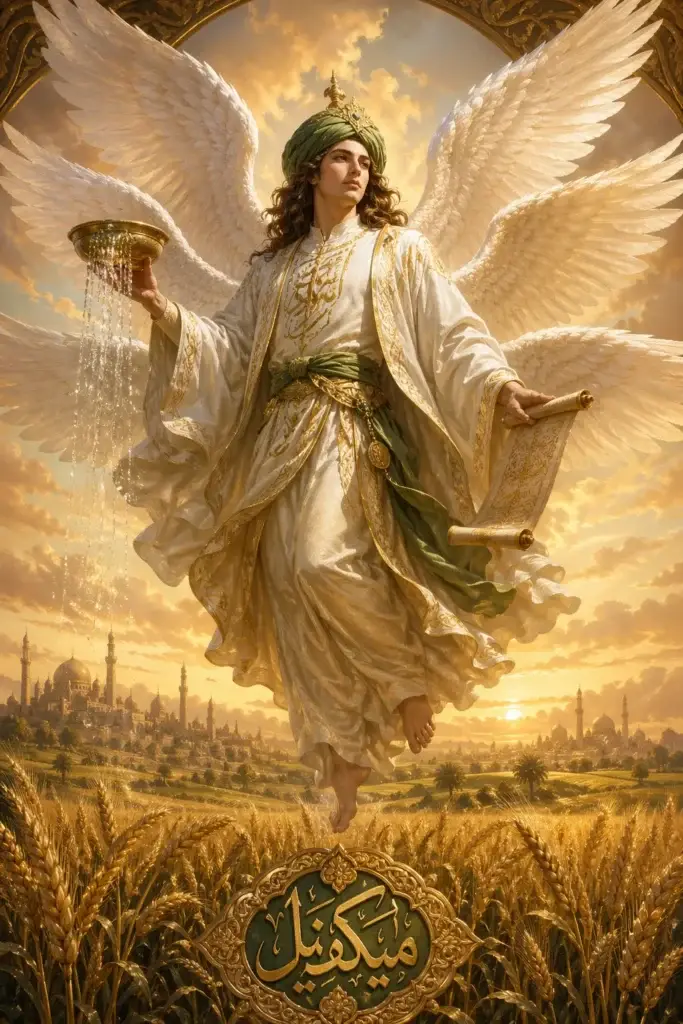
Mikail iconographically: a male figure with great wings of green and gold, shining like water (Arabic: Bi-Suwar al-Nur). His attributes are a water bowl (blessing, fertility), sometimes a scale (the weighing of souls, Yawm ad-Din).
In Sufi miniature painting: a green robe (fertility), a halo. The iconographic connection to water distinguishes Mikail from Christian archangels.
Mikail was regarded as a good, protective being with active care. The practices of invocation included prayers for blessing (Barakah), protection from evil (the Shayatin) and provision.
In Sufi traditions, meditations upon Mikail were practiced (Muraqaba) in order to attain spiritual purification and closeness to Allah. Respect for Mikail expressed itself in reverence, the requirement of purity (Wudhu) before invocation, and the ritual obligatory prayers (Salah) under his heavenly support.
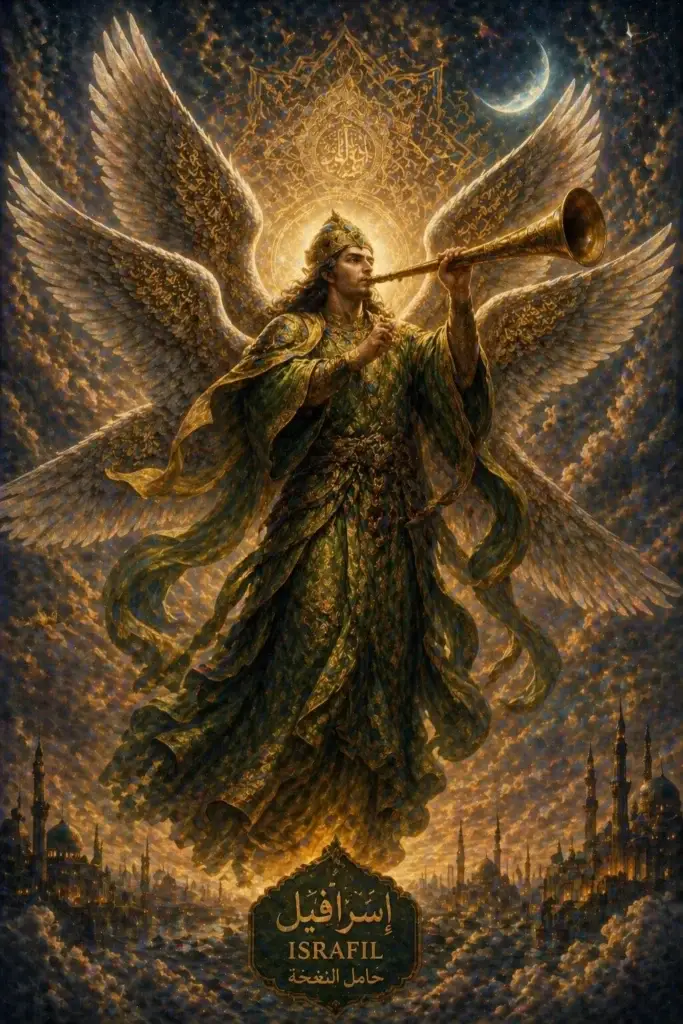
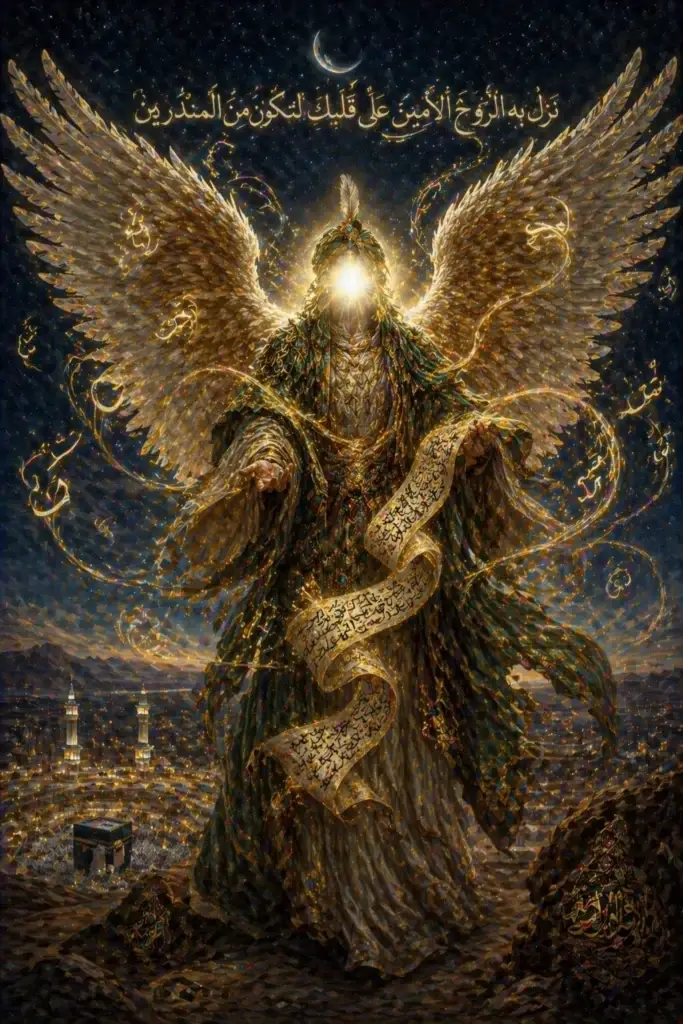
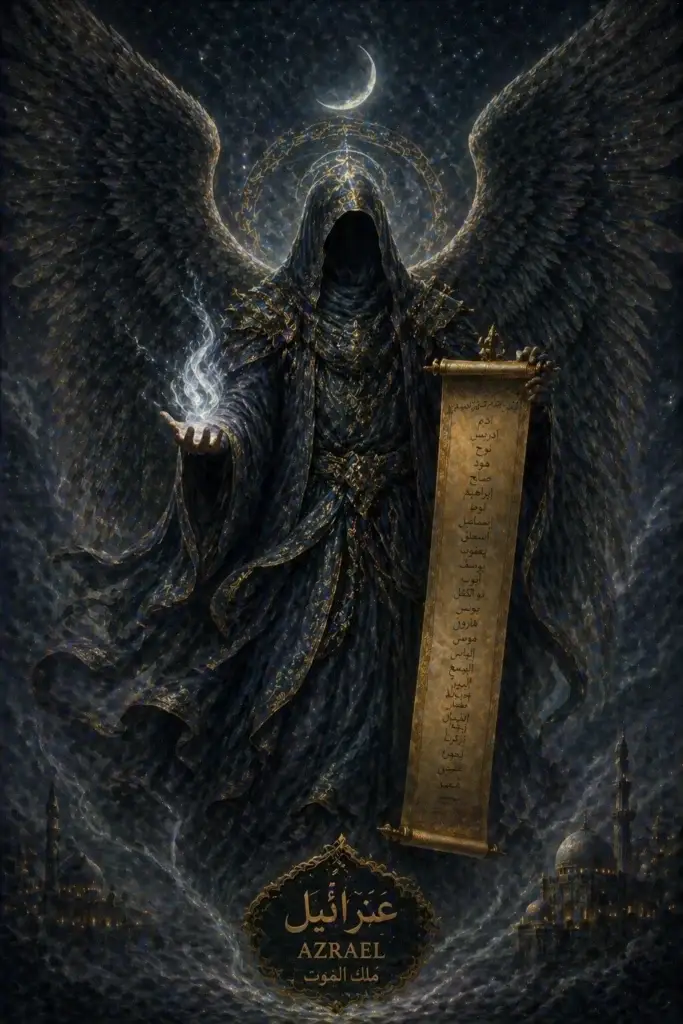
Comparable figures in Islam: Jibril (Gabriel, the angel of revelation), Israfil (the trumpet angel, resurrection), Azrael (the angel of death). Outside Islam: the Jewish Michael (a war leader, but less caring), the Christian Michael (militaristic), the Zoroastrian Spenta Mainyu (the good spirit, care). The emphasis on care rather than war makes Mikail unique.
Defense in Everyday Life
Rituals and Veneration
Mikail is invoked in religious prayers (Dua), especially in supplications for healing and provision. In Sufi mystical orders (Tariqah) there are special invocation prayers (Wird) for his blessing. Mosques often display calligraphic depictions of his names.
Conjurations and Invocations
Classical invocations in Quranic style: „Ya Mikail, angel of provision, send blessing down to us.” Sufis recite the 99 names of God in meditation. A transmitted formula ran: „Mikail, mightiest administrator, shield us and our family.” Conjurations in times of need (illness, scarcity) are widespread in folk Islam.
Amulets and Protective Symbols
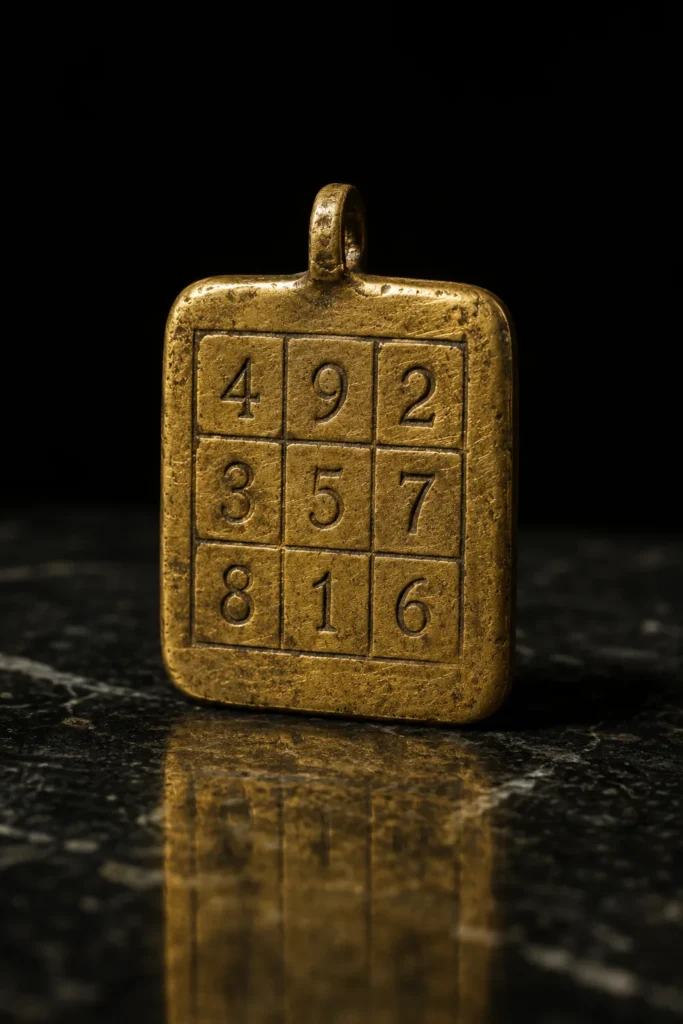
The name Mikail in Arabic calligraphy is worn as an amulet. Green and gold colors symbolize his domain. The „angel signet ring” (with the Mikail sigil) is a traditional protective object. Muslims carry verses from Sura 2:98 as written talismans.
Mikail, Parallels in Other Cultures
Jewish tradition: The Jewish Michael is the closest equivalent (Hebrew: Who is like God, the same name etymology). Michael, however, is primarily a war angel and a demon subduer, not a provider. Gabriel’s role of revelation differs from Mikail’s care. Uriel (judgment) has no parallel in Mikail’s gentle protection.
Greco-Roman world: No direct parallels. Distantly related: Hermes as a messenger of the gods and protector of travelers, or Iris (a heavenly mediator, but without martial power). The personal protective aspect of Mikail resembles the functionality of Hermes.
Mesopotamia: Mesopotamian counterpart: Marduk (leader of the gods, victory over chaos, not a direct angel). Closer is Nabu (scribe, revelation). The combination of ruling power and the function of care is shared by Mikail and Marduk.
India/Asia: Indian counterpart: Indra (warrior god, leadership of the gods, Hindu). Buddhist parallel: bodhisattvas with a protective function (Avalokiteshvara, compassion). The combination of power and protection is shared by Mikail and Indra.
Mikail in the Quran and in Hadith Transmission
Mikail, who in German is usually rendered as Michael, appears by name in the Quran only a single time. In Sura 2, verse 98, God, his angels, Gabriel (Jibril) and Michael (Mikal) are named together.
The verse stands in the context of a dispute over the question of who is an enemy of God, and emphasizes that enmity toward God’s angels is equivalent to enmity toward God himself. This brief mention is the only direct Quranic basis for Mikail.
Far more detailed is the Hadith literature and the exegetical tradition. There, a specific task is attributed to Mikail: he is the angel responsible for the sustenance of creatures, for rain, plant growth and provision.
While Jibril is regarded as the bringer of revelation, Mikail stands for the preservation of the material world. Some traditions assign him hosts of subordinate angels who administer every drop of rain and every leaf.
Islamic scholarship also connected Mikail with the tradition that, together with Jibril, he stood by the Prophet Muhammad at important points of his work.
The commentaries on the Sura also discuss a Jewish prehistory of the verse: according to several traditions, the verse was sent down in response to a claim that Mikail was well disposed toward the faithful, while Jibril was an angel of misfortune.
The Quran rejects this distinction and places both angels as equal in rank under obedience to God.
His Place in Islamic Angelology
In the systematic angelology of Islam (ilm al-mala’ika), Mikail belongs to the four or five highest angels, often alongside Jibril, Israfil and Izrail, the angel of death.
This hierarchy is not unfolded in the Quran itself, but was compiled by theologians from Hadiths and exegetical tradition. Scholars such as al-Ghazali and later works of popular eschatology assigned each of the foremost angels a cosmic function.
Mikail stands in this system for provision and for the ordered working of nature. Some texts connect him with the administration of the heavenly storehouses from which rain and food come. Israfil is associated with the blast of the trumpet at the end of time, Jibril with revelation, Izrail with death.
Mikail forms the counterpart to these: he stands for the maintenance of life as long as the world exists. This division of tasks is an example of how Islamic theology understands the angels not as mere messengers, but as functionaries of an ordered creation.
Important for understanding is that Islamic doctrine fundamentally conceives of angels as beings created from light, without any will against God. Mikail can therefore neither fall nor rebel. He acts solely on God’s command. Unlike in some folk conceptions, he is not an independently acting patron of protection, but an executor.
The theological literature clearly distinguishes this conception from veneration: angels are not worshipped; they are acknowledged as part of belief in the unseen world, which belongs to the articles of faith of Islam. Related figures of the same class are found in the context of Islamic belief in angels.
Michael, Mikail and the Shared Abrahamic Transmission
Mikail is one of the figures in which the close interweaving of the three monotheistic religions shows itself particularly well.
The name goes back to the Hebrew Mikhael, which is interpreted as the rhetorical question ‚Who is like God?‘ In Jewish scripture, above all in the Book of Daniel, Michael appears as the great prince who intercedes for the people of Israel.
In Christianity he became the archangel and leader of the heavenly hosts, who defeats the dragon in the Revelation of John.
Islam adopted the name and the basic conception of a high angel, but gave him his own profile. The warlike role that shapes Michael in the Christian image recedes in the case of Mikail.
In its place comes responsibility for provision and the order of nature. This shift is instructive from the perspective of the history of religion: it shows that the Abrahamic traditions carry the same name, yet shape it differently according to theological need.
Research on Islamic angelology, such as the work of Stephen Burge in Angels in Islam (2012), has worked out how Islamic scholars took up older Jewish and Christian traditions and integrated them into their own system.
Burge shows that the Hadith collections on the angels contain material that in part goes back to shared late antique sources.
Mikail is therefore not an isolated Islamic phenomenon, but a node of a long, shared history of transmission. For comparison, it is worth looking at the Christian archangel tradition, in which the same figure received a markedly different emphasis.
Mikail in Piety, Calendar and Folk Belief
Although Islamic theology excludes the veneration of angels, Mikail has left traces in the lived piety of various Islamic regions. In the tradition of supplication he is occasionally mentioned when rain or provision is requested, since these domains are assigned to him.
According to orthodox understanding, such prayers are directed to God alone, but name Mikail’s function in order to situate the petition.
In some traditions of religious timekeeping, Mikail is connected with certain nights on which the angels are held to be especially near, for example in the accounts of Lailat al-Qadr, the Night of Decree in the month of Ramadan.
Here the angels appear in great number, and individual traditions assign them leaders. In the popular eschatological literature too, which depicts the events of the Last Day, Mikail has his place alongside the other foremost angels.
In the folk belief of individual regions, above all where Islamic and older local conceptions met, Mikail was occasionally understood more strongly as an independent patron of protection than theology provides for. The observation in religious studies of such phenomena shows a recurring tension between learned norm and lived practice.
For Mikail, however, it should be noted that in all layers of the transmission he is understood as a pure servant of God, whose rank derives from his task and not from his own power. This sobriety distinguishes the Islamic image clearly from the richer legend-building that other traditions have developed around the same figure.