Buduh: the magic number square of the Islamic tradition
By Ralf Ittermann · last reviewed on
Buduh is a magic number square of the Islamic tradition. Its nine cells add up to the same total in every direction. As a sign of protection and blessing it was written on amulets, letters and doors.
Classification
Buduh is a magic square from the tradition of Islam. It is a number square, that is, an arrangement of numbers in a square made up of several cells.
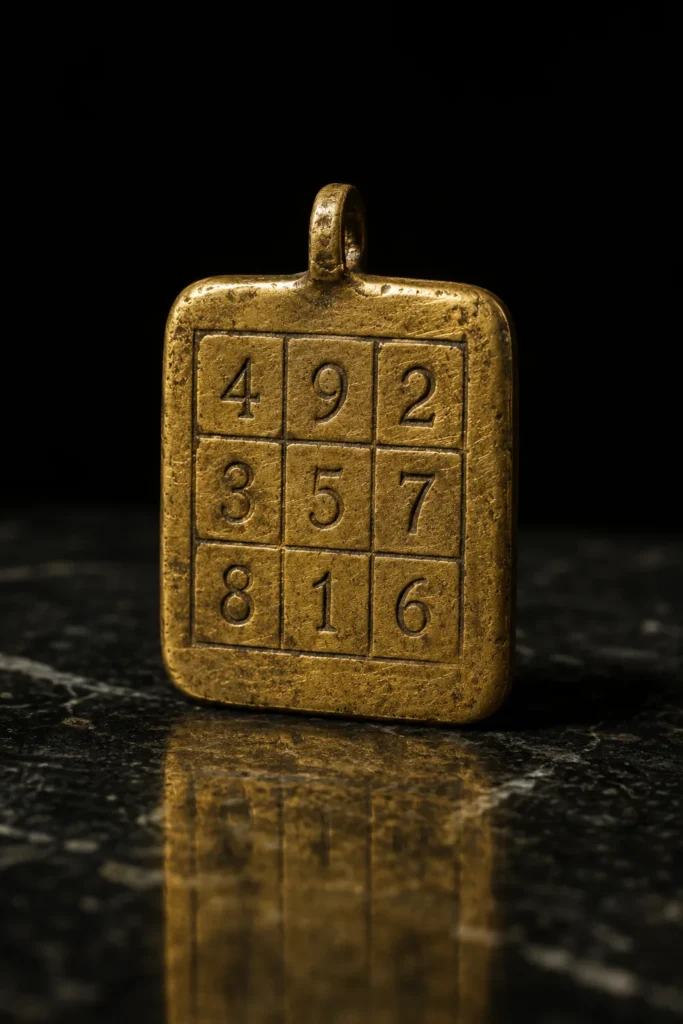
In its basic form, the Buduh square consists of nine cells, arranged in three rows of three cells each. The numbers from one to nine are entered into these cells.
What is special about this square is a precise order. The numbers are distributed in such a way that their sum is the same in every row, in every column and in both diagonals.
As Buduh, this square became a sign of protection and blessing. It was written on amulets, on letters, on doors and on other objects.
In religious studies, Buduh is a good example of a magic number square. Its protective effect rests on the perfect order of the numbers, not on an image.
Buduh thus belongs to the group of formulas of protection and magic squares. It is the Islamic form of an idea that understands ordered perfection as powerful.
The number square
In its basic form, the Buduh square is a square of nine cells. This form, three by three cells, is the simplest true magic number square.
The numbers from one to nine are entered into the nine cells. Each number appears exactly once. The skill lies in the correct distribution of the numbers across the cells.
The distribution follows a precise rule. The numbers are arranged so that the sum in every horizontal row, in every vertical column and in both diagonals yields the same value.
When arranging the numbers from one to nine, this common sum is the number fifteen. In whatever direction one adds three cells together, the result is always fifteen.
This perfect balance is not easy to achieve. It is the result of a carefully considered order. A magic square is, as it were, a perfect symmetry expressed in numbers.
It is precisely this perfect order that is essential to the protective meaning of Buduh. A construct that is balanced within itself and the same from all sides was regarded as powerful and as an image of a seamless order.
The name Buduh
The name Buduh is connected to the number square in a particular way. It is derived from the numbers in the four corners of the square.
In the Arabic tradition, the letters of the alphabet also have numerical values. This correspondence of letters and numbers is denoted by the term abjad.
The numbers in the four corners of the magic square can be translated into letters through this system. Reading these corner letters together yields the word Buduh.
In this way the number square received a name that emerges from itself. The word Buduh is, as it were, the square read in letters.
Over time the word Buduh could also be used on its own. Instead of writing out the whole square, it was sometimes enough to write the word Buduh as a sign of protection and blessing.
The name Buduh thus shows a characteristic feature of the Islamic art of talismans. Numbers, letters and their values interlock. A number square becomes a word, and this word can itself become a sign.
Buduh as a sign of protection and blessing
Buduh was used in the Islamic world as a sign of protection and blessing. This use is widely attested.
The Buduh square was credited with a preserving and a favourable effect. It was meant to protect against misfortune and at the same time to bring about blessing and good success.
The use of Buduh against the evil eye and against harmful powers was widespread. It was written on amulets that were worn on the body.
Buduh was also used to protect mother and child. It was regarded as helpful for a good birth and for the well-being of the newborn.
One distinct and well-known use concerned letters. The word Buduh or the square was written on letters so that they would reach their destination safely and intact.
Buduh was thus a versatile sign. It protected the person, the child and even the letter on its way. In all these uses, the same square was at work, the same perfect order of the numbers.
The operative principle of perfect order
Buduh does not ward off through a frightening image and is not a sacred image. Its protective effect rests on a principle of its own, the principle of perfect order.
The magic square is perfectly balanced. In every direction the same sum results. There is no preferred side, no weak point, no disorder.
This perfect balance was regarded as powerful. A construct of such order was an image of seamless perfection at rest within itself.
Such a square offered misfortune no place where it could take hold. The perfect order was, as it were, impenetrable.
In this the Buduh square resembles other protective signs that rest on perfect order. It stands particularly close to the SATOR square, the Latin letter square. On the page about the SATOR square, this operative principle is described in more detail.
Buduh and the SATOR square are both magic squares. One works with numbers, the other with letters. Both rest on the same idea, that ordered perfection possesses a protective power.
Magic squares across cultures
The magic square is not confined to the Islamic world. It is a type of sign that is found in several cultures.
The simplest magic square, the square of nine cells, is especially widespread. It is also known from the Chinese tradition, where it is connected with a legend of its own.
In the Jewish tradition, magic squares were written on amulets. They are also known in the European tradition, connected with the teaching of the planets and their numbers.
All magic squares are based on the same fundamental idea. The perfect order, balanced in every direction, is regarded as powerful and as an image of completeness.
The Islamic tradition elaborated this idea with particular richness. Alongside the simple square of nine cells, it also knew larger magic squares and connected them with letters, names and meanings.
Buduh is the best-known form of the magic square in the Islamic world. It shows that the idea of the protective perfect order was understood across cultures.
Numbers, letters and meaning
The Buduh square is a good example of a characteristic feature of the Islamic art of talismans, the close interplay of numbers and letters.
Because the Arabic letters also carry numerical values, numbers can be translated into letters and letters into numbers. This connection opened up wide possibilities for the art of talismans.
With Buduh this is shown directly. From the corner numbers of the number square, the word Buduh is formed by way of the letter-and-number system. Number and word merge into one another.
This connection was used in many ways in the Islamic art of talismans. Names of God could be translated into numerical values, verses cast into squares, letters joined into signs.
Buduh is a particularly clear example of this art. In it, the perfect order of the numbers and a word derived from these numbers combine into a single protective sign.
This connection of number, letter and meaning belongs to the distinctive character of the Islamic tradition of protection. Buduh shows it in a concentrated, readily graspable form.
Buduh and the Islamic art of talismans
Buduh belongs to a rich Islamic art of talismans. This art was concerned with signs, numbers, letters and squares and with their protective use.
This art of talismans drew on learned knowledge. It was connected with the teaching of the letters, of the numbers and of the attributes of God.
Within this art, the Buduh square was one of the best-known and most frequently used signs. It was simple enough to become widespread and was at the same time regarded as effective.
As with other means of protection in Islam, it should be borne in mind here too that the handling of such signs was judged differently among scholars. On the page about Taʿwīz, this discussion is described in more detail.
The art of talismans moved in a field between recognised piety and critically regarded practice. Buduh as a magic square belonged to this contested but widespread art of talismans.
Buduh is thus a good example of the Islamic tradition of protection beyond the purely scriptural texts. Alongside the written word of God stood numbers, squares and signs, and Buduh was the best-known among them.
Reception today
Today Buduh is above all a historical and a religious-historical subject. In the study of the Islamic art of talismans it is a well-researched topic.
In collections of Islamic amulets and talismans, the Buduh square is frequently represented. It appears on amulets, on bowls and on other objects of protective practice.
In parts of the Islamic world, the use of magic squares as signs of protection and blessing has remained alive into the present, even though, like other talismans, it is judged differently.
Buduh is also instructive for the history of mathematics and of numbers. Magic squares connect protective practice with the knowledge of numbers and their order.
A factual account names Buduh as what it is, a magic number square of the Islamic tradition that rests on the notion of the protective power of perfect order.
Buduh is thus a striking example of a magic square. In it combine the perfect order of the numbers, the interplay of number and letter, and the belief that ordered perfection grants protection and blessing.
Literature (selection)
Related key terms: Buduh magic square number square abjad talisman formula of protection SATOR Islam.
iWell Guard and traditions of protection
iWell Guard stands in the cultural-historical line of portable protective objects, to which the Buduh square also belongs. A modern companion for people who live with protective symbols: made in Germany, 41 layers of solid gold, platinum and silver, with a 30-day right of return.
Personal experiences may vary. Not a medical device. No healing promise.