Lagahoo, from human to headless figure of terror
By Ralf Ittermann · last reviewed on
Lagahoo is a demon of Trinidadian folklore.
Human by day, a headless figure with a coffin and chains by night. The profile shows the transformation from human to headless figure of terror. Lagahoo is the Caribbean shapeshifter, and the following sections explain which transformations are attributed to him.
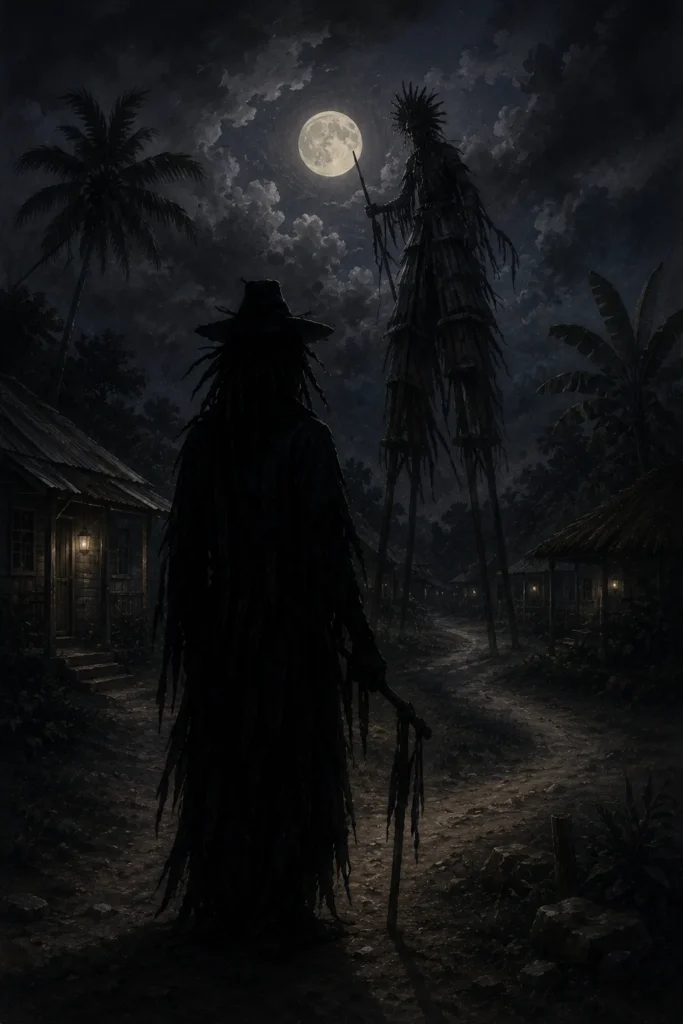
Lagahoo is a werewolf-like shapeshifter of Trinidad folklore. By day an ordinary human, often interpreted as a sorcerer, by night he roams as a headless figure carrying a coffin with three burning candles and dragging a heavy iron chain behind him.
Linguistically, Lagahoo or Ligahoo is a Creolised form of the French loup-garou, werewolf. The being came to Trinidad with French planters and enslaved Africans after the Cedula of Population of 1783, merging the European werewolf with West African notions of shapeshifting witches and man-eating spirits.
In battle he passes through every form, dog, horse, cat, pig and bull, becomes raging waves of water, and finally dissolves into black mist.
Type: Werewolf-like shapeshifter and bloodsucker
Origin: Creolisation of the French loup-garou, brought to Trinidad from 1783
Texts: Popular-folkloric and literary tradition
Period: Folklore of Trinidad and Tobago since the influx of French Catholics from 1783
Appearance: a human by day, a headless figure with coffin, candles and chains by night, and a shapeshifter

Area of origin and sources
Period of the Texts
The folklore of Trinidad and Tobago has known the Lagahoo since the influx of French Catholics following the Cedula of Population of 1783.
Area of Diffusion
Trinidad and Tobago. He roams the streets at night, where he also threatens livestock.
Sources
Popular and literary: Popular and literary literature predominates for the Lagahoo; independent scholarly monographs are lacking.
Name and variants
Creole: The name is a Creolisation of the French loup-garou, werewolf, into Lagahoo or Ligahoo. Both spellings refer to the same being of Trinidad folklore.
Form and effect
Appearance
Headlessness, the coffin with three candles and the chains form a motif of death and damnation. The shapeshifting is the core of the being, which has no fixed form; chains and blood-sucking link it to motifs of punishment and vampirism.
Effect
The Lagahoo spreads nocturnal terror on the streets and is a bloodsucker, also attacking livestock. In battle he passes through every form, dog, horse, cat, pig and bull, becomes raging waves of water, and finally dissolves into black mist.
Profile: Lagahoo
The key aspects of the shapeshifter at a glance.
Creole diaspora syncretism, combining the European werewolf with West African notions of shapeshifting witches.
Night-time travellers on the streets of Trinidad, as well as livestock, which he attacks as a bloodsucker.
A headless figure with a wooden coffin, three burning candles and a heavy, dragging iron chain.
Nocturnal terror and blood-sucking; in battle he changes through several animal forms, culminating in waves of water and black mist.
A stick consecrated for nine days in holy water and holy oil dissolves the being in battle; the defence remains Christian in character.
Related is the Soucouyant, who shares the same loup-garou root, as well as the Jamaican Rolling Calf; beyond the Caribbean, the Slavic Vukodlak is closely related.
From the French loup-garou to the Lagahoo
The name is a creolisation of the French loup-garou, werewolf, into Lagahoo or Ligahoo. The being came to Trinidad with French planters and enslaved Africans following the Cedula of Population of 1783.
In this process, the Lagahoo merges the European werewolf with West African notions of shape-shifting witches and man-eating spirits into a distinct creole figure, tempered by Catholic warding practices with holy water and holy oil.
Afterlife in the literature of Trinidad
The Lagahoo is a fixed figure in the storytelling culture of Trinidad and Tobago and appears in literature, among others in the work of James Christopher Aboud and Tracey Baptiste.
From a religious-studies perspective, the Lagahoo is a pure diaspora syncretism in which the European werewolf meets African shape-shifting witchcraft, tempered by Catholic warding practices with holy water and holy oil. It is a colonial figure of nocturnal fear and an expression of suspected witchcraft directed at the ordinary person by day.
The consecrated stick against shape-shifting
Attested in sources is a stick that was placed in holy water and holy oil for nine days: striking the being with it makes it pass through all its shapes and dissolve into black mist. An amulet and cold iron are also held to work against the shape-shifter, as are the cross and consecrated signs of Christian-based warding.
Werewolves and shape-shifters compared
The Lagahoo traces back to the European werewolf, the loup-garou, and is related to the Slavic Vukodlak, the werewolf-vampire. As a creole shape-shifter it is also closely related to the Haitian Loogaroo and to the Soucouyant, which shares the same loup-garou root.
Frequently asked questions about the Lagahoo
What does the name mean?
Lagahoo is the creole form of the French loup-garou, werewolf.
What does it look like?
At night, headless, carrying a coffin and three candles with dragging chains, otherwise a shape-shifter.
How is it defeated?
With a stick that has been consecrated for nine days in holy water and holy oil.
Further links
Further reading:
- Soucouyant – shares the same loup-garou root
- Rolling Calf – a related nocturnal terror of Jamaica
- Vukodlak – the Slavic werewolf-vampire
- Holy water, amulet, iron – traditional protective means
- Protection Compass – an overview of protective means
Literature (selection)
Further standard works in the bibliography.
The Lagahoo is a Caribbean werewolf and shape-shifter of Trinidad: by day an ordinary person, by night a headless figure with a coffin and chains that shifts through ever new forms in combat until it disintegrates into black mist.