La Diablesse, beauty as a deadly trap
By Ralf Ittermann · last reviewed on
La Diablesse is a spirit of the tradition of Trinidad.
A hidden cow’s hoof reveals the deadly seductress.
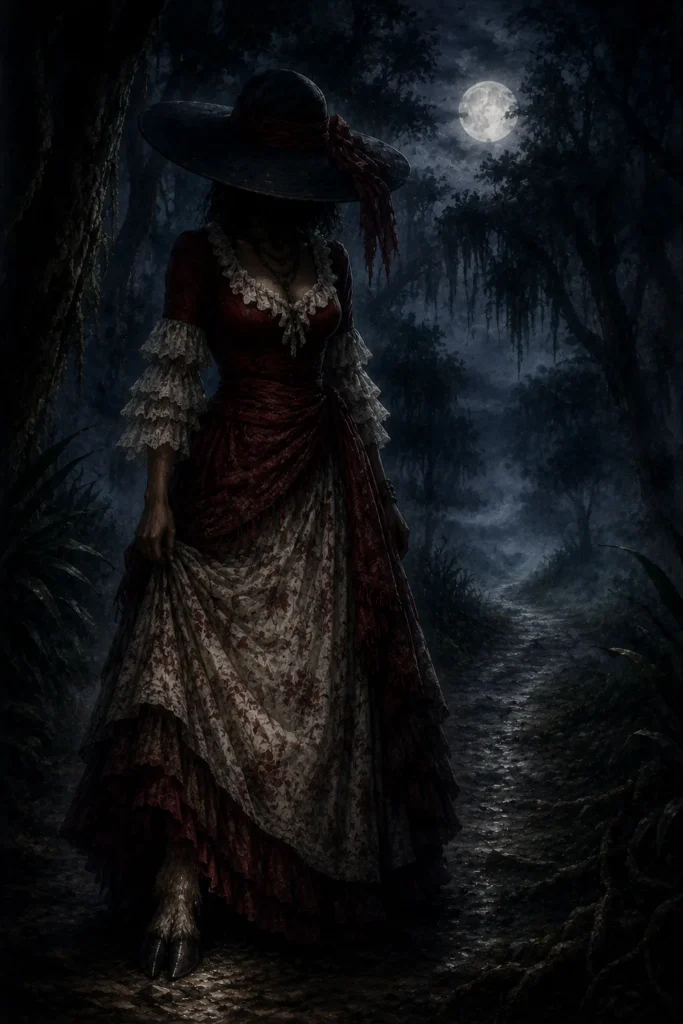
La Diablesse, the she-devil, is a female spirit of the Caribbean folklore of Trinidad and Tobago. Appearing as a beautiful, elegantly dressed woman with a wide hat, she comes at night to lonely paths; however, one leg ends in a cow’s or goat’s hoof, which her long dress conceals.
According to tradition, she was once an enslaved African woman who sold her soul to the devil for eternal beauty, thereby becoming half human. La Diablesse thus combines African, French and indigenous Amerindian elements into a distinct figure whose origin probably lies in Martinique.
She lures young men, often on their way home from dances, off the paths until they meet their death in a ravine or a river.
Type: Female spirit of seduction, lures men to their death
Origin: Caribbean folklore, origin probably in Martinique
Texts: Popular folkloric tradition
Period: 19th and 20th centuries, firmly established in the folklore of Trinidad and Tobago
Appearance: beautiful, elegantly dressed woman with a cow’s or goat’s hoof and a wide hat
Historical Classification
Period of the Texts
19th and 20th centuries: La Diablesse has been firmly anchored in the folklore of Trinidad and Tobago since this time.
Area of Diffusion
Trinidad and Tobago as well as the Francophone Caribbean; the origin of the figure probably lies in Martinique, to which her attire alludes.
Sources
Popular folkloric: For La Diablesse, popular folkloric literature predominates; independent scholarly monographs are largely lacking.
Name and variants
Creole: The name comes from French Creole and means the she-devil; in Creole spelling it also appears as Lajablès. According to tradition, she was an enslaved African woman who sold her soul to the devil for eternal beauty.
Appearance
Appearance
The cow’s or goat’s hoof is her hidden devilish trait, drawing on the Christian image of the hoofed devil. The long dress conceals the hoof, the wide hat her true, deathlike face. She smells of fine perfume and, at the same time, of decay: beauty is the trap, the contrasting scent the motif of unmasking.
Effect
She appears to young men at night, often on their way home from dances, enchants them and lures them off the paths into the forest, where she vanishes. The victim wanders about, falls into a ravine or a river, and meets his death. La Diablesse is thus a classic cautionary figure against infidelity and nocturnal wandering.
Profile: La Diablesse
The key aspects of the she-devil at a glance.
Part of the Caribbean Creole folklore of Trinidad, a syncretism of African, French and indigenous Amerindian elements.
Young men out alone at night, especially on their way home from dances.
Beautiful, elegantly dressed woman with a wide hat and long dress that conceals the cow’s or goat’s hoof.
A cautionary figure against infidelity and nocturnal wandering: she lures people off the path into ravines and rivers.
Wearing clothing inside out, lighting a blessed candle or a match, and walking home backwards.
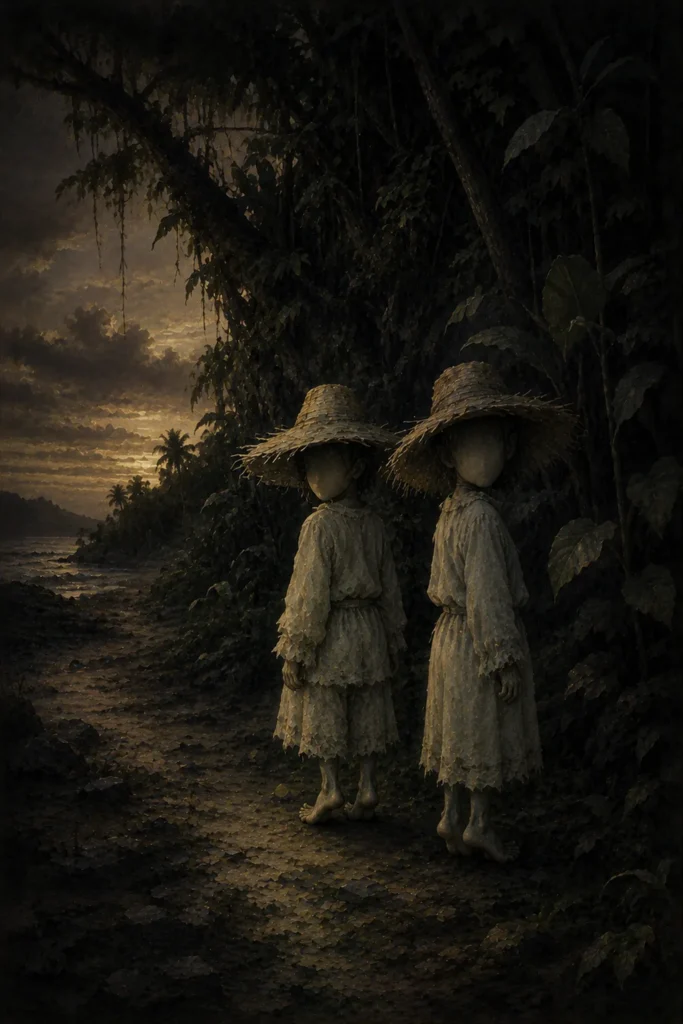
The Douen shares the folklore of Trinidad with her; beyond the Caribbean, she corresponds to the Mexican La Llorona and the Venezuelan La Sayona.
The enslaved woman who gave her soul for beauty
The name comes from French Creole: la diablesse means the she-devil. According to tradition, she was an enslaved African woman who sold her soul to the devil for eternal beauty and thus became half-human, flawless in appearance but with the telltale hoof of an animal.
La Diablesse is a syncretism of African, French and indigenous Amerindian elements; her origin most likely lies in Martinique, as suggested by the Creole dress in which she is still depicted today.
From narrative to carnival figure
La Diablesse is a fixed carnival and storytelling figure in the folklore of Trinidad and Tobago, present in illustration, on stage and in folklore collections.
From a religious-studies perspective, La Diablesse is a colonial figure of fear and moral control, a warning to men. She merges the Christian image of the devil with the African motif of the sale of the soul and with the femme fatale as seductress.
Clothes inside out and the light of a candle
Well documented are wearing clothing inside out to break the spell, and lighting a consecrated protective candle or a match. Walking home backwards, away from the place where she was last seen, is also considered effective. Consecrated signs such as the cross and holy water are considered Christian defences against the she-devil, as is an amulet.
Seductresses and warning figures compared
La Diablesse corresponds to the Mexican La Llorona and her variants, the Venezuelan La Sayona, and the Central American Siguanaba, who likewise lures men away and reveals a frightful face. The hoof points to the devil of European-Christian iconography; the South Asian Churel is also closely related in motif.
Frequently asked questions about La Diablesse
How can you recognise La Diablesse?
By the hidden cow or goat hoof and the wide hat that conceals her true face.
How does one escape her?
By turning one’s clothing inside out, lighting a candle or a match, and walking home backwards.
Where does she come from?
Most likely from Martinique, as suggested by her dress; the name itself comes from French Creole.
Further links
Further reading:
- Douen, Jumbie – further spirit beings of Trinidad folklore
- La Llorona, La Sayona – related seductresses of Latin America
- Protective candle, amulet, holy water – traditional protective means
- Protection Compass – protective means at a glance
Literature (selection)
Further standard works in the bibliography.
As a she-devil with a hoof, also called Lajablès in Creole, La Diablesse remains the most striking warning figure of Trinidad folklore: a beauty whose scent of decay betrays her only too late.