Douen, the faceless child with the reversed feet
By Ralf Ittermann · last reviewed on
Douen is a spirit of Trinidadian tradition.
Reversed feet in the forest lure children with a familiar voice.
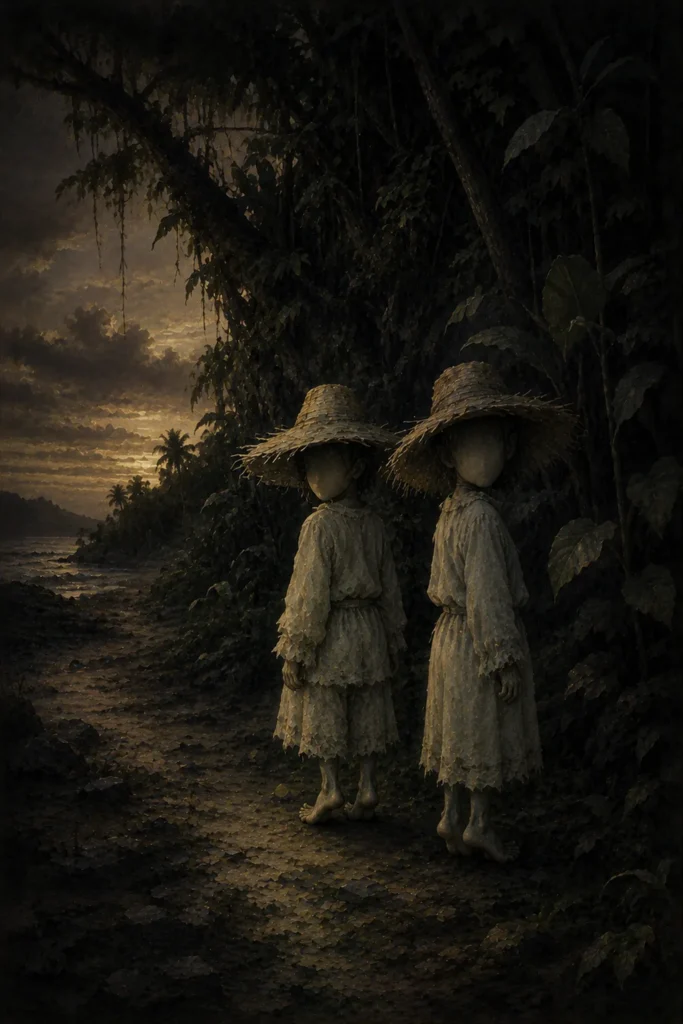
Douen is the spirit of a child who died unbaptised in the folklore of Trinidad. The figure is recognisable by its feet turned backwards and a faceless head beneath a wide straw hat, with which it hides its missing countenance.
If a Douen hears a child’s name, it imitates the voice of parents or siblings to lure the child into the forest. Its effect is more mischievous and troublesome than deadly: it raids gardens or plays tricks on people before leaving its victim to fend for itself in the thicket.
The roots of the figure are predominantly African, overlaid with French, Spanish and English influences from Trinidad’s colonial history.
Type: spirit of a child who died unbaptised, a figure used to frighten children
Origin: predominantly African-influenced folk belief of Trinidad with French, Spanish and English colonial influences
Texts: popular folkloric tradition
Period: firmly established in the folklore of Trinidad and Tobago, still told today
Appearance: feet turned backwards, faceless head beneath a wide straw hat
Context of tradition
Period of the Texts
The Douen is firmly rooted in the oral folklore of Trinidad and Tobago and is still told today, though the belief cannot be precisely dated.
Area of Diffusion
Found chiefly in Trinidad, where the figure is called Douen; on St. Lucia the related form is known as Dwen.
Sources
Popular-folkloric and rather narrow: dedicated academic studies on the Douen alone are lacking; the figure appears chiefly in the collections of Besson and Hill on Trinidad and Tobago.
Name and variants
Name: The roots of the Douen are predominantly African, overlaid with French, Spanish and English influences from colonial history. Possible, unconfirmed link: the Latin American Duende and the Maya Tata Duende.
Appearance
Appearance
The backward-turned feet are the sign of the unnatural and otherworldly: their tracks lead anyone who follows them astray. The facelessness stands for the lost child, never accepted into community and church, and the wide straw hat conceals this missing countenance.
Effect
The Douen imitates the voice of parents and siblings as soon as it hears a child’s name, luring it into the forest until it loses its way. More mischievous and troublesome than deadly, it raids gardens or plays tricks on people.
Profile: Douen
The key aspects of the Douen at a glance.
A figure used to frighten children in Trinidad folklore, arising from African roots with European colonial influences.
Living children, whom the Douen lures into the forest by imitating the voice of parents or siblings.
A faceless head under a broad straw hat, with feet turned backwards, whose tracks lead astray.
More mischievous and disruptive than deadly: it raids gardens or plays tricks before abandoning its victim in the woods.
Not calling names aloud in the woods or outdoors, not letting children go alone to the edge of the forest at dusk, plus baptism and holy water.
Backward feet, straw hat and the voice in the woods
The backward-turned feet are the Douen’s defining trait: they mark it as an unnatural, otherworldly being, and their tracks lead anyone who tries to follow them astray. The facelessness stands for the lost child who was never received into community and church, and the broad straw hat conceals this missing face.
The roots of the Douen are predominantly African, overlaid with French, Spanish and English influences from the colonial history of Trinidad. A possible, though unconfirmed, link exists to the Latin American Duende and the Maya Tata Duende. The state of being unbaptised itself reflects the Christian-colonial imprint on the figure: the Douen combines African strands with European influences into a distinct child-scare figure of its own.
A cautionary figure between the nursery and literature
The Douen is a firm part of the storytelling culture of Trinidad and Tobago and of local child warnings. In literature it appears in the work of Nalo Hopkinson and in the series Haven.
From a religious-studies perspective, the Douen is a classic figure among the unbaptised dead, related to the concept of limbo, blended in a diaspora-syncretic way with African notions of children’s souls. As a cautionary figure in child-rearing, it instils respect for the forest, thresholds and baptism.
Keep names silent, keep children close
What is well documented in the sources is watching over children and, especially at dusk, not letting them go alone to the edge of the forest. It is likewise recorded that children’s names should not be called out loudly in the woods or outdoors, so that the Douen cannot catch and mimic them. Holy water and baptism are considered means of binding the unbaptised spirit-child, which is why folk tradition also links the general advice to have children baptised. A consecrated amulet or a worn sign of the cross likewise serves as protection, as does salt, which in folk belief is considered protection against the alluring spirits.
Unbaptised children's souls in cultural comparison
The Douen corresponds to the Philippine Tiyanak, the spirit of a child who died unbaptised and lures with crying, and to the Scandinavian Myling. It shares its backward-turned feet with the South Asian Churel and the Indian Bhoot. Within the Caribbean spirit world it stands alongside the La Diablesse and the Lagahoo, two other fear-inspiring figures of Trinidad, while the Jumbie serves as the broader Caribbean collective term for the category to which the Douen belongs as its own, clearly defined type.
Frequently asked questions about the Douen
Who becomes a Douen?
Children who died unbaptised. In the Christian-influenced colonial tradition of Trinidad, being unbaptised is considered the reason why the child’s soul cannot rest.
Why does the Douen have backward-turned feet?
They mark it as an unnatural being, and their tracks lead anyone who follows them astray.
How can children be protected from the Douen?
By not calling their names aloud in the woods or outdoors, and by not letting them go alone to the edge of the forest, especially at dusk.
Further links
Further reading:
- La Diablesse – another fear-inspiring figure of Trinidad
- Tiyanak, Myling – spirits of similarly deceased children elsewhere
- Jumbie – the Caribbean collective term for evil spirits
- Holy water, amulet, salt – traditional protective means
- Protection Compass – protective means at a glance
Literature (selection)
Further standard works in the bibliography.
As the spirit of unbaptised children, the Douen remains a faceless child under a straw hat: not a hunting demon, but a lost being that calls, in the voice of parents, for the one it is not allowed to find.