Juno, Goddess of the Roman Tradition
By Ralf Ittermann · last reviewed on
Juno is the goddess of marriage, of women’s lives and of state sovereignty in the Roman tradition.
She embodies not only love and sexuality, but above all protection and dignity, as the protectress of Roman women and as the guardian of the state itself. In religious studies, Juno is an example of the pluralization of female functions in polytheisms.
Juno
Juno encompasses several aspects: Juno Regina (royal patroness), Juno Lucina (helper in childbirth), Juno Pronuba (maker of marriages) and Juno Moneta (the warner). In myth she appears as the consort of Jupiter, yet at the same time as an independent goddess with her own cults.
Central to her is the month of June, which is sacred to her, and the festival of the Matrona and Matronalia (1 March), at which married women were honoured.
At a Glance: Juno
Sources: Ovid’s Metamorphoses and Fasti, Virgil’s Aeneid, Cicero’s De Natura Deorum, Macrobius’ Saturnalia, Latin inscriptions. The veneration of Juno extended throughout the entire Roman Empire. Georg Wissowa, Walter Burkert and Hubert Cancik have examined her functions in cult and state; unique is her double role as lover and goddess of state.
Classification
Period of the Texts
The continuity of the tradition is remarkable and shows deep cultural rootedness and stability of meaning. In modern times too the memory and veneration remain alive, sometimes transformed, but recognizable in their essential features.
Mythological Classification
Juno is one of the great Roman goddesses, consort of Jupiter and queen of the gods. She is the goddess of marriage, fertility, birth and women’s lives. In her Greek form she is Hera. Juno is complex: protective, jealous, powerful. Her role is central to society.
Area of Distribution
Juno was not regionally confined or bound to particular locations, but was universally known and venerated or feared throughout the entire Roman world. Whether in urban centres or peripheral rural regions, whether among the elite or among ordinary people, the spiritual or cultural significance of this entity was consistently and universally recognized.
That Juno was at once the city goddess of Rome and the protective goddess of marriage and childbirth joined state and private piety: married women celebrated in her honor at the Matronalia, while the epithets Juno Lucina for help in childbirth and Juno Moneta for the temple on the Capitol bundled different spheres of action. Her worship was found not only in Rome but also among Italic peoples such as the Etruscans, in the figure of Uni.
Source Situation
Primary sources: Ovid’s Metamorphoses (especially the love affair with Jupiter), Virgil’s Aeneid (Books 1 and 4, Juno as the opponent of Aeneas), Horace, Martial, Cicero’s De Natura Deorum, Macrobius’ Saturnalia (table talk on Juno and Jupiter). Period: 6th century BC to 5th century AD. Researchers: Georg Wissowa (Roman Gods), Kurt Latte, Walter Burkert, Hendrik Versnel. Archaeological findings: temples on the Capitoline and the Aventine, votive offerings from Campania and Germania.
Name and Variants
Juno is depicted in the various traditions and sources with certain iconographic elements that remain relatively consistent across decades and places. These elements are not purely decorative or random, but are symbolically encoded and carry deep meaning.
They convey functions, sources of power, areas of responsibility and cosmic role. The visual system is like a script: it allows the initiated or the culturally educated to grasp and understand the essential meaning. Colours, sacred objects, bodily attributes, accessories, everything is significant and handed down by tradition.
Characteristics
Juno was central to the religious practice and the everyday understanding of the Romans. People turned to this entity in particular critical life situations or at particular times of year, with structured rituals, prayers or offerings. The practice was not arbitrary or ad hoc, but precisely handed down and led by priests or specialists.
The continuity of these practices over many generations shows that the practice was regarded as effective, or at least as necessary and symbolically meaningful. Some functions were preventive (averting misfortune), some healing (relief of illness), some transformative (transition between stages of life).
Appearance and Symbolism
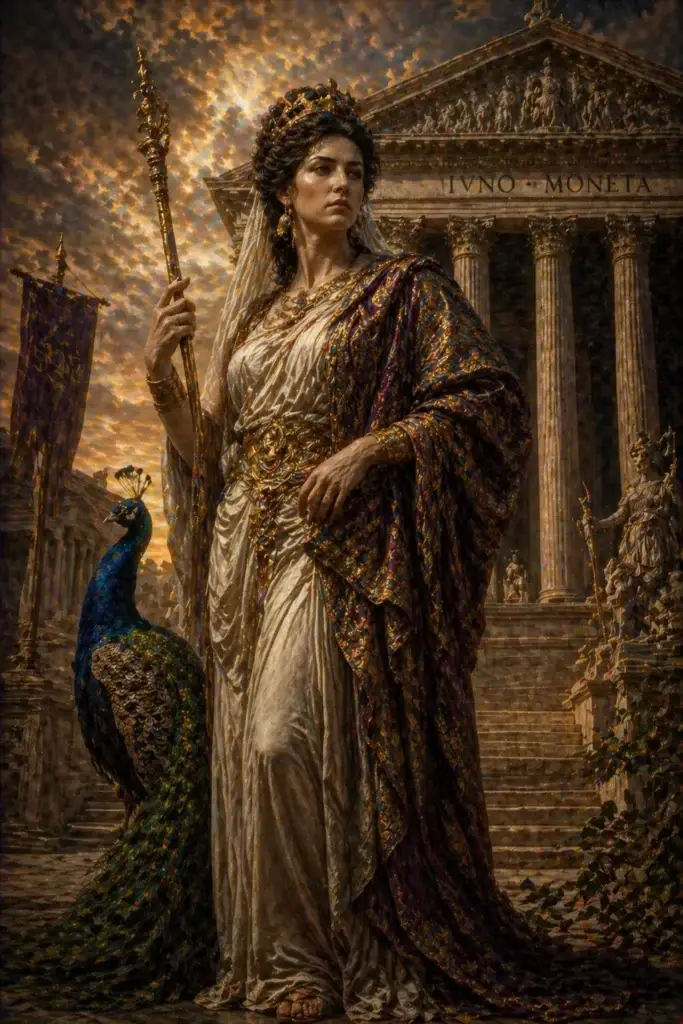
Juno is depicted as a majestic woman in celestial garments, often with a diadem or crown. The peacock is her sacred animal. Lilies and the pomegranate are her symbols. She often carries a sceptre. White and gold are her colours. Honour and dominion radiate from her.
Profile: Juno
The Profile unfolds Juno’s nature across six perspectives: her historical origin and distribution, the veneration practice of different social groups, her iconographic form, her religious significance and protective function, comparisons with neighbouring cultures, as well as the comprehensive overview of her roles in the Roman cosmos.
Juno has Indo-European roots in a sky goddess; the early Italic cult forms show transitions from a fertility goddess to a protectress of royal power.
The first evidence in cult goes back to the 6th century BC. The temple on the Capitoline (alongside Jupiter and Minerva in the Capitoline Triad) was founded around 509 BC. Her identification with the Etruscan Uni shows cultural overlayering in early Roman history.
Juno was invoked by women of all classes, especially wives and mothers. The cult of the matrons (Matronalia) was a women’s festival at which mistresses gave small gifts to their female slaves.
Among the elite, people prayed to Juno Pronuba at weddings. Pregnant women appealed to Juno Lucina. In the state cult Juno was invoked as queen and patroness of the empire, a function that has no parallel in the iconography of the gods.
Juno was depicted as a dignified, crowned woman, often in a peplos or in a stola (long mantle). Her attributes are the peacock (symbol of vanity and royalty), the diadem or crown, the sceptre, the lily.
Sometimes she also wears the kalathos (tall crown), especially as Regina. On Roman coins she sits enthroned. On altars beside Jupiter she symbolizes the cosmic pairing of king and queen of heaven.
Area of effect: Juno protects women in all phases of life: girls, women, mothers. She accompanies birth, marriage, fertility and menopause. She is the guardian of the female cycle and of the power of birth.
June bears her name, in order to give blessing to the wedding season. In Rome she is the goddess of the state, and at the same time of private fertility, a being who blesses power and intimacy in equal measure.
Juno stood under invocation and veneration, not as a goddess of harm, but as protectress and guardian. During labour, people offered chickens and liquid offerings.
Her temples were places of refuge for persecuted women. The month of June was sacred to her; according to Ovid, weddings were considered favourable in the second half of June and unfavourable in May and in the early days of June. Offences through infidelity or disobedience required propitiatory rites.
In Greek myth the closest correspondence is Hera, a goddess of marriage, but with less state power. In the Celtic sphere the Matres and Matronae show parallels to the protectress of women.
In the Germanic pantheon Frija/Frigg, as the consort of Wotan, corresponds in part to Juno’s role. The Indian Lakshmi shares with Juno prosperity and the blessing of houses.
Juno, Parallels in Other Cultures
Juno corresponds to the Greek Hera, but in the Roman pantheon she takes on additional protective functions for marriage, birth and the civic community. Her identification with the Etruscan Uni and the Punic Tanit-Astarte shows how the cult of Juno absorbed other Mediterranean chief goddesses.
Jewish tradition: In the Hebrew Bible there is no direct goddess of marriage beside YHWH. Wisdom (Chokhmah) is feminized, but not as a consort of God. Late antique syncretisms among Hellenistic Jews show isolated adaptations, but no institution of Juno veneration.
Greco-Roman world: Hera is Juno’s counterpart, but in Greek mythology she is less powerful in state affairs. The merging of the two goddesses under Roman rule created a hybrid iconography. Athena retained her role as patroness of the state alongside Juno/Hera.
Mesopotamia: Inanna/Ishtar is a goddess of love and of war, but not primarily of marriage. Other goddesses share individual functions, but none has a central consort-of-the-king role like Juno in the Roman state cult.
India/Asia: Lakshmi becomes Vishnu’s consort, but does not share Juno’s legal and state protective functions. Parvati in her role as the consort of Shiva shows cultural and structural parallels, but without direct kinship. In early Buddhism there is no analogy.
The Capitoline Triad and Juno Regina
Juno belongs to the Capitoline Triad, the central group of three gods of the Roman state cult, together with Jupiter and Minerva. On the Capitoline they had a shared temple from the early Republic onward, in which each deity possessed its own cella.
In this constellation Juno is addressed as Iuno Regina, the queen, the consort of the highest god of the state. The triad had Etruscan precursors, and scholarship sees in the trinity Tinia, Uni and Menrva a probable model.
Juno Regina, however, also had her own temple on the Aventine.
According to tradition, her cult was brought to Rome through the evocatio from the conquered Veii: before the capture of the Etruscan city, the general Camillus is said to have solemnly called upon the city goddess Juno there to give up her former dwelling and move to Rome.
This episode, recorded by Livy, is a central testimony to the Roman understanding that protective deities could be relocated.
As Regina, Juno was at the same time a recipient of state vows in times of crisis. The sources repeatedly report extraordinary rites, such as processions and votive gifts, that were ordered for Juno after omens or military threats.
Her position in the triad makes clear that, in the Roman system, Juno was not merely the consort of Jupiter, but an independent figure of the state cult with her own sanctuary, her own priestly personnel and her own festivals.
Juno Moneta and the Origin of Money
One of the best-known cult epithets of Juno is Moneta.
Her temple stood on the Arx, the northern summit of the Capitoline, and was, according to tradition, consecrated in 344 BC. With this sanctuary is bound up one of the most consequential conceptual histories of antiquity: within the temple precinct of Juno Moneta, or in its immediate vicinity, lay the Roman mint.
From the epithet Moneta derive the Latin word for coin and thereby the modern words money, monnaie and related formations.
The meaning of the epithet itself is disputed. An explanation widespread in antiquity connected it with the verb monere, to warn or admonish.
This fits with the story of Juno’s sacred geese, which were kept on the Arx and are said to have warned the defenders with their cackling of a nocturnal attack by the Gauls.
Whether this etymology is correct in linguistic-historical terms is open; some researchers consider other derivations. Scholarship still debates the question today, without a conclusive result.
Of interest for the history of religion is the close interlocking of sanctuary and state financial administration. That the mint of all places lay within the area of a temple of Juno fits into the Roman pattern of placing economic and administrative functions under divine protection.
Juno Moneta thus combined the idea of divine warning with the reliability of the state currency. The connection was so stable that it outlasted the original cultic meaning of the epithet and continues to take effect in the conceptual history of money to this day.
Juno and the Life of Women: Lucina, Sospita, Matronalia
Beside her function in the state, Juno was the goddess who accompanied the lives of Roman women. In the figure of Iuno Lucina she was the protective goddess of birth; her temple on the Esquiline was regarded as an older foundation.
The epithet was connected in antiquity with lux, the light, that is, with bringing the child to light. Pregnant women and women in childbed turned to Juno Lucina, and the vow connected with assistance in childbirth also belonged to her sphere.
In Lanuvium, a city south of Rome, Juno was venerated as Iuno Sospita, the saviour or helper. Her cult image showed her in warlike form, with a goatskin, spear and shield, a markedly different type from the calm queen.
After the incorporation of Lanuvium, Rome took over this cult, and Roman consuls sacrificed there regularly. Scholarship sees in Juno Sospita a good example of how local Italic Junos with their own profile were integrated into the Roman system.
The most important festival of women was the Matronalia on 1 March, the anniversary of the temple of Juno Lucina. On this day married women prayed for a happy marriage, received gifts from their husbands and brought offerings to Juno. Beside it stood the Nonae Caprotinae in July, in which female slaves also took part.
These festivals show that in everyday life Juno was experienced above all as the protective power of marriage, of birth and of the female course of life.
The classical philologist Georg Wissowa and later researchers concluded from the abundance of epithets that behind the one Juno there originally stood several regional goddesses, whom the Roman cult combined into a single figure with many functions.
Juno's Wrath in the Aeneid
The literarily most powerful depiction of Juno comes from Virgil’s Aeneid. There she is the driving counterforce against Aeneas and the founding of Rome. The very opening of the epic names her implacable resentment, and the famous phrase about the tears of things stands in the context of this theme.
Juno pursues the Trojans over land and sea, because several grievances continue to work within her: the judgement of Paris, the abduction of Ganymede and the knowledge of the future destruction of Carthage, her favourite city, by Rome.
Juno intervenes again and again. She prompts the wind god Aeolus to unleash a storm against the fleet of Aeneas. She furthers the union of Aeneas and Dido in order to distract the hero from his task. In the second part of the epic she kindles war in Latium through the fury Allecto.
Only towards the end, in conversation with Jupiter, does she abandon her resistance, though on one condition: the name of the Trojans is to be absorbed into the new people, and the language and custom of Latium are to remain.
This literary Juno is not simply to be equated with the cult goddess. Virgil reworks older epic patterns, above all the Hera of Homeric poetry, and shapes Juno as the embodiment of historical resistance that must be overcome, but also reconciled.
Significant for religious studies is the closing condition: it binds in the Augustan interpretation, according to which Rome emerges from the reconciliation of the foreign and the native, and Juno herself becomes the protective power of the united people.
The Aeneid thereby shaped the image of a wrathful but ultimately integrated Juno, which determined later reception more strongly than any individual cult finding.
The Juno-Spirit and the Etymology of the Name
A peculiar conception of Roman religion connects Juno with the personal protective spirit of the woman. While every man possessed his Genius, an accompanying divine power connected with his birthday and his procreative force, every woman had her Iuno.
This personal Juno was venerated on the woman’s birthday. The parallelism of Genius and Juno suggests that the name Juno was closely linked with life force and the beginning of life.
This is precisely where the etymology comes in. An interpretation widespread in scholarship connects the name Iuno with an Indo-European root for life force or youthful strength, which is also contained in the Latin iuvenis, the young man.
Juno would then originally have been the power of youthful life force, which would fit both her role as the personal protective spirit of the woman and her responsibility for birth and marriage. This derivation is not proven with certainty, but it is regarded as the most plausible.
The month name June is also traditionally referred to Juno, even though the ancient authors themselves wavered and in part proposed a derivation from iuniores, the younger citizens. This uncertainty is typical: already the Roman scholars of the late Republic and the imperial period, such as Varro, collected competing explanations without committing themselves.
For modern religious studies it is precisely this multilayered quality that is revealing. Juno appears as a deity whose name, functions and epithets condensed over centuries from several sources, from the personal life force of the individual woman to the queen of the state cult on the Capitoline.