Frigg, Goddess of the Germanic Tradition
By Ralf Ittermann · last reviewed on
High goddess of Germanic mythology, wife of Odin, mother of Baldur. In the Norse sources Frigg counts as the highest goddess of the Aesir family and ruler of Fensalir. She stands for marriage, motherhood and the ordered household, and at the same time possesses the gift of seeing fate without speaking of it.
Frigg
Overview: Frigg
Type: Principal Germanic goddess, Aesir goddess, wife of Odin, mother goddess
Pantheon: Germanic / Norse (Aesir lineage)
Function: motherhood, protection of the home, wisdom (silent knowledge), foresight (all-knowing, without speaking of it)
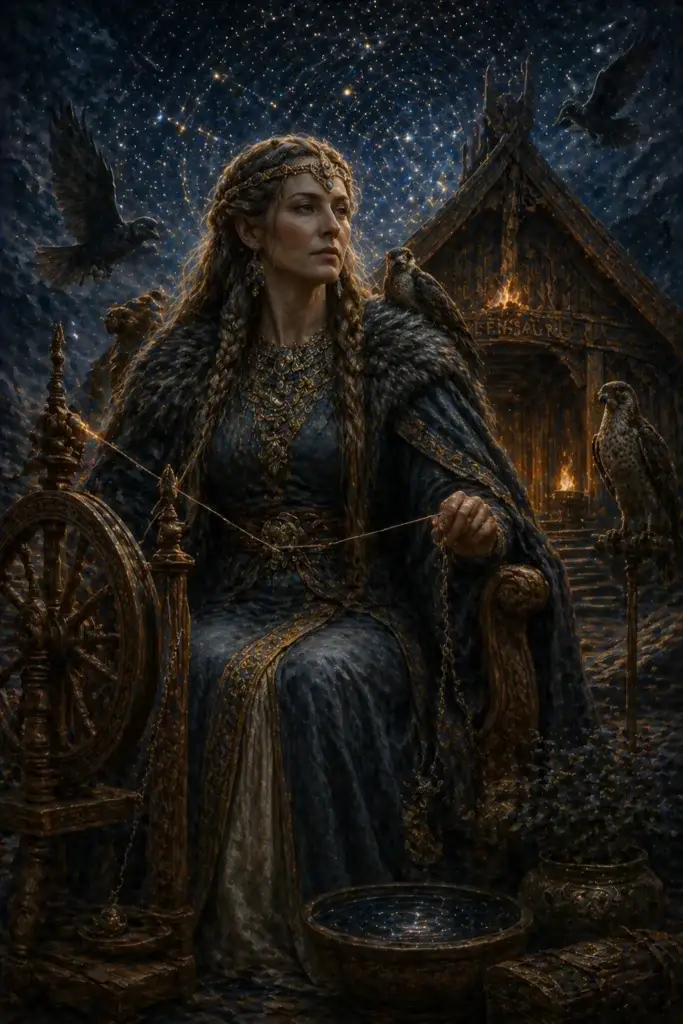
Main attributes: spinning wheel, bunch of keys (protection of the home), falcon-feather cloak, court robe
Main cult sites: no temples of her own documented, spread in Saxony and Lower Saxony in pre-Christian times
Roman identification: Venus (in the weekday tradition: Friday = Frigg’s day, parallel to Veneris dies)
Historical Classification
Period of the Texts
Frigg is central from the earliest Germanic sources (weekday names of the Interpretatio Romana from about the 4th century), later attested in Paul the Deacon (Frea) and in Snorri Sturluson‘s Edda, 13th century.
The main literary source is the Prose Edda (1220) and the Poetic Edda (collected in the 13th century, containing older mythological poems). In the Germanic weekday system, Friday is named after Frigg (Germanic Frijādagaz, parallel to the Latin dies Veneris).
The Christianization of Scandinavia (10th to 12th century) interrupted the cult, but it was preserved in the name of the weekday, in folk customs and in the literary tradition. In the 19th and 20th centuries there was a Germanic-romantic and neopagan Asatru revival.
Area of Distribution
Direct Frigg temples are not clearly documented. Old Germanic veneration was essentially household cult and folk belief.
In the Scandinavian Middle Ages her appearances are dominated by literary sources (Edda, skaldic poetry). In the modern Asatru tradition (Germanic heathen religion active since the 1970s) she is again actively venerated; Asatru blót gatherings exist today in Germany, the USA and Scandinavia.
Source Situation
Central sources: Snorri Sturluson, Prose Edda (Gylfaginning, Skaldskaparmal); Poetic Edda (Vafthrudnismal, Lokasenna with Frigg’s defense speech); Saxo Grammaticus, Gesta Danorum (12th century, euhemerized Germanic myths).
Secondary literature: Simek, Lexikon der germanischen Mythologie; de Vries, Altgermanische Religionsgeschichte; Lindow, Norse Mythology. A Guide to the Gods, Heroes, Rituals, and Beliefs; Davidson, Roles of the Northern Goddess.
Name
Frigg is depicted as a mature, dignified woman, often with a distaff or a bunch of keys, both symbols of domestic power in the Viking-age North.
Her falcon garment grants her, and occasionally gods who borrow it such as Loki, the ability to fly. The twelve Asynjur, subordinate goddesses, are regarded as her attendants. Her colors are white, silver and pale blue; her animal is the falcon.
Description
Frigg guarantees the order of the household and of kinship.
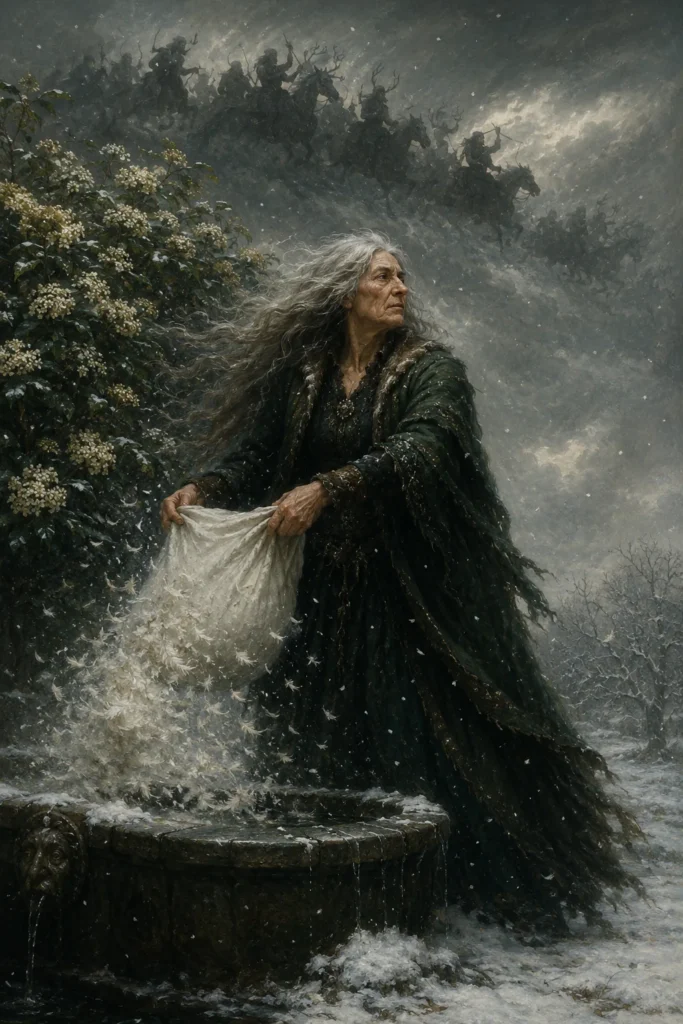
She knows the fate of all beings but remains silent about it. This gift makes her a tragic mother: she knows of the death of her son Baldur but cannot prevent it. In the myth of Baldur’s death she tries to bind all things of the cosmos by an oath never to harm her son, and in doing so overlooks the young mistletoe sprig with which Loki ultimately kills him.
Profile: Frigg
The most important aspects of Frigg at a glance. The following fields summarize origin, function, appearance, veneration, symbols and cultural parallels.
Tradition
Frigg is the wife of Odin (Germanic Wodan) and mother of the bright god Baldur. Daughter of Fjorgyn (in one tradition; the genealogy is unclear). Leader of the Aesir goddesses (Asynjur).
Her main myth is foresight and the futile attempt to save her son Baldur from death: she has all things in the world swear not to harm him, but overlooks the mistletoe, which Loki later uses to kill Baldur.
Sphere of Influence
Mother goddess, patroness of marriage and the household. Keeper of the keys of the house (a symbol of household authority; in Old Germanic tradition the mistress of the house carried a bunch of keys at her belt).
All-knowing seeress who nonetheless keeps silent (unlike Odin, who speaks). In personal folk cult, invocation during labor, at weddings, for the protection of the home. In the Asatru movement she is patroness of women’s initiation and of the family blót.
Frigg's Appearance
Frigg has no fixed iconographic form from the Viking Age (there are very few pictorial depictions of Germanic deities). In the literary tradition: a matronly female figure with long fair hair, in a festive court robe, with a bunch of keys at her belt, often seated at the spinning wheel (she spins fate).
In folk tradition she is linked with the constellation of Orion’s Belt (in northern Germany the Friggerock, Frigg’s distaff). In modern Asatru visual art she is typically shown as a noble matronly queen with crown and jewelry.
Frigg's Effect
Sphere of influence: In the Old Germanic household cult, invocation in matters of birth, before weddings, for the protection of the home. Frigg’s distaff (a constellation) was associated in northern German folk tradition with weather forecasting and the protection of spinners. In Christianity she was reinterpreted as Mary (Mary the spinner).
In the modern Asatru tradition (active again in Germany, Scandinavia, the USA and the UK since the 1970s) she is invoked at women’s initiation blót and at family festivals. No central feast day is documented, but Friday (Frigg’s day) is traditionally regarded as her weekday.
Means of Protection
Bunch of keys (household authority), spinning wheel/distaff, falcon-feather cloak (which she lends to Loki), festive court robe, crown. Sacred plants: mistletoe (central in the Baldur myth, paradoxically as her oversight), lady’s mantle (a folk Frigg plant).
Sacred animals: falcon (through her feather cloak), cuckoo (in folk tradition), stork (brings the children, birth symbolism). Sacred weekday: Friday.
Counterparts
Freyja (Germanic, Vanir goddess of love; in some scholarly theories identical with or closely related to Frigg, but clearly distinguished in the Edda tradition), Fricka (Wagner’s form of the name, a later variant), Hera (Greece, wife of Zeus, patroness of marriage), Iuno (Rome), Inanna/Ishtar (Mesopotamia, but more strongly erotic).
German linguistic relatives: Friede, Frigerich. Functionally paralleled with Hera/Iuno as a “mother goddess and patroness of the household.”
Frigg, Parallels in Other Cultures
Functionally comparable are Iuno (Rome) as goddess of marriage and the city, Hera (Greece) as high goddess and consort of the chief god, and Frigga as a South German variant. Etymologically she is related to Freyja, Frigg going back to the Indo-European *priH-jaH (the beloved), Freyja to the Germanic *frawjōn (mistress). In the Anglo-Saxon tradition she appears as Frige.
Indo-European comparative goddesses: In religious-studies research Frigg is understood as a representative of an Indo-European layer of goddesses that extends across various cultures. The structural similarity to Hera in Greek religion (as the wife of the king of the gods, protector of marriage and family) points to a shared Indo-European heritage.
Parallels likewise appear with the Roman Iuno (Latinized Juno), who stood alongside Jupiter and Minerva in the Capitoline triad. Both goddesses share with Frigg the attributes of the wife-goddess, of fertility and of domestic protection.
The Vedic Saraswati, by contrast, represents more the aspects of wisdom and knowledge, yet traces of the mother-goddess function can be found in her as well.
Slavic-Baltic parallels: In the Slavic traditions Mokosh appears as an earth and mother goddess associated with fertility, craft and female destiny. The Baltic Lauma has similar traits as a goddess of fate and protector of the family.
Both show structural kinship with Frigg: they act as mediators between the world of gods and the world of humans, weave the fate of mortals and shape the domestic and the cultic. Frigg’s aspect as weaver and spinner, knowing the fates of all yet not revealing them, resonates directly with these Eastern European goddesses.
Celtic-Scandinavian syncretisms: The Irish Brigit embodies similarities with Frigg in her role as protector of craft (especially smithing and weaving) and as goddess of sacred sites. The warlike Macha in turn shares with Frigg authority over the fate of warriors and rulers.
In the Norse syncretism process, especially where the Vanir (fertility and household gods such as Freya) were interwoven with the Aesir (ruling gods such as Odin and Frigg), hybrid forms emerged in which Frigga features (protection, weaving, marriage) were mixed with Freya features (love, sexuality, martial training).
These syncretistic processes point to a shared Indo-European core that differentiated itself in various ways across the cultures.
Frigg in the Poetic Edda and the Prose Edda
The most important testimonies about Frigg come from the two medieval collections known by the name Edda. The older one, the Poetic Edda, offers a vivid picture above all in the poem Lokasenna: there the gods quarrel, and Loki accuses Frigg of having taken up with others while Odin was far away.
Frigg answers with restraint, and Freyja defends her with the remark that Frigg knows the fate of all, even if she does not speak it. This passage is central because it ascribes to Frigg a knowledge of fate that she keeps to herself.
More detailed is the Prose Edda, the textbook of poetics written in the thirteenth century by Snorri Sturluson. Snorri calls Frigg the foremost of the Aesir goddesses, the wife of Odin and the mother of Baldr.
In his work is also found the most detailed myth about Frigg, the prelude to Baldr’s death. Frigg has an oath taken from all things in the world not to harm Baldr, but overlooks the young mistletoe sprig, which she considers too insignificant. Loki exploits precisely this gap.
Snorri is a valuable but not unproblematic source. He wrote a good two centuries after the Christianization of Iceland and arranged the transmitted material into a system partly shaped by learned and Christian ideas.
Religious-studies research therefore reads Snorri as an editor, not as a direct witness to a heathen religion. Nevertheless his account preserves narrative cores that are also found in part in the older poetry and are thus regarded as comparatively old.
The Baldr Myth and Frigg's Vain Precaution
The best-known myth in which Frigg plays a decisive role is the death of her son Baldr.
The narrative combines several themes important to the Norse image of the gods: the inevitability of fate, the limits of divine power and the destructive influence of Loki. Frigg stands at the center of the attempt to avert the foreseen calamity.
When Baldr is plagued by evil dreams, Frigg travels through the world and takes from all things, from fire, water, iron, stone, animals and diseases, the promise to do her son no harm.
Only the mistletoe does she pass over. Loki learns of this, fashions a missile from the mistletoe sprig and induces the blind Hödr to hurl it at Baldr. Baldr dies, and Frigg’s careful precaution proves insufficient.
In research this myth is interpreted in different ways. Some see in it an old narrative about the dying and non-returning god, others emphasize the literary motif of the one overlooked possibility that undoes the whole undertaking.
Important is Frigg’s double role: she is the one who knows fate and at the same time the one who cannot avert it. After Baldr’s death she sends a messenger into the underworld, and the recovery almost succeeds, but once again Loki prevents the success.
The myth shows Frigg as an active, far-sighted figure whose power, however, finds its limit at the order of fate. Further connections lead to other figures of the Germanic pantheon.
Frigg, Freyja and the Problem of the Double Goddess
One of the oldest and most discussed questions in the history of Norse religion is the relationship between Frigg and Freyja. Both goddesses display striking commonalities. Both are credited with a feather garment with which one can fly.
Both are connected with love, marriage and fertility. Both their names can be traced linguistically to similar roots, with Frigg being linked to a word for “love” and Freyja to “lady.”
Part of the older research, for instance in the circle of Jan de Vries, therefore supposed that Frigg and Freyja had originally been a single goddess who split into two figures only in the course of transmission.
Other researchers, including newer work on the Viking Age, argue against this, pointing out that both goddesses are clearly distinguished in the sources: Frigg belongs to the Aesir, Freyja to the Vanir, they have different husbands and different functional emphases.
Frigg is more strongly connected with marriage, household and motherhood, Freyja with desire, war and a magical art of her own, the seiðr.
The discussion is still unsettled today, because the sources permit no clear verdict. What can be held is that both goddesses were venerated as separate figures in the transmitted religion of the Viking Age, though their similarity may point to a shared prehistory or to a mutual influence.
For an understanding of Frigg the distinction is important: she is not the goddess of love in the sense of desire, but the mistress of the house, of marriage and of far-sighted care. A comparison with related female figures of the transmission sharpens this profile.
Traces on the Continent, in Place Names and in the Weekday
Frigg is not only a figure of Old Norse poetry but left traces throughout the Germanic language area. The clearest evidence is the weekday Friday.
The Roman naming of the weekdays assigned planetary gods to the days, and the day of Venus was given to a goddess of its own when it was taken over into Germanic.
In English Friday, in German Freitag, and similarly in the Nordic languages, this equation is present. Which goddess exactly was meant, Frigg or Freyja, is disputed because of the kinship already mentioned, but most language historians tend toward Frigg or her continental equivalent.
On the continent a goddess related to Frigg appears in Lombard transmission under the name Frea. In his Historia Langobardorum from the eighth century, Paulus Diaconus reports a narrative in which Frea helps her husband Godan, that is Odin, to victory through a ruse.
This episode counts as an important indication that the veneration of a Frigg figure was not limited to Scandinavia but was known among various Germanic peoples.
Place names that refer to Frigg are rarer and less certain than with some other deities, which research partly explains by the domestic, less publicly cultic character of her veneration. An old designation of the constellation now known as Orion’s Belt was in Scandinavia partly connected with Frigg, but this transmission is late and uncertain.
On the whole, the search for traces shows that Frigg, beyond the Icelandic texts, was a broadly anchored figure whose veneration nonetheless played out more in the domestic than in the monumental sphere and therefore left fewer visible archaeological traces.
Further Links
Literature (Selection)
In the Norse transmission Frigg counts as High Goddess of the Aesir, wife of Odin and mother of Baldur; the Edda portrays her as guardian of the threads of fate and steward of oaths.