iWell Guard

Kári, the wind in the lineage of Fornjótr

Kári is a god of the Germanic tradition.

Personification of the wind, son of the primordial giant Fornjótr.

Table of Contents

Kári, the wind personification of Norse saga
Kári

Kári, in simplified spelling Kari, is in Norse tradition the personification of the wind, son of the primordial giant Fornjótr and brother of Logi, fire, and Ægir, the sea. He is not an Edda god and was never the object of a cult, but rather a literary, systematising ancestral figure.

Kári is documented in genealogical-scholarly sources of the 13th and 14th centuries, such as Hversu Noregr byggðist, Fundinn Noregr and the prologue to the Orkneyinga saga. Together with his brothers he represents the elements air, fire and water.

At a glance: Kári

Type: Personification of the wind, genealogical ancestral figure
Origin: Norse-Icelandic region
Texts: Hversu Noregr byggðist, Fundinn Noregr, prologue to the Orkneyinga saga
Period: genealogical-scholarly sources of the 13th and 14th centuries
Appearance: no iconography, pure personification

Historical Classification

Period of the Texts

Kári does not appear in Eddic mythology, but in genealogical-scholarly sources of the 13th and 14th centuries.

Area of Diffusion

The Norse-Icelandic region: the Fornjótr genealogies belong to the scholarly saga literature of Iceland and Norway.

Sources

Moderate: Hversu Noregr byggðist, Fundinn Noregr and the prologue to the Orkneyinga saga; Kári is absent from Eddic mythology.

Name and variants

Old Norse: Kári is usually interpreted as wind or gust of storm, comparable to Norwegian and Icelandic kåre, gust of wind. The etymology is not fully settled; the wind meaning derives chiefly from the genealogical role.

Description

Appearance

Kári has no iconography; he is a purely genealogical personification of the wind, not a cultically venerated god.

Effect

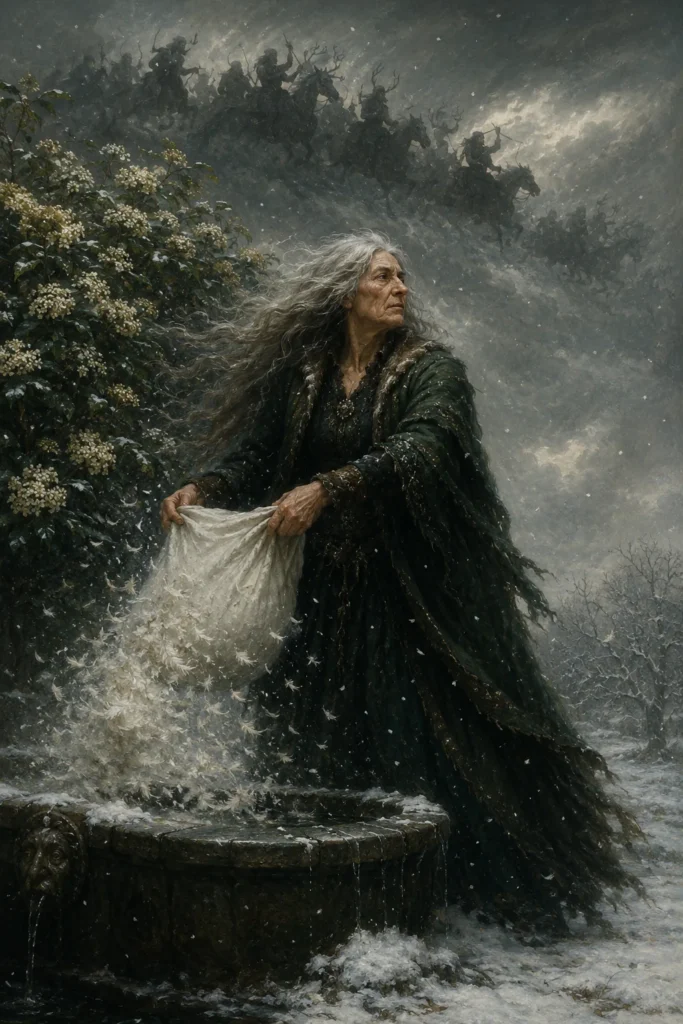
Kári is the personification of the wind. As the son of Fornjótr, he stands together with his brothers Logi, fire, and Hlér or Ægir, the sea, for the elements air, fire and water. He is the father of Frosti or Jökull, the ice, who in turn is the father of Snær, the snow, a cosmological-genealogical chain of cold from wind through frost and ice to snow.

Profile: Kári

The key aspects of the wind personification at a glance.

Tradition

Learned saga tradition of the 13th and 14th centuries: an ancestral figure in the Fornjótr genealogy, not part of Eddic mythology.

Relates To

The learned genealogy: Kári places the wind within a line of ancestors, having no active role towards humans.

Depiction

No iconography: Kári is a pure personification, a name for the wind within the kinship of the elements.

Function

Link in the chain of cold: father of Frosti or Jökull, the ice, who is the father of Snær, the snow.

Cult

Kári has no cult; any veneration would be a modern neopagan addition. This must be stated honestly.

Parallels

The personified winds of other traditions, such as the circle of the Anemoi and the wind-lord Aiolos.

The elemental genealogy of the Fornjótr kin

Old Norse Kári is usually interpreted as wind or a gust of storm, comparable to Norwegian and Icelandic kåre, gust of wind; the etymology is not fully established, and the wind meaning derives mainly from the genealogical role. Kári does not appear in Eddic mythology but in genealogical-learned sources of the 13th and 14th centuries, such as Hversu Noregr byggðist, Fundinn Noregr and the prologue of the Orkneyinga saga.

There he is the son of the primordial giant Fornjótr and stands together with his brothers Logi, fire, and Hlér or Ægir, the sea, for the elements air, fire and water. The line continues downward: Kári is the father of Frosti or Jökull, the ice, who in turn is the father of Snær, the snow, a cosmological-genealogical chain of cold from wind through frost and ice to snow.

Modern reception and classification

In modern fantasy and in neopaganism, Kári is popularised as a wind god, often in exaggerated form. Genealogy websites present him with pseudo-biographical dates as king of Kvenland, which is saga-genealogical fiction, not history.

From a religious-studies perspective, Kári is an abstract genealogical personification with no active role towards humans. Three clarifications are important: he is not an Eddic god and was never the object of a cult, only of genealogical systematics. The royal genealogies with dates are fiction. And he is not to be confused with the human Kári Sölmundarson from the Njáls saga.

Why there is no cult of Kári

Kári has no cult. He is not an attested cult god but a literary, systematising ancestral figure; any veneration would be a modern neopagan addition. This must be stated honestly: the sources know no place of sacrifice, no festival and no invocation of the wind under this name, only the learned genealogy.

Personified winds in comparison

Within the Fornjótr genealogy, Kári belongs to the elemental trio of wind, fire and sea, alongside Logi and Ægir. Typologically he is comparable to the personified winds of other traditions, such as the Greek circle of the Anemoi; Aiolos as lord of the winds also offers itself as a figure for comparison, albeit with cult and mythic material that Kári precisely lacks.

Frequently asked questions about Kári

Who is Kári?

The Norse personification of the wind, son of the primordial giant Fornjótr.

Is Kári an Eddic god?

No. He appears only in genealogical-learned sources, not in Eddic mythology, and had no cult.

Who are his brothers?

Logi, fire, and Ægir or Hlér, the sea; together they stand for air, fire and water.

Further links

Recommended internal links:

Literature (selection)

A selection of key sources and studies:
  • Orkneyinga saga. 13th century.
  • Simek, Rudolf: Lexikon der germanischen Mythologie. Stuttgart 2006.
  • Flateyjarbók (with Hversu Noregr byggðist). 14th century.

Further standard works in the bibliography.

As the Norse personification of the wind and son of Fornjot, Kári does not represent cult and sacrifice but rather the ordering thought of the learned saga tradition, which made wind, fire and sea into brothers of a single primordial-giant kin.

Classification & Protection

ILEVEL
The Protection Compass assigns this being to influence level I, Minor influence.

Against its influence, cross-cultural tradition names these protective means:

Compare in the Protection Compass →

Recommended protective means

iWell Guard

The simplest protective means in this collection: 41 layers of fine gold 999, platinum, silver and silicon, manufactured in Ruhla, Thuringia. It requires no activation, is bound to no person, and is effective within a radius of around 50 meters, even without being worn.

All protective means at a glance →