Mars, God of Roman Tradition
By Ralf Ittermann · last reviewed on
Mars is the god of war and martial prowess in Roman tradition. As the father of Romulus, he was regarded as the patron of the dynasty and of the Roman state itself, which is why he received particular veneration.
From a religious-studies perspective, Mars is an example of the transformation of a god from agricultural protector to state god, and thus of the political reshaping of cults.
Mars
Mars embodies not only aggression and destruction but also order in war and protection of the community. His central aspects are bravery, military strategy and the community’s sanctioning of violence.
In myth he appears in various roles: as the lover of Venus, as the father of Romulus and as protector against plague and misfortune. The Equirria were central festival days on which horses and weapons were consecrated to the god.
Quick Overview: Mars
Primary sources are numerous: Ovid, Virgil, Horace, the Acta Arvalium and Latin inscriptions. Secondary scholars such as Karl Latte, Georg Wissowa and Walter Burkert have examined the origins and the transformation from war god to state god. The spread of the cult of Mars extended across the entire Roman Empire and merged with Gallic, Germanic and British war gods.
Classification
Period of the Texts
The continuity of the tradition is remarkable and shows deep cultural rootedness and stability of meaning. In modern times too, the memory and veneration remain alive, sometimes transformed but recognizable in their essential features.
Mythological Classification
Mars is the Roman war god, but more complex than mere love of battle. Mars is also the god of order, courage and masculinity. In contrast to Ares (Greek), he is not wild but disciplined and strategic. He is the father of Rome. His role unites violence and civilization.
Area of Diffusion
Mars was not regionally limited or bound to particular locations but was universally known and venerated or feared throughout the Roman world. Whether in urban centers or peripheral rural regions, whether among the elite or the common people, the spiritual or cultural significance of this entity was consistently and universally recognized.
Mars ranked immediately after Jupiter and was considered the ancestor of the Roman people, since he appears in the founding legend as the father of Romulus and Remus. His cult extended from the Campus Martius as the assembly and training ground of the army to the rural processions around the fields, and beyond the Latin alliances he was also invoked by other Italic peoples under related names such as the Oscan Mamers.
Source Situation
Primary sources: Ovid’s Metamorphoses and Fasti, Virgil’s Aeneid (Bk. 8), Horace’s Odes, Cicero’s De Natura Deorum, Macrobius’ Saturnalia. The evidence ranges from the early Republic (6th century BC) to late antiquity. Scholars: Georg Wissowa, Karl Latte (Roman Religious History), Walter Burkert (Greek Religion), Hubert Cancik. Inscriptions and archaeological findings document temple construction and rituals in Rome, Campania, Gaul and along the Rhine frontiers.
Name and Variants
Mars is depicted in the various traditions and sources with certain iconographic elements that remain relatively consistent across decades and locations. These elements are not purely decorative or arbitrary but are symbolically coded and carry deep meaning.
They convey functions, sources of power, areas of responsibility and cosmic role. The visual system is like a script: it allows the initiated or culturally educated to grasp and understand the essential meaning. Colors, sacred objects, bodily attributes, accessories, everything is significant and traditionally handed down.
Characteristics
Mars was central to the religious practice and everyday understanding of Rome. People turned to this entity in certain critical life situations or at certain times of the year, with structured rituals, prayers or offerings. The practice was not arbitrary or ad hoc but precisely handed down and led by priests or specialists.
The continuity of these practices over many generations shows that the practice was regarded as effective, or at least as necessary and symbolically meaningful. Some functions were preventive (warding off misfortune), some healing (alleviation of illness), some transformative (transition between life stages).
Appearance and Symbolism
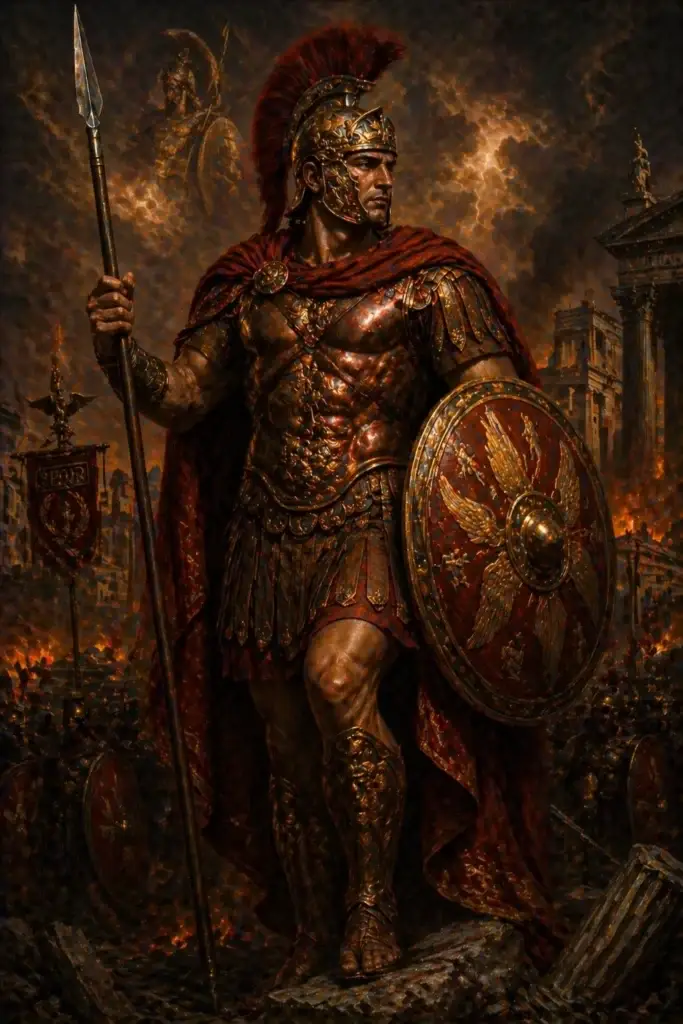
Mars is depicted as a muscular warrior in full armor, often with helmet, shield and lance. Red belongs to him. Spear and sword, eagle and wolf are his symbols. The month of March is named after him. Strength and martial honor define him.
Profile: Mars
The following Profile explains the six aspects of Mars: his historical and cultural origin, the practice of veneration, the iconographic depiction, the significance for protection and invocation, parallels to other cultures, and a concluding overview of related divine figures in neighboring traditions.
Mars is among the oldest Roman deities. Traces lead back to Indo-European war gods and to the Italic prehistoric form of a fertility daimon. In Latium he was originally a protector of herds and fields, but under the growing military demands he was reshaped into the god of war.
The first secure mention in the Lapis Satricanus dates to around 500 BC, but cults existed far longer. The temple of Mars on the Forum of Augustus in Rome was newly consecrated in 2 BC by Augustus.
Mars was invoked by warriors, generals, soldiers, farmers and citizens, especially before campaigns and in times of war. The Roman priesthood of the Salii celebrated him with the Equirria (horse races).
The Lupercalia custom (February), which belongs to Faunus/Lupercus and is not a Mars festival, signified purification and a fertility blessing for field and family. Augustus used the cults of Mars politically: as the father of Romulus, the god legitimized the dynasty. Military strategists prayed before battles.
Mars was depicted as a bearded, fully armed warrior with helmet, shield and spear. Iconographically he wore the armor of a Roman soldier, often with a dramatic gaze.
His attributes were the horse, the spear, the sacred shields (ancilia), and sometimes also the serpent (chthonic aspect). On coins he appears standing or on horseback. On altars he is shown with Venus, since the liaison symbolized mythological and cosmic harmony.
Sphere of Effect: Mars is a war god and at the same time a god of vegetation and field crops. His festival, the March festival, marks fertility and purification rituals.
In Rome Mars is venerated above all as protector of the city and of agriculture, the warrior who defends the people and makes the land fruitful. His sons with Rhea Silvia (Romulus and Remus) show his connection to foundation and state.
Mars stood under invocation and reverent respect, no mere protective god but a moral force. Before important undertakings, bulls, sheep and horses were sacrificed.
Rites to ward off misfortune aimed to appease Mars and to channel his aggressive power into orderly paths. In private houses, small Mars figures (sigilla) were set up to preserve the house and the family from harm.
In the Greek tradition, Ares corresponds to a similar but less respected god, disorderly and bloodthirsty. The Etruscan figures of Laran show parallels to the war deity.
In the Germanic sphere, Tiwaz/Tyr and Wodan shaped similar roles. The Mesopotamian Nergal and Erra embody plague and war. These deities share with Mars the transformation from agrarian protector to war deity.
Mars, Parallels in Other Cultures
Mars combines the functions of the Greek Ares with those of a vegetation and field god, a complex of roles for which there is no direct Greek counterpart. While Ares mostly appears as a pure war fanatic, Mars is already associated in the Roman calendar in March with sowing rites.
Jewish Tradition: In Jewish theology there is no direct parallel to Mars. The idea of war as a divine function is treated differently: YHWH is the God of hosts (Sabaoth), but not as a specialized war god. The Hellenistic period brought contact but no fusion with the cults of Mars.
Greco-Roman World: Ares is the Greek counterpart, but despised and secondary to Athena, who embodies strategy. Mars, by contrast, was highly esteemed, which underscores Rome’s different political role. The fusion under later emperors (Ares-Mars syncretism) nonetheless shows mutual adaptation.
Mesopotamia: Nergal, war god and lord of the dead, shares with Mars the duality of destruction and protection. Erra is an aggressive war figure but less integrated into state structure. The Mesopotamian warriors sought Nergal’s blessing just as Roman legionaries sought that of Mars.
India/Asia: Skanda/Murugan in Hinduism is a war god, yet subordinate in the cosmic hierarchy. In early Buddhism there is no war deity. China knew Guan Yu, the war god of honor and justice, later canonized, a structural parallel to the politicization of Mars.
Mars as an Old Italic God Before the Equation with Ares
In popular perception, Mars is regarded as the Roman counterpart to the Greek war god Ares. This equation is literarily correct but obscures the fact that Mars was originally an independent old Italic god with a considerably broader sphere of action.
The oldest testimonies, above all the archaic Arval hymn and references in Cato the Elder, show a god who was responsible for the protection of fields, cattle and boundaries just as much as for war.
Cato hands down in his work De agri cultura a prayer instructing a farmer to ask Mars for the protection of his estate, his family and his cattle, and to offer him for this a threefold sacrifice, the so-called suovetaurilia of pig, sheep and bull.
In this prayer, Mars appears as a power of defense against illness, infertility and storms. This agricultural side is not a marginal feature but belongs to the core of the old cult of Mars.
Scholarship explains this wide range of responsibility in different ways. One interpretation sees Mars originally as a general protective god of the community, whose defensive function expressed itself outwardly as warfare and inwardly as protection of field and herd.
The Italic Mars was thus less narrowly specialized than the Greek Ares, who remained a rather unpopular, purely warlike marginal figure in the Greek pantheon.
Only the literary equation in the Hellenistic and imperial periods pushed the old functions into the background. For understanding the Roman Mars, it is therefore important not to take the Greek foil for the whole.
Mars as Forefather of Rome
Mars holds a special genealogical position in the Roman self-understanding. He is regarded as the father of the twins Romulus and Remus and thus as the ancestor of the Roman people.
According to the foundation legend handed down by Livy and others, the Vestal Rhea Silvia bore the twins by Mars. The children were exposed, suckled by a she-wolf, an animal sacred to Mars, and raised by a shepherd. Romulus later founded the city.
This descent made Mars a dynastic and political god, not merely a power of nature. The gens Iulia, the family of Caesar and thus also of Augustus, traced itself back to Aeneas via Venus, yet the connection of Rome as a whole to Mars remained a fixed component of state ideology.
Augustus expanded this line by erecting the temple of Mars Ultor, the Avenger, and making it the center of his new forum. The epithet Ultor was connected with the vengeance for the murder of Caesar and with the recovery of the military standards captured by the Parthians.
The woodpecker sacred to Mars, the picus Martius, and the wolf belonged to the animals through which the god acted in the foundation legend. The month of March, Latin Martius, also bears his name and was regarded in the old Roman calendar as the beginning of the year and of the campaign season.
The interweaving of myth, calendar and political history makes Mars a god whose cult was closely bound up with the identity of the city. Unlike with many deities, with him it was not only a matter of veneration but of the origin narrative of the community itself.
The Salii and the Cult of the Sacred Shields
Among the most striking institutions of the Roman cult of Mars were the Salii, a priesthood of twelve members open exclusively to patricians. Their name is derived from the Latin salire, to leap or to dance, for their ritual consisted essentially of a weapon dance through the city.
The Salii processed through Rome above all in March, the month of Mars, in archaic dress: with bronze helmet, short sword, a painted garment and a sacred shield on the arm.
These shields, the ancilia, stood at the center of the ritual. According to tradition, one of them had fallen from heaven, a pledge for the survival of Rome. So that it could not be stolen, the legendary king Numa Pompilius had eleven identical copies made.
The Salii preserved the twelve shields and carried them along in their processions. The dance was accompanied by the singing of the carmen Saliare, related to the Arval hymn, a text so archaic that even the Romans of the classical period scarcely understood it any longer.
The Salii marked the beginning and the end of the campaign season. Their rites in March opened the time in which war could be waged; another ritual in October closed it. This integration into the course of the year again shows how Mars stood between the warlike and the agricultural sphere.
For scholarship, the Salii are valuable because they preserved a very old piece of Roman religion conserved in language and form. Much about their ritual remained obscure even to the ancient authors, which makes the source situation correspondingly fragmentary.
Sanctuaries, the Field of Mars and Festivals
The topographical anchoring of Mars in Rome was unusual. His oldest cult site lay, according to tradition, outside the actual city area, on the Campus Martius, the Field of Mars in the bend of the Tiber.
This location had a sacral-legal reason: armed men and the army were not permitted to cross the pomerium, the sacred city boundary.
The Field of Mars was therefore the place for levies, military exercises, the popular assembly in its martial form and the census. Only Augustus, with the temple of Mars Ultor on his forum, demonstratively brought the god into the center.
The festival calendar of Mars concentrated on March and October. In March several festivals took place, including horse races and the festival of the Quinquatrus, at which, among other things, the sacred weapons were cleaned.
October closed with the October equus, a horse sacrifice in which the right-hand horse of the victorious two-horse team was sacrificed to Mars.
Its tail was quickly brought to the Regia, a venerable building on the Forum, in which the blood was to drip onto the hearth. The ancient scholars themselves disputed over the exact understanding of this rite.
In the Regia, the hastae Martiae, sacred lances of Mars, were also kept. According to tradition, a general touched them before setting out to the field with the words that the god should keep watch.
If the lances moved of their own accord, this was regarded as a threatening omen. This connection of cult object, place and rite shows that the cult of Mars in Rome was no abstract belief system but firmly bound to places and objects that helped shape public life.
Mars in the Provinces and the Fusion with Native Gods
With the expansion of the Roman Empire, the cult of Mars also spread, yet it rarely remained unchanged in the process. In the provinces, especially in Gaul, Britain and on the Rhine, Mars merged in many cases with native deities.
This procedure, designated by scholarship as interpretatio Romana, led to a large number of Mars epithets that appear on votive inscriptions. Examples include Mars Lenus in Trier, Mars Camulus in the Celtic sphere or Mars Thingsus in Britain, who was connected with a Germanic deity.
It is striking that the provincial Mars frequently appears more strongly as a healing and protective god than as a war god. Mars Lenus, for instance, was an important healing deity with a large temple precinct.
This shift of emphasis is explained partly by the qualities of the native gods with whom Mars was equated, partly by the already mentioned broad protective function of the old Italic Mars himself. The god offered a point of connection because he was not purely defined as warlike.
The provincial cults are important for scholarship because they show how Roman religion functioned in the encounter with local traditions. It was no rigid system simply imposed from above but allowed existing deities to be addressed in Roman form.
The numerous votive altars, inscriptions and temple precincts that archaeologists have uncovered above all in northwestern Europe form an extensive material basis.
They make clear that the single name Mars could in practice cover a whole bundle of regionally differing conceptions of the god. A uniform theology of the provincial Mars cannot be derived from it.
Afterlife: Mars in Astrology, Art and Modern Culture
Beyond ancient religion, Mars continued to exert influence above all as a planetary god. The reddish planet has borne his name since antiquity, and in the astrological tradition that reached medieval Europe through the late-antique and Arabic intermediaries, Mars was regarded as the star of war, aggression and iron.
In this function he appears in countless medieval and early modern depictions, for instance in the planetary-children images that show which people and activities were assigned to Mars, among them soldiers, smiths and butchers.
In the visual art of the Renaissance and the Baroque, Mars was usually depicted after the model of the Greek Ares, frequently in connection with Venus.
The motif of Mars and Venus, which interprets the taming of war by love, is found among others in Botticelli, Veronese and Rubens. This pictorial tradition goes back less to the old Italic protective god than to the literary fusion with the Greek myth.
Mars is also still present in language today. The adjective martial derives from him, as does the month name March in many European languages. In modern popular culture, Mars appears as a planet and as a figure in literature, film and games, often narrowed to the aspect of war.
This narrowing corresponds more to the Greek Ares than to the Roman original. Whoever wants to understand the historical Mars must therefore go back behind the later reception and consider the god in his old Italic context, in which war and field protection were two sides of the same defensive power.