Garlic as Protection
By Ralf Ittermann · last reviewed on
Garlic is among the best-known protective remedies in folk tradition, far beyond the renown shaped by vampire legends.
The bulb with its characteristic smell was regarded in numerous cultures as a protective plant: against blood-sucking beings, against the evil eye, against demons and against general harm from the spirit world. This protective function is attested from Europe across the Near East to East Asia.
As part of the protective substances and protective plants, garlic belongs to the group of plant-based protective remedies whose effect tradition attributes primarily to smell, pungency and a repelling power inherent in the plant. The folkloric protective function must be strictly separated from medical claims of effect: what tradition describes is folk belief, not a proven healing effect.
Quick Overview
In tradition, garlic counts as one of the most important means of defense against vampires and vampire-like beings in Eastern Europe and the Mediterranean. Beyond this, it is used in many cultures against the evil eye, against demons and against spirits of disease.
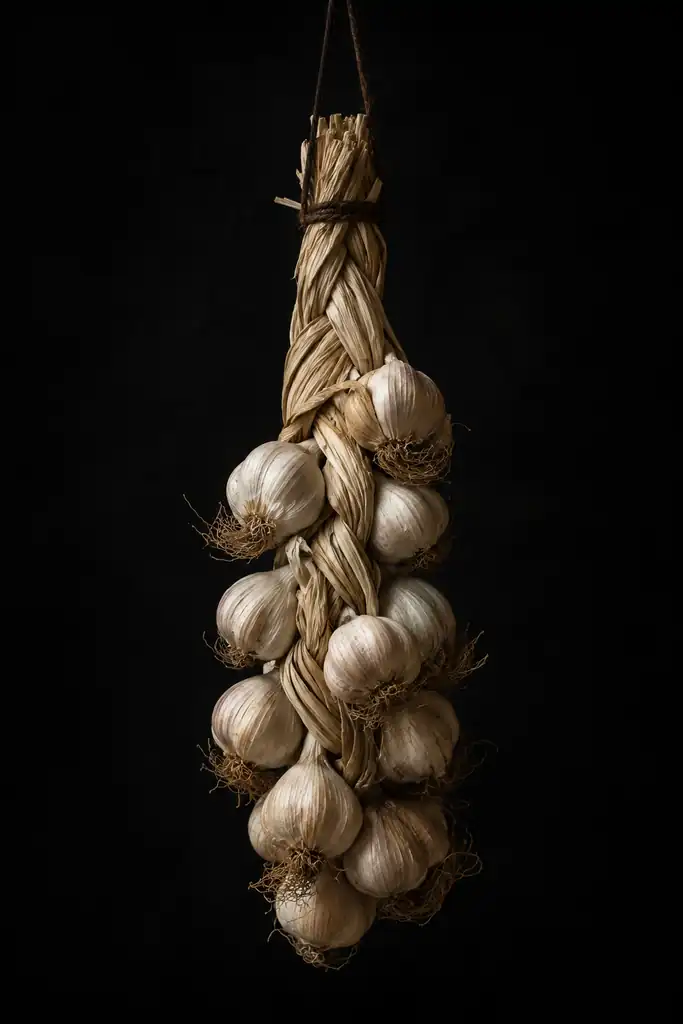
Typical forms of use are dried garlic braids over doors and windows, garlic cloves at beds and children’s beds, as well as the rubbing of door thresholds and wall openings. The protective effect is attributed to the particular pungency and the penetrating smell of the plant.
Origin and Tradition
The protective-magical use of garlic is attested in written sources since antiquity. Egyptian papyri and ancient Greek sources point to the warding power of garlic against spirit beings. In Greek folk belief, garlic was placed at crossroads, which counted as dwelling places of Hecate and her retinue of spirits, in order to keep them away.
In Europe the connection between garlic and protection from vampires has been documented since the Middle Ages, although in its widespread form it is strongly shaped by the Balkan tradition of the 17th to 19th centuries.
Austrian and Serbian reports from this period, recorded in vampirological sources such as the case of Arnaud Paole (1726), describe garlic as one of the standard means in cases of suspected vampirism: into the mouth of the suspect, over the thresholds of the affected house, into the grave.
At the same time, there exists a tradition of garlic as protection against the evil eye that is independent of the vampire lore.
This is especially strong in the Mediterranean: in Greece, southern Italy, Turkey and the Near East, carrying a piece of garlic or hanging up garlic braids counts as protection against the Nazar, the evil eye. Together with salt and blue eye amulets, garlic forms a classic protective set in this region.
Working Principle According to Tradition
Tradition traces the protective effect of garlic back to several properties.
The penetrating smell counts as the most frequently cited explanation. Beings that, according to folk notions, are bound to particular qualities of the air, the dark, the silence, the cold, cannot, by this logic, endure the intense sensory presence of garlic.
Smell as a marker of boundaries is widespread in folk tradition: what smells strongly can keep the invisible at bay.
In Christian-influenced European cultures there is additionally a symbolic reading: the bulb, which forms under the earth and on being pulled out enters a new element, counts as a threshold plant, as a mediator between the subterranean and the earthly sphere. This property makes it, by folk logic, a suitable means against beings that use the same threshold.
Tradition also names the intense vitality of the plant as an explanatory approach: garlic grows under conditions in which other plants fail, its bulbs survive drought and cold. This vital force is transferred, in folk understanding, to the protective function.
Cross-Cultural Spread
Garlic as a protective object is attested on several continents, albeit with differing emphases.
In Eastern Europe, the connection to vampire protection is most strongly pronounced. From Serbia across Romania, Ukraine and Bulgaria all the way to Poland, garlic belongs to the standard equipment of protection against vampires and vampire-like beings. Garlic in food, over doors and at beds appears consistently in ethnographic reports of the 19th and early 20th centuries.
In the Mediterranean region, the protective function against the evil eye is in the foreground. Garlic braids over front doors, pieces of garlic at children’s beds and the wearing of small pieces of garlic are widespread in Greece, Southern Italy, Spain and the Levant.
In the Near East, garlic is described in some Islamic folk traditions as a protective object against jinn and harmful spirit beings.
In East Asia, Japanese folk tradition uses garlic to a limited extent as protection against Demons and evil Spirits; similar uses are found in some Chinese regional cultures.
In Indian folk tradition, garlic is occasionally mentioned in defensive rituals against Demons and malevolent influence, although it plays a less central role there than in European traditions.
What It Is Used Against
According to traditional accounts, garlic has been used mainly against the following classes of beings and types of influence:
Against vampires and bloodsuckers: this is the area best known in folk culture. In Eastern European tradition, garlic belongs to the core set of vampire defense. Strigoi, Vrykolakas, Upyr and related beings are said to be unable to endure garlic.
Against the evil eye: in the Mediterranean region and the Near East, garlic is considered an effective countermeasure against the effect of the evil eye, which in these cultures is regarded as a real harmful force.
Against Demons and harmful spirit beings: in several cultures, garlic is used to cleanse rooms of demonic presence or to keep Demons from entering.
Against disease Spirits: in some folk-belief traditions in which illness is regarded as caused by spirit beings, garlic serves as protection against the entry of these Spirits.
Application and Limits
Dried garlic braids above doors and windows are the most widespread form. Individual cloves are placed in cracks, doorposts or under thresholds. In some Eastern European traditions, garlic is sewn into clothing or worn in a protective pouch. When going to sleep, cloves are tucked under the pillow or into the cushions.
Some traditions require fresh garlic for the protective effect; dried garlic or garlic preserved in vinegar is considered weakened in certain traditions. Other sources see no difference.
Important: the folkloric protective tradition of garlic refers exclusively to defense against spirit beings and supernatural influence, as tradition describes it. No medical claim of efficacy is associated with it.
Literature (Selection)
Related key terms: garlic protection vampire evil eye.
iWell Guard and Protective Traditions
Garlic shows how an ordinary plant came to be understood in many cultures simultaneously and independently as a bearer of protection. This recurring conviction that certain natural substances carry a protective power within themselves forms the background for the concept of the iWell Guard, which as a wearable protective object connects various strands of tradition in human protective thinking.
Personal experiences may vary. Not a medical device. No healing promise.