Poseidon, Greek god of the sea
By Ralf Ittermann · last reviewed on
Poseidon is one of the three brothers who divide the world among themselves after the fall of Kronos, receiving the realm of the sea. In Homer he is called the Earth-shaker (enosichthon, ennosigaios), because earthquakes too are ascribed to him.
In the local cults of Greece he appears in a far broader role than as a mere sea god: he is patron of horses, of springs and of seafaring, and in Argos as well as Athens he lays claim to the rule of the city itself.
His epithet Hippios (the Horseman) connects him with the Mycenaean warrior aristocracy; Asphaleios (the one who grants security), with protection from earthquakes; Phytalmios (the nourisher of plants), with the subterranean springs that ensure growth. This range points to an old, pre-classical god with wide-ranging functions, restricted to the sea only within the Olympian order.
Myth and genealogy
Hesiod names Poseidon in the Theogony (lines 453 to 458) as the son of Kronos and Rhea, born between Hades and Zeus.
Like his siblings he is swallowed by Kronos and later disgorged; an Arcadian tradition recorded by Pausanias (VIII, 8, 2) reports, however, that Rhea entrusted Poseidon to the shepherds of Mantinea and gave Kronos a foal as a substitute offering, which is held to explain the epithet Hippios.
The division of the world among the three brothers takes place, according to Homer (Iliad XV, 187 to 193), by lot: Zeus receives the heavens, Hades the underworld, Poseidon the sea; earth and Olympus remain common property.
Poseidon’s consort is Amphitrite, a Nereid or Oceanid; from this union comes Triton, half man, half fish.
In addition Poseidon has countless descendants by mortal and immortal women: Pegasos and Chrysaor arise from his union with Medusa, Polyphemos from his union with Thoosa, Theseus (in one variant) from Aithra, Pelias and Neleus from Tyro, the giant brothers Otos and Ephialtes from Iphimedeia.
This far-reaching paternity makes Poseidon the genealogical forefather of numerous Greek noble houses, particularly in Boiotia and Thessaly.
The Mycenaean Linear B tablets from Pylos name a god po-se-da-o-ne, who occupies a leading position in the palace cult and receives offerings of exceptional richness.
From this Martin Nilsson concluded that Poseidon was originally the supreme god of the Mycenaean Pylos region and was only subordinated to his brother Zeus within the Olympian order. The goddess po-si-da-e-ja mentioned in the Pylos archive is likely an archaic consort of the god, whose function later passed to Demeter or Amphitrite.
The link between Poseidon and Demeter belongs to the most archaic myths. In Pausanias (VIII, 25, 4 to 7) a Demeter Erinys appears at Thelpusa and Phigalia, pursued by Poseidon in horse form, by whom she conceives the mysterious being Despoina and the divine horse Areion.
The narrative is held to reflect an old connection between earth mother and horse god in the pre-Greek religion of Arcadia.
Symbols, iconography and attributes
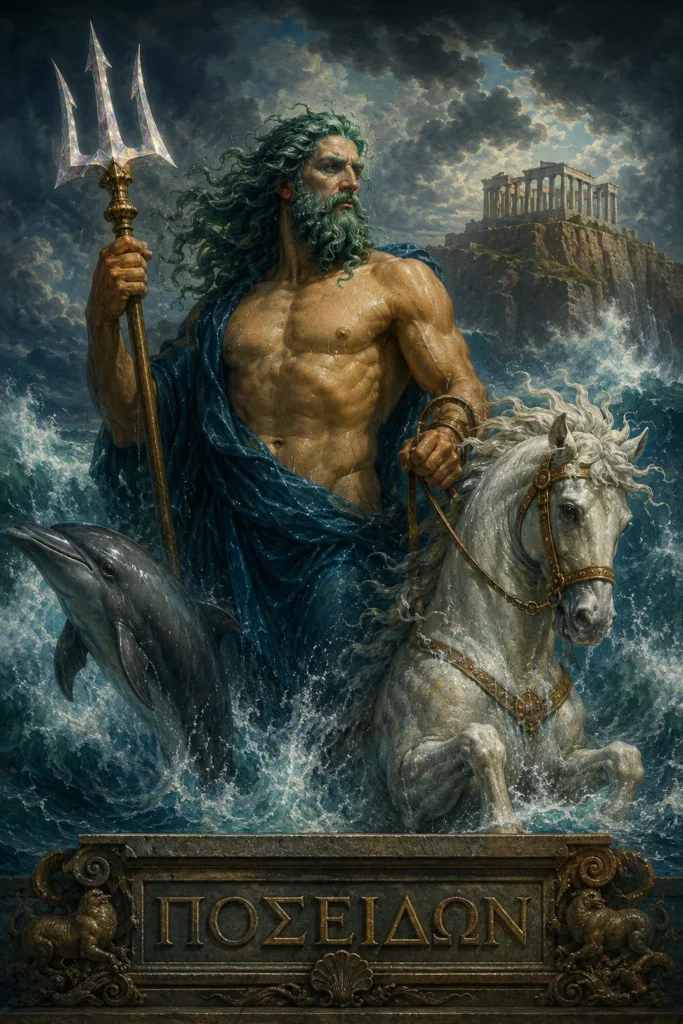
Poseidon’s principal attribute is the trident, a fishing fork that the god repurposes as a cosmic weapon. With the trident he strikes the rocks, whereupon springs or horses burst forth, and with it he raises the waves or makes the earth shake.
According to a late tradition (Apollodorus I, 2, 1) the implement comes from the Cyclopes, who had equipped Poseidon for the struggle against the Titans, parallel to Zeus’s thunderbolt and Hades’s cap of invisibility.
Horse and bull are his sacred animals. The bull embodies the bellowing, untamed force of the Earth-shaker; at Onchestos in Boiotia a horse offering was given to the water (Homeric Hymn to Apollo 230 to 238).
The horse is his creature in several variants: at one time he brought it forth in the contest with Athena on the Acropolis (Virgil, Georgics I, 12 to 14), at another it sprang as Areion and Pegasos from his amorous unions.
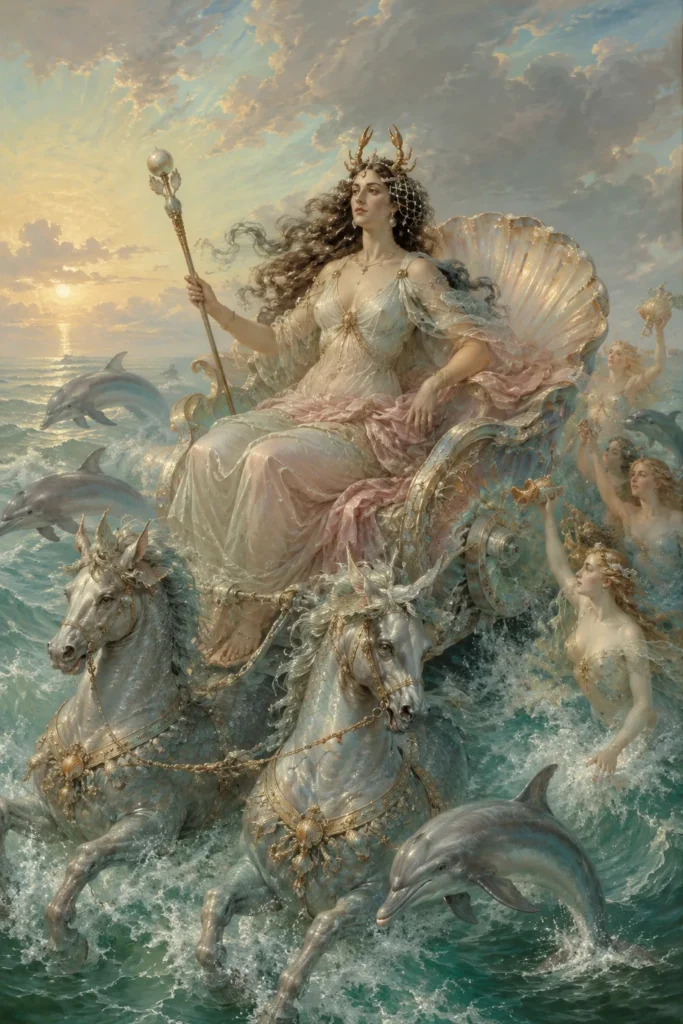
Dolphins accompany him in the pictorial tradition as his zoological escort, often at the edge of the divine chariot.
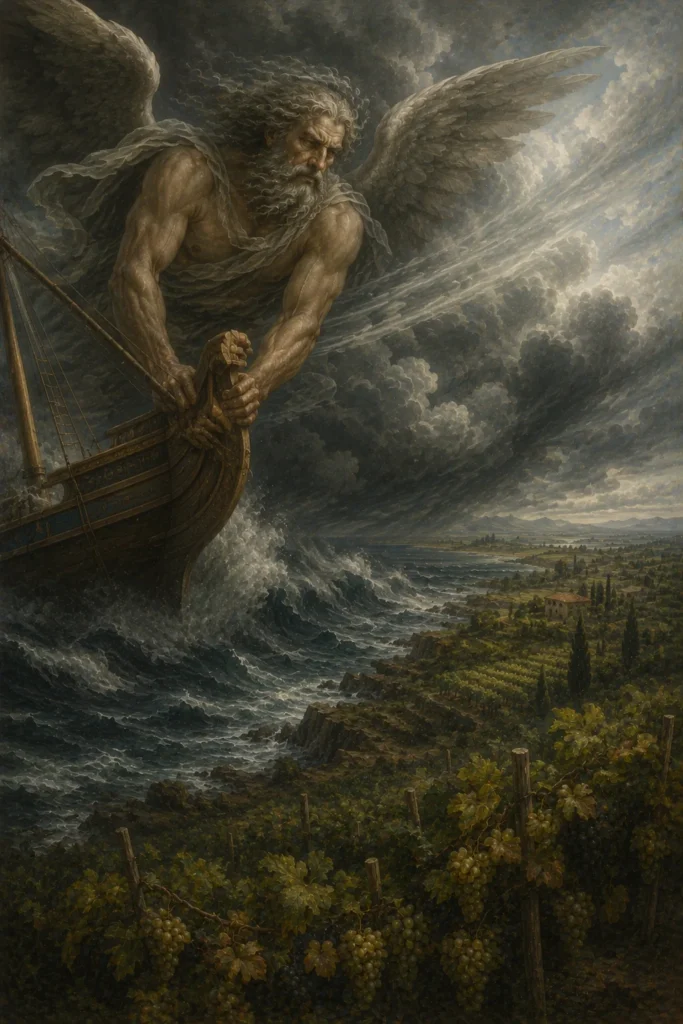
Poseidon’s typical representation shows him as a bearded, sturdily built god in middle years, often with bare torso, sometimes with a flowing cloak that the wind catches behind him. He drives a chariot drawn by hippokamps, horses with a fish’s tail.
The famous bronze statue from Cape Artemision (today in the National Museum of Athens) shows a god in throwing pose with raised right arm; whether this is Poseidon with the trident or Zeus with the thunderbolt remains disputed. The identification as Poseidon rests on the close stylistic kinship with coin images.
More unusual is Poseidon in his black manifestation as Melas at Sikyon (Pausanias II, 12, 1) and as Kyamites, the guardian of beans, at Eleusis. These chthonic aspects are the legacy of the old earth god who, before the sorting of the pantheon, held wider domains than were assigned to him in the Olympian order.
Cult and worship
The cult of Poseidon was concentrated on coastal cities and on those inland regions where ancient horse breedings and springs were sacred. His most important panhellenic festival was the Isthmian Games at the Isthmus of Corinth, celebrated biennially from 582 before the common era.
Victors received a wreath of pine or celery. The games were closely linked to the hero cult of Melikertes-Palaimon, whose lifeless body a dolphin is said to have carried to the Isthmus and who was venerated there as an immortal being.
At the southern tip of Attica there rose, on the rock of Sounion, the famous temple of Poseidon, dedicated around 444 before the common era. Athenian seafarers brought him offerings here before setting out on great voyages; the temple precinct served at the same time as a military fortress for the control of shipping routes.
The nearby shore was the setting of mythical episodes: Aigeus threw himself from this cliff when he saw the black sail that signalled the supposed defeat of his son Theseus.
At Onchestos in Boiotia the Hippios cult was maintained through a peculiar chariot race without drivers: the chariots were released in a sacred grove, and where they overturned was the sacred site. These rites preserve a memory of old Indo-European horse ceremonies.
On the Peloponnesian island of Kalauria (today Poros) there was a panhellenic amphictyony of seven member states, which held their assemblies in the Poseidon temple (Strabo VIII, 6, 14); Demosthenes ended his life there in 322 before the common era.
In the Ionian sphere the Poseidon Helikonios cult at Mykale was the religious bond of the Panionian League; the Panionia held here was the most important political gathering of the twelve Ionian cities.
At Sparta Poseidon Hippokurios and Erechthonios were venerated; in Magna Graecia Tarentum possessed a principal cult on the west coast of the city. In many places Poseidon appeared together with the earth mother, which is why the comparably archaic Demeter-Poseidon cult forms a separate layer in the history of religion.
Important sanctuaries and temples
The Doric temple of Sounion, erected from 444 to 440 before the common era on the site of a predecessor destroyed by the Persians, ranks as a canonical example of Attic temple architecture.
Of the originally 34 columns 15 still stand today. The site on the cliff, 60 metres above the sea, offered ship captains a landmark; the temple is visible from the sea on clear days over great distances.
The temple of Poseidon at the Isthmus of Corinth, erected in the middle of the sixth century and repeatedly renewed after fires, stood at the centre of the Isthmian sanctuary.
Pausanias (II, 1, 7 to II, 2, 2) describes the cult image of Poseidon, who set one foot on a dolphin, and in the forecourt the statues of the victors of the Isthmian Games. The sanctuary controlled the isthmus and thereby the traffic between the Peloponnese and central Greece.
The temple of Kalauria (today Poros) is the oldest surviving Poseidon temple, erected around 520 before the common era. It served the Kalaurian amphictyony as an assembly place.
At Paestum (Poseidonia) in Italian Lucania the second great temple (today usually addressed as a temple of Hera) counts as the best-preserved Doric temple of all; earlier scholarship saw in it the principal temple of Poseidon, after whom the city was named.
Tarentum possessed two important sanctuaries within its city territory, which are only fragmentarily documented archaeologically.
In the Erechtheion at Athens the saltwater well was shown which Poseidon is said to have brought forth in the contest with Athena; Pausanias (I, 26, 5) mentions a depression in the rock held to be the imprint of the trident.
At Onchestos the horse cult was linked with the sanctuary, the precise location of which Pierre Roesch identified in the 1970s to the south-west of present-day Akraiphnion. On Tenos there rose an important Poseidon and Amphitrite temple, which became a panionic pilgrimage destination above all in the Hellenistic period.
Mythic narratives
Poseidon’s central myth against a mortal hero is the pursuit of Odysseus in the Odyssey. Polyphemos, the one-eyed Cyclops, is blinded by Odysseus; since Polyphemos is the son of Poseidon, the god swears revenge and ensures that Odysseus returns home only after ten years and after the loss of all his companions.
The episode forms the dramatic engine of the entire Odyssey and ends only when Odysseus, on the instruction of Teiresias, performs in the interior of Greece an atoning offering that reconciles Poseidon.
In the Trojan War Poseidon stands on the Greek side because King Laomedon had refused him the agreed reward for the building of the walls of Troy. In Homer (Iliad VII, 452 to 463) Poseidon reminds Zeus that he and Apollo had served the Trojan king for a year.
The god avenges the withheld reward with a sea monster, to which Herakles eventually puts an end. During the fighting itself Poseidon openly intervenes and pushes the Greeks with his strength against the Trojan wall.
One of the oldest rivalry stories of the gods is also attributed to Poseidon: the contest with Athena for the patronage of Athens. At Argos he loses to Hera, at Corinth he shares the city with Helios, at Troizen with Athena.
This accumulation of defeats in the elections of city gods is read in modern scholarship as an indication that Poseidon was an older figure, once dominant in many regions, displaced by younger gods in the new polis religion.
The myths surrounding Poseidon and Demeter are the most enigmatic. Pausanias transmits, from the Arcadian sanctuary at Phigalia and Thelpusa, a tale in which Poseidon, in horse form, rapes the grieving Demeter and begets with her the child Despoina (the Mistress) and the divine horse Areion.
Demeter Erinys withdrew into a cave; a cosmic famine followed, until Pan found her and Zeus reconciled her. According to Burkert, this story preserves a pre-Greek stratum of relations among the gods with reference to vegetation and horse symbolism.
Relations within the pantheon
The relationship between Poseidon and Zeus is marked by shifting rivalry. In the Iliad Poseidon claims equal rank with his brother because the world was divided by lot (XV, 185 to 199); Zeus enforces his supremacy only through the right of the eldest and the threat of the messenger Iris.
With Hades there is a calm sibling relationship; the three rulers of the three realms encounter one another only rarely.
With Athena there is the most pronounced rivalry, visible in several local contest myths. The Athenian dispute ends with Poseidon’s defeat and the naming of the city after Athena; at Troizen he must share the city with the goddess.
With Apollo he builds the walls of Troy and shares with him the fate of being cheated of his reward by Laomedon. With Hermes he shares the foundation of the horse race.
His consort Amphitrite appears only rarely as an acting figure in myth; Bacchylides (Dithyramb 17) has her receive Theseus in the sea and present him with crown and cloak. Triton, the son, functions as a messenger being who, with the triton shell, can produce storm and calm.
Poseidon’s relations with his mortal lovers display his ambivalent position between pantheon and earth’s surface; many Greek noble families traced themselves back to him as forefather, which is why his paternity is genealogically more densely attested than that of most other Olympians.
Reception
At Rome Poseidon was identified with Neptunus, an originally Italic god of springs and fresh water, whose domain was extended through the identification to the sea.
The Neptunalia were celebrated on 23 July; Pliny the Elder and Festus give complementary information. Imperial coin imagery represents Neptune with trident and dolphin in countless variants, frequently in connection with imperial frontiers or naval victories.
In the Middle Ages Poseidon largely disappeared behind Christian personifications of the sea; in the Etymologiae of Isidore of Seville he appears only as an allegory of the element water.
The Renaissance produced, with Nicola Salvi’s Trevi Fountain (completed in 1762, with the central Oceanus-Neptune), Raphael’s Galatea and Annibale Carracci’s Triumph of Neptune and Amphitrite, a rich pictorial tradition. In the Baroque park of Versailles stands the famous Bassin de Neptune with the chariot of the god accompanied by tritons.
Romanticism and the nineteenth century saw in Poseidon the emblem of unbridled natural force; in Goethe’s Faust (Classical Walpurgis Night) he appears in the figure of Seismos, who heaves up the earth.
The scholarly reception by Erwin Rohde, Walter Otto and Walter Burkert has brought out the pre-classical profile of the god and has treated systematically the myths involving Demeter, Pegasos and the Mycenaean palace cult.
Modern popular culture (comic, film, video game) uses him as an archetypal sea god figure, often without regard for the original complexity.
Religious-historical classification
The etymology of the name Poseidon is disputed. The Mycenaean form po-se-da-o-ne and the Doric Poteidan suggest a basic form with the meaning Husband of the Earth (potis + das, comparable to Demeter), which supports the link with Demeter in the Arcadian myths.
Another interpretation derives the name from Lord of the Waters. The Mycenaean evidence makes it likely that Poseidon was, in the second millennium before the common era, a principal god, possibly the supreme god of Pylos, who was restricted to the sea only in the shape of Olympian religion.
Considered in Indo-European terms, Poseidon shows the typical features of an Indo-European horse god, as found in parallel in the Vedic Asvin figure, the Celtic Epona complex and the Germanic Sleipnir myth.
Georges Dumezil assigned him to the third function (fertility, nourishment), which accounts for the link to Demeter and the patronage of springs. Walter Burkert sees in Poseidon a stratum of an old Indo-European horse deity that merged in a substrate compound with Aegean earth-mother conceptions and thus developed its peculiar profile.
In religious-historical comparison, structural similarities stand out with the Hindu Varuna, water god and guardian of cosmic order, and with the Ugaritic Yam, who in the West Semitic myths represents the seas and is overthrown by the weather god Baal.
Unlike Yam, however, Poseidon is not dethroned but integrated into the Olympian system, which displays the Greek tendency towards a distribution of divine domains rather than towards a battle among gods.
The more recent scholarship of Madeleine Jost (on the Arcadian cult) and Robert Parker (on the Athenian cult) has further differentiated the picture of a multi-layered god, whose alleged unity was first produced in the Homeric reception.
Etymology and Mycenaean roots
The name Poseidon (Mycenaean po-se-da-o-ne, Doric Poteidan, Ionic Poseidaon) is attested from the second millennium before the common era onward. Linear B tablets from Pylos, Knossos and Thebes name a recipient of unusually extensive offerings; at Pylos he receives larger shares of bulls, sheep and wine than any other god named.
This body of evidence is one of the most important indications that Poseidon was, in Mycenaean times, the supreme god of one or more palace-centred regions.
The etymological discussion revolves around two main proposals. Earlier scholarship (Kretschmer, Solmsen) derived the name from potis (lord) and da (earth), meaning Husband of the Earth, which supports the link to Demeter in the Arcadian myths.
Robert Beekes assessed this Indo-European etymology sceptically and considered a pre-Greek origin. More recent Mycenological scholarship by Stefan Hiller and Jose Luis Garcia Ramon has returned to the first reading and brought it into accord with the Arcadian Demeter-Poseidon cults.
The Mycenaean-archaic shift of the theological hierarchy from Poseidon to Zeus is one of the central events of Greek religious history. Walter Burkert has interpreted this shift as a reflex of the Dorian migration and of the political reordering of Greece after the collapse of the Mycenaean palace culture.
The archaic polis religions had to adapt to the new social conditions; the patriarchal supremacy of Zeus fitted the aristocratic polis state better than the older royal position of Poseidon.
Sources
Homer, Iliad, particularly XIII, XV and XX, and Odyssey, particularly I, V, IX and XIII. Hesiod, Theogony 453 to 458 and 930 to 933. Apollodorus, Bibliotheke, I, 2, 1 and I, 4, 6. Pausanias, Description of Greece, II, 1 (Isthmus), VIII, 8 and 25 (Arcadia). Pindar, Isthmian Odes, particularly the opening passages.
Strabo, Geographica VIII, 6, 14 (Kalauria). Virgil, Aeneid I, 124 to 156, and Georgics I, 12 to 14. Walter Burkert, Griechische Religion der archaischen und klassischen Epoche, Stuttgart 1977. Madeleine Jost, Sanctuaires et cultes d’Arcadie, Paris 1985. Robert Parker, Polytheism and Society at Athens, Oxford 2005.
Frequently asked questions about Poseidon
Who is Poseidon in Greek mythology?
In Greek mythology Poseidon is the god of the sea, of earthquakes and of horses, one of the twelve Olympian gods. He is the brother of Zeus and Hades; in the division of the world after the fall of the Titans the sea fell to him, while Zeus received the heavens and Hades the underworld.
His principal attribute is the trident, with which he stirs up the sea and shakes the earth. His Roman counterpart is Neptune.
Why was Athens named after Athena and not after Poseidon?
A famous myth tells of the contest between Poseidon and Athena for patronage of the city of Attica. Both were to give the citizens a gift. Poseidon struck his trident on the rock of the Acropolis and caused a saltwater spring to rise, and some traditions also name the first horse.
Athena caused the first olive tree to grow. The citizens or gods decided that the olive tree, as a giver of food, oil and wood, was the more valuable gift, and the city was named after Athena.