Hera, Goddess of Marriage and Queen of Olympus
By Ralf Ittermann · last reviewed on
Hera ranks among the twelve principal Olympian deities of the Greek pantheon and is regarded as the sister and consort of Zeus.
She embodies lawful marriage, the marital bond, and the sovereignty of the queen. In Hesiod’s Theogony she is named as the daughter of Kronos and Rhea, which places her among the oldest generation of Olympians.
Her epithet teleia, the Fulfiller, designates her as patroness of the consummated marriage; in the Argive cult she appears as Argeia, the Argive.
Beyond the Homeric epic, Hera is tangible in numerous local cults, from Argos and Samos to Olympia and Magna Graecia. The cultic practice there points to an independent city sovereign who only secondarily became the Olympian consort.
Profile: Hera
Hera: the most important aspects at a glance. The following fields summarise origin, function, appearance, veneration, symbols and parallels.
Hera is one of the twelve principal Olympian deities, daughter of Cronus and Rhea and sister and wife of Zeus. Her cult centres at Argos, on Samos and at Perachora appear older than the Olympian order; Mycenaean tablets already name a recipient of offerings under the name e-ra in the thirteenth century BCE.
Hera embodies lawful marriage, the marital bond and the sovereignty of the queen; as teleia, the fulfilled one, she protects the consummated marriage. Through her children she appears as founder of social institutions: marriage, birth, youth. In myth she acts as queen, for example against the rivals of Zeus and in the Trojan War.
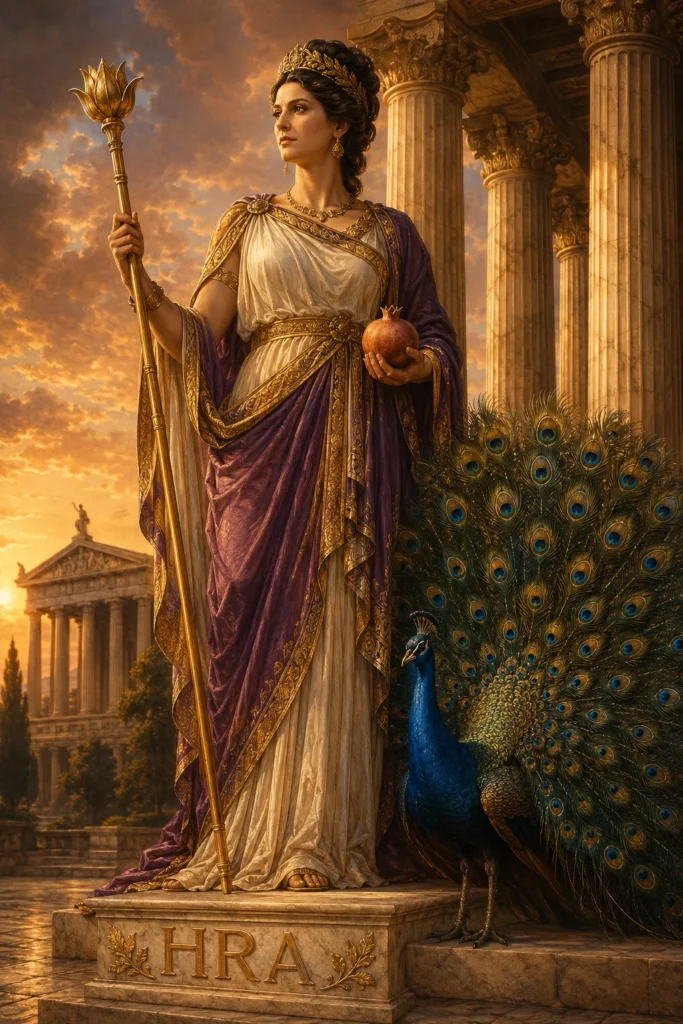
Hera’s classic attribute is the diadem or stephane, a tall, often tower-like crown; she frequently holds the sceptre. In vase painting she wears a long, belted peplos with a veil, occasionally the pomegranate. Polykleitos’s cult statue in the Heraion of Argos showed her with a wreath, a pomegranate and a sceptre on which a cuckoo sits.
Important cult sites are the Heraion of Argos with the festival of the Heraia, the Heraion on Samos, where at the Tonaia the cult image was carried to the beach at night, wrapped in branches of the lygos and washed, as well as Olympia and Perachora. At Plataea the Daidala were celebrated, a wedding festival with a wooden image dressed as a bride.
Her symbols include the sceptre, diadem, pomegranate and the bowl (phiale). The peacock is firmly associated with her in Roman times and goes back to Ovid; in the archaic period the cuckoo and the cow dominate. The epithet boopis, cow-eyed, refers to cattle.
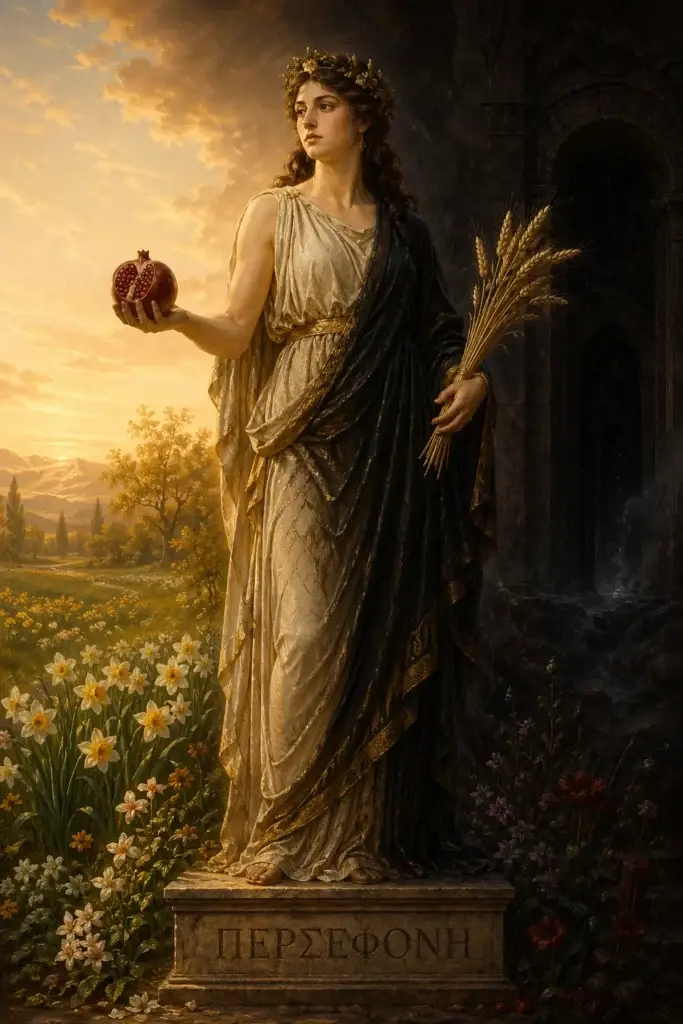
In Rome Hera is identified with Juno, who was worshipped together with Jupiter and Minerva in the Capitoline Triad. The pomegranate links Hera with Persephone, and in archaic depictions she remains iconographically indistinct from Demeter.
Myth and Genealogy
Hesiod assigns Hera in the Theogony (lines 453 to 458) to the second generation of divine beings: she is the daughter of the Titans Kronos and Rhea, sister to Hestia, Demeter, Hades, Poseidon and Zeus.
According to the swallowing myth, she is devoured by Kronos along with her siblings and later released through the emetic administered by Rhea.
Pausanias records an Argive tradition according to which she grew up as a girl by the river Asterion near Argos, nurtured by its three daughters Euboea, Prosymna and Akraia, who were later venerated as spring nymphs of the sanctuary.
The Theogony interprets the union with Zeus as hieros gamos, a sacred wedding that cosmologically founds kingship on Olympus. From this marriage, according to Hesiod, issue Ares, Hebe and Eileithyia; Hephaistos, depending on the source, is born to Hera alone, as a defiant response to the parthenogenetic birth of Athena from Zeus’ head.
In Homer the genealogies appear more stable, yet the motif of Hera’s autonomous motherhood remains a recurring element of her myths. A late Hellenistic tradition preserved in Diodorus (V, 72) names Argos itself as her birthplace and makes Temenos, son of Pelasgos, the first organiser of her rites.
The indications of a pre-Greek autonomy are noteworthy: in Greek Religion of the Archaic and Classical Epoch, Walter Burkert pointed out that Hera’s cult centres in Argos, on Samos and at Perachora appear older than the matured Olympian order.
Finds of Mycenaean Linear B tablets from Pylos and Thebes attest under the name e-ra a recipient of offerings as early as the thirteenth century before the common era. The goddess thus carries the features of an independent city sovereign who was only secondarily integrated into the Homeric system as consort of Zeus.
Genealogically, Hera reaches far into myth through her children. Ares becomes father of Eros (in one of the competing traditions), of Phobos and Deimos; Hebe marries the deified hero after Heracles’ apotheosis; Eileithyia becomes the indispensable companion of every birth.
This line shows Hera less as a cosmological primordial mother than as founder of social institutions: marriage, birth, youth.
Symbols, Iconography and Attributes
Hera’s classical attribute is the diadem or stephane, a high, often tower-like crown that marks her royal standing. She frequently holds the sceptre, occasionally the bowl (phiale) for libation.
The peacock, firmly associated with her in Roman times, only appears late in the Greek pictorial tradition; in the Archaic period, cuckoo and cow predominate. The link with the peacock goes back to Ovid (Metamorphoses I, 722 to 723), who has the hundred eyes of the slain Argos reappear on the bird’s feathers.
The epithet boopis, ox-eyed, is a standard Homeric epitheton and points to an ancient connection with cattle. Heinrich Schliemann and subsequent generations of researchers found idols in the Argive material that were interpreted as bukrania (bull skulls) and confirm Hera’s proximity to horned cattle.
The cuckoo plays a role in the wedding myth: Zeus is said to have transformed himself into a freezing cuckoo, which Hera took in, whereupon the god revealed himself and courted her. Pausanias (II, 17, 4) confirms this variant as an Argive local tradition.
In classical vase painting, Hera wears a long, girded peplos, with a veil and occasionally the pomegranate as fruit of marriage and fertility.
Polykleitos created for the Argive Heraion a chryselephantine cult statue, of which Pausanias reports that it wore a wreath with Charites and Horai, holding the pomegranate in one hand and the sceptre with a perched cuckoo in the other.
The statue counted as one of Polykleitos’ principal works, comparable to his Doryphoros, and shaped the image of the mature, enthroned goddess for centuries.
Less familiar attributes are the lygos shrub (chaste tree), which wrapped her cult image at the Samian Tonaia, and the pomegranate. The latter connects Hera with Persephone and points to the dual function of the fruit as a symbol of marital fertility and underworld binding.
The iconographic distinction between Hera and Demeter remains blurred in Archaic depictions, which supports the thesis of an originally related vegetation and city goddess.
Cult and Veneration
The Heraion cult divides into several major lines. In Argos, Hera was regarded as city goddess: the Heraion between Mycenae and Argos was the central sanctuary of the Argolid, with its own priestly office and a multi-day festival, the Heraia. Hecatombs were offered at these games, which is why the Heraia were also called Hekatombaia.
The cultic order included a chariot race whose victor received a bronze shield as a prize, as well as a solemn procession of the priestess on a cart drawn by white cattle, described in the episode of Kleobis and Biton in Herodotus (I, 31).
On Samos stood the Ionian Heraion, whose temple construction in the sixth century before the common era reached enormous dimensions. Herodotus describes the sanctuary as one of the largest in Greece (Herodotus III, 60).
The central ritual was the Tonaia: the cult image was carried at night to the shore, wrapped in lygos branches and washed, which is interpreted as a renewal of the virginal Hera and a symbolic return to the pre-marital state.
Myth explained the rite as a memory of an attempted theft of the cult image by Carian pirates.
At Olympia, the temple of Hera stood older than the temple of Zeus; here the Heraia were celebrated, a footrace of unmarried girls in three age classes over five-sixths of the stadium length, described by Pausanias (V, 16). Sixteen matronae, selected from the Elean phylai, wove the peplos garment for the goddess.
At Perachora near Corinth, the sanctuary of Hera Akraia and Limenia, the rocky and harbour-bound Hera, attests an early maritime cult with reference to seafaring; thousands of votive finds, including Phoenician scarabs, show the importance of the harbour cult in the seventh and sixth centuries before the common era.
A separate line is formed by the wedding cult. At Plataiai, the Boeotians celebrated the Daidala, in which a wooden cult image was adorned as a bride, carried in triumphal procession to Mount Kithairon and finally burned.
Pausanias (IX, 3) explains the festival as a feast of reconciliation between Zeus and Hera, who had withdrawn after a quarrel. Such rites show Hera as the personification of a cyclically repeated marital union, in which separation and reunion carry cosmic meaning.
Important Sanctuaries and Temples
The Argive Heraion lies about eight kilometres north-east of Argos on a terrace at Mount Euboea. The Archaic temple of the seventh century burned down in 423 before the common era, as Thucydides (IV, 133) notes; the classical successor building was erected under the architect Eupolemos.
According to later tradition, the date of the Argive years was here counted by the priestesses of Hera; Thucydides dates an event of the Peloponnesian War by the priestess Chrysis.
The Samian Heraion at Ireon developed from the eighth century into a Panhellenic point of attraction. The third temple, designed by Rhoikos and Theodoros, was a dipteros with over a hundred columns.
Finds range from Egyptian bronzes to North Syrian ivories and show the wide network of the sanctuary. Polykrates had a successor building erected which, according to Herodotus, was said to have been the largest Greek temple of its time, but was never completed.
Other significant sites are the Heraion of Foce del Sele near Paestum in Lucania, the temple foundation of Hera Lakinia near Kroton in Calabria (Strabo VI, 1, 11) and the temple of Hera in the Olympian grove (Heraion of Olympia), in which, according to Pausanias, the Hermes of Praxiteles was set up. The second temple of Paestum, in the nineteenth century called the Temple of Poseidon, is today predominantly addressed as a temple of Hera.
The Heraion Lakinion was a place of assembly for the Italiote Greeks and centre of a league that continued into Roman times.
Among the less well-known sanctuaries are the Heraion of Tiryns, erected after the destruction of the Mycenaean citadel on the ruins of the former megaron, the Heraion of Corinth and the Heraion of Mantineia.
The continuity of these places between Mycenaean and Archaic times is one of the most important arguments for a pre-Greek layer of the Hera cult.
Mythic Narratives
Three narrative cycles shape Hera’s mythical figure. The first is the persecution of Zeus’ rivals and bastards. In Apollodorus (Bibliotheke II, 4, 8), Hera sends two snakes to kill the infant Heracles in the cradle; the child strangles them.
Later she strikes him with madness so that he kills his children, which becomes the occasion for the twelve labours.
With Io, Zeus transforms his beloved into a cow, which Hera requests and has guarded by Argos Panoptes.
After his killing by Hermes, a gadfly sent by Hera pursues Io through the world all the way to Egypt, where she regains her human form; Aeschylus in Prometheus Bound makes this journey a foreshadowing of the genealogy of Heracles.
The second cycle concerns the birth dramas. According to Homer (Iliad XIX, 95 to 133), Hera delays the birth of Heracles by holding back Eileithyia, so that Eurystheus comes into the world first and thereby obtains the right of primogeniture.
In the quarrel over Leto, Hera bars the pregnant beloved of Zeus from firm ground; Delos, a floating island, becomes the birthplace of Apollo and Artemis. The transformation of Kallisto into a bear, recorded in Ovid (Metamorphoses II, 466 to 495), is in some variants also attributed to Hera.
The third cycle portrays Hera as an acting queen in the Trojan War. In the Deception of Zeus (Iliad XIV, 153 to 360) she seduces her consort on the summit of Mount Ida with the girdle of Aphrodite in order to gain advantages for the Achaeans.
This scene counts as one of the earliest examples of female cunning power in European literature. In the prehistory of the war, after the judgement of Paris, she is Troy’s most embittered enemy: Paris had awarded the golden apple of Eris to Aphrodite, not to Hera, who had promised him kingship and martial glory.
A fourth, less well-known episode forms the rebellion on Olympus: in Homer (Iliad I, 396 to 406) Achilles reports that Hera, Poseidon and Athena once bound Zeus until Thetis summoned the hundred-handed Briareos to his aid, who freed the father of the gods.
This episode shows Hera as the leader of an aristocratic faction against the monarchical claim of her consort and underlines her position as an independently acting sovereign.
Relations within the Pantheon
The tension between Hera and Zeus pervades the entire Homeric epic. It is not mere jealousy, but the expression of two competing claims to sovereignty: Zeus as Olympian sovereign, Hera as lawful queen.
In Pindar and in tragedy, she appears as the incorruptible guarantor of marital law. The frequent reconciliation of both gods, as in the Daidala myth of Plataiai, can be read as a ritual re-enactment of a cosmic marital union that must be annually renewed.
With Poseidon she is connected by the dispute over Argos, which she won: Pausanias relates that the river gods Inachos, Kephisos and Asterion decided in favour of Hera, whereupon Poseidon had the rivers dry up. With Aphrodite there is an ambivalent relationship: Hera borrows her girdle, yet rejects the principle of erotic seduction.
The sharp separation between marital bond (Hera) and free eroticism (Aphrodite) belongs to the fundamental polarities of the Greek divine collegium.
Hephaistos, depending on tradition her son, forges in one variant a golden throne that binds his mother, until Dionysos brings back the drunken smith god and persuades him to release her.
The relationship with Heracles, son of Alkmene, remains the most pronounced enmity of the pantheon; only after his apotheosis are the two reconciled, and Hebe, daughter of Hera, becomes his Olympian consort.
With Iris, the messenger of the gods, there exists a peculiarly close servant-mistress relationship: Iris carries out Hera’s commissions mostly without detour through Zeus.
Reception
In Roman religion, Hera is identified with Juno, who was venerated in Rome as part of the Capitoline Triad with Jupiter and Minerva. Juno’s epithets such as Lucina (the birth-helper), Moneta (the admonisher) and Regina translate functions of the Greek Hera into the Latin context, but add new state-cultic aspects.
Virgil’s Aeneid makes Juno the principal antagonist of the Trojan migration to Italy and thus the adversary of Roman state foundation, before she is finally reconciled (Aeneid XII, 791 to 842).
The Middle Ages knew Hera primarily through the Ovid reception. In the Ovide moralisé and in Boccaccio’s mythographic handbooks, she appears as an allegorical figure, often reduced to jealousy.
The Renaissance brings, with the works of Botticelli and Raphael, a rediscovery of ancient iconography; Annibale Carracci’s gallery in the Palazzo Farnese shows Juno’s triumphal chariot drawn by peacocks. Rubens painted several versions of Juno’s Oath and the dispute over the Golden Apple.
In the nineteenth and twentieth centuries, scholarly reception concentrates on the question of an Aegean precursor of Hera.
Martin Persson Nilsson saw in her a reflection of Minoan city goddesses; Karl Kerényi interpreted Hera as the personified fulfilment of the female life cycle of maiden, consort and widow, which can be read off the epithets Pais, Teleia and Chera.
In modern comparative religion, Hera serves as a paradigm of the sovereign marital sovereign as opposed to the erotic love goddess. Feminist mythological research has, since the 1980s, newly read Hera as a complex female figure of power who in the literary sources was often reduced to secondary roles.
Religious-Historical Classification
From an Indo-European perspective, Hera’s connection with Zeus is probably the younger layer; an Indo-European etymology of her name is disputed. Derivations from hora (season, due time) have been proposed, by which Hera would be interpreted as the personification of the mature, marriageable time.
Other authors, including Robert Beekes, consider a pre-Greek, possibly Aegean origin more plausible. The Mycenaean attestation e-ra confirms the existence of the name but does not allow a secure inference about the original function.
In comparison with Ancient Near Eastern material, parallels emerge with the Sumerian Inanna or the Hittite Hebat, who likewise appear as city sovereigns and queens of the weather god.
Yet Hera differs from these through her strict anchoring in the lawful marital state; she is not a goddess of love but of covenant. Aegean early history may have known an independent city goddess who in the course of Greek immigration was integrated into the Olympian system.
Burkert classifies Hera within the scheme of polis religion: she is primarily protectress of a political community, secondarily cosmic spouse. Older research by Wilamowitz-Moellendorff saw in Hera evidence for the merging of local cult traditions into a Panhellenic figure, which still serves as the basic model today.
Recent work by Joan Breton Connelly on the role of priestesses highlights the institutional standing of the Hera priesthood, which in Argos functioned as a dating instance and thus possessed a political dimension lacking in comparable form in male divine cults.
Sources
Hesiod, Theogony, lines 453 to 506 and 921 to 929. Homer, Iliad, especially Books I, IV, XIV and XIX. Apollodorus, Bibliotheke, I, 1 to 4 and II, 4, 8. Pausanias, Description of Greece, II, 17 (Heraion of Argos), V, 16 (Olympia) and IX, 3 (Plataiai-Daidala).
Herodotus, Histories, I, 31 and III, 60. Thucydides, History of the Peloponnesian War, IV, 133. Ovid, Metamorphoses, especially Book I (Io) and II (Kallisto). Virgil, Aeneid, especially Books I and XII.
Walter Burkert, Greek Religion of the Archaic and Classical Epoch, Stuttgart 1977. Karl Kerényi, Zeus and Hera. Archetype of Father, Husband and Wife, Leiden 1972. Martin P. Nilsson, History of Greek Religion, Munich 1955.
Frequently Asked Questions about Hera
Who is Hera in Greek mythology?
In Greek mythology, Hera is the queen of the gods, sister and consort of Zeus, one of the twelve Olympian gods. She is the goddess of marriage, family and birth, and counts as protectress of married women.
Hera is depicted as a dignified, majestic figure, often with diadem and sceptre; her sacred animal is the peacock. Her Roman counterpart is Juno, after whom the month of June is named.
Why is Hera regarded as jealous in the myths?
Hera appears in numerous myths as a jealous and resentful consort, which is directly connected with the infidelity of Zeus: Zeus fathered countless children with goddesses and mortal women, and Hera’s wrath was often directed against these lovers and their offspring.
Best known is her lifelong persecution of Heracles, a son of Zeus, whose name paradoxically means glory of Hera. From a religious-historical perspective, these conflicts probably reflect the merging of an old, independent mother goddess with the cult of Zeus.