Aphrodite, Goddess of the Greek Tradition
By Ralf Ittermann · last reviewed on
Olympian goddess of love, beauty and desire. Aphrodite belongs to the twelve principal deities of the Greek pantheon and stands at the centre of all myths concerned with eros, longing and marital bonds.
Born from the foam of the sea or handed down as the daughter of Zeus, she unites two birth myths that mark different spheres of function: the cosmic primal power of desire (Aphrodite Urania) and her integration into the Olympian order (Aphrodite Pandemos).
Aphrodite is the Olympian goddess of love, of beauty and of erotic attraction.
Type: Principal Olympian deity, goddess of love and beauty
Pantheon: Greece (Olympus)
Function: Eros, beauty, courtship, marriage, fertility of vegetation
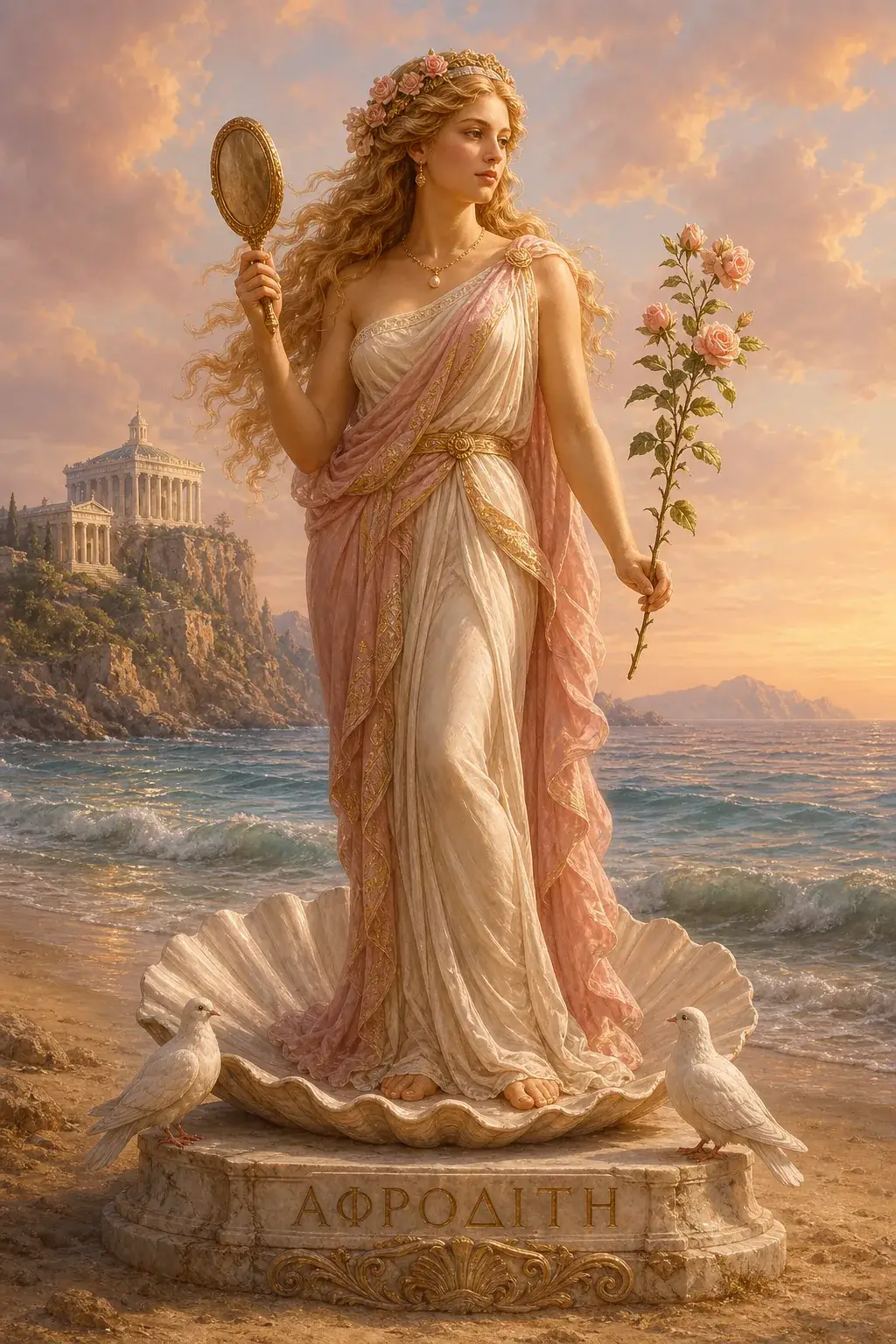
Main attributes: shell, doves, roses, golden mirror, kestos himas (girdle of seduction)
Main cult sites: Paphos (Cyprus), Knidos, Kythera, Corinth
Roman counterpart: Venus
Classification
Aphrodite myths are attested in literature from Homer onward (8th century BC); archaeologically, precursors, a Cypriot goddess of love and fertility with roots in the Phoenician Astarte, can be traced back as far as the 12th century BC. Hesiod’s Theogony and the Homeric Hymn to Aphrodite shape the classical image.
In Roman times she merges as Venus with the Italic goddess of vegetation and becomes the ancestral mother of the gens Iulia.
The centres of the Aphrodite cult are Cyprus (Paphos, Idalion, Amathus; the island was regarded as her birthplace), Kythera, Corinth, Knidos in Asia Minor (with the famous Aphrodite of Praxiteles), Athens and Sicily. With the Roman reception as Venus, her sphere of influence extends across the entire empire.
The core consists of the Homeric Hymn to Aphrodite, Hesiod’s Theogony (birth myth), Sappho’s lyric poetry (personal invocations) and the poetry of Anacreon. Added to these are inscriptions from Paphos and Knidos, Attic vase painting, the Knidian Aphrodite of Praxiteles and Roman receptions (Lucretius, Virgil). Later systematic sources: Apollodorus, Pausanias.
Name and Variants
Greek: Aphrodite. The ancient folk etymology derives the name from aphrós (“foam”) and connects it with the birth myth. Modern scholarship favours Phoenician roots via Astarte and Asherah.
Epithets: Urania (heavenly Aphrodite), Pandemos (communal, common), Anadyomene (she who rises from the water), Cypria (the Cypriot), Cytherea (she of Kythera), Areia (the warlike, in Sparta). In Homer also chrysé (the golden) and philomeidés (the laughing). Roman: Venus.
Description
Appearance
Aphrodite is depicted as a young woman of perfect beauty, often half or fully unclothed; the famous Aphrodite of Praxiteles at Knidos (4th century BC) is regarded as the first fully nude depiction of a goddess in Greek art and became an ancient “place of pilgrimage”.
In the archaic period she appears more often clothed, in a flowing peplos and veil; in the classical and Hellenistic periods increasingly disrobed.
Attributes
Shell (birth myth; the Aphrodite Anadyomene rises from a shell), doves or swans (the animals that draw her chariot), roses, myrtle, golden mirror, the kestos himas (an elaborately embroidered girdle of seduction that makes anyone desirable), pomegranate. Companions: Eros (often depicted as her son), the three Charites (Graces), Peitho (persuasion), Himeros (desire), Pothos (longing).
Profile: Aphrodite
The most important aspects of Aphrodite at a glance. The table summarises origin, function, appearance, veneration, symbols and parallels.
Two competing birth myths: according to Hesiod (Theogony) she arises from the sea foam that forms from the genitals of Uranus cut off by Cronus, making her older than the Olympian generation.
According to Homer (Iliad) she is the daughter of Zeus and Dione. The tension between the two myths reflects the ancient distinction between Aphrodite Urania (heavenly, cosmic) and Aphrodite Pandemos (communal, Olympian).
Patroness of eros, beauty, courtship and marriage. Beyond the purely erotic sphere she is also a goddess of vegetation (spring, blossom) and, in some local traditions, warlike (Aphrodite Areia in Sparta, presumably an old legacy of the Phoenician Astarte).
A young woman of perfect beauty with golden hair, in flowing robes or unclothed. Frequently with a mirror and a rose; doves at her feet or in her hair. Accompanied by Eros and the Charites. In the Anadyomene motif she rises from an opened shell or from the water.
Main cult sites: Paphos on Cyprus (birthplace, a cult stone as pictorial symbol, aniconic veneration as in the Phoenician cult), Knidos (the Praxiteles statue as a destination for ancient pilgrimage), Kythera, Corinth (with a contested tradition of “temple prostitution”, critically debated in scholarship), Athens.
Offerings: doves (the main sacrificial animal), roses, incense, and in Corinth also cocks.
Shell, doves, swans, roses, myrtle, the kestos himas (girdle of seduction), golden mirror, pomegranate. Also the apple, linked through the Judgement of Paris with the Trojan War.
Venus (Rome), Turan (Etruscans), Astarte (Phoenicia), Inanna and Ishtar (Mesopotamia), Hathor and Isis (Egypt), Freyja (Germanic), and in part Lakshmi (Hinduism). The Phoenician Astarte is regarded as the direct source deity for the Cypriot tradition.
Veneration in Everyday Life
Aphrodite was strongly present in both private and public life. Unlike Zeus, she was a deity who was called upon directly in personal matters: before a wedding, in the sorrow of love, in concerns about fertility.
Girls dedicated toys and locks of hair to her before marriage, women dedicated mirrors and jewellery. Men asked her for success in courtship. In lyric poetry, especially in Sappho’s invocations, she appears as an immediately approachable adviser in the distress of love.
In the public cult her great festivals, the Aphrodisia on Cyprus and in Athens, took place in spring, often with processions, animal sacrifices (doves) and feasts. The Knidian Aphrodite statue drew ancient educational travellers from across the Mediterranean; Pliny reports special structures that made it possible to walk around the statue.
Aphrodite, Parallels in Other Cultures
Roman Tradition
Venus takes over most of Aphrodite’s functions and is politically charged through the claim of the Julii (Caesar, Augustus) to descend from her as their ancestral mother. In the Aeneid, Virgil makes her the divine mother of Aeneas and thereby the ancestress of Rome.
Phoenician-Cypriot Tradition
Astarte and Aphrodite are barely separable in the Cypriot cult. The oldest sanctuaries at Paphos show a cult stone (omphalos-like) that suggests an imageless veneration as in the Phoenician cult. Astarte inscriptions from Idalion and Kition attest the continuity.
Mesopotamian Tradition
Inanna (Sumer) and Ishtar (Akkad/Babylon), as goddesses of love and war, share with Aphrodite the connection of eros and aggression as well as the mythical motif of the dying beloved (Tammuz/Adonis). The Adonis myth travels directly via Cyprus and Syria into the Greek Aphrodite circle.
Egyptian Tradition
Hathor, as a goddess of love, music and fertility, is identified syncretistically with Aphrodite in the Hellenistic period (Hathor-Aphrodite in Alexandria). Isis too takes on Aphrodite-like features in the Roman imperial era.
Germanic Tradition
Freyja shares with Aphrodite the protective function over love and fertility, but more strongly adds the warlike and death-related dimension (sharing the fallen with Odin).
Literature (Selection)
Further standard works in the literature index.
Two Birth Myths and Their Interpretation
The ancient tradition knows two different accounts of Aphrodite’s origin, and even ancient authors noticed this contradiction. The first appears in Hesiod’s Theogony. There Aphrodite arises from the foam of the sea that forms around the genitals of the castrated Uranus thrown into the water.
She rises from the sea at Kythera and then at Cyprus, which is why she bears the epithets Kythereia and Kypris. This version makes her one of the oldest deities of all, older than Zeus and the Olympian generation.
The second account, which appears among others in Homer, calls Aphrodite a daughter of Zeus and Dione. Here she is a regular Olympian of the younger generation of gods.
In his Symposium, Plato turned this twofold ancestry into a philosophical distinction: the Aphrodite Urania, the heavenly one, who stands for a higher, spiritual love, and the Aphrodite Pandemos, the common one, responsible for physical love.
Religious studies today interpret the two myths less as a contradiction than as an indication of different layers of origin. The foam birth, with its firm connection to Cyprus and the eastern Mediterranean, is often associated with the influence of Near Eastern goddesses such as Ishtar and the Phoenician Astarte.
Cyprus was a hub between the Greek and the Near Eastern world, and the Aphrodite cult there, especially in Paphos, is regarded as an important link. The integration into the Olympian lineage would then be the later attempt to place an originally foreign or independent goddess into the Greek pantheon.
Eastern Roots and the Cult on Cyprus
Aphrodite’s connections to the eastern Mediterranean are a central theme of scholarship. Several of her traits point beyond the genuinely Greek world of gods. These include the connection with war that appears in some cults, for example in Sparta, where Aphrodite was also depicted armed.
They include the close bond with a dying and returning beloved, the beautiful Adonis, whose very name derives from the Semitic word for lord. Such motifs have counterparts in the cult of the Mesopotamian Ishtar and her beloved Dumuzi, as well as in the Syrian-Phoenician Astarte.
The sanctuary of Paphos on Cyprus was one of the most famous of the ancient world. It is remarkable that the goddess was long venerated there not in human form but in the form of a conical stone, a cult form reminiscent of Near Eastern models.
Ancient authors report a rich cult operation with its own priesthood. Kythera too, the second island of her birth legend, lay on an old sea trade route.
Older scholarship sometimes concluded from these observations that Aphrodite was simply an imported oriental goddess. More recent work judges more cautiously. It emphasises that the Greek Aphrodite emerged from a long encounter of different traditions and that there is no single point of origin.
In his studies on the cultural exchange between the Orient and Greece, Walter Burkert worked out this interweaving. What is certain is that Aphrodite stands at the interface between the Greek and the Near Eastern religious world, and that her cult on Cyprus forms a key piece of evidence for this exchange.
Aphrodite in the Trojan Cycle
Aphrodite is deeply woven into the cycle of myths surrounding Troy. It begins with the Judgement of Paris. The three goddesses Hera, Athena and Aphrodite quarrel over who is the most beautiful, and the Trojan prince Paris is to decide.
Aphrodite promises him the most beautiful woman in the world and wins the contest. The promised woman is Helen, the wife of the Spartan king Menelaus. Her abduction by Paris triggers the Trojan War. Aphrodite thus bears a share of the blame for the war, a trait that Greek poetry does not gloss over.
In Homer’s Iliad, Aphrodite stands on the side of Troy. She intervenes several times, for instance when she rescues Paris in single combat by wrapping him in a cloud and carrying him out of the battle.
In a famous scene she is herself wounded on the hand by the Greek hero Diomedes when she tries to protect her son Aeneas. Wounded and weeping, she withdraws to Olympus, where Zeus admonishes her to keep out of the business of war and to hold to the works of love.
This episode is instructive for the history of religion. It assigns Aphrodite a clearly defined sphere and sets her apart from the war deities.
At the same time, her connection to Aeneas points to a significant aftermath: in the Roman tradition, Aeneas is regarded as the forefather of the Romans, and thus Aphrodite, Roman Venus, becomes the divine ancestress of Rome and especially of the lineage from which Caesar and Augustus descended.
From a scene of the Iliad thus arises a building block of Roman imperial ideology.
Aphrodite in the Visual Arts
Few deities have shaped ancient and post-antique art as much as Aphrodite. In the early and classical period she was at first depicted clothed.
A turning point is marked by the Aphrodite of Knidos by the sculptor Praxiteles from the 4th century BC. It is regarded as the first life-sized depiction of the goddess in the nude and caused a great stir in antiquity.
The original is lost, but numerous Roman copies give an impression of the type: the goddess in the act of bathing, with one hand in a protective gesture.
In the Hellenistic period further famous statue types arose, among them the Aphrodite of Melos, better known as the Venus de Milo, and the crouching Aphrodite.
These works were copied many times in Roman times and adorned houses, gardens and public spaces. On vases, mirrors and jewellery the goddess often appears with her attributes: the dove, the sparrow, the shell, the apple and the little Eros.
The afterlife of this pictorial tradition reaches into the present. In the Renaissance, painters such as Botticelli took up the ancient foam birth again with the Birth of Venus, and ever since, Venus, as Aphrodite is called in Latin, has been a fixed part of European art history.
For religious studies, this rich pictorial tradition is at once a source and a problem: it shows how the goddess was seen, but directs attention strongly to the aspect of physical beauty and can push into the background the cultic and cosmological role of Aphrodite, for instance as the power that, according to Hesiod and the philosopher Empedocles, holds the world together.
Frequently Asked Questions about Aphrodite
Who is Aphrodite in Greek mythology?
Aphrodite is the Greek goddess of love, beauty and fertility, one of the twelve Olympian gods.
Two birth versions exist: according to Homer she is the daughter of Zeus and Dione; according to Hesiod she arose from the foam (aphros) produced by the genitals of the castrated Uranus thrown into the sea, hence Aphrodite (the foam-born).
She was washed ashore at Cyprus and Kythera, hence her epithets Kypris and Kytherea. Her Roman counterpart is Venus.
What was the Aphrodite sanctuary on Cyprus?
Paphos on Cyprus was one of the most significant Aphrodite sanctuaries of the ancient world, active for about 1,500 years. Here the goddess is said to have risen from the sea. The sanctuary was so prominent that Roman emperors made pilgrimages there (for example Titus in AD 69).
Whether the cult practice, as in the Phoenician mother cult, included ritual temple prostitution is highly disputed in scholarship. Herodotus describes such a custom for Babylon, not for Paphos. The sanctuary survived into the 4th century AD, when the Christianising imperial policy put an end to it. The ruins are today a UNESCO World Heritage Site.