iWell Guard

Namarrkon, creator of lightning and thunder in the Aboriginal tradition of West Arnhem Land

Namarrkon is the “Lightning Man” of the Kunwinjku and neighbouring Aboriginal groups in West Arnhem Land, northern Australia. He brings the monsoonal thunderstorms of the Wet Season, strikes trees with his stone axes, and is a central creator being of the region.

CreatorAboriginalBeing of lightning and thunder

Table of Contents

Namarrkon - gods from the Aboriginal tradition, historical and illustrative

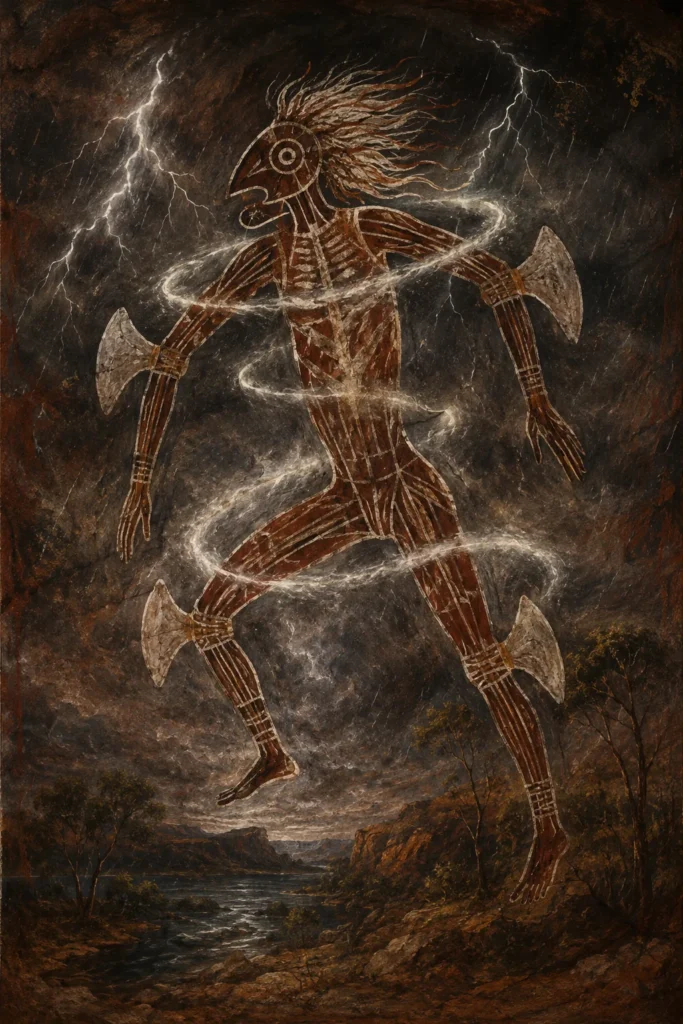
Namarrkon, the thunder creator of the Aboriginal tradition of West Arnhem Land, strikes the thunder with his stone axes.

Classification and Brief Profile

Namarrkon (also Namarrgon, Namarrgun) is the “Lightning Man” of the Kunwinjku and neighbouring Aboriginal language groups in western Arnhem Land (Northern Territory). He is one of the principal figures of Kunwinjku mythology and at the same time one of the most frequent depictions in the rock art of Kakadu National Park.

Within the Aboriginal tradition, Namarrkon is a creator figure of the monsoonal Wet Season; he brings the thunderstorms that characterise the tropical monsoonal climate of northern Australia. His relationship to the Rainbow Serpent is close but functionally distinct: while the Rainbow Serpent is generally associated with water, Namarrkon is specialised in lightning and thunder.

In terms of the phenomenology of religion, Namarrkon belongs to the class of “thunderers”, a family of gods found across many religions that includes Indra (Vedic), Thor (Germanic), Zeus (in his thunder function, Greek), Shango (Yoruba) and Tlaloc (Mesoamerican).

Name and Etymology

The name Namarrkon is a compound in the Kunwinjku idiom: namarr- is a prefixed stem suggesting “flash of light” or “electrical discharge”, combined with the personal suffix -kon. Literally, then, something like “The Lightning Man” or “The Bringer of Lightning”.

In neighbouring languages he is named somewhat differently: Namarrgun in the standard Kunwinjku variant, Wagilag-Namarrkon in some Yolngu-related traditions, Walarringgu in the Rembarrnga tradition. This diversity reflects the place-bound differentiation of Aboriginal religion.

In Aboriginal Art (1998), Howard Morphy systematically described the regional variations of the Namarrkon complex. His linguistic and pictorial tradition is one of the best examples of the close connection between linguistics and the ethnology of religion.

Description and Iconography

In the Kunwinjku tradition, Namarrkon is described as a powerful man surrounded by lightning. In rock art he is typically depicted in “X-ray style”: with visible internal organs, framed by arcs of lightning, with stone axes on his knees, elbows and ankles. These stone axes produce the thunder.

The “X-ray style” is characteristic of the Kunwinjku rock-art tradition and is regarded as one of the latest stylistic forms, having probably developed within the last 2,000 to 4,000 years. Charles P. Mountford first described it systematically in Records of the American-Australian Scientific Expedition (1956).

In the contemporary bark-painting tradition of the Maningrida and Gunbalanya region, Namarrkon continues to be depicted in “X-ray style”. Artists such as Bardayal “Lofty” Nadjamerrek, Spider Namirrkki and John Mawurndjul have created iconic Namarrkon works that can be seen in many museums worldwide.

Mythological Narratives

The central Namarrkon narrative describes his role in the Wet Season: during the dry period Namarrkon rests in a sacred waterhole at Lightning Dreaming Country (east of Gunbalanya).

With the onset of the Wet Season he awakens, ascends to the sky and brings the monsoonal thunderstorms. The lightning bolts are the strikes of his stone axes; the thunder is their rolling.

A second narrative recounts how Namarrkon created the first stone axes and attached them to his body. This creation narrative links his function (bringer of lightning) with the stone-axe technology of the Kunwinjku, which archaeologically reaches far back into prehistory.

A third narrative describes a conflict between Namarrkon and a harmful figure who seeks to prevent the bringing of rain. Namarrkon prevails by throwing his stone axes, an aetiological myth that explains the annual return of the Wet Season.

Cult and Veneration

In the Kunwinjku tradition Namarrkon has no independent cult, but he is part of several initiation and seasonal rituals. Before the onset of the Wet Season he is “invited” by the tribal elders; certain sacred waterholes in his country are visited and tended ritually.

During the Wet Season itself, certain taboos are observed: loud noises, whistling, or touching certain trees may “disturb Namarrkon”. These rules have a clear ecological background: caution against lightning strikes in storm conditions.

In contemporary Kunwinjku practice, Namarrkon is kept alive above all through the bark-painting tradition. The annual “Maningrida Festivals” and other Aboriginal art events bring Namarrkon images to an international public.

Protective Practice and the Apotropaic

Described in religious-studies terms: apotropaic practices in the Namarrkon complex aim at avoiding lightning damage during the Wet Season. Prohibited are: speaking loudly during a storm, standing under isolated trees, swimming in open bodies of water during a storm.

A particular protective practice is the avoidance of certain rock-art sites during the Wet Season; one does not enter Namarrkon’s rock-art sites when he is “active”. This rule is part of the broader Aboriginal practice of treating sacred places in a seasonally differentiated way.

From an external ethnographic perspective, these practices are everyday-structuring rules that combine ecological caution (lightning protection) with religious practice. In terms of the phenomenology of religion, this is a classic example of the “ecological function” of traditional taboos.

Parallels in Other Cultures

Thunderer deities are attested worldwide in the phenomenology of religion. Structurally comparable are: Indra (Vedic), Thor (Germanic), Zeus in his thunder function (Greek), Jupiter Tonans (Roman), Shango (Yoruba), Tlaloc (Mesoamerican), Raijin (Japanese). In Siberia, Khormusta is typologically related in his Vajra function.

The point of interest in the phenomenology of the thunderers is their dual function: they bring life-giving rain and at the same time deadly lightning. Namarrkon is a classic example here; the Kunwinjku tradition explicitly reflects this dual nature.

Namarrkon’s connection with the monsoonal Wet Season is specific in the history of religion: it makes him the embodiment of the northern Australian tropical climate cycle. In the more southerly Aboriginal traditions of Australia this specialisation is absent; there the thunderers are less prominent.

Present-Day Reception and Research

The most important early source is Charles P. Mountford’s Records of the American-Australian Scientific Expedition to Arnhem Land (1956), vol. 1 (Art, Myth and Symbolism). This extensive documentation contains much Namarrkon-related material.

Howard Morphy’s Aboriginal Art (Phaidon 1998) and Luke Taylor’s Seeing the Inside (1996) are the most important contemporary art-historical studies of the Namarrkon tradition. Both works link rock-art material with modern bark-painting practice.

George Chaloupka’s Journey in Time (1993) is the most important study of the Kakadu rock art, in which Namarrkon is prominently represented. Chaloupka’s chronology of the rock-art styles is now standard.

Research Debates and Open Questions

Several research debates revolve around Namarrkon. First: how old is the Namarrkon conception? The “X-ray style” rock art is relatively young (perhaps 2,000 to 4,000 years); older rock-art styles show lightning-like beings that are typologically related but not necessarily identical.

Second: what is Namarrkon’s relationship to the Rainbow Serpent? In some narratives they are connected with one another (Namarrkon as “lightning serpent”); in others they are clearly separate beings. The relationship varies by region.

Third: how is the Namarrkon tradition changing in the face of climate change? The monsoonal Wet Season of northern Australia is increasingly subject to anomalies, which affects the religious significance of Namarrkon. Indigenous climate critique increasingly takes up this aspect.

Namarrkon and the Kakadu Rock-Art Complex

Namarrkon’s place in the Kakadu rock-art complex deserves a closer look. Kakadu National Park, a UNESCO World Heritage Site since 1981, contains thousands of rock paintings, several hundred of which are depictions of Namarrkon. This concentration makes Kakadu the most important visual archive of the Namarrkon tradition.

In Journey in Time (1993), George Chaloupka presented a comprehensive study of the Kakadu rock-art tradition. His standard work is now regarded as the most important reference; it contains detailed descriptions and datings of Namarrkon images spanning several millennia.

Particularly interesting from a religious-studies perspective: the rock art continues to be cared for by the traditional owners (today’s Kunwinjku communities); some images are ritually “renewed” (repainted). This care is part of the living Namarrkon tradition and not merely archaeological preservation.

Namarrkon in Contemporary Bark Painting

The bark-painting tradition of the Kunwinjku region has attracted international attention since the 1950s. Namarrkon is one of the most frequent motifs of this tradition. Well-known artists such as Bardayal “Lofty” Nadjamerrek (1926, 2009), Spider Namirrkki and John Mawurndjul have created iconic Namarrkon works.

In several essays, Howard Morphy has shown how the transition from ritual rock painting to marketable bark painting has changed the religious function without falsifying the tradition. The works are today exhibited in many major museums: Musée du Quai Branly Paris, British Museum London, National Gallery of Australia Canberra.

From the perspective of the sociology of religion, this development is a textbook case: indigenous religion continues to be cultivated through an art economy without giving up its religious character. The Aboriginal communities have developed mechanisms for dealing with this dual function.

Methodological Reflection and Sources

Several methodological problems arise in Namarrkon research. First: the archaeological dating of the “X-ray style” is disputed; different methods yield different results. A consensus chronology is still lacking.

Second: much Namarrkon knowledge is not “restricted” in the strictest sense, but is deeply embedded in local practice. Respectful work with the sources is required, agreed upon with the traditional owners.

Third: the art-historical and the religious-anthropological perspectives on Namarrkon should work together. Both disciplines have their strengths; treating them in isolation misses the depth of the Namarrkon tradition.

Those wishing to study the Namarrkon complex in its breadth will find on the overview page Aboriginal tradition the most important cross-references to related figures such as the Rainbow Serpent, the Mimi spirits and the Wandjina.

Namarrkon and Kakadu's UNESCO Status

Kakadu National Park has been a UNESCO World Heritage Site since 1981, both for its natural richness and for its cultural depth. The rock art in which Namarrkon prominently appears is a central part of the UNESCO recognition.

This international recognition has ambivalent consequences. On the one hand it secures the preservation of the rock-art sites; on the other hand it transforms them into “World Heritage objects”, which changes religious practice itself. The traditional owners (Bininj/Mungguy) today administer the park jointly with the Australian government.

From the perspective of the sociology of religion, Kakadu is a textbook case of the contemporary entanglement of indigenous religion, nature conservation, tourism and international heritage protection. This entanglement will continue to grow in importance over the coming decades.

Namarrkon and Climate Change in the Top End

A current research perspective connects the Namarrkon tradition with the consequences of climate change for the Aboriginal communities of the Top End. The monsoonal Wet Season cycle, which is economically, ecologically and religiously central to the region, is increasingly subject to anomalies.

Changing rainfall patterns, rising sea levels (which threaten the coastal rock-art sites), more frequent extreme weather events: all of this directly affects the Namarrkon tradition. Indigenous climate critique increasingly takes up these aspects.

From the perspective of the anthropology of religion, this turn is interesting. A religious tradition that has been interwoven with the monsoonal cycle for millennia is being brought into a novel tension by anthropogenic climate change. Scholars such as Tyson Yunkaporta and Marcia Langton have conceptualised this tension as an indigenous climate theology.

Namarrkon and Aboriginal Astronomy

An astronomical dimension worth exploring is Namarrkon’s anchoring in the Aboriginal night sky. In the Kunwinjku traditions, Namarrkon is identified with certain stars or stellar constellations that rise in the sky with the onset of the Wet Season.

The Aboriginal astronomy of the Top End groups has become a field of research in its own right in recent decades. Duane Hamacher and others have shown that the traditional astronomical observations are remarkably precise and correspond to modern scientific observations.

This astronomical anchoring is important in terms of the phenomenology of religion. Namarrkon is not only a religious being but a cosmological constant. He “announces himself” through certain stellar constellations; the ritual practices follow this astronomical calendar.

Namarrkon and the Kakadu Joint Management Plan

Kakadu National Park has been administered since 1976 under a joint management plan between the traditional owners (Bininj/Mungguy) and the Australian government. This administrative structure is one of the first of its kind worldwide; it has become a model for similar structures elsewhere.

The plan includes the care of the rock-art sites, including the Namarrkon images, according to traditional rules. Repainting is carried out under the supervision of the traditional owners; tourist routes are planned so that sensitive sites are protected.

From the perspective of the sociology of religion, Kakadu is a textbook case of the integration of indigenous religion into modern administrative structures.

Here Namarrkon is a religious figure and at the same time a point of reference for administration. This dual function changes the religion itself, a phenomenon that must be analysed carefully in the anthropology of religion.

Namarrkon and Aboriginal Weather Knowledge

An ethnologically interesting dimension worth exploring is the connection between Namarrkon and Aboriginal weather knowledge. The Top End Aboriginal people recognise a six-part seasonal calendar that is far more differentiated than the Western four-season calendar.

Among the Kunwinjku a distinction is made between: Gunumeleng (pre-monsoon), Gudjewg (monsoon), Banggerreng (end of the storms), Yegge (cool transitional period), Wurrgeng (cold dry season), Gurrung (hot dry season). Namarrkon is associated with Gunumeleng and Gudjewg.

This finely calibrated weather classification is an extraordinary example of indigenous ecological knowledge. It combines observation, religion and practical life organisation into an integrated form. Here too, Namarrkon is not “merely” a religious figure but part of a comprehensive knowledge ecology.

Namarrkon and the Maningrida Artists' Association

The Maningrida artists’ association (Maningrida Arts and Culture) is one of the most important centres of contemporary Aboriginal art in northern Australia. It represents several hundred artists from various language groups of the region. Namarrkon motifs are part of the established repertoire of these artists.

The association is interesting from the perspective of the sociology of religion, because it combines traditional practice with modern marketing. Artists receive fair prices for their works; the association secures cultural continuity and economic sustainability. This dual function has become a model for similar initiatives elsewhere.

From the perspective of the anthropology of religion, a contemporary mode of indigenous religion shows itself here: it survives through tradition and through innovation alike. Namarrkon is not a figure of the past but a continuously reinterpreted religious reality in the Maningrida region.

The Cicada That Announces the Thunder: Namarrkon in the Annual Cycle of Arnhem Land

The Lightning Man Namarrkon, also written Namarrgon, is closely tied in the tradition of western Arnhem Land to a precisely observed natural process.

Unlike an abstract weather god, Namarrkon is linked to a concrete seasonal event that speakers of Kunwinjku and neighbouring languages capture in a differentiated seasonal calendar. This calendar recognises not two or four but up to six seasons, tied to wind, humidity, flowering times and the behaviour of animals.

Part of this system is the link between Namarrkon and a particular cicada known in the region as the Leichhardt’s grasshopper cicada, which bears its own name in local languages.

This brightly coloured insect appears towards the end of the dry season, shortly before the first heavy thunderstorms of the coming rainy season set in. In the tradition, the cicada is regarded as a child or messenger of the Lightning Man.

Its appearance announces that Namarrkon will soon become active again, that thunder and lightning are returning and that preparation for the rainy season must begin. The figure thus explains the storm and, beyond that, belongs to a body of practical knowledge that structures the year.

Namarrkon himself is depicted in the narratives and in rock art with stone axes that sit on his elbows and knees, with which he makes the clouds thunder and the earth burst open. A luminous band surrounding him is interpreted as lightning.

A well-known painted depiction of this figure is found on a rock face in present-day Kakadu National Park and is among the most visited rock-art sites in Australia, which raises its own questions of protection and appropriate treatment.

Important for an accurate account is that the connection between cicada, the onset of storms and the Lightning Man was not introduced from outside, but is part of the oral tradition of the traditional owners and has been attested in ethnographic works on the natural knowledge of Arnhem Land.

It shows that the figure of Namarrkon does not stand in opposition to precise natural observation, but is its religious form. Seasonal forecasting and the mythical narrative are two sides of the same knowledge in this tradition.

Literature (Selection)

  • Howard Morphy: Aboriginal Art (Phaidon 1998)
  • Luke Taylor: Seeing the Inside (1996)
  • Charles P. Mountford: Records of the American-Australian Scientific Expedition (1956)
  • Ronald M. Berndt & Catherine H. Berndt: Man, Land and Myth (1970)
  • George Chaloupka: Journey in Time (1993)
  • Tony Swain: A Place for Strangers (1993)
  • Lynne Hume: Ancestral Power (2002)

Namarrkon is the creator of lightning and thunder in the Aboriginal tradition of West Arnhem Land in northern Australia.

In the visual language of the rock paintings of the Kakadu region he appears as a humanlike figure with stone axes on his elbows and knees, with which he shatters the clouds. His activity is closely bound to the wet monsoon season between October and March.

As the lightning spirit of West Arnhem Land, Namarrkon strikes the clouds with stone axes on his knees and elbows; the oral sources of the Kunwinjku link him with the monsoon season and with rock paintings in the Kakadu region.

Related key terms: Namarrkon Kunwinjku Arnhem Land lightning Wet Season rock art.

iWell Guard and Protective Traditions

iWell Guard draws on the cultural-historical tradition of portable protective objects, in the tradition of the Aboriginal people and many other cultures worldwide. 41 layers, solid gold, platinum, silver, made in Germany. 30-day right of return.

Personal experiences may vary. Not a medical device. No healing promise.

Classification & Protection

IIILEVEL
The Protection Compass assigns this being to influence level III, Burdensome influence.

Against its influence, cross-cultural tradition names these protective means:

Compare in the Protection Compass →

Recommended protective means

iWell Guard

The simplest protective means in this collection: 41 layers of fine gold 999, platinum, silver and silicon, manufactured in Ruhla, Thuringia. It requires no activation, is bound to no person, and is effective within a radius of around 50 meters, even without being worn.

All protective means at a glance →