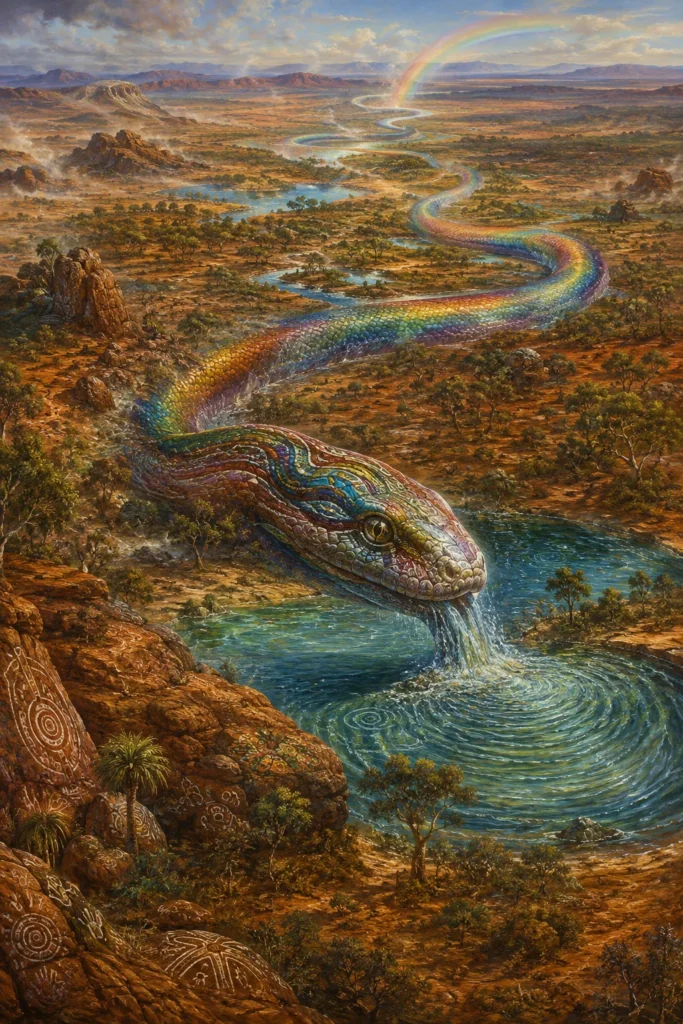
The Rainbow Serpent (in various languages also Wanambi, Galeru, Ngalyod, Yurlungur) is one of the most widely attested and oldest creator figures in Australian Aboriginal religions.
The Rainbow Serpent is the central creator figure in Australian Aboriginal traditions.
The Rainbow Serpent is documented in nearly all Aboriginal language groups of Australia, with locally distinct names: Ngalyod in Arnhem Land (Kunwinjku), Yurlungur in Yolnu, Wanambi in the Western Desert, Galeru among the Yorubareke, Wagyl in the southwest (Noongar).
Despite this linguistic diversity, the concepts share common structural features: serpent as form, water as element, rainbow as manifestation, and creative power as function.
The term “Rainbow Serpent” was introduced in 1926 by anthropologist A. R. Radcliffe-Brown as a scholarly collective designation. Tony Swain cautioned in A Place for Strangers (Cambridge 1993) against conflating this collective term with a single unified Aboriginal deity; rather, it refers to a family of related but locally distinct beings.
Within the Aboriginal tradition, the Rainbow Serpent is one of the oldest religious concepts in Australia.
Rock paintings depicting it in Arnhem Land have been dated to up to 6,000 years ago; some researchers (Paul Tacon, Christopher Chippindale) date them back as far as 8,000 years, making the Rainbow Serpent potentially the oldest continuously attested religious figure in the world.
A unified etymology is not possible given the linguistic diversity. The most important regional names are: Ngalyod (Kunwinjku, western Arnhem Land), Almudj (Mayali), Yurlungur (Yolnu, eastern Arnhem Land), Wititj (Yolnu, female variant), Wanambi (Pitjantjatjara, Western Desert), Galeru (Wuradjeri), Wagyl (Noongar, Western Australia), Bolung (Jawoyn).
In Yolnu versions the Rainbow Serpent is dual: Yurlungur as the male aspect, Wititj as the female; both belong to the Wagilag Sisters narratives. This gender duality is significant from a phenomenology-of-religion perspective and distinguishes the Yolnu tradition from many other Aboriginal groups.
Howard Morphy demonstrated in Aboriginal Art (Phaidon 1998) the connection between linguistic diversity and iconographic diversity: each language group has its own representational conventions corresponding to local language versions.
The Rainbow Serpent appears in Aboriginal art in a variety of forms, each referring to specific regional traditions. The most common form is a long, multicolored serpent with head fins or horns; crocodile, kangaroo, or bird elements are often incorporated.
The painting follows regional styles, such as the rarrk cross-hatching in western Arnhem Land or the dot style of central Australia.
It resides in deep waterholes (billabongs), which are considered its dwelling places and are precisely recorded on traditional maps. Such waterholes are sacred places subject to strict taboos; desecrating them is regarded as causing storms, illness, or the serpent’s departure from the waterhole.
The oldest preserved depictions are the rock paintings at Mount Brockman, Cadell, Ubirr, and Nourlangie in Kakadu, as well as at the Wallaroo Plateau. Paul Tacon and Christopher Chippindale placed these images in chronological order in Australian Archaeology (1998).
The most important narrative is that of the Wagilag Sisters (Yolnu, Arnhem Land): two sisters journey in search of food; they violate a waterhole taboo by contaminating it; Yurlungur, the Rainbow Serpent, emerges, swallows them, regurgitates them, and thereby establishes the central Yolnu initiation rites.
W. Lloyd Warner first documented this narrative systematically in A Black Civilization (1937).
In the Kunwinjku tradition (western Arnhem Land), Ngalyod shapes the landscape by travelling through the territory during the Dreaming time, leaving rivers, mountains, and waterholes behind with its body. This creation mythology is a classic example of Aboriginal topography: landscape as the material result of mythic movement.
Among the Noongar (southwestern Western Australia), the story is told of how Wagyl descended from the mountains and formed the Swan River that flows through Perth today. This narrative remains alive in the urban Aboriginal context and is referenced in official tourism materials.
The Rainbow Serpent stands at the centre of several initiation complexes. The most important is the Yolnu-Wagilag complex, in which young men are initiated into the first mysteries of tribal religion through songs, dances, and body paintings that performatively re-enact the serpent narrative. Ronald M. Berndt described this complex in detail in Kunapipi (1951).
In the Kunwinjku tradition, the Rainbow Serpent forms part of the mardayin complex, the highly secret male initiations. Entry into these mysteries occurs gradually over several years of life.
In everyday practice, the Rainbow Serpent is “notified” before any crossing of a waterhole: a quiet call, a brushing of sand across the forehead, sometimes throwing a handful of stones into the water. This everyday courtesy belongs to the continuously living Aboriginal religion.
From a religious-studies perspective: apotropaic practices within the Rainbow Serpent complex are aimed less at warding off harm than at preserving the purity of sacred places.
Prohibited acts include spitting into sacred waterholes, throwing human waste or rubbish into the water, using the water site in the wrong season, and approaching without the permission of tribal elders.
Within the tradition, violating these taboos is regarded as triggering storms, floods, and illness. One well-known account: when in 1953 a mechanical excavator was sent by Perth authorities to straighten the Swan River, the Noongar elders protested by invoking Wagyl. The plan was later abandoned.
From the external ethnographic perspective, these practices are everyday structural rules that interweave ecological caution with social respect. Deborah Bird Rose described this interweaving in Dingo Makes Us Human (1992) as “country religion.”
Serpent creators are a broadly attested motif in the phenomenology of religion. Structurally comparable figures include: Quetzalcoatl in Mesoamerica, the Naga serpents in Hinduism and Buddhism, the Greek Echidna, the Norse Midgard Serpent, the Egyptian Wadjet, and the Persian Azhi Dahaka. In Polynesia there are serpent aspects of Tangaroa.
Despite these broad parallels, the Rainbow Serpent is unique in the history of religions for its great age, its continuous attestation (rock paintings since the Holocene), and its integral connection with Aboriginal topography. It is not simply a “snake god among many” but part of a specific continental religious tradition.
Mircea Eliade attempted in Australian Religions (1973) to situate the Rainbow Serpent within his phenomenological framework; W. E. H. Stanner criticised him for not giving sufficient weight to the specific Australian topography.
The Rainbow Serpent is today one of the most widely recognised Aboriginal symbols worldwide. It appears on postage stamps, in the official emblems of several Aboriginal organisations, and in international art contexts (Documenta, the Australian Pavilion at the Venice Biennale).
Key scholarly works: A. R. Radcliffe-Brown: The Rainbow-Serpent Myth of Australia (1926); Ronald M. Berndt and Catherine H. Berndt: The World of the First Australians (1964); Tony Swain: A Place for Strangers (1993); Howard Morphy: Aboriginal Art (1998); Lynne Hume: Ancestral Power (2002).
A distinct research strand is concerned with the archaeological dating of Rainbow Serpent rock paintings. Paul Tacon and Christopher Chippindale have contributed foundational work in this area since the 1990s.
Several research debates surround the Rainbow Serpent. First: is it an originally shared figure or a convergence of locally developed serpent beings? Tony Swain argues for the second reading and warns against the “pan-Aboriginal trap.”
Second: how did the Rainbow Serpent concept change with the inundation of today’s coastal regions of Australia by rising seas (approximately 6,000 to 7,000 years ago)? Paul Tacon has postulated a correlated spread of this concept.
Third: what gender aspects does it have? In many traditions it is male, in others female, and among the Yolnu it is dual. This variability is instructive from a history-of-religions perspective and is the subject of contemporary gender studies.
The connection between the Rainbow Serpent and the Aboriginal concept of Country deserves closer attention. In Aboriginal understanding, land is not passive matter but a living co-agent with its own history and kinship. The Rainbow Serpent shaped Country during the Dreaming time by travelling through it and leaving behind water, mountains, and plants.
Deborah Bird Rose introduced the concept of Country as a central category of Aboriginal religion in Nourishing Terrains (1996). Country encompasses not only geographical space but the totality of relationships among people, animals, plants, ancestors, and mythical beings.
Within this logic, the Rainbow Serpent is not merely a deity but a constitutive part of Country itself. This ontological entanglement is a distinct category in the phenomenology of religion that cannot readily be captured by Western monotheistic concepts.
Contemporary Aboriginal art, present on the international art market since the 1970s, frequently draws on the Rainbow Serpent. Well-known artists such as Yirawala (Kunwinjku), Crusoe Kuningbal, John Mawurndjul, Mick Kubarkku, Yvonne Koolmatrie, and in the west Wagyl-related works by Sandra Hill have rendered the Rainbow Serpent in modern media (acrylic, print on paper, sculpture).
Howard Morphy showed in Becoming Art (2007) how the transition from ritual body and rock painting to marketable acrylic painting has transformed, without abolishing, the religious function of Rainbow Serpent imagery.
From a sociology-of-religion perspective, this art practice is ambivalent: it generates income for indigenous communities and makes Aboriginal religion visible internationally, but it also transforms originally secret, context-bound images into tradeable objects.
A current research perspective connects the Rainbow Serpent with the effects of climate change on Australian Aboriginal communities. Rising sea levels threaten sacred coastal sites in Arnhem Land; bushfires endanger sacred waterholes in the interior.
Indigenous climate activists and researchers such as Tyson Yunkaporta (in Sand Talk, 2019) link traditional Rainbow Serpent narratives with contemporary ecological movements. The serpent becomes a reference figure for an indigenous climate critique directed against extractive industries.
From a phenomenology-of-religion perspective, this development is noteworthy: a creative power is reactivated in its protective dimension to contextualise contemporary conflicts. Religious studies, ecology, and political theory converge here.
Rainbow Serpent research raises several methodological problems. First: the most important sources come from anthropologists such as Spencer and Gillen (1899), Warner (1937), Stanner (1966), Berndt (1964), and Morphy (1998). Their outside perspective deserves critical reflection; they did not create the tradition, but they did introduce consolidations.
Second: much material is “restricted” knowledge that may only be passed on at specific initiation levels. An ethics of handling such material has been established in Australian anthropology since the 1970s, requiring careful source work.
Third: contemporary Aboriginal self-representation, through indigenous researchers, through art, and through political movements, constitutes its own source level. Books by Tyson Yunkaporta, Bruce Pascoe, and Marcia Langton complement the academic outside perspective.
Those wishing to study the Rainbow Serpent complex in its full breadth will find the most important cross-references to related figures such as Wandjina, Baiame, and Yhi on the overview page Aboriginal tradition.
The gender ambivalence of the Rainbow Serpent deserves particular attention. In some traditions it is clearly male (Ngalyod in the Kunwinjku tradition, Yurlungur among the Yolnu), in others female (Wititj among the Yolnu, some Wagilag versions), and in yet others dual-gendered or gender-neutral.
Diane Bell systematically described the female aspects of Aboriginal religion in Daughters of the Dreaming (1983); her work extended the previously dominant male perspective in Aboriginal anthropology with an important dimension. In the Rainbow Serpent complex, female traditions are particularly rich.
From a phenomenology-of-religion perspective, the gender ambivalence of the Rainbow Serpent is an instructive example of the plasticity of indigenous religions: a figure can take on different genders without losing its identity. This plasticity stands in contrast to the often rigid gender assignments of monotheistic religions.
In cross-cultural comparison, the Rainbow Serpent belongs to a broad phenomenological family of serpent creators: Quetzalcoatl in Mesoamerica, the Naga in Hinduism and Buddhism, the ancient Sumerian Tiamat, Apophis in ancient Egypt, Jormungandr in Norse mythology. These parallels are notable from a history-of-religions perspective.
Mircea Eliade elaborated the universal significance of the “serpent as primordial ground” in Patterns in Comparative Religion (1949). The Rainbow Serpent is one of his examples; its connection with water, fertility, and creation fits the pattern Eliade described.
Tony Swain cautioned in A Place for Strangers (1993) against too hasty a universalisation. The Rainbow Serpent is specifically Australian in its topography and its connection with the concept of “Country.” It should not simply be read as an “Australian variant” of a global serpent archetype.
The creation topography deserves closer examination. In Kunwinjku narratives, the Rainbow Serpent is responsible for specific landscape features: certain rivers such as the Liverpool River are its tracks; certain waterholes (such as Ngandjadnga and Ngandalbira) are its resting places; certain mountain peaks are its heads. The topographic precision of these attributions is striking.
This ontological entanglement distinguishes Aboriginal religion fundamentally from monotheistic religions, in which the world is created by a transcendent god. In Aboriginal tradition, the world itself is part of mythic reality; the Rainbow Serpent is present within the landscape, not above it.
Research ethics in the study of Aboriginal religion deserves particular methodological attention. Since the 1970s, a comprehensive practice of informed consent has become established: scholarly publications on Aboriginal religion are produced in consultation with the traditional owners.
The Australian Institute of Aboriginal and Torres Strait Islander Studies (AIATSIS) has developed standard practices for this. These include: anonymisation of sensitive information, avoidance of publishing “restricted knowledge,” recognition of indigenous authorship, and financial participation by the community.
For Rainbow Serpent research, this ethics is central, because much content is initiation-related and not public. Careful research ethics protects both the religious substance and the scholarly material from unethical use.
The designation Rainbow Serpent is an English collective term shaped by the anthropological literature of the twentieth century. It encompasses a variety of regionally bound beings that carry their own names in Aboriginal languages and traditions.
In Arnhem Land, Ngalyod is known among the Kunwinjku and Yingarna as an associated female figure; in Western Australia, Wagyl or Waugal of the Noongar is encountered; in northern Queensland, Taipan; and in the Central Australian desert further designations are found.
The anthropologist Alfred Radcliffe-Brown introduced the collective term into scholarship in 1926 in his essay The Rainbow-Serpent Myth of Australia and postulated a myth motif distributed across the continent.
Later research, including Mircea Eliade and, more critically, Luise Hercus and Philip Clarke, has emphasised that this unification does not do justice to local particularities. The individual beings differ considerably in gender, character, habitat, and mythic function.
Common to many traditions is the connection with water sources, the rainy season, and the phenomenon of the rainbow, which is interpreted as a sign of the being’s presence or movement. Yet even whether the serpent is considered protective, dangerous, or ambivalent depends on the respective language group.
From a religious-studies perspective, it is therefore more precise to speak of a complex of related but distinct beings. Those who use the term Rainbow Serpent should always specify which regional tradition they are referring to concretely, since a pan-Australian deity of this kind does not exist.
In numerous traditions of the north and west, the Rainbow Serpent belongs to the beings of the Dreaming, the time of creation, whose English rendering as “Dreamtime” only imperfectly captures the original concept.
The serpent moves through an initially formless land and, through its journey, creates the topography: riverbeds, waterholes, gorges, and rock formations arise where its body winds or rests.
For the Noongar of southwestern Australia, the Wagyl shaped the course of the Swan River and the surrounding wetlands. Certain rocks and springs in the Perth region are still regarded today as places where the Wagyl rests or moves through, and are thereby of great significance for the cultural heritage of the Noongar.
In Arnhem Land, Ngalyod shapes the landscape but also swallows people who violate ritual rules and releases them transformed, a motif connected with ideas of initiation.
This creative function links the Rainbow Serpent with the idea that the beings of creation time have not vanished into a distant past but remain present in the places they shaped. The landscape itself is testimony and repository of the myth.
Rock paintings in Kakadu National Park and Arnhem Land, some several thousand years old, depict serpentine beings that researchers connect with this tradition, even though the precise interpretation of individual images remains debated.
The serpent is thus simultaneously creator and enduring guardian of order, whose violation can be answered with drought, flood, or the drying up of water sources.

The pictorial tradition of serpentine beings in Australian rock art is extensive, but its interpretation is methodologically sensitive. In Arnhem Land and the Kimberley region there are depictions of elongated beings, often combined with animal features, that researchers have identified with the Rainbow Serpent since early investigations.
The archaeologist Paul Tacon and colleagues proposed that an image group featuring serpentine beings arose in connection with the rise in sea level after the last ice age, that is, during a period of considerable environmental change several thousand years ago.
These dating proposals rely on stylistic sequences, the layering of painted surfaces, and occasionally scientific methods, but are subject to uncertainties.
Rock art can rarely be directly dated, and the attribution of an image to a specific named being is only possible with certainty where living tradition-bearers confirm the depiction. For many older images this connection is absent, because the associated traditions were interrupted by colonial ruptures.
There is also an ethical dimension: rock art sites are sacred places for the respective Aboriginal communities, and their interpretation is subject to cultural access rights. Research in Australia today takes place only in collaboration with the traditional owners, and some images may not be publicly reproduced or interpreted.
From a religious-studies perspective, this requires a double caution: rock art attests a very long tradition of serpentine creator beings, but the concrete identification with the Rainbow Serpent as known today is only secure for more recent images supported by living tradition.
Older depictions demonstrate the continuity of a motif without allowing a continuous myth to be reconstructed from them.
Related key terms: Rainbow Serpent Wanambi Ngalyod Yurlungur Wagilag Dreaming.
iWell Guard draws on the cultural-historical tradition of wearable protective objects, in the tradition of Aboriginal and many other cultures worldwide. 41 layers, real gold, platinum, silver, crafted in Germany. 30-day return policy.
Personal experiences may vary. Not a medical device. No promise of healing.
Against its influence, cross-cultural tradition names these protective means:
Recommended protective means
The simplest protective means in this collection: 41 layers of fine gold 999, platinum, silver and silicon, manufactured in Ruhla, Thuringia. It requires no activation, is bound to no person, and is effective within a radius of around 50 meters, even without being worn.
Related Beings

Longwang, the Chinese Dragon King: ruler of the four seas, giver of rain, temple cult and appeara...

Damballa Wedo is the serpent god of Vodou: the oldest loa and creator of the world, husband of Ay...

Hine-Tu-Whenua, the benevolent Polynesian wind goddess. Origin, the favourable sailing wind and t...

Kanaloa is the Hawaiian high god of the ocean and healing. A religious-studies classification wit...

Oya, Yoruba Orisha of the Niger, the storms and the dead. Origin, relationship to Shango, symboli...

Marassa are the sacred twins of Vodou: Dawa and Damba, Dossou and Dossa. Patrons of children and ...