Milarepa, Tibetan yogin and saint
By Ralf Ittermann · last reviewed on
Milarepa is a Tibetan yogin and saint whose life, leading from grave transgression to enlightenment, is regarded as an exemplary path. Milarepa (Tibetan Mila Repa, “the cotton-clad Mila,” ca. 1052 to 1135) is one of the best-known yogins in Tibetan religious history.
Unlike Padmasambhava, he is a historically tangible person whose biography was at the same time heavily stylized in religious-historical terms. He is regarded as a central teacher of the Kagyu school, and his verses (mgur) rank among the most widely read texts of Tibetan religious literature.
Profile: Milarepa
Milarepa: the most important aspects at a glance. The following fields summarise origin, function, appearance, veneration, symbols and parallels.
Milarepa (Tibetan Mila Repa, ca. 1052 to 1135) was a Tibetan yogi and central teacher of the Kagyü school. According to the biography he was born in Kya Ngatsa in western Tibet; his teacher Marpa Chökyi Lodrö had studied under Naropa in India. The biography arose about three hundred and fifty years after his death.
His life path from grave wrongdoing to enlightenment is regarded as exemplary. The tradition about Milarepa stresses that even grave moral transgressions can be purified in the same lifetime through tantric practice. His songs (mgur) are among the most widely read texts of Tibetan religious literature.
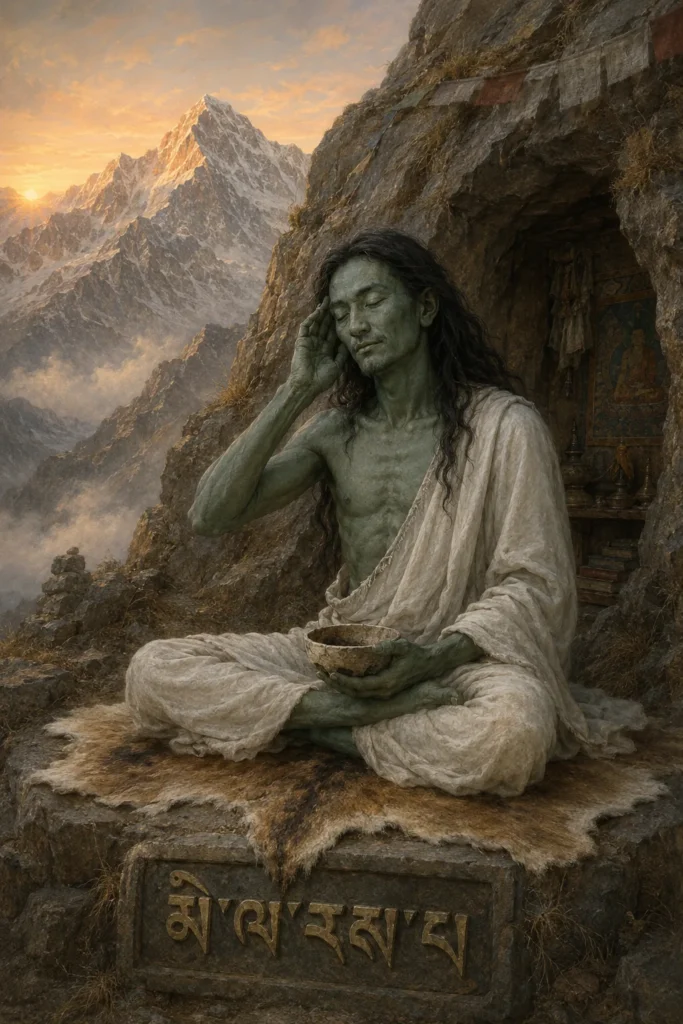
The biography depicts him for decades in remote mountain hermitages, often almost naked and clothed only in a cotton cloth (repa), hence his epithet “cotton-clad Mila.” Nourished by wild nettle, his body is said to have turned greenish.
His caves are pilgrimage sites to this day, among them Drakar Taso, the caves of Lapchi on the border between Tibet and Nepal, the caves of Chuwar in the Nyalam region and the caves of Kyirong. In Western Tibetan Buddhism, especially in the Kagyü lineages, he is a central figure of identification for practitioners.
The inner heat (tummo) for which he became famous is the first of the Six Yogas of Naropa and let him manage with a cotton cloth during snowstorms. The Sekhar Guthok tower in Lhodrak in southern Tibet is regarded as the final building that he did not have to tear down again after Marpa’s testing.
In contrast to Padmasambhava, he is a historically tangible person. Unlike the Theravada notion of the saint, in which purity and merit are present from the outset, the tradition about Milarepa knows the enlightened one who arises from deep guilt. Both are among the most prominent Tibetan figures in the Western reception of Buddhism.
Biographical Sources
The most detailed account of his life is the “Nampar Tharpa” (full liberation title), in short “Mila Tharpa,” composed by Tsangnyön Heruka (1452 to 1507), a yogin and writer who reimagined Milarepa as an idealized yogin figure for his reform movement of the late Kagyu.
This vita is exceptionally accomplished as literature and has been translated into several Western languages, but it arose roughly three hundred and fifty years after Milarepa’s death and draws on older oral and written traditions, some of which are lost.
In “The Yogin and the Madman” (New York 2014), Andrew Quintman reconstructed the textual history of the Milarepa vita and showed that at least three older versions existed, some of which survive only in fragments.
The “Hundred Thousand Songs” (Mila Gurbum), likewise compiled by Tsangnyön Heruka, gathers the verses that Milarepa is said to have improvised for his disciples and petitioners in various teaching situations. This collection is the second central Milarepa source; its individual songs are dated very differently and probably reflect a tradition that grew over several centuries.
Youth and Black Magic
According to the vita, Milarepa was born as the son of a wealthy landowner in Kya Ngatsa in western Tibet. His father died early, whereupon his uncle and aunt seized the family fortune and enslaved the household.
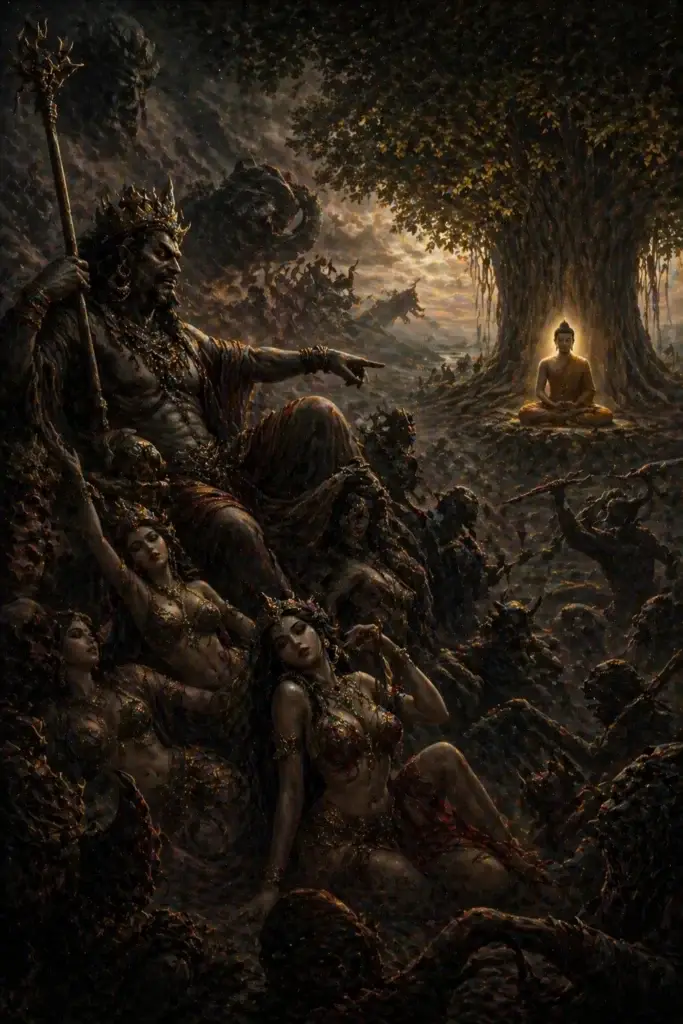
At his mother’s urging, Milarepa learned black magic and, through a hail ritual, killed thirty-five of the uncle’s relatives along with harvests that destroyed their wealth.
The bad karma of this deed later drove him to seek religious liberation. This narrative is important in terms of the phenomenology of religion: it introduces a saint who is not holy from the outset but reaches enlightenment out of deep guilt.
Donald Lopez (“Religions of Tibet in Practice,” Princeton 1997) reads this element as a reflection of tantric teachings that recognize the “path of defilement” (kleshamarga) as a possible route to liberation.
Marpa as Teacher
Milarepa found his teacher in Marpa Chökyi Lodrö (1012 to 1097), a Tibetan translator who had undertaken several journeys to India and had been instructed there by Naropa.
For many years Marpa subjected Milarepa to an extreme ordeal: he had him single-handedly erect numerous towers of stone, each time with the instruction to tear them down again as soon as they were finished.
The Sekhar Guthok tower, still preserved today in Lhodrak in southern Tibet, is traditionally regarded as the final structure that Milarepa was no longer required to demolish. According to the vita, the ordeal served to purify the bad karma of the hail magic before Milarepa could receive the higher tantric initiations.
After completing the ordeal he received the full transmission of the Mahamudra teaching and of the Six Yogas of Naropa, among them inner heat (tummo), the clear light body (ödsal), and dream yoga (milam). These transmissions form the core of the Kagyu teaching and are passed on in an unbroken lineage to this day.
The Life of a Cave Hermit
After his time of study, Milarepa withdrew into the caves of the Himalayas, above all into the region around the Lapchi massif, which lies between Tibet and Nepal.
The vita depicts him for decades in remote mountain hermitages, often almost naked, sustained by wild nettles, which are said to have given his body a greenish tinge. He developed inner heat to such a degree that during snowstorms he got by clad only in a cotton cloth (repa), hence the epithet Repa.
This practice is attested in the Tibetan yogin tradition outside the hagiographic narrative as well; in the twentieth century Alexandra David-Néel documented it ethnographically, and more recent physiological studies of tummo practitioners in Ladakh and Nepal have made warming effects measurable.
From the perspective of religious studies, it is significant that the combination of extreme asceticism and bodily heat generation is in the Vajrayāna a path of practice systematically described in the tantras.
Songs and the Form of Teaching
Milarepa did not teach in the form of canonical lectures or through books but improvised spontaneous verses to suit the situation at hand. A hunter, a doubting female disciple, a band of robbers, all were addressed according to their respective state of mind. The “Hundred Thousand Songs” are the written collection of these improvisations.
They stand in the tradition of the Indian dohā and caryāgīti literature, which already played an important role in Indian Vajrayāna. In eleventh-century Tibet, the form of the sung discourse was an effective method for conveying teachings even to illiterate listeners.
In “Tantric Treasures” (Oxford 2004), Roger Jackson set out in detail how the Tibetan mgur tradition connects to its Indian models.
Disciples and Succession
Milarepa had two principal disciples, Gampopa Sönam Rinchen (1079 to 1153) and Rechungpa (1085 to 1161). Gampopa, a former physician and monk of the Kadam school, integrated Milarepa’s tantric yogin practice into a monastic framework and thereby founded the monastic line of the Kagyu schools.
Rechungpa preserved the non-monastic yogin tradition. From Gampopa’s disciples emerged the “four great” and “eight lesser” Kagyu sub-traditions, among them the Karma Kagyu with its famous Karmapa incarnation lineage. In this way Milarepa’s individual experience of ordeal and enlightenment became the foundation of a large institutional school.
Classification in Religious Studies
Andrew Quintman shows that the Milarepa vita established a model of the “enlightened one out of deep guilt” that was repeated many times in later Tibetan religious history.
In contrast to the Theravāda conception of the saint, in which purity and merit are present from the outset, the Milarepa tradition emphasizes that even grave moral transgressions can be purified through tantric practice within the same lifetime.
In terms of the phenomenology of religion, this is a central claim of the Vajrayāna; it distinguishes it from older Buddhist schools, in which several existences were held to be necessary for a complete purification.
Reception in the West
The first European translation of the Milarepa vita is by Jacques Bacot (Paris 1925), the first English one by Walter Yeeling Evans-Wentz (Oxford 1928). The latter is known for its theosophical coloring and is today superseded in scholarly Tibetology. In 1977 Lobsang Lhalungpa produced a philologically reliable English translation.
In the twentieth century Milarepa became, alongside Padmasambhava, the most prominent Tibetan figure in Western reception of Buddhism. His biographical tangibility, the mixture of moral transgression and sanctification, and the simple, often nature-poetic songs gave him an independent influence beyond the strictly tantric transmission lineage.
Sources and Further Reading
Primary sources: Tsangnyön Heruka, “Mila Tharpa” (Vita of Milarepa), 15th century; “Mila Gurbum” (Hundred Thousand Songs of Milarepa), 15th century.
Secondary literature: Andrew Quintman, “The Yogin and the Madman. Reading the Biographical Corpus of Tibet’s Great Saint Milarepa,” New York 2014; Donald Lopez, “Religions of Tibet in Practice,” Princeton 1997; David Snellgrove, “Indo-Tibetan Buddhism,” London 1987; Roger Jackson, “Tantric Treasures,” Oxford 2004; Lobsang Lhalungpa, “The Life of Milarepa,” New York 1977; Robert Buswell and Donald Lopez, “Princeton Dictionary of Buddhism,” Princeton 2014.
Mahamudra and Dzogchen
The teaching that Milarepa received from Marpa and passed on to his disciples belongs to the Mahamudra tradition (“Great Seal”). It aims at the direct, non-conceptual recognition of the nature of mind.
Mahamudra is structurally similar to the Dzogchen tradition (“Great Perfection”) of the Nyingma school but methodologically different. Whereas Dzogchen takes the primordial purity of mind as its starting point, Mahamudra proceeds step by step from conceptual cognition to direct vision.
In “Enlightenment by a Single Means” (Vienna 1994), David Jackson documented the historical debate between the Sakya understanding of Mahamudra and the Kagyu understanding. In terms of Tibetan philosophy, this debate is one of the most important of the thirteenth to fifteenth centuries and bears directly on the interpretation of Milarepa’s teaching.
The Six Yogas of Naropa
Alongside Mahamudra, the transmission of the “Six Yogas of Naropa” is the second main line of Kagyu practice that goes back to Milarepa.
These six yogas comprise inner heat (tummo), the clear light body (ödsal), dream yoga (milam), bardo yoga (yoga of the intermediate state), the transference of consciousness (phowa), and the illusory body practice (gyulü).
They form a systematic program of exercises that goes back to the Indian yogin Naropa and was passed on via Marpa to Milarepa.
The inner heat for which Milarepa became famous is the first of these and in many respects the foundational practice. In “The Six Yogas of Naropa” (Ithaca 1996), Glenn Mullin translated and commented on the corpus of practice.
Ethnographic research on present-day tummo practitioners, in particular the work of Herbert Benson at Harvard Medical School in the 1980s, has documented physiologically measurable increases in skin temperature, without thereby confirming or refuting the religious claims of the tradition.
Milarepa's Caves as Pilgrimage Sites
The caves in which, according to tradition, Milarepa meditated are pilgrimage sites to this day. Particularly prominent are the cave of Drakar Taso (“White Rock Horse Tooth”), the Lapchi caves on the border between Tibet and Nepal, the Chuwar caves in the region of Nyalam, and the Kyirong caves, likewise on the Nepalese border.
Until the Chinese annexation of Tibet, the pilgrimage routes to these sites were an important axis of Buddhist spirituality.
Today they are partly accessible again, but pilgrim traffic is limited by political restrictions. In Tibet, the Lapchi region on the border with Nepal and Mount Kailash are central pilgrimage destinations, including for the veneration of Milarepa. In “The Cult of Pure Crystal Mountain” (New York 1999), Toni Huber documented the geography of Tibetan pilgrimage in detail.
Milarepa in Modern Reception
In the twentieth century Milarepa became one of the most prominent Tibetan figures in the Western reception of Buddhism.
In “The Way of the White Clouds” (London 1966), Lama Anagarika Govinda devoted extensive passages to him, in which the connection between ascetic life and mystical insight is presented as a central Tibetan achievement. Lobsang Lhalungpa’s translation (1977) led to a broad Western reception.
The Tibetan film “Milarepa” (2006) by the teacher Neten Chokling first brought the story to an international cinema audience.
In Western Tibetan Buddhism, especially in the Kagyu lineages, Milarepa is a central figure of identification for practitioners, in whose vita the connection of ethical transgression, ordeal, and enlightenment is read as a model for their own path.
Milarepa and Nature Poetry
His nature poems form a distinct literary strand of the Milarepa songs. They describe life in the mountain hermitages, the perception of the seasons, of animals, rocks, snow, and wind. These poems stand in a tradition of Tibetan ascetic poetry that, much like Japanese Zen poetry, develops a direct, unaffected language of nature.
They were received by Western writers such as Gary Snyder and Allen Ginsberg and thus unfolded a broader influence than within the strictly religious tradition alone. In “Divinity Secularized.
An Inquiry into the Nature and Form of the Songs Ascribed to the Sixth Dalai Lama” (Vienna 1990), Per Sørensen traced the structural connections between Milarepa’s songs and the later Tibetan secular love poetry.
Tsangnyon Heruka and the Standard Vita
The life account of Milarepa that is canonical today (Mi la ras pa’i rnam thar) was composed in 1488 by Tsangnyon Heruka (1452 to 1507).
Tsangnyon, himself an eccentric yogin of the “mad saints” tradition, drew on earlier sources but shaped them into a self-contained literary work with a clear structure: prehistory and birth, youth and magic, Marpa and the trials, the path of liberation, the teaching years, death.
Andrew Quintman (“The Yogin and the Madman,” New York 2014) reconstructed the source history of the Milarepa vita in detail. He shows that at least three older layers of the vita exist, the earliest of which goes back to Gampopa (1079 to 1153), the immediate disciple of Milarepa.
Tsangnyon’s version is so successful as literature that it practically displaced the older sources. It has become the benchmark of Tibetan hagiography and shapes the popular image of Milarepa to this day.
The Hundred Thousand Songs as a Literary Work
The collection “Mila Grubum” (Hundred Thousand Songs of Milarepa) was likewise cast in literary form by Tsangnyon Heruka but contains older material.
It comprises some 130 episodes in which Milarepa imparts teachings in poetic verses (“mgur”), tests disciples, or seeks conversation with the people. The mgur are a distinct Tibetan literary genre that combines religious spirituality with folk poetry.
Garma C.C. Chang (“The Hundred Thousand Songs of Milarepa,” New York 1962) produced a complete English translation. The songs are structured in varying metrical forms and follow an alternation between the object of instruction and personal recollection. They are both religious practice material and folk literature, which explains their broad influence.
Milarepa's Caves and Pilgrimage Sites
The most important caves in which, according to tradition, Milarepa meditated are Drakar Taso near Nyalam in southern Tibet, Chubar in Nyalam County, Lapchi in the Tibetan-Nepalese border region, and the caves on Mount Kailash.
Lapchi and Kailash are today difficult to access because of the pandemic and Chinese travel restrictions, while Drakar Taso was partly rebuilt after 1980 as a monastery ruin.
Toni Huber (“The Cult of Pure Crystal Mountain,” New York 1999) documented ethnographically the pilgrimage practice around Tsari, another Milarepa setting, and showed how the pilgrimage sites function as a spatial extension of the hagiography.
The connection of vita text and pilgrimage site is a classic phenomenon of religious geography, and Milarepa is among the most strongly spatially anchored Tibetan saints.
The Kagyu Lineage and Its Four Great Subdivisions
Milarepa stands in the main line of the Kagyu school (bka’ brgyud, “transmission lineage of the oral instructions”). This lineage was brought from India to Tibet by Marpa Lotsawa.
After Milarepa’s principal disciple Gampopa, the Kagyu split into four great and eight lesser sub-lineages. The four great ones are Karma Kagyu (with the Karmapas), Tselpa Kagyu, Baram Kagyu, and Phagdru Kagyu.
From the Phagdru line in turn emerged the Drikung Kagyu, Drugpa Kagyu, and Taglung Kagyu. The Drukpa line is the state school of Bhutan. Matthew Kapstein (“The Tibetans,” Oxford 2006) presented the school’s historical development in the context of the political history of Tibet.
The Mahamudra Teaching of Milarepa
Milarepa practiced and transmitted the Mahamudra teaching (“Great Seal”), which belongs to the highest stage of Anuttarayoga tantra practice. The Mahamudra transmission came through Maitripa and Naropa to Marpa and then to Milarepa.
In contrast to the Dzogchen teaching of the Nyingma school, to which Mahamudra is philosophically closely related, Mahamudra practice emphasizes the gradual ascent via shamatha (mental calm) and vipashyana (insight) to the direct recognition of the nature of mind.
The “Four Yogas of Mahamudra,” one-pointed concentration, non-construction, one taste, and non-meditative realization, are regarded as the central sequence of stages. David Jackson (“Enlightenment by a Single Means,” Vienna 1994) examined the Mahamudra tradition comprehensively in the dispute between the Sakya and Kagyü conceptions.
Milarepa in Modern Literature and Art
Milarepa has had a broad history of influence in Western literature and visual art. In 1968 Eric Frechette rendered the “Hundred Thousand Songs” into French.
In 1977 Lobsang Lhalungpa provided a much-noted English translation of the vita. In 2006 the Bhutanese film director Neten Chokling shot a two-part film “Milarepa” depicting his youth and the path of liberation.
The Swiss painter Aldo Walker and the British Buddhist artist Robert Beer created portraits of Milarepa that orient themselves to the traditional Tibetan models. The modern Tibetan diaspora has made Milarepa a figure of identification for a spirituality that mediates between monastic discipline and yogic independence.
Frequently Asked Questions
Was Milarepa a historical person? Yes. His dates are generally placed at about 1052 to 1135, though individual aspects are disputed. In “The Yogin and the Madman,” Andrew Quintman examined in detail the historical reliability of the source situation.
What are the “Six Yogas of Naropa”? A program of tantric yoga practice comprising inner heat, the clear light body, dream yoga, bardo yoga, the transference of consciousness, and the illusory body practice. They are the central line of practice of the Kagyu schools.
Why was Milarepa greenish? According to the vita, for decades he fed himself almost exclusively on wild nettles, which are said to have discolored his body. Whether this happened exactly so historically is uncertain; in any case the motif underscores his extreme asceticism.
Who were Milarepa’s most important disciples? Gampopa Sönam Rinchen (1079 to 1153), who founded the monastic line of the Kagyu schools, and Rechungpa (1085 to 1161), who continued the non-monastic yogin tradition.