Mara, deity of the Buddhist tradition
By Ralf Ittermann · last reviewed on
The tempter at the Bodhi tree, lord of the sense realm.
Mara’s temptation of the Buddha
Mara’s central episode is the temptation of the Bodhisattva Siddhartha beneath the Bodhi tree in Bodhgaya.
Three phases are reported canonically: first, the appearance with armies of demons (ten armies, the first four of which are named below); second, the sending of his three daughters (Tanha, Arati, Raga) in seductive form; third, the challenge through doubt and claim (“Who witnesses your merit?”).
Siddhartha touches the earth, the bhūmisparśa-mudrā, and the earth goddess bears witness to his attainment. Mara is defeated. His first four of ten armies are kāma (desire), arati (discontent), kṣut-pipāsā (hunger and thirst), tṛṣṇā (craving). In Mahayana Buddhism, Mara expands into four Maras: Skandha-Mara (the five aggregates), Klesha-Mara (defilements), Mrityu-Mara (death), Devaputra-Mara (heavenly temptation).
Mara
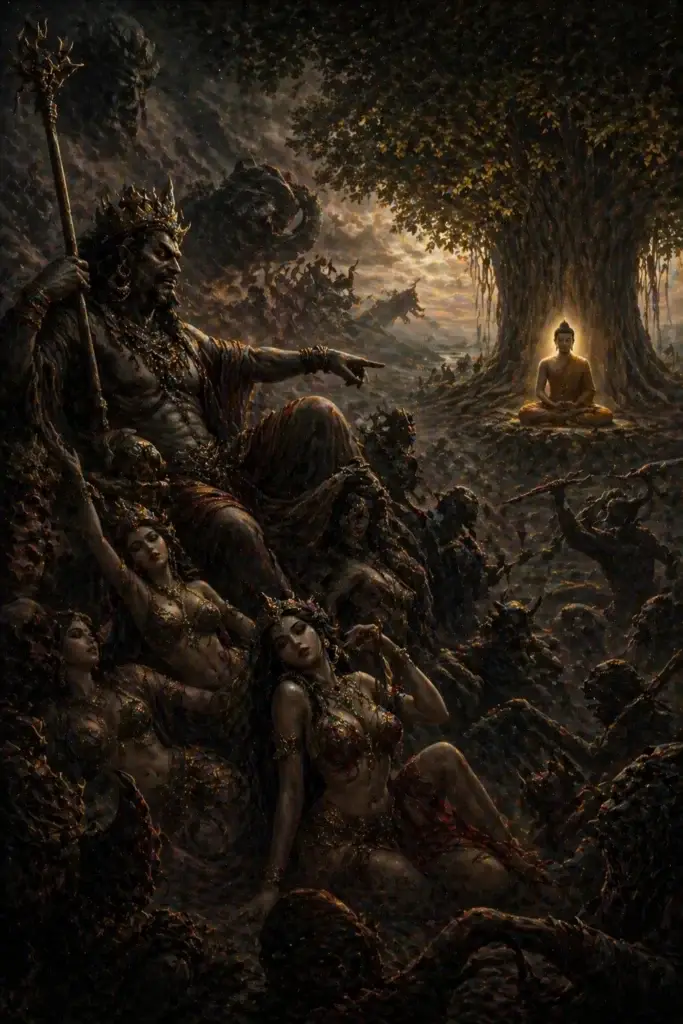
Mara is the central adversary figure of the Buddhist tradition. His most celebrated scene is the night before the Buddha’s awakening: beneath the Bodhi tree in Bodhgaya, Mara sends his army and his three daughters, desire, aversion, greed, to prevent the Bodhisattva from attaining enlightenment.
The Bodhisattva touches the earth as witness, the earth trembles, and Mara withdraws. This scene is iconographically widespread worldwide and theologically central.
Mara is not a cosmic counter-deity in the monotheistic sense. He is lord of the Kamadhatu (sense realm), a deva figure who has become an obstacle on the path through attachment and pride.
In an extended Buddhist interpretation there are four Maras: Skandha-Mara (aggregates), Kleshamara (defilements), Marana-Mara (death), Devaputra-Mara (the personal figure). All of them designate obstacles on the path to liberation. This makes the Mara teaching a comprehensive theory of what stands in the way of practice.
Profile: Mara
Type: Tempter, lord of the sense realm
Origin: Deva of the Kamadhatu; according to some texts: fallen through pride
Four Maras: Skandha, Klesha, Marana, Devaputra
Texts: Pali Canon (Padhana Sutta), Lalitavistara, Jatakas
Period: 5th century BCE to the present
Context
Attested with the Buddha (5th century BCE). Pali Canon (3rd century BCE to 1st century CE) with numerous Mara episodes. Mahayana sutras expand further (Lalitavistara, Saddharmapundarika). Vajrayana integrates Mara into tantric protective practices. Modern Buddhist practice worldwide.
Origin in northern India; spread with Buddhism to Sri Lanka, Southeast Asia, East Asia, Tibet, and into modern global Buddhist communities. Local Mara images throughout Asia, Thai temple paintings, Tibetan thangkas, Japanese woodblock prints.
Padhana Sutta (Sutta Nipata), Mara-Samyutta (Samyutta Nikaya), numerous Jataka narratives, Lalitavistara (Mahayana Buddha biography), Tibetan commentary tradition.
Name and variants
Sanskrit and Pali: Māra.
Epithets: Papiyas (“the Worse One”), Kanha (“the Dark One”), Namuci (“the Non-Releasing”), Antaka (“Death”).
Four Maras (four-Mara doctrine): Skandha-Mara (the aggregates as obstacle), Kleshamara (mental defilements), Marana-Mara (death), Devaputra-Mara (the personal Mara).
East Asian: Chinese 魔 (Mo), Japanese Ma.
The four-Mara doctrine turns Mara into more than a personal figure: a system describing everything that blocks the path. This is philosophically rich and explains why Mara need not simply be defeated; he is overcome through insight.
Characteristics
Appearance
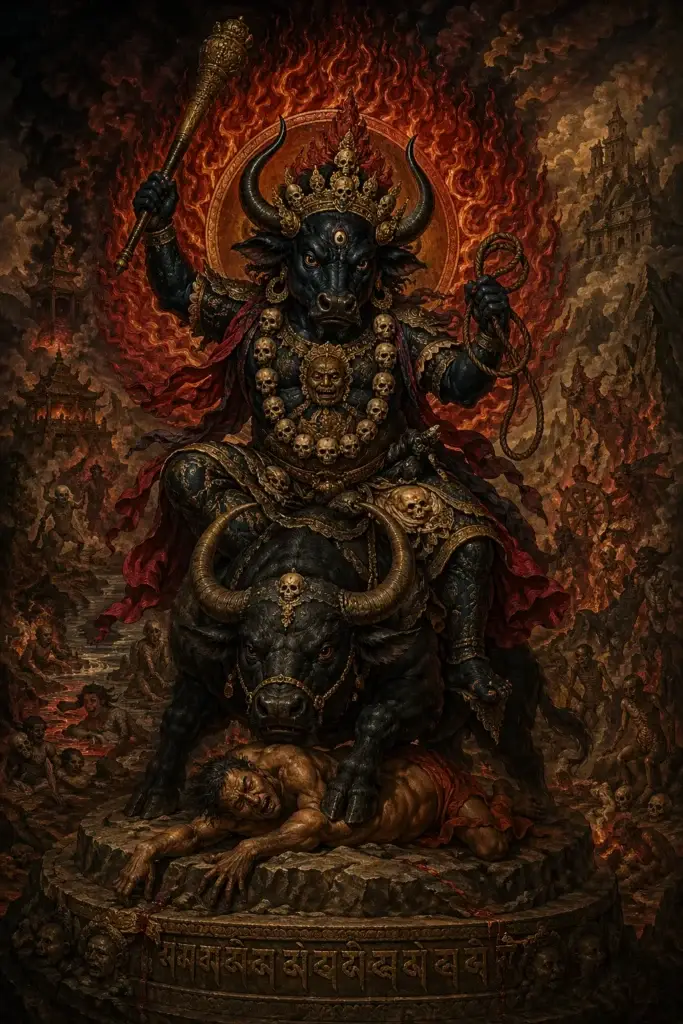
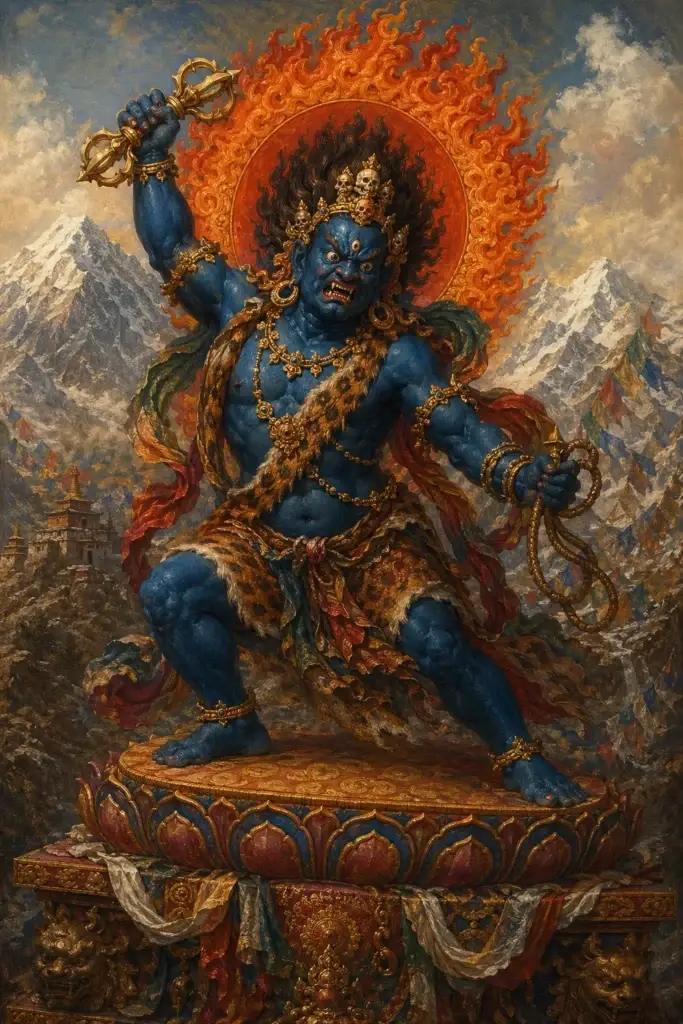
As a beautiful deva of the Kamadhatu in full majesty, youthful and radiant. In the attack on the Buddha: mounted on an elephant, with a great army, surrounded by his daughters. Wrathful aspect: terrifying, armed, breathing fire. Iconography varies by tradition and episode.
Behavior
Not violent but seductive and psychological. He sends sensory enticements, fear, self-doubt, pride, and self-pity. His three daughters Tanha (desire), Arati (aversion), Raga (greed) illustrate typical lines of attack.
Sphere of influence
The entire sense realm (Kamadhatu) is his domain. His power extends as far as beings cling to sensuality. At thresholds of awakening, at the Bodhi-tree moment and during advanced meditation, he becomes especially active.
Mythological classification
He is a deva, not a demon in the Western sense. His figure combines a cosmological position (lord of the Kamadhatu) with a psychological function (representative of all obstacles). In some traditions he even becomes a disciple of the Buddha after his defeat and is converted.
Fact Sheet: Mara
The most important aspects of Mara at a glance.
Deva of the Kamadhatu, lord of the sense realm. In some texts: fallen through pride. In the extended teaching: four Maras as a comprehensive theory of obstacles.
All beings who cling to the sensory realm. Particularly active with advanced meditators and at thresholds of awakening.
Beautiful deva in majesty; mounted on an elephant with an army; with three daughters (desire, aversion, greed). Also wrathful, as a terrifying warrior.
Not through force, but through suggestion: fear, doubt, desire, pride. Psychologically sophisticated, intimately acquainted with every person.
Earth-witness gesture (Bhumisparsha-Mudra), recitation of Paritta texts, Metta-Bhavana (loving-kindness meditation), wisdom and mindfulness as fundamental protection. Not annihilation, but clear seeing through.
Practical approach
Ritual practice
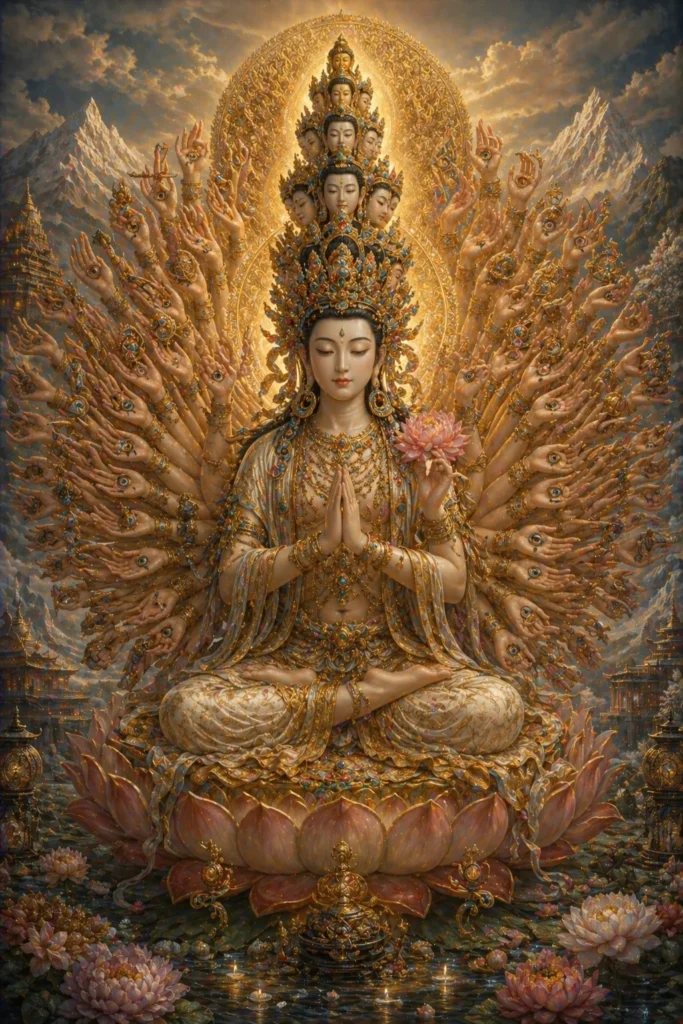
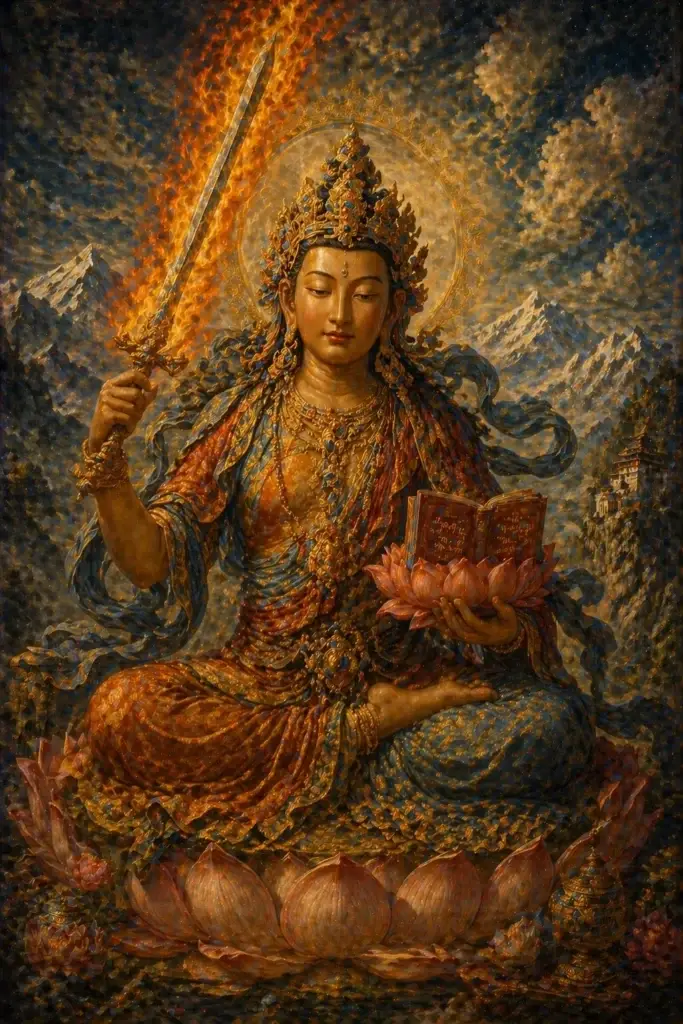
Paritta recitation (Theravada) in critical moments. The Ratana Sutta (“Jewel Sutta”) and the Karaniya Metta Sutta as central protective texts. In the Mahayana tradition, invocation of Bodhisattvas (Avalokiteshvara, Manjushri) against Mara’s influence.
Meditative practice
The most important “defense” against Mara is no defense at all, but clear seeing through. Mindfulness (sati), insight (vipassana), and loving-kindness (metta): all three dissolve Mara’s power because they do not engage with his enticements. The earth-witness gesture of the Buddha is the archetypal image of this practice.
Vajrayana transformation
In tantric traditions, Mara’s energy is not combated but transformed through wrathful meditative deities (Yamantaka, Heruka). The figure of the wrathful protector is structurally connected with Mara’s energy, albeit in transformed form.
Parallels and reception
Religious parallels: Satan and Iblis share the tempter function. The difference: Mara operates within the karma system, not as a cosmic counter-deity. His role is structurally necessary, not evil in an absolute sense.
Psychological interpretation: Modern Buddhist teachers (Bhikkhu Bodhi, Stephen Batchelor) read Mara largely in psychological terms: the sum of inner resistances against the path. This makes him immediately relevant for contemporary meditators.
Art and popular culture: The Mara attack scene is one of the most important pictorial motifs of Buddhism worldwide. Depicted from Gandhara (2nd to 5th century) through Borobudur to modern Japanese manga. In video games and fantasy novels, Mara is an established figure.
The temptation beneath the Bodhi tree
The central episode of the Mara myth is his attack on the not-yet-awakened Buddha, the Bodhisattva Siddhartha Gautama, on the night before his awakening beneath the fig tree near Bodhgaya.
This narrative is transmitted in numerous texts, among them the Padhana Sutta of the Pali Canon and at length in later biographies such as the Buddhacarita of Ashvaghosha and the Lalitavistara.
Mara recognizes that the Bodhisattva is on the verge of a breakthrough and will escape his dominion over the world of birth and death. He first deploys his armies, a fearsome array of demonic figures attacking with weapons, storm, fire, and darkness.
Yet all projectiles turn into blossoms as they reach the meditating Bodhisattva. Mara then sends his daughters, named in some texts Tanha, Arati, and Raga (craving, aversion, lust), to seduce the ascetic, but this too fails.
Finally, Mara challenges the Bodhisattva’s right to occupy the seat of awakening. The Bodhisattva touches the earth with his right hand and calls it to witness his merit accumulated over countless lives.
The earth bears witness, Mara is defeated and withdraws. This gesture, bhumisparsha mudra, the earth-touching gesture, became the most frequent representational form of the Buddha throughout Buddhist art.
Mara as a psychological principle in canonical teaching
In the oldest texts of the Pali Canon, Mara is not only a narrative figure but also a doctrinal concept. The word mara derives from the root for dying and literally means “the killer” or “death.” Mara embodies everything that binds beings to the cycle of birth and death.
The commentarial tradition distinguishes several aspects or forms of Mara. Those mentioned include Mara as deity (devaputta-mara), Mara as the five aggregates of existence (khandha-mara), Mara as the mental defilements (kilesa-mara), and Mara as death itself (maccu-mara).
Mara is thus simultaneously a concrete adversary and a cipher for the inner forces that prevent liberation.
In the Samyutta Nikaya there are numerous short encounters in which Mara appears to the Buddha or to his monks and nuns in order to unsettle, distract, or lead them into doubt. Noteworthy is the attitude of the awakened figures: they simply recognize Mara, address him by name, and thereby he loses his power.
The Theravada tradition often reads these scenes as allegories of inner states. Religious studies scholarship emphasizes that in early Buddhism the mythic and the psychological level were not separated but conceived as two sides of the same matter.
Mara's position in Buddhist cosmology
Within the Buddhist worldview, Mara is not an extra-worldly adversary but himself part of the cosmos of rebirth. He is regarded as ruler over the highest heaven of the sense realm, in some texts as a denizen of the Paranirmita-vasavartin heaven.
Mara is thus a powerful being of long life and great might, but he is neither eternal nor liberated.
His interest in preventing awakening follows from this position. As long as beings remain in the cycle of rebirth, they remain within Mara’s domain of power.
Whoever attains liberation withdraws from that dominion. Mara is therefore not an absolute evil in the sense of a cosmic dualism, but a power within the conditioned world that defends its own sphere.
This construction distinguishes Buddhism clearly from dualistic religions in which a principle of evil stands as an equal counterpart to the good. Mara is powerful, but in principle surmountable, and his defeat is not the destruction of an enemy but the simple slipping out of his sphere of influence.
Research has noted that later traditions, especially in the Mahayana, nuanced Mara’s role and some even taught that an awakened being could meet Mara with compassion, since Mara too is a suffering being within the cycle of existence.
A distant parallel to the tempter figure can be found in other religions, such as in the figure that Christian texts know as adversary, but the cosmological framework differs fundamentally.
Further links
Research literature
Further standard works in the literature index.
Frequently asked questions about Mara
Who is Mara in the Buddhist tradition?
Mara (Sanskrit for death, tempter) is in Buddhism the personification of temptation, worldly attachment, and death.
Mara confronted the Buddha beneath the Bodhi tree and sought to prevent his enlightenment, with armies of demons, with his three daughters (desire, aversion, lust) and with the charge that the Buddha had no right to enlightenment. The Buddha touched the earth, which bore witness to him, and defeated Mara through steadfastness.
What are the four Maras in Buddhism?
Buddhist teaching distinguishes four aspects of Mara: (1) Skandha-Mara, the temptation through the five aggregates of existence (form, feeling, perception, mental formations, consciousness); (2) Klesha-Mara, the temptation through defilements (greed, hatred, delusion); (3) Mrtyu-Mara, death itself; (4) Devaputra-Mara, the heavenly tempter (the personified figure). All four must be traversed on the path to liberation.