Amitābha, known in East Asia as Amida, is the transcendent Buddha of the Pure Land Sukhāvatī. His vow to receive all beings who call upon him forms the foundation of the Pure Land schools. His veneration shapes the piety of large parts of Asia.
In Buddhism, Amitābha belongs to the most important transcendent or supramundane Buddhas of the Mahāyāna. Unlike the historical Buddha Shakyamuni, who is understood as a teacher acting within history, Amitābha is a figure of the timeless, cosmic Buddha teaching. He is associated with a pure Buddha realm, the Pure Land Sukhāvatī.
From the perspective of religious studies, Amitābha is closely linked to the development of a distinct strand of piety that has found wide distribution in the Chinese-speaking world, in Korea, Japan, and Vietnam.
These Pure Land traditions place trust in the salvific power of Amitābha and his vow at the center. They are among the largest Buddhist movements in East Asia in terms of membership.
The most important sources are three texts that scholarship refers to as the Pure Land sūtras: the longer and the shorter Sukhāvatīvyūha sūtra as well as the Amitāyurdhyāna sūtra, the sūtra on the contemplation of Amitāyus.
The longer Sukhāvatīvyūha sūtra recounts the prehistory of Amitābha and his vow, the shorter one praises the beauty of the Pure Land and recommends the invocation of the name, and the third describes a sequence of visualizations.
These texts emerged from Indian Mahāyāna, presumably in the first centuries of the common era, and were intensively translated, commented on, and interpreted in East Asia.
Scholarship debates how the Amitābha cult arose. Some hypotheses point to the influence of notions of light and the afterlife from northwestern India and Central Asia, while others emphasize the inner-Buddhist development of the doctrine of the many Buddhas and their Buddha realms.
It is certain that the cult becomes tangible in China from the fourth and fifth centuries onward and spread from there across East Asia.
The name Amitābha is a Sanskrit term and means immeasurable light. Alongside it stands the closely related form Amitāyus, which means immeasurable life.
Both names refer to the same figure but emphasize different aspects, namely the boundless light and the boundless lifespan of a Buddha. In the East Asian image tradition, Amitāyus is in part treated as a distinct manifestation associated with long life.
In East Asia the name has spread in various linguistic forms. In Chinese it appears as Amituofo, in Japanese as Amida, in Korean as Amita, and in Vietnamese in a corresponding pronunciation.
The Japanese form Amida has become especially well known in Western usage, since the Japanese Pure Land schools were studied early on by European and North American scholarship.
The invocation of the name holds a central place in Pure Land practice. The formula by which the practitioner orients themselves toward Amitābha is called Nianfo in Chinese and Nembutsu in Japanese, and in the common Japanese form it reads Namu Amida Butsu, that is, veneration to the Buddha Amida.
The repeated, trustful pronouncing of the name is regarded in these traditions as an essential, and in some schools a sufficient, form of religious practice. The term Nembutsu originally also encompassed the meditative recollection of the Buddha, but in the later Japanese tradition it increasingly narrowed to the oral invocation.
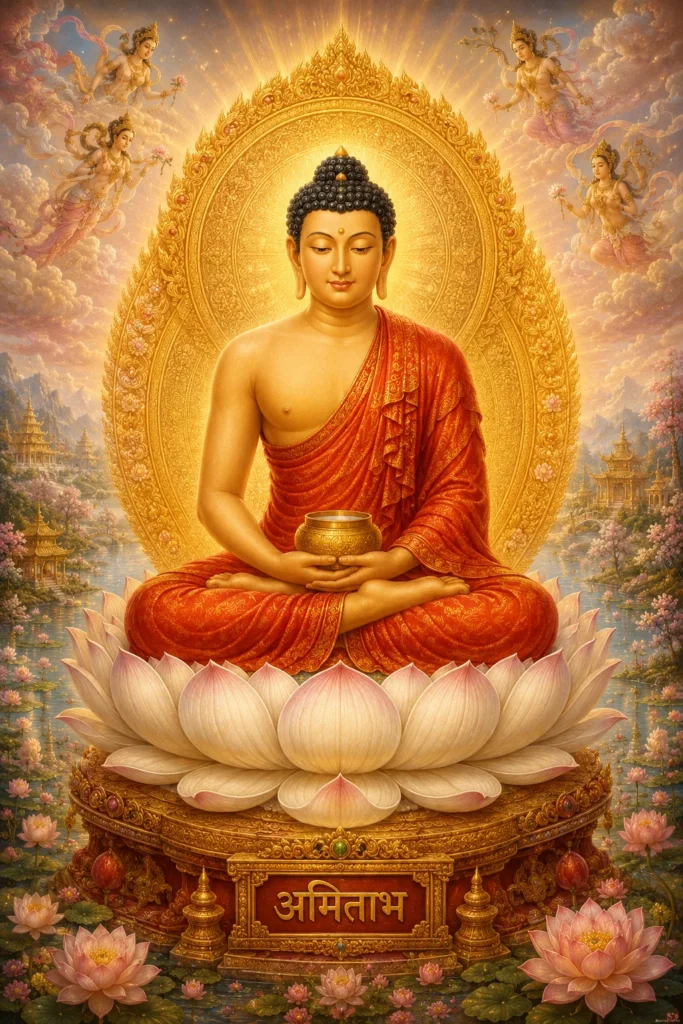
In Buddhist visual art, Amitābha is usually depicted as a seated or standing Buddha in monastic robes. A characteristic feature is often a red body color that distinguishes him from other transcendent Buddhas.
In the systematic arrangement of the five Buddha families, as developed by esoteric Buddhism, Amitābha is assigned to the West; the element fire, the lotus as a symbol, and the overcoming of desire are associated with him.
Widespread image types show him in the gesture of meditation, with both hands in the lap, or in the gesture of greeting and reception, in which one hand is raised and turned outward.
A particularly important East Asian image form is the depiction in which Amitābha descends on a cloud together with attendants in order to receive a dying or deceased person into the Pure Land. This scene is called Raigō in Japanese and was artfully elaborated in the painting of the Heian and Kamakura periods.
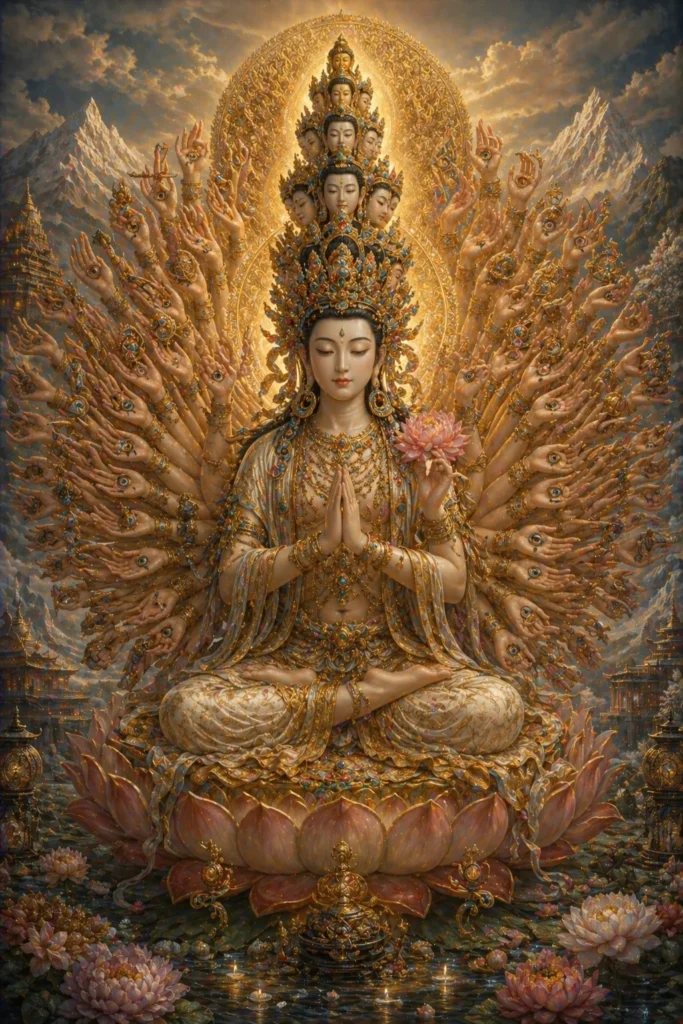
Amitābha frequently appears in a group of three, the so-called Amida triad. At his sides stand the bodhisattvas Avalokiteśvara, who embodies compassion, and Mahāsthāmaprāpta, who represents the power of wisdom. This group is widespread in temples across East Asia and sums up the central message of the Pure Land teaching in pictorial form.
Monumental Amitābha statues, such as the great Buddha of Kamakura, are among the best-known works of East Asian Buddhist art. In Tibet, Amitābha is likewise present; there the Panchen Lama is regarded as his embodiment.
The central narrative unfolded by the longer Sukhāvatīvyūha sūtra recounts the prehistory of Amitābha. According to the tradition, immeasurably long ago there lived a king who heard the teaching of a Buddha of that time named Lokeśvararāja, thereupon gave up his rule, and entered the order as a monk named Dharmākara.
Under the guidance of this Buddha, he resolved to strive for Buddhahood himself and to establish his own Buddha realm that was to surpass all existing ones in perfection.
Dharmākara had his teacher show him countless Buddha realms and thereupon took a series of vows in which he laid down the qualities of the Pure Land and the conditions of rebirth within it. The transmitted number of these vows is forty-eight in the widespread text.
Among other things, they concern the absence of forms of existence marked by suffering in that realm, the mental faculties of its inhabitants, and the certainty of attaining full enlightenment from there.
Among these vows, one is of particular importance for later Pure Land piety, the eighteenth in the Japanese counting. In it, Dharmākara promises that all beings who orient themselves toward him with a trustful, sincere spirit and call upon his name shall be reborn in his Buddha realm.
The monk declared that he would accept Buddhahood only if this vow were fulfillable. The efficacy of the vow is thereby tied to the fact that Dharmākara actually attained Buddhahood.
After immeasurably long practice, Dharmākara attained Buddhahood and thus became Amitābha. His Buddha realm, the Pure Land Sukhāvatī, thought of as lying in the West, is therefore regarded as realized, and his vow is regarded as effective.
The Pure Land sūtras describe this Pure Land as a place of extraordinary beauty, with ponds of jewels, trees of precious materials, melodious music, and an atmosphere in which the teaching is everywhere audible. Those reborn there appear from lotus blossoms and find conditions under which the path to enlightenment proceeds without hindrance.
Important for the religious-studies understanding is that the Pure Land teaching understands this Pure Land not as a final goal but as a place where beings can continue to work undisturbed toward full enlightenment, free from the obstacles and distractions of the ordinary realms of existence.
The narrative of Dharmākara thus establishes a perspective of salvation that is directed especially at people who regard their own powers as insufficient in a difficult age.

The veneration of Amitābha developed above all in East Asia into independent schools. In China the Pure Land tradition emerged as a broad movement of piety that found great resonance also outside monastic circles.
Important early figures are regarded as Huiyuan, who in the fourth century founded a community for shared veneration, as well as Tanluan, Daochuo, and Shandao, who systematically elaborated the teaching. In China the Pure Land practice often combined with the meditation school of Chan into a common form of practice.
In Japan, independent Pure Land schools took shape in the medieval period. Hōnen founded the Jōdo-shū in the twelfth century and placed the invocation of the name at the center as the sole necessary practice.
His disciple Shinran founded the Jōdo-Shinshū, which emphasizes trustful reliance on the power of the vow even more strongly and lets one’s own effort recede.
These schools became the largest Buddhist movements in Japan in terms of membership. In Korea and Vietnam, the veneration of Amitābha is likewise firmly established, there mostly embedded in a broader Buddhist framework.
The central practice is the invocation of the name. In the various schools, the role played by one’s own effort and the role played by trust in the power of the vow are weighted differently.
Some movements emphasize the frequent, counted repetition of the invocation of the name, while others foreground the single moment of trustful faith and understand the further invocation as an expression of gratitude.
In ritual life, devotions before images of Amitābha, the recitation of the Pure Land sūtras, and special ceremonies in connection with dying and death are widespread. The notion that Amitābha receives the deceased has deeply shaped the culture of burial and remembrance in several East Asian societies.
In Japan, the connection to Amitābha remains visible to this day in many burial rites. The transfer of merit for the deceased and the repetition of the name formula on memorial days are part of the established repertoire of practice.
In the orbit of the veneration of Amitābha there are practices that in religious studies are described as apotropaic or as oriented toward salvation. These include the invocation of the name, the recitation of sūtras, and the placing of images in temples and household altars.
Devotees understand these forms as an expression of trust in the salvific power of the vow and as protection against fear, especially the fear of a rebirth marked by suffering.
Especially in connection with dying, the invocation of Amitābha takes on an important significance.
In several traditions, the dying person is supported by relatives or monks in orienting themselves toward Amitābha in the final moment, for instance through the joint speaking of the name formula or through an image of the descending Amida triad at the deathbed.
This is understood as preparation for the hoped-for rebirth in the Pure Land. In the teaching of Shinran, by contrast, the moment of salvation is bound not first to the hour of death but already to the moment of sincere trust in life.
From the standpoint of the history of religion, it should be noted that these are transmitted beliefs and ritual practices. A factual account describes them as part of the Buddhist tradition without ascribing to them an objective, verifiable effect.
What is especially illuminating from a religious-studies perspective is how the Pure Land practice places dying and death within a sustaining framework of meaning.
The Pure Land teaching can be understood in religious-studies terms as a response to a particular problem situation. It proceeds from the notion that the present is a degenerate age in which most people lack the power to reach enlightenment through their own practice, such as long meditative training.
Against this background, the tradition distinguishes between the path of one’s own power and the path of the other power, that is, trust in the help effective in the vow of Amitābha.
This distinction forms the axis along which the schools are distributed. Hōnen understood the invocation of the name as the practice appropriate for the degenerate age, chosen by Amitābha himself.
Shinran went a step further and interpreted trust itself already as a gift of Amitābha, so that even faith does not appear as one’s own achievement. Other movements, above all in the Chinese sphere, held to an interplay of practice and grace.
In doctrinal terms, the fundamental Buddhist framework is thereby preserved. The Pure Land is not an eternal heaven, and Amitābha is not a creator god.
Sukhāvatī is regarded as a particularly favorable place of practice created by the vow of a Buddha, from which the actual goal, full enlightenment and the extinction of suffering, is reached.
Philosophical reflection has moreover emphasized that Amitābha and the Pure Land are ultimately not to be thought of as outside the mind, which connects the Pure Land teaching with the meditative schools.
The notion of a pure, otherworldly realm that eases the path to final salvation invites comparisons with other religious traditions. Researchers have related the Pure Land to paradisiacal afterlife notions of various traditions.
Such comparisons must carefully take into account the respective doctrinal differences, since the Pure Land is understood not as an eternal goal but as a favorable place of practice, and Amitābha is not a god who creates the world.
The emphasis on trust and devotion in the Pure Land schools, especially in the teaching of Shinran, has also been much discussed in comparative scholarship.
Earlier interpretations that hastily equated this piety with concepts of other religions and in part presented it as influenced from outside are today regarded as reductive. More recent scholarship emphasizes the independent inner-Buddhist logic of the Pure Land teaching and its rootedness in the Mahāyāna.
Within Buddhism, Amitābha stands in the line of the transcendent Buddhas and is part of the system of the five Buddha families. The contrast with the historical Buddha Shakyamuni makes clear the difference between a historical and a timeless Buddha figure.
The comparison with the veneration of other Buddhas and bodhisattvas, such as the healing Buddha Bhaiṣajyaguru or the future Buddha Maitreya, shows that East Asian piety knows a whole landscape of such salvific figures, within which Amitābha drew the most widespread cult to himself.
Amitābha is strongly present in the contemporary religious culture of East Asia. The Pure Land schools are among the most widespread Buddhist movements in several countries; in Japan they constitute a considerable share of all Buddhist congregations.
The invocation of the name, temple devotions, and memorial ceremonies are a fixed part of the religious everyday life of many people, and the connection to Amitābha continues to shape burial culture.
Through migration and through the growing interest in Buddhism, the Pure Land traditions have also found distribution outside Asia, particularly in North America, to which Japanese emigrants carried the Jōdo-Shinshū in the nineteenth and twentieth centuries.
Religious studies investigates how these traditions develop further under new cultural conditions, how they relate to other Buddhist movements, and how they convey their teaching in pluralistic societies.
Academic research deals with the textual history of the Pure Land sūtras and their various Indian and Chinese versions, with the emergence of the individual schools, and with the question of the relationship between one’s own effort and trustful devotion.
An important field is the critical examination of earlier Western interpretations that viewed Pure Land piety through a foreign lens. Amitābha thus remains a central object of Buddhist studies and of comparative religious studies.
Related key terms: Amitābha Amida Sukhāvatī Pure Land Nembutsu Mahāyāna Dharmākara Buddha.
iWell Guard draws on the cultural-historical tradition of portable protective objects, in the tradition of Buddhism and many other cultures worldwide. 41 layers, solid gold, platinum, silver, made in Germany. 30-day return policy.
Personal experiences may vary. Not a medical device. No healing claim.