Dumuzi, Mesopotamian shepherd and vegetation god
By Ralf Ittermann · last reviewed on
Dumuzi is a Mesopotamian shepherd and vegetation god whose death and return mirror the change of the seasons. Dumuzi, in Akkadian form Tammuz, is an ancient Mesopotamian shepherd-god, youthful consort of the goddess Inanna (Ishtar) and a central figure in the narratives of death and return in ancient Mesopotamian religion.
His myth, which deals with his cyclical descent into the underworld and his partial return to the land of the living, ranks among the most striking texts of ancient Sumerian literature and has influenced the religious ideas of the entire ancient Near East.

Myth and Origin
Dumuzi is attested in the ancient Sumerian texts as a shepherd-god who protects the herd and thereby the livelihood of the rural population. His name means “the faithful son”.
In the royal lists of early Sumer he is recorded as the mythical king of Bad-Tibira, one of the cities before the great flood. This royal standing connects him closely with the political self-understanding of the ancient Sumerian city-states.
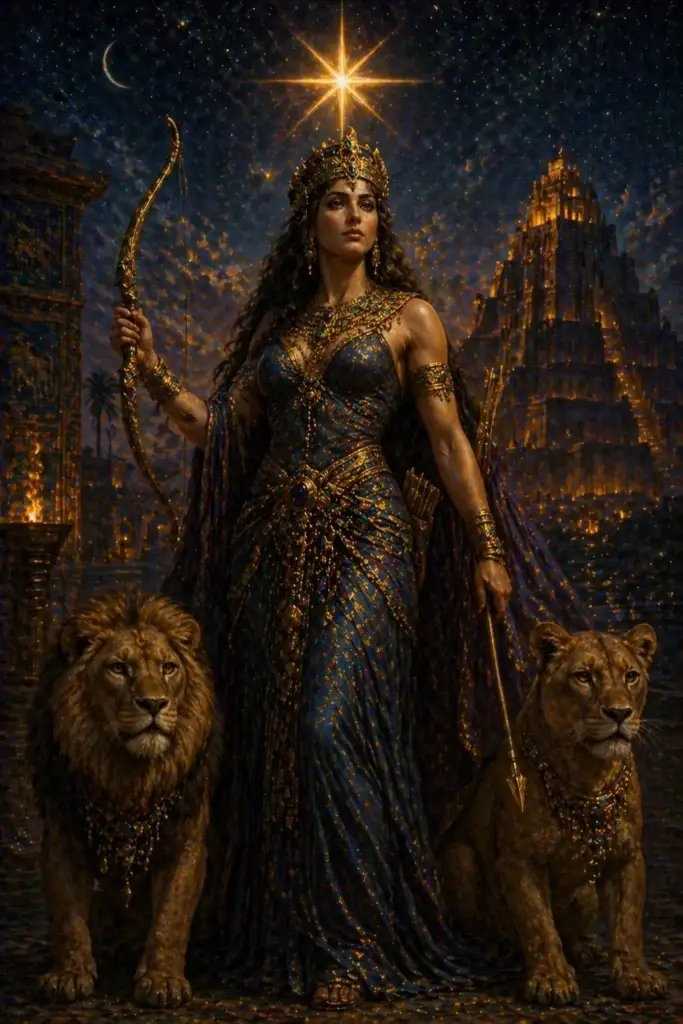
His most important mythical context is the relationship with Inanna, the goddess of love, war and fertility. In the love songs “Dumuzi and Inanna” and “The Wedding of Inanna” the courting encounter of the two deities is depicted in physical and erotic language.
The texts are important for the history of religion because they develop the concept of a marriage allegory between gods, in which annual fertility and cosmic order are interwoven.
The central narrative around Dumuzi is the song “Inanna’s Descent to the Underworld”. Inanna descends into the realm of her sister Ereshkigal, is killed there and finally revived, but only on the condition that she finds a substitute. She chooses Dumuzi, who sat unconcerned on her throne instead of mourning.
The galla demons drag him into the underworld. His sister Geshtinanna, a goddess of the grapevine, offers to take his place for part of the year, so that Dumuzi and Geshtinanna dwell in alternation each year in the underworld and in the world of the living.
This narrative connects with the agrarian calendar: Dumuzi was regarded as a youthful vegetation god whose decline in the dry summer was accompanied by loud lamentation rituals and whose return in spring was celebrated with festivals.
The East Semitic form Tammuz gave the month in the Jewish calendar its name, and in the biblical Book of Ezekiel women are mentioned who wept for Tammuz in Jerusalem, which attests to the spread of the cult beyond Mesopotamia.
Symbols and Attributes
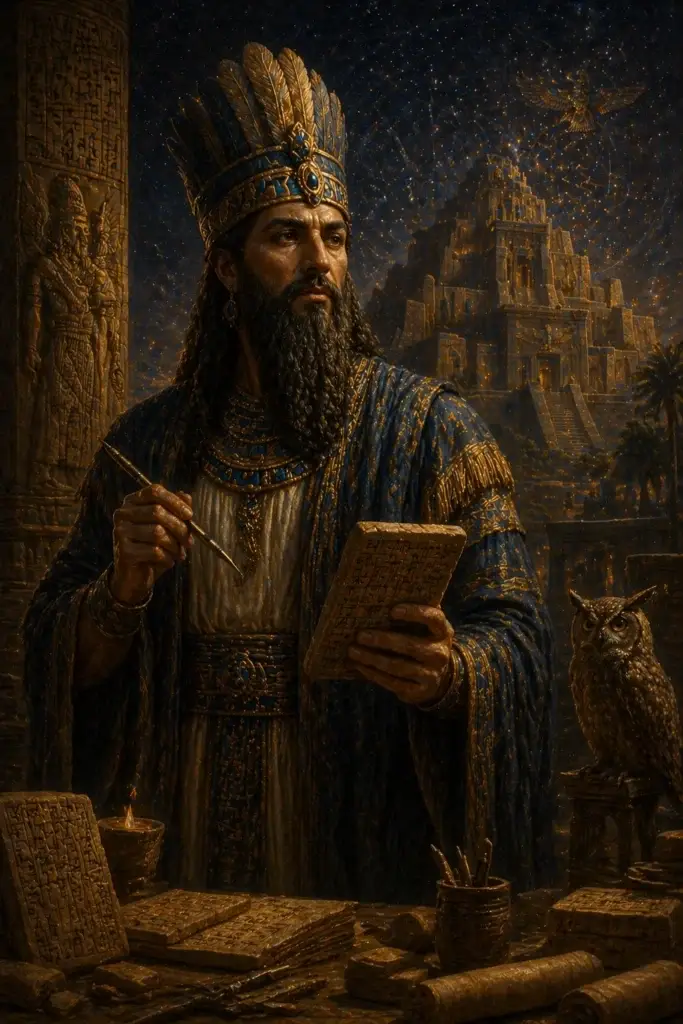
Dumuzi appears in visual art as a youthful, beardless man with a shepherd’s staff and a flock of lambs. In some depictions he wears a short loincloth, in others a festive bridal garment, an allusion to his function in the wedding rituals with Inanna.
On seal impressions he often stands beside a woman who is identified as Inanna by a horned crown and jewelry.
The lamb is his most important symbolic animal. It marks him as patron of sheep breeding, which played a central role in the Mesopotamian economy. Wool, milk and meat were important economic goods, which is why the shepherd-god held an important position in the pantheon.
The farmer-god Enkimdu, his rival, is set in competition with him in an ancient Sumerian disputation, in which Inanna in the end decides for the shepherd.
The grapevine is an attribute assigned rather to his sister Geshtinanna, but through the close mythical connection of the two siblings it passed over to Dumuzi himself.
In some texts Dumuzi appears as a connoisseur of wine and provider of spirited drinks. Other plants assigned to him are the reed species of the marshes, in which according to ancient Sumerian tradition he seeks refuge from the galla demons.
Cult and Worship
The cult of Dumuzi had two annual climaxes: the wedding festival with Inanna in spring and the lamentation festival in high summer.
At the wedding festival, the sacred marriage or hieros gamos, ritual unions were presumably performed between a priestess and the ruler, which symbolically re-enacted the marriage of Inanna and Dumuzi. This practice is attested for several Sumerian city-states, above all for Uruk, Isin and Larsa.
The lamentation festival in high summer, in the month Du’uzu (Tammuz), accompanied the withering of the vegetation. Women wept publicly for the deceased shepherd-god, sang lamentations and presented small offerings. This lamentation tradition is preserved in literature in texts such as “Lament for Dumuzi” and “Lamentations of Inanna”, some in very poetic Sumerian language.
In Bad-Tibira, one of the ancient Sumerian cities, Dumuzi was the city god. His temple was the E-mush, the “House of the Snake”, a reference to the chthonic layer of worship.
In Uruk, the main cult center of Inanna, Dumuzi was worshipped alongside her and integrated into the festival ritual. Traces of his cult are also documented in Akkad, Babylon and Nippur.
The East Semitic form Tammuz was worshipped in later times far beyond Mesopotamia. In the Levant he partly merged with Adonis, the Greek vegetation youth. In Phoenician and Syrian religion comparable lamentation festivals were observed.
The Tammuz month in the Jewish calendar, in which the siege of Jerusalem is also remembered on the 17th of Tammuz, is the last linguistic trace of his cult.
Important Myths
“Inanna’s Descent to the Underworld” is the most important Dumuzi myth. Inanna resolves to descend into the underworld to her sister Ereshkigal, whether out of grief over the death of Ereshkigal’s consort, or out of the ambition to rule the underworld.
She must pass through seven gates, at each of which she gives up a piece of her jewelry and clothing. Naked and stripped, she reaches the throne of Ereshkigal, who immediately kills her. For three days and three nights her corpse hangs on a hook.
With the help of Enki, the god of wisdom, she is revived, but the laws of the underworld demand a substitute. Inanna searches through the land. She finds Dumuzi on her throne, lavishly dressed and without mourning for her death. She hands him over to the galla demons.
Dumuzi tries to flee, is transformed into a frog and into a snake, but is finally captured. His sister Geshtinanna persuades the gods to take on half a share in his place, so that the two siblings inhabit the underworld in annual alternation.
A second narrative, “Dumuzi’s Dream”, tells of a foreboding of the shepherd-god. He dreams of his impending death and seeks refuge in the steppe, but is pursued by the galla demons and finally seized.
His sister Geshtinanna is called upon, yet she cannot save him, only share his fate. This narrative condenses the motif of inescapable destiny and sisterly loyalty.
A third narrative is “Dumuzi and Enkimdu”. Inanna is to choose between Dumuzi, the shepherd, and Enkimdu, the farmer. Both court her, and a dialogic disputation ensues.
Inanna decides, not without wavering, for the shepherd Dumuzi. This narrative belongs to the “disputation dialogues”, an ancient Sumerian literary genre that often treats two aspects of the economy comparatively.
Relationships in the Pantheon
Dumuzi is the son of Sirtur (in some texts also Duttur), a sheep-mother goddess, and brother of Geshtinanna, the goddess of the grapevine.
His most important relationship is with Inanna, the goddess of love and war. This relationship is erotic, agrarian and cosmic at the same time and stands at the center of several mythical texts.
With Ereshkigal, the goddess of the underworld and sister of Inanna, Dumuzi is connected only indirectly, but through his cyclical presence in her realm. With Enkimdu, the farmer-god, he stands in mythical competition, which however in ancient Sumerian theology does not lead to a dissolution of the shared economic function.
In the wider pantheon Dumuzi shares many characteristics with Damu, another healing and vegetation god. In later texts both gods were partly merged. In Syrian and West Semitic tradition he was identified with Adonis, and in late antique syncretism with Osiris in comparable vegetation myths.
Dumuzi stands in close connection with Damu, a healing god from Isin, whose mother Ninisinna laments him as a lost son. The Damu laments are partly intertwined with the Dumuzi laments, so that the two divine figures are at times difficult to separate.
This phenomenon of the merging of laments has been interpreted by Mark Cohen and Andrew George as the consequence of a regional liturgical shift.
With Ningishzida, an underworld god and doorkeeper of the palace of Anu, Dumuzi has a peculiar dual role: both are described in some texts as doors of the world of Anu and are invoked together by Adapa.
This dual identity is an expression of the Mesopotamian idea that the gate between life and death is guarded jointly by several gods.
Reception and Influence
The myth of Dumuzi and Inanna ranks among the most frequently cited ancient Mesopotamian texts in modern history of religion.
James George Frazer treated Dumuzi-Tammuz extensively in his work “The Golden Bough”, in which he analyzed him as an example of dying and rising vegetation deities alongside Adonis, Attis and Osiris. This comparative construction is methodologically disputed today, but it strongly shaped the modern understanding of ancient Near Eastern religion.
In the psychoanalytic reception of the 20th century, Inanna’s descent into the underworld was interpreted as an image of the process of initiation and maturation. Sylvia Brinton Perera and others read the text as an archetypal narrative of female consciousness.
In popular culture Tammuz appears in novels, games and musical pieces, often as a symbol of lost youth or cyclical renewal. In biblical scholarship the Tammuz cult is discussed as the background of several forms of lamentation and mourning that later entered into Jewish and Christian liturgy.
The Tammuz lamentation topos is deeply rooted in the Judeo-Christian tradition. Jerome reports in his Letter 58 to Paulinus of Nola that the mourning lament for Tammuz was still cultivated in his time (4th century AD) in the Syrian villages around Bethlehem.
This late attestation connects the Mesopotamian vegetation god with the emerging Christian Good Friday lament.
In modern poetry T. S. Eliot used the Dumuzi-Tammuz complex in “The Waste Land” (1922) as a background topos. The connection of Frazer’s “Golden Bough”, the flooded and dry land and the dying fisher king leads directly back to the Dumuzi line.
Eliot himself named Frazer as the main source and thereby placed Mesopotamian history of religion at the center of literary modernism.
Religious-Studies Classification
Thorkild Jacobsen described the Dumuzi cult in several studies as a central piece of evidence for the ancient Sumerian theology of cyclical death and return. He sees in Dumuzi not a monotone vegetation god, but a multilayered figure in which shepherd and royal function merge.
Jean Bottéro emphasizes the social anchoring of the cult. The lamentation festivals in July and August were public events in which above all women participated, which makes Dumuzi, in the sociology of religion, a god of female lament and of communal mourning.
Walther Sallaberger systematically reconstructed the Tammuz cult in the Ur III calendar and showed that the lamentation phase in the dry high summer was anchored precisely in the calendar.
Stefan Maul, Andrew George and Bendt Alster edited and commented on the literary texts.
Bendt Alster reconstructed the ancient Sumerian original in “Dumuzi’s Dream”, and Andrew George analyzed in “The Babylonian Gilgamesh Epic” the interweaving of the Dumuzi material with the Gilgamesh Epic. Stephanie Dalley translated the myth “Inanna’s Descent to the Underworld” for a broader audience.
Inanna's Descent and the Death of Dumuzi
The most significant myth around Dumuzi is “Inanna’s Descent to the Underworld”, a Sumerian text in 412 lines that belongs to the densest narratives of Mesopotamian literature.
The text was edited fundamentally by Samuel Noah Kramer in 1937 and in complete form by William R. Sladek in 1974 in his dissertation “Inanna’s Descent to the Netherworld”.
Inanna, the goddess of love and war, descends into the realm of her sister Ereshkigal in order to claim power there. At the seven gates of the underworld she must lay down a garment or piece of jewelry at each gate, until she stands naked before the throne of Ereshkigal and dies.
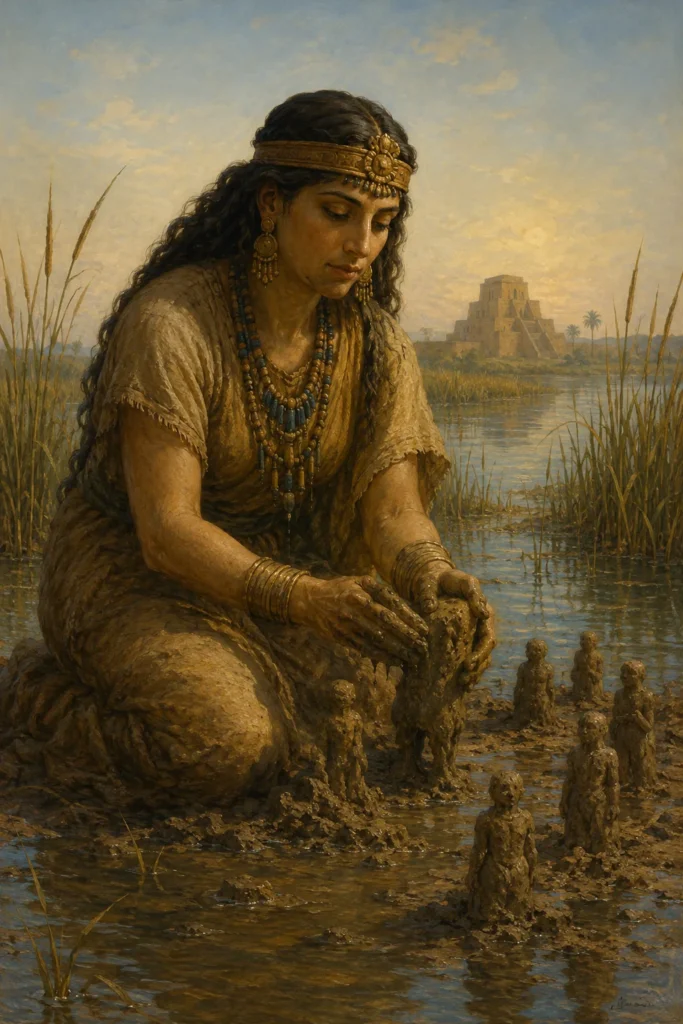
Enki rescues her by means of two creatures formed from clay, the Galaturra and Kurgarra, who take up Ereshkigal’s laments and in return obtain for her the permission to lead Inanna back into life. Inanna, however, returns only on the condition of sending a substitute into the underworld.
She finds her consort Dumuzi sitting in royal attire on a festival throne, instead of mourning for her. Enraged, she consigns him to the galla demons, who drag him into the underworld. This episode is the mythical justification for Dumuzi’s annual disappearance, which coincides with the summer dry season.
A partial solution is brought by Geshtinanna, the sister of Dumuzi. She offers to take the position in the underworld for half of the year, so that Dumuzi and Geshtinanna alternate every six months.
This solution of seasonal halving is related, in the history of religion, to Persephone’s fate in the Greek Demeter myth. Thorkild Jacobsen worked out the structural parallels in “The Treasures of Darkness” and pointed to a possible typological kinship, without asserting direct dependence.
Lamentations and the Festival Calendar
A genre of its own in Mesopotamian literature is the Dumuzi lamentations, which were sung in the hot months of Du’uzu (June and July). Over twelve such lamentations are preserved in the Sumerian and Akkadian languages, edited in Mark Cohen’s “The Canonical Lamentations of Ancient Mesopotamia” (1988).
Well-known texts are “Edina usagake”, “In the steppe in the early grass”, and “Ushumgalkalama”, “Dragon of the land”. These texts depict Inanna or the sister Geshtinanna in search of the vanished Dumuzi and are composed in a strongly repetitive lamentation mode that compensates for the ritual form of recitation.
The laments were performed by professional female mourners, the Gala, often in the women’s language, Emesal. The Emesal texts are distinguished grammatically and phonetically from the normal Sumerian language, Emegir.
The Gala women were a ritual occupational group of their own, whose social position was examined in detail by Walther Sallaberger. Their laments were part of a cosmic ritual in which the disappearance of the vegetation god was mourned and his return in spring was prepared through the lamenting.
In the festival calendar the Du’uzu month in high summer was observed as a time of mourning for Dumuzi. Women presented laments, often with rites of self-flagellation and the strewing of ashes.
These rites are indirectly attested in Ezekiel 8:14, where the prophet sees the “women weeping for Tammuz” at a gate of the Jerusalem Temple and joins in the prohibition of this practice. The biblical passage shows how far the Dumuzi cult had penetrated beyond Mesopotamia into Syrian and Palestinian religion.
The Adonis-Tammuz Line and Mythical Migration
The line of the dying and returning vegetation god can be traced from Dumuzi through Tammuz, the Akkadian form of the name, through Adonis in the Phoenician sphere, into the Hellenistic Mediterranean.
James George Frazer presented this line in “The Golden Bough” (12 volumes, 1890 to 1915) as the paradigm of his general theory of the vegetation myth.
Frazer’s construction is disputed today in its details, above all the specific identifications with Osiris and Christ. The basic thesis, that there is a coherent line of dying vegetation gods in the ancient Near East, has however not been refuted.
The Adonis cult, described in detail by Lucian of Samosata in the 2nd century AD in “De dea Syria”, is clearly an inheritance of the Dumuzi cult. Lucian describes the annual lament for Adonis in Phoenician Byblos, the slaughter of lambs and the red coloring of the river of Adonis, which he explains astronomically.
The women of Byblos shaved their hair as a mourning rite, which has a direct parallel in Mesopotamian lamentation practices. Peggy L. Day has, in several studies, traced the line from Dumuzi through Tammuz to Adonis in detail.
A further important stage is the Attis cult of Phrygia, which reached the Hellenistic and Roman sphere via the Pessinus temple of Cybele.
Attis as the youthful beloved of the Magna Mater shows structural similarity to Dumuzi and Inanna, whereby the self-castration practice of the Galloi priests represents a development of its own. Walter Burkert sees here an independent reformulation of the Mesopotamian model in the Hellenistic context.
Sources and Further Reading
Ancient sources: “Inanna’s Descent to the Underworld”, “Dumuzi’s Dream”, “Dumuzi and Enkimdu”, lamentations for Dumuzi, hymns to Inanna and Dumuzi, Old Akkadian Tammuz laments, biblical mention in Ezekiel 8:14.
Research literature: Thorkild Jacobsen, “The Treasures of Darkness”, New Haven 1976. Jean Bottéro, “La religion babylonienne”, Paris 1952. Bendt Alster, “Dumuzi’s Dream”, Copenhagen 1972. Walther Sallaberger, “Der kultische Kalender der Ur III-Zeit”, Berlin 1993. Andrew George, “The Babylonian Gilgamesh Epic”, Oxford 2003. Stephanie Dalley, “Myths from Mesopotamia”, Oxford 1989. Wilfred Lambert, “Babylonian Creation Myths”, Winona Lake 2013.