Ishtar, goddess of the Mesopotamian tradition
By Ralf Ittermann · last reviewed on
Ishtar is a goddess of the Mesopotamian tradition.
Goddess of love, war and Venus, untamed ruler of the heavens. Ishtar (Sumerian Inanna) is the most powerful female deity of Mesopotamia and scarcely to be tamed. She is at once seductive and warlike, tender and wrathful, a goddess who grants kings victory and damns them in the next hour.
Ruling from Uruk over love and the morning star, she is the favourite goddess of humankind, feared by the gods themselves.
Ishtar (Sumerian Inanna) is the central female deity of the Mesopotamian pantheon and unites the seemingly contradictory spheres of love, war and kingship.
Her hymnic texts (Enheduanna, ca. 2300 BCE) are among the oldest preserved authored religious texts. The myth of Inanna’s descent into the underworld is one of the key texts of Mesopotamian theology. Her cult extends throughout the Semitic language area and influences later Aphrodite and Astarte cults.
Ishtar
Type: Major Mesopotamian deity, goddess of love and war
Pantheon: Akkad/Babylon/Assur (Sumerian counterpart: Inanna)
Function: love, sexual desire, war, cosmic power, the Venus star
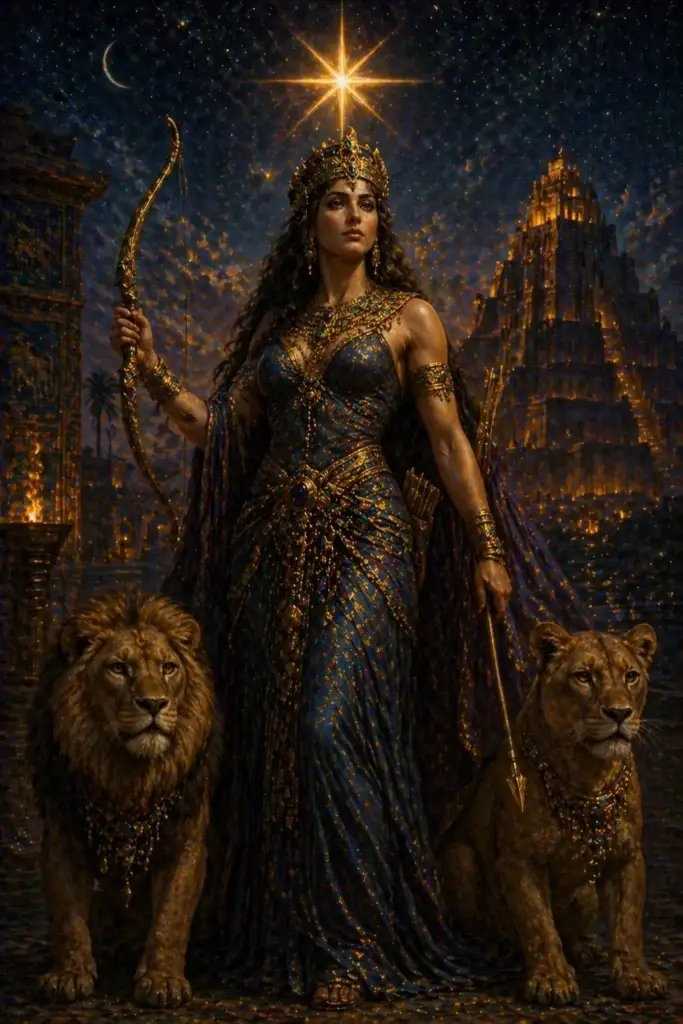
Principal attributes: star crown, lion mount, bow and arrow, eight-pointed star (symbol)
Principal cult sites: Nineveh (E-mesh-mesh temple), Uruk (Eanna), Babylon (Ishtar Gate)
Astronomical identification: Venus (Dilbat)
Historical context
Ishtar is attested from the Old Akkadian period (3rd millennium BCE) onwards, the Akkadianisation of the Sumerian Inanna (in Uruk). The principal flourishing of her cult falls in the Old, Middle and Neo-Babylonian periods.
In the Assyrian empire she was the chief goddess of Nineveh and Arbela, the protective patronesses of the Assyrian kings. The famous Ishtar Gate of Babylon (today in Berlin) is one of the largest surviving structures of antiquity. In the biblical tradition she is mentioned as Ashtoreth.
Principal cult sites: Nineveh (E-mesh-mesh temple, principal cult site in Late Assyrian times), Uruk (Eanna temple as Inanna sanctuary), Babylon (Ishtar Gate, temple within the Esagila complex), Arbela (today Erbil, one of the oldest continuously inhabited cities).
In Akkad as the principal goddess of Sargon. In the Mediterranean world, via Astarte, as a forerunner of Aphrodite.
Central sources: the Inanna and Dumuzi mythic cycle (Sumer), Inanna’s Descent into the Underworld, the Epic of Gilgamesh (Tablet VI, in which Ishtar demands Gilgamesh in marriage), Inanna and Enki, the Ishtar Hymn, Neo-Assyrian inscriptions concerning Ishtar of Arbela.
Secondary literature: Wolkstein/Kramer, Inanna. Queen of Heaven and Earth; Foster, Before the Muses; Black/Green, Gods, Demons and Symbols.
Name
Ishtar is depicted in a twofold guise: above in a translucent garment, with the crown of power, her body bare or martial; below armoured like a warrior with lance and shield, a lion or panther at her feet.
The eight-pointed star crown identifies her, a symbol of the morning star (Venus). Her weapon is the piyattu (fire lance). A scorpion or a dove may accompany her. She is often shown kneeling or standing in warlike pose.
Characteristics
Ishtar is goddess of love, a warrior, guardian of law and power. She decides the outcome of battles and blesses or damns kings according to her mood.
In Ishtar’s Descent she is stripped of her insignia through the seven gates of the underworld, as a punishment for her pride, a profound mythic narrative of female power and its limits.
The priestesses served in her temple. There were great festivals in her honour, liturgical marriages (hieros gamos) with kings, and in times of war mass offerings. Ishtar was the goddess of the people, invoked directly, feared directly.
Profile: Ishtar
The most important aspects of Ishtar at a glance. The following fields summarise origin, function, appearance, veneration, symbols and parallels.
Ishtar is daughter of the moon god Sin (Nanna) and of Ningal, sister of the sun god Shamash. In the Sumerian counterpart Inanna she is daughter of Nanna and Ningal, in another tradition of An.
The consort of the goddess of love is Dumuzi (Tammuz in Akkadian), a young god of shepherds and vegetation. The myth of Inanna’s Descent: she descends into the underworld to her sister Ereshkigal, is first killed there and then revived through Ea; Dumuzi must descend into the underworld in atonement.
Twofold function: goddess of love and of war (united in one figure, a constellation unique in the ancient world). Aspect of love: sexual desire, erotic attraction, marriage.
Aspect of war: royal battle, leadership of armies. Astronomically: morning and evening star (Venus). In personal cult also patroness of women, of the temple priestesses (nadi-tu) and of female diviners.
Anthropomorphic as a beautiful young woman in a long multi-layered garment, with a star crown or tall hat diadem. Characteristic attributes: bow and arrow (war), double mace (war), eight-pointed star (her principal symbol, representing Venus).
Mount: the lion (often standing on a pair of lions). Also a naked form (Inanna-Astarte tradition) on terracotta reliefs. In the Neo-Babylonian period the eight-pointed star alone appears as a divine symbol on stelae and seals.
Sphere of action: Ishtar was invoked by all classes, by women in matters of love, by kings before battle, by priests in divination.
The Assyrian kings (Sargon II, Sennacherib, Esarhaddon) were her particular wards; on every campaign the king invoked “Ishtar of Arbela”. The nadi-tu priestesses are known above all from the cloisters (gagûm) of Sippar, Babylon and Kish. Personal invocation with incense of cedar and the roasting of mutton.
Eight-pointed star (principal symbol, representing Venus), bow and arrow, double mace, lion (mount), star crown, tall hat diadem, multi-layered garment. Plants: cedar, dates, lily. Sacred animals: the lion (especially when accompanied by the Mushhushshu dragon), the serpent.
Inanna (Sumer, her forerunner), Astarte (Phoenicia, an almost identical adoption), Anat (Ugarit), Ashtoreth (Hebrew, biblical mention), Aphrodite (Greece, aspect of love), Athena (Greece, aspect of war), Venus (Rome, astronomically), Hathor (Egypt, late syncretism), Freyja (Germanic, love and choice on the battlefield), Durga (Hinduism, warrior goddess riding a lion).
Practical defence
Rituals of veneration
Ishtar (Sumerian Inanna) was one of the most central deities of Mesopotamia, at once goddess of love, of war and of Venus. Her principal sanctuary was Eanna in Uruk (4th to 3rd millennium BCE).
Sacred marriage rites, hieros gamos (Sumerian nig-mussa-tum), between the king and the high priestess as embodiment of Inanna are attested from Shulgi (Ur III) and Sin-Iddinam (Larsa, 19th century BCE) onwards (cf. Frymer-Kensky, In the Wake of the Goddesses). Temple prostitution (Sumerian nu-gig) as part of her veneration is contested in religious studies (cf. Lambert, Roth).
Invocations
The “Descent of Inanna” (Sumerian; Kramer, The Sumerians) and the Akkadian counterpart “Ishtar’s Descent to Hades” (Foster) are the central mythic texts.
The “Great Ishtar Hymn” (Old Babylonian, time of Ammi-ditana, ca. 1600 BCE) is a personal invocation addressed to her; the earliest personal Inanna hymns are by Enheduanna (ca. 2300 BCE). The ritual prayer “šuʾila” (the hand-raising prayer) was often directed to Ishtar in personal crisis.
Amulets and protective symbols
The eight-pointed star (the Venus symbol) on Babylonian cylinder seals and boundary stones (cf. Black/Green). Lion companions (she rides a lion, the seven-lion chariot). Apotropaic clay figurines of naked women with their hands beneath their breasts (Ishtar images) were buried in house walls (Ur, Larsa, Sippar, excavations of Woolley).
Ishtar, parallels in other cultures
Inanna and Ishtar: one goddess in two languages
Behind the name Ishtar stands one of the oldest and most important deities of Mesopotamia. In the Sumerian sources she is called Inanna, in the later Akkadian, Babylonian and Assyrian texts Ishtar.
Scholarship assumes that the Akkadian Ishtar was largely equated with the Sumerian Inanna, and that in this process an originally independent Semitic goddess was also absorbed into her figure. Over the course of millennia several traditions converged.
Ishtar unites spheres of competence that at first sight appear opposed. She is the goddess of sexual love and at the same time a goddess of war. She stands for desire and attraction as much as for battle and violence.
Older scholarship has occasionally seen in this a contradiction, or the coexistence of two goddesses. More recent work emphasises instead that both spheres are linked in Mesopotamian thought by a common property: a boundary-breaking, order-shattering force at work in both passion and war.
Her astral aspect is the planet Venus. As morning and evening star, Ishtar was associated with the most conspicuous celestial body after the sun and moon. Here too her twofold nature is apparent, for the planet appears now in the morning, now in the evening.
This connection with Venus is significant in the history of religion, since it forms a bridge to the later love goddesses of the Mediterranean, to the Phoenician Astarte and the Greek Aphrodite, who were likewise associated with the planet Venus.
Ishtar's descent into the underworld
The best-known coherent myth concerning Ishtar is her descent into the underworld. It is preserved both in an older Sumerian version, Inanna’s Descent into the Underworld, and in a shorter Akkadian version, Ishtar’s Descent to Hades.
The goddess resolves to descend into the realm of the dead, which is ruled by her sister Ereshkigal.
On her way through the seven gates of the underworld, Ishtar must surrender at each gate an article of clothing or jewellery, a sign of her power.
Naked and stripped of her insignia, she at last comes before Ereshkigal and is there killed; her corpse is hung up. With the death of the goddess of love, all fertility on earth ceases, and humans and animals no longer beget offspring.
Through the intervention of the higher gods Ishtar is revived and allowed to leave the underworld, yet the law of the realm of the dead demands a substitute. In the Sumerian version her husband Dumuzi, Akkadian Tammuz, is appointed; he must henceforth spend part of the year in the underworld.
This myth is important for religious studies in several respects. It associates a goddess with the alternation of fertility and barrenness, and so provides an early example of the widespread motif of the vegetation deity periodically bound to the underworld.
At the same time, the gradual surrender of insignia at the seven gates reveals a carefully developed ritual conception. The older reading as a purely vegetation myth is today regarded as too narrow; scholarship now places more weight on the themes of power, powerlessness and the boundary between worlds.
Temples, priesthood and cult practice
Ishtar possessed temples and sanctuaries in numerous cities of Mesopotamia. An ancient centre of her cult was the city of Uruk, where the great sanctuary Eanna, the House of Heaven, stood.
In Nineveh and other Assyrian cities she was also a leading deity; the Assyrian kings invoked Ishtar as a helper in battle and ascribed their victories to her.
Cult practice involved a varied circle of temple personnel and ritually active individuals. The cuneiform sources name various groups of persons in the service of Ishtar, among them some whose gender role is described as standing between the usual categories.
Older accounts have often summed up the cult of Ishtar with the catchword of temple prostitution.
More recent scholarship is markedly more cautious here. It points out that the ancient testimonies for this, above all a famous passage in Herodotus, come from outside, may be misleading and do not easily align with the indigenous cuneiform sources. The precise nature of the sexually connoted elements of the cult remains contested.
By contrast, hymns and prayers to Ishtar, which are among the most impressive texts of Mesopotamian literature, are well attested. They praise her power, describe her beauty and her terror, and ask for her aid.
Some of these texts were ascribed to tradition-shaping figures, such as the Old Akkadian priestess and poet Enheduanna, to whom several Inanna hymns are attributed. Such texts show that Ishtar was the object not only of the official state cult but also of personal piety.
Ishtar in the Epic of Gilgamesh and in cultural memory
A famous literary episode shows Ishtar in a critical light. In the Epic of Gilgamesh, the best-known work of Mesopotamian literature, the goddess woos the hero Gilgamesh and offers him marriage.
Gilgamesh refuses and confronts her with the fate of her former lovers, to whom her love had brought misfortune, above all Dumuzi. Enraged, Ishtar demands from her father the Bull of Heaven in order to punish Gilgamesh, and so causes great calamity until the bull is slain by Gilgamesh and Enkidu.
This episode is illuminating for the history of religion, because it shows that Mesopotamian poetry could ascribe to its gods features of wrath, danger and injured pride. Ishtar here appears as powerful, passionate and unpredictable. The text does not thereby devalue her but renders her boundary-breaking nature visible.
In cultural memory Ishtar has remained present chiefly along two paths. One is the archaeological rediscovery of Mesopotamia in the 19th and 20th centuries.
Famous is the reconstructed Ishtar Gate of Babylon with its wall of blue glazed bricks, which today stands in a museum in Berlin and makes the goddess’s importance for the Babylonian city visible.
The other path leads through the history of religion itself: the combination of love, war and the planet Venus makes Ishtar a key to understanding later goddesses of the eastern Mediterranean.
Scholarship sees in her one of the most influential female deities of the ancient world, whose traces can be followed from Sumer into Greek religion.
Further reading and links
Sources and literature
Further standard works in the literature index.
Frequently asked questions about Ishtar
Who was Ishtar in Babylonian and Assyrian mythology?
Ishtar (Akkadian Ištar, Sumerian Inanna) was the most important goddess of Mesopotamia, at once goddess of love, of fertility and of war. This contradictory twofold function (love and war) is typical of her ambivalence.
Her most famous myth is the descent of Inanna/Ishtar: she descends into the underworld to her sister Ereshkigal and on the way is stripped of her seven items of jewellery (seven gates, one item surrendered at each). She dies below and returns only through divine intervention, a myth of vegetative renewal.
What is the Ishtar Gate?
The Ishtar Gate was the eighth city gate of the Babylonian capital Babylon, built around 575 BCE under Nebuchadnezzar II. It was a double gateway of blue glazed bricks, decorated with reliefs of bulls (for the weather god Adad), dragons (Mušḫuššu, for Marduk) and lions (for Ishtar).
It was one of the most famous structures of the ancient world, probably the very building meant when the Hanging Gardens of Babylon are listed among the wonders of the world. The reconstructed front of the gate is today the centrepiece of the Pergamon Museum in Berlin.