Xi Wangmu, Queen Mother of the West
By Ralf Ittermann · last reviewed on
Xi Wangmu, the “Queen Mother of the West”, is one of the oldest and at the same time most complex female divine figures in Chinese mythology.
According to traditional belief she resides on the Kunlun mountains in the far west and possesses the peaches of immortality, which ripen only every three thousand or nine thousand years.
In the history of religion she has undergone a remarkable transformation, from the archaic, semi-bestial western monster of the Zhou period to the elegant Daoist celestial queen of the later tradition.

Profile: Xi Wangmu
Xi Wangmu: the most important aspects at a glance. The following fields summarise origin, function, appearance, veneration, symbols and parallels.
Xi Wangmu, the “Queen Mother of the West,” is one of the oldest female divine figures in Chinese mythology. The oldest evidence is in the Shanhaijing, whose oldest layers go back to the 4th to 3rd century BCE. There she appears as a half-animal being; later she became the Daoist Queen of Heaven.
In the Shanhaijing she is responsible for plagues and punitive judgments. From the time of the Han she becomes the giver of immortality and the supreme patron of the pursuit of bodily immortality (xian). In Daoism she is regarded as the highest female teacher of immortality.
In the Shanhaijing she is a hybrid being with human features, a panther’s tail, tiger’s teeth and wild hair. The tomb reliefs of the Han show her with the headdress sheng, an ornament in the form of a shuttle-like part of the loom. From the time of the Tang she appears as a courtly lady in long robes, often with a peach or a phoenix feather.
Temples of Xi Wangmu are widespread in China, especially in the west and north. The Wangmu Palace on Mount Huashan in Shaanxi is one of the most famous sanctuaries. Festival days are the third day of the third lunar month (birthday) and the 18th day of the seventh lunar month (day of the Peach Festival), on which peach cakes and longevity noodles are offered.
Her most important attribute is the peach of immortality (pantao), which ripens only every three thousand years; whoever eats a fruit becomes a xian. Her companions are the three-legged bird that brings her food, the nine-tailed fox and the moon hare. The peach also stands for longevity, and peach wood is used to drive away demons.
Kunlun, her dwelling, is regarded as a vertical world-axis mountain, comparable to Mount Meru of the Indian tradition or Olympus of the Greek. Through Chang’e, who carries the elixir of immortality off to the moon, she is connected with the moon goddess. Iranian or Central Asian notions may have flowed in, but a path of transmission cannot be demonstrated.
Early Evidence in the Shanhaijing
The oldest evidence for Xi Wangmu is found in the “Shanhaijing” (“Classic of Mountains and Seas”), a work whose oldest layers reach back to the fourth and third centuries before our era.
The book “Western Mountains” describes her as a hybrid being with human features, a panther’s tail, tiger’s teeth and wild hair, who dwells on a mountain in the west and is responsible for pestilences and punitive judgements.
This early figure is anything but graceful; she stands in a line with other archaic Chinese divine beings that carry zoomorphic elements. Edward Schafer showed in “The Divine Woman” (Berkeley 1973) that the later iconographic smoothing of Xi Wangmu only begins from the Han period onward and reflects a profound shift in meaning.
The Han-Period Transformation
In the Han period (206 before our era to 220 of our era) the image of Xi Wangmu shifts radically. The monstrous plague goddess becomes the bestower of immortality.
The peaches of immortality, which grow on her trees on Kunlun, become the central motif. The Han period knew an intense preoccupation with the striving for bodily immortality (xian), and Xi Wangmu becomes the supreme patroness of this quest.
In the “Huainanzi” (second century before our era) she is the guardian of the elixir of immortality, which the archer Hou Yi receives from her and which his wife Chang’e then carries off to the moon.
This narrative links the Queen Mother of the West with the moon goddess and establishes an astronomical and cosmological depth dimension.
A significant episode is the legendary encounter of Xi Wangmu with the Zhou king Mu, transmitted in the “Mu Tianzi Zhuan” (fourth to third century before our era). The king travels west, meets the Queen Mother on one of her mountains and exchanges poems with her.
This encounter was taken up many times in later Chinese literature and art and stood for the connection of the earthly ruler with the divine powers of the west. Stephen Bokenkamp (“Early Daoist Scriptures”, Berkeley 1997) analysed the significance of this narrative for the self-legitimation of the early Daoist movements.
The Peaches of Immortality
The pantao, the peaches of immortality, are the iconically most important attribute of Xi Wangmu. According to the traditions they ripen only every three thousand years; some versions speak of three thousand, six thousand and nine thousand years for three different varieties. Whoever eats a fruit becomes a xian, an immortal.
In “Journey to the West” (Xiyou Ji) the plundering of the peach garden by the Monkey King Sun Wukong is one of the best-known episodes of Chinese novelistic literature. This narrative elaboration is literary, but it draws on a mythological complex that has existed since the Han period.
Connection with Yu Huang
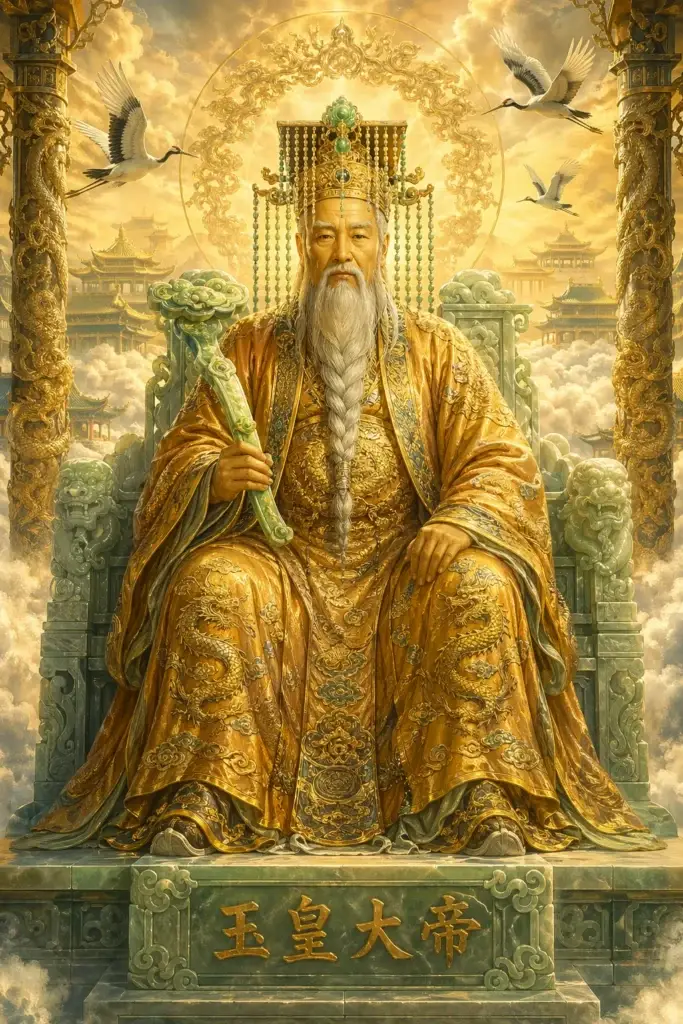
With the establishment of the Jade Emperor in the Song period, Xi Wangmu becomes the “Royal Mother” (Wangmu Niangniang), his consort. In the history of religion this connection is a late construction that brings together two originally separate divine complexes.
In this constellation she rules over the female half of the divine heaven and is the patroness of the female immortals, the Xian women.
Her seven daughters are central figures in the narratives of folk religion, above all the seventh daughter Zhinü, the “Weaver Girl”, whose story with the herdsman Niulang gives rise to the Qixi festival on the seventh day of the seventh lunar month.
Iconography
The iconographic transformation of Xi Wangmu shows a shift in meaning that is exemplary for the Chinese history of religion.
The Han-period reliefs of the Sichuan and Shandong tombs still frequently show her with the sheng headdress, a characteristic crowning piece resembling a loom shuttle, and with her companion animal, the three-legged bird that brings her food, as well as the nine-tailed fox and the moon hare.
From the Tang period onward her depiction changes into that of an idealised courtly lady in long robes, often with a peach or a phoenix feather. In the Ming and Qing periods she is iconographically scarcely distinguishable from other Daoist celestial ladies; her symbol remains the peach.
Cult and Veneration
Temples of Xi Wangmu are widespread in China; they are concentrated especially in the west and north of the country. The Wangmu Palace on Mount Hua in Shaanxi is one of the most famous sanctuaries.
Her festival days fall on the third day of the third lunar month (her birthday) and the eighteenth day of the seventh lunar month (the day of the peach festival).
On these days peach cakes and longevity noodles are offered. In Taiwan and in the Chinese diaspora her veneration is alive, especially in connection with the wish for longevity and in connection with the birthday celebrations of older family members, who are often given peach sculptures made of rice dough.
The Western Motif and Cultural Contacts
The placing of Xi Wangmu in the “far west” is an element of interest in the religious geography. In the awareness of the early Han period the outermost known west lay in the regions of present-day Xinjiang, Kazakhstan and Iran. The Queen Mother thus became the mythological personification of the unknown beyond.
With the opening of the Silk Road from the late second century before our era, connections with western realms actually came into being, and the preoccupation with Xi Wangmu intensified.
In several studies Edward Schafer considered the possibility that Iranian or Central Asian religious conceptions might have flowed into the later shaping of the Queen Mother, without a direct path of transmission being demonstrable.
Daoist Appropriation
In organised Daoism, above all in the Shangqing school of the fourth to sixth centuries, Xi Wangmu became the supreme female teacher of immortality.
She is said to have revealed several central texts of the school, among them instructions on breath meditation and inner alchemy. Suzanne Cahill examined this Daoist appropriation in detail in “Transcendence and Divine Passion.
The Queen Mother of the West in Medieval China” (Stanford 1993) and showed that within Shangqing theology Xi Wangmu occupies a distinct position, independent of the later, Confucian-shaped hierarchy.
Her study also makes clear that female Daoist practitioners found in Xi Wangmu a figure of direct identification, whose existence was not legitimated through any male mediation.
Classification in Religious Studies
Anne Birrell and Sarah Allan have independently pointed out that Xi Wangmu, as a divine figure, embodies a transition from an archaic, nature-magical conception to a courtly and civilisational one.
The peaches of immortality thereby symbolise not only power over life and death; they are also an image of cultivation, for the peach is a deliberately cultivated fruit and thus represents a civilisational achievement.
In this tension between wild power and cultivated dignity lies one of the foundations of the enduring significance of Xi Wangmu for Chinese religion.
Sources and Further Reading
Primary sources: Shanhaijing (“Classic of Mountains and Seas”), book “Western Mountains”; Mu Tianzi Zhuan (fourth to third century before our era); Huainanzi; Han-period tomb reliefs from Sichuan and Shandong; Shangqing texts of the fourth to sixth centuries; Journey to the West (Xiyou Ji).
Secondary literature: Edward Schafer, “The Divine Woman”, Berkeley 1973; Suzanne Cahill, “Transcendence and Divine Passion. The Queen Mother of the West in Medieval China”, Stanford 1993; Anne Birrell, “Chinese Mythology. An Introduction”, Baltimore 1993; Stephen Bokenkamp, “Early Daoist Scriptures”, Berkeley 1997; Sarah Allan, “The Shape of the Turtle”, Albany 1991; Mark Lewis, “The Construction of Space in Early China”, Albany 2006.
Mount Kunlun as a Cosmic Place
Mount Kunlun, on which Xi Wangmu resides according to tradition, is a central cosmic place in Chinese mythology.
Geographically it is mostly identified with the present-day Kunlun mountains in Xinjiang or with the mountain ranges of eastern Tibet, but mythologically it is primarily a vertical world-axis mountain, comparable to Mount Meru of the Indian tradition or Olympus of the Greek.
On its summit, according to the conception of the Huainanzi, lies the “Hanging Garden” (Xuanpu), which bears the peaches of immortality. From Kunlun the most important Chinese rivers flow down, among them the Yellow River, whose source was thought, according to the Han-period conception, to lie on the mountain.
In “Pacing the Void” (Berkeley 1977) Edward Schafer set out in detail how Kunlun was constructed in the Daoist cosmography of the Han and Tang periods as the centre of cosmic geography.
The Three-Legged Bird and the Nine-Tailed Fox
The companions of Xi Wangmu, above all in the Han-period iconography, form a mythological ensemble of their own. The three-legged bird (sanzu wu) is regarded as the food-bringer of the goddess; it is also frequently identified with the sun, in which, according to traditional belief, a three-legged raven dwells.
The nine-tailed fox (jiuwei hu) is a symbol of cosmic prosperity and bliss, but in later narratives this fox also took on ambivalent, sometimes demonic connotations.
The moon hare, which pounds the elixir of immortality, is according to some versions identified with the woman Chang’e, who received the elixir from Xi Wangmu and carried it off to the moon.
These three animal figures together form the cosmic court of the Queen Mother and are depicted in her surroundings in numerous Han-period tomb reliefs.
Xi Wangmu and the Shangqing School
The Shangqing school of Daoism, founded in the 360s in southern China, gave Xi Wangmu a special position. According to the revelations granted to Yang Xi and his associates, she is the supreme female teacher of immortality.
She is said to have revealed several central texts of the school, among them instructions on breath meditation, on the visual imagination of the inner body and on the absorption of starlight.
Suzanne Cahill translated and commented on the Shangqing texts concerning Xi Wangmu in detail in “Transcendence and Divine Passion” (Stanford 1993). One of her most important observations is that Shangqing theology permits female practitioners a direct identification with Xi Wangmu, without mediation through male teachers being necessary.
This constellation has been described in the research on the history of religion as one of the few female-autonomous spaces of Daoist practice.
The Peach as a Cultural Symbol
The peach (tao), the most important attribute of Xi Wangmu, is in the Chinese cultural context more than merely a fruit. It stands for longevity, is apotropaic in its effect (peach wood is traditionally used to drive away demons) and symbolises fertility, youth and feminine grace.
At the birthday celebrations of older family members, peach-shaped cakes made of rice dough are traditionally given (shoutao, “longevity peaches”).
This tradition goes back to the pantao veneration of Xi Wangmu and is a good example of how a religious conception can pass over into a secular cultural custom without the religious root having to be explicitly present.
The Mu Tianzi Zhuan Encounter
The “Mu Tianzi Zhuan” (Records of the Son of Heaven Mu), a text probably composed in the late Zhou or early Han period, describes the legendary journey of the Zhou king Mu (reigned ca. 956 to 918 before our era) to the dwelling of Xi Wangmu.
The text was rediscovered in 281 of our era in a royal tomb at Ji (Henan) and is thus archaeologically attested. It describes in detail the king’s journey west, the meeting with Xi Wangmu on Mount Kunlun and the exchange of poetic songs between the two.
This narrative marks the transition of Xi Wangmu from a wild demi-deity in the older layers to a dignified queen who deals with the Son of Heaven as an equal.
Rémi Mathieu translated and commented on the Mu Tianzi Zhuan into French in 1978. The significance of the text for religious studies lies in its attesting the transformation of the goddess in an intermediate phase: the wild being with tiger’s teeth from the Shanhaijing is here already softened, but the full Han-period ennoblement into a court goddess is still to come.
The Han Reliefs and the Western Motif
In Han tomb reliefs (first to third century of our era) Xi Wangmu is one of the most frequent depictions.
She typically sits on a throne, flanked by the three-legged bird (san zu wu), the nine-tailed fox (jiu wei hu) and the moon hare, which pounds the elixir of immortality. These companion animals are standard iconographic attributes.
Suzanne Cahill (“Transcendence and Divine Passion: The Queen Mother of the West in Medieval China”, Stanford 1993) systematically evaluated the Han iconography and showed that the reliefs are concentrated in two main regions: Shandong and Sichuan.
The Shandong reliefs from the tomb chambers of Cangshan and other places are particularly rich in detail and depict Xi Wangmu in a western-heaven court surrounded by numerous immortals. This visualisation was motivated by religious eschatology: people hoped to reach Xi Wangmu in the afterlife and to attain immortality at her court.
The Peach Motif in the Han Wudi Neizhuan
The motif of the peach trees in Xi Wangmu’s garden, whose fruits ripen only every 3000 or 9000 years and confer immortality, is an older Han tradition and received its canonical form in the “Han Wudi neizhuan” (Inner Records of the Han Emperor Wu, probably fourth to sixth century).
There it is reported how Xi Wangmu gave seven peaches to the Han Emperor Wu (reigned 141 to 87 before our era).
The emperor kept the stones in order to cultivate them himself, which Xi Wangmu met with the remark that these peaches grew only in the western heaven and not in the earthly world.
This episode is interesting in terms of religious politics; it addresses the tension between imperial power and transcendent immortality. In the “Xiyou Ji” (Journey to the West, 16th c.) the motif was taken up in literature, with Sun Wukong plundering Xi Wangmu’s peach plantation and thereby disrupting the famous bucolic divine festival.
The Shangqing School and the Spiritual Transformation of Xi Wangmu
In the Shangqing school of Daoism (founded in the fourth century of our era) Xi Wangmu underwent a spiritual reinterpretation. She became the teacher of the immortals and the guardian of the secret revelations.
The Shangqing texts, above all the “True Scriptures of the Great Purity” (Shangqing Jing), describe how Xi Wangmu appeared to Yang Xi (330 to 386) and other visionaries within the mountains and transmitted secret teachings to them.
Isabelle Robinet (“Méditation taoïste”, Paris 1979) and Edward Schafer (“Mirages on the Sea of Time”, Berkeley 1985) examined the Shangqing visionary literature in depth. The ennoblement of Xi Wangmu into the supreme female Daoist is completed in this school; she becomes the mother of all female immortals and the teacher of paradigmatic texts of initiation.
The Peach as a Symbol of Longevity
The peach is one of the most prominent symbols of longevity in the Chinese cultural sphere. This symbolism goes directly back to the Xi Wangmu myth.
In the visual art of the Ming and Qing periods the peach, alongside the crane and the pine, became a fixed pictorial cipher for a long life. In the modern culture of the Chinese-speaking world too, peaches are traditional birthday gifts to elders.
Beyond this, folk religion interprets the peach apotropaically: peach-wood swords (taomu jian) are regarded as effective against demons. This apotropaic function is attested in the Yijing commentary and in the Han-period dictionary Shuowen Jiezi. The peach tree of Xi Wangmu is therefore not only a symbol of immortality, but also of cosmological protective power.
The Moon Hare and the Elixir of Immortality
The moon hare (Yutu) belongs to the court of Xi Wangmu and pounds the elixir of immortality in a mortar on the moon. This conception is attested since the Han reliefs and is transmitted in comparable form across Korea, Japan and Vietnam.
The connection of the hare with the moon and with immortality is possibly of Central Asian origin and migrated into the Chinese canon by way of the Silk Road.
The hare already appears in Indian Jataka stories and in Mongolian and Turkic myths. In several studies on the Tang period Edward Schafer discussed the transcontinental spread of the moon-hare motif.
In the modern Chinese Mid-Autumn Festival (Zhongqiu Jie) the moon hare is a central pictorial figure, especially in children’s literature and in mooncake packaging design.
Frequently Asked Questions
Who is Xi Wangmu? The “Queen Mother of the West”, one of the oldest female divine figures of Chinese mythology. In the course of the history of religion she was reinterpreted from an archaic plague deity into the elegant bestower of immortality.
What are the peaches of immortality? The pantao, which according to tradition ripen only every three thousand, six thousand or nine thousand years. Whoever eats one becomes a xian, an immortal.
Where does Xi Wangmu live? On Mount Kunlun in the far west. Geographically this mountain is mostly identified with the present-day Kunlun mountains in Xinjiang or with eastern Tibet, but mythologically it is primarily a vertical world-axis mountain.
What is her relationship to the Jade Emperor? In later Chinese folk belief (from the Song period onward) she is venerated as the consort of the Jade Emperor. This connection is a late construction in the history of religion that brings together two originally separate divine complexes.