Guan Yin, Chinese goddess of compassion
By Ralf Ittermann · last reviewed on
Guan Yin is the Chinese goddess of compassion, to whom those seeking help in distress, illness and danger turn. Guan Yin (Chinese Guanyin, fully Guanshiyin Pusa, “she who perceives the weeping of the world”) is the most prominent bodhisattva figure in Chinese Buddhism and in popular religion.
In the history of religion she goes back to the Indian bodhisattva Avalokiteśvara, but in China she developed into an independent, predominantly female-connoted figure of compassion. From the perspective of religious studies, Guan Yin is the best-known case of a gender transformation of a Buddhist salvific figure in a new cultural context.
Profile: Guan Yin
Guan Yin: the most important aspects at a glance. The following fields summarise origin, function, appearance, veneration, symbols and parallels.
Chinese goddess of compassion in Chinese Buddhism and folk religion. She goes back to the Indian bodhisattva Avalokiteshvara, who first appears in the Mahayana sutras of the 1st to 3rd century CE, and in China became an independent figure with predominantly female connotations. Her name means “She Who Perceives the Weeping of the World.”
People in need, sickness and danger turn to Guan Yin for help. According to Chapter 25 of the Lotus Sutra, the bodhisattva meets beings in the most varied predicaments with manifold manifestations. As the Child-Giving Guanyin (Songzi Guanyin) she is the patron of women who wish for a child.
In India, Avalokiteshvara is always depicted as male with a mustache; early Chinese images from Yungang and Longmen show a male or gender-neutral bodhisattva. From the 9th to 10th century, Guanyin takes on female features, and under the Song (960 to 1279) the female depiction dominates. The child-giving form shows her with a child in her arms.
The holiest pilgrimage site is the island of Putuo Shan off the coast of Zhejiang Province, whose pilgrimage tradition is documented from the 10th century. She is venerated in Buddhist temples as well as in folk-religious shrines and family altars. Women who wish for a child present offerings of red thread, children’s clothing and symbolic gifts.
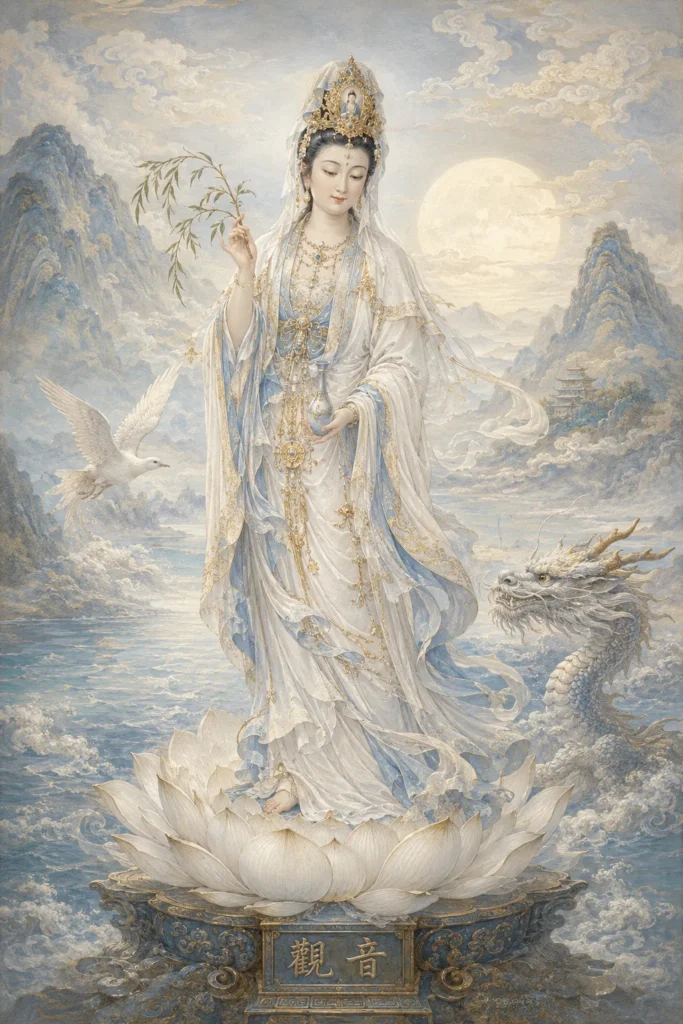
The Guanyin with the water jug (Yangliu Guanyin) holds a willow branch and a vase of pure water, which she sprinkles for purification. The long white robe of the White-Robed Guanyin symbolizes purity and the connection with clouds and mist. With the Thousand-Armed one, each hand bears its own attribute, from the lotus flower and the sword to a small image of a buddha.
Avalokiteshvara becomes Chenrezig in Tibet, Kannon in Japan, Gwaneum in Korea and Quan Am in Vietnam. With the Catholic Mary, Guan Yin shares the function of a female-connoted figure of compassion who acts as intercessor for the concerns of the faithful. The parallel is not historically grounded.
Avalokiteśvara and the Indian Background
The name Avalokiteśvara (“the lord who looks down with compassion”) first appears in the Indian Mahāyāna sūtras of the first to third centuries of our era. Chapter 25 of the Lotus Sūtra (Saddharmapuṇḍarīka) is devoted to this bodhisattva and describes his manifold manifestations, with which he meets beings in the most varied situations of distress.
The chapter was transmitted early in China as an independent sūtra under the title “Guanyin Jing” and remains to this day one of the most frequently recited canonical scriptures of Chinese Buddhism.
Another central work is the Kāraṇḍavyūha Sūtra (around the fourth century), which systematically unfolds the cosmic significance of Avalokiteśvara. In India, Avalokiteśvara is always unambiguously male, depicted with a moustache and male attributes.
Transmission to China
The first Chinese translation of the Lotus Sūtra by Dharmarakṣa in the year 286 of our era introduces the bodhisattva as Guangshiyin. The subsequent, more influential translation by Kumārajīva (406) establishes the form Guanshiyin, which was later shortened to Guanyin because of the taboo name of Emperor Tang Taizong (Li Shimin).
In the first centuries of Chinese reception, Guanyin is still unambiguously male; early depictions from the caves of Yungang (fifth century) and Longmen (fifth to seventh century) show a male or at least gender-neutral bodhisattva.
The Gender Transformation
From the ninth to tenth century onward an iconographic shift begins, in which Guanyin increasingly takes on female features. By the Song period (960 to 1279) the female depiction has become dominant.
In her foundational study “Kuan-yin. The Chinese Transformation of Avalokitesvara” (New York 2001), Chün-fang Yü has shown that this transformation was not a single event but a long-term process in which several factors interacted.
First, Chinese perception identified compassion more strongly with a female base figure. Second, Chinese hagiographies emerged that recounted a female background for Guanyin, above all the legend of Princess Miaoshan. Third, concrete female bearers of a Guanyin cult, such as the “Madonnas with the fish basket”, played an important role.
The Miaoshan Legend
The most influential hagiographic narrative is that of Princess Miaoshan, which was set down in writing in several versions in the eleventh to twelfth century.
According to this account, Miaoshan was the youngest daughter of a king who refused to marry and chose the religious life instead. Her father persecuted her, she was finally shut away in a monastery from which she escaped after several attempts on her life.
When her father later became gravely ill, she sacrificed her eyes and hands to him as medicine, whereupon through divine intervention she received a thousand eyes and a thousand arms.
This narrative links the iconographic form of the “Thousand-Armed Guanyin” with a Chinese family ethic. In “The Legend of Miao-shan” (London 1978), Glen Dudbridge examined in detail the textual history and the religious implications of this narrative.
Iconographic Forms
Guanyin developed numerous manifestations in the Chinese tradition. The “Water-Jug Guanyin” (Yangliu Guanyin) holds a willow branch and a vase of pure water, which she sprinkles for purification.
The “White-Robed Guanyin” (Baiyi Guanyin) wears a long white robe that symbolizes purity and her connection with clouds and mist. The “Thousand-Armed” (Qianshou Qianyan Guanyin) is the iconically densest form.
The “Child-Bringing Guanyin” (Songzi Guanyin) shows her with a child in her arms and is the patron saint of women who wish to have children.
The “Guanyin with the Fish Basket” (Yulan Guanyin) goes back to a popular-religion legend of a young woman of superhuman beauty who, as she was dying, finally revealed herself as a manifestation of Guanyin.
The Island of Putuo Shan
The most sacred place of pilgrimage in the veneration of Guanyin is the island of Putuo Shan off the coast of Zhejiang province.
It is one of the four sacred mountains of Chinese Buddhism and is traditionally regarded as the earthly manifestation of the island of Potalaka, which is described in the Avataṃsaka Sūtra as the dwelling place of Avalokiteśvara.
The tradition of pilgrimage to Putuo is documented from the tenth century onward; the main part of the temple architecture visible today dates from the Ming and Qing periods. In a separate study (“Pilgrims and Sacred Sites in China”, Berkeley 1992), Chün-fang Yü documented the Putuo pilgrimage in terms of the ethnography of religion.
Spread Across East Asia
From China the female form of Guanyin spread to Korea (Gwaneum), Japan (Kannon), Vietnam (Quan Am) and into the Chinese diaspora worldwide.
In Japan the gender connotation is less unambiguously female; many depictions of Kannon are androgynous. In the Theravāda Buddhism of Southeast Asia, Guanyin is absent, since the cult of the bodhisattva is generally less pronounced there.
The figure found a particular reception in Chinese Christianity: the Jesuit mission of the late Ming and early Qing periods had images of the Madonna painted in the visual language of the white-robed Guanyin, which led to an independent cross-cultural pictorial tradition.
Guan Yin and Mary
The typological parallel between Guanyin and the Catholic Mary has been discussed repeatedly in religious studies. Both are female figures of compassion who act as intercessors for the concerns of the faithful; both are depicted with white robes and children.
The parallel is not historically grounded, since Guan Yin developed before any substantial Christian mission in China.
It does, however, point to a comparable function in the psychology of religion of a female-connoted figure of compassion in two strongly patriarchal religious traditions.
Classification in Religious Studies
The veneration of Guanyin is the most prominent example of the cultural translation of an Indian salvific figure into an East Asian context. It shows that Buddhist teaching figures are not static but can undergo profound transformations in their encounter with new cultures.
Avalokiteśvara becomes Chenrezig in Tibet (male or neutral in gender), Guanyin in China (female), Kannon in Japan (often androgynous).
This difference is not merely iconographic but touches the understanding of what a bodhisattva figure is. Chün-fang Yü describes this plurality as the “polymorphism” of the bodhisattva concept, in which the essential function, comprehensive compassion, finds expression in context-specific forms in each case.
Sources and Further Reading
Primary sources: Lotus Sūtra (Saddharmapuṇḍarīka), chapter 25; Kāraṇḍavyūha Sūtra; “Guanyin Jing” as an independent Chinese tradition; Miaoshan hagiographies (eleventh to twelfth century).
Secondary literature: Chün-fang Yü, “Kuan-yin. The Chinese Transformation of Avalokitesvara”, New York 2001; Glen Dudbridge, “The Legend of Miao-shan”, London 1978; Anne Birrell, “Chinese Mythology. An Introduction”, Baltimore 1993; Edward Schafer, “The Divine Woman”, Berkeley 1973; Robert Buswell and Donald Lopez, “Princeton Dictionary of Buddhism”, Princeton 2014.
Putuo Shan and the Pilgrimage Tradition
The island of Putuo Shan off the coast of Zhejiang is not only the most important sanctuary of Guan Yin, but also one of the historically most illuminating pilgrimage destinations in China.
The identification of the island with the mythical Potalaka, the dwelling place of Avalokiteśvara in the Avataṃsaka Sūtra, was made in the tenth century.
A well-known narrative reports that the Japanese monk Egaku wanted to bring a statue of Guanyin from a mainland temple to Japan, but the ship ran aground off Putuo in a storm.
Egaku understood this as a sign that the statue wished to remain there, and founded a temple on this spot. This narrative is legendary, but it reflects the close historical exchange between Chinese and Japanese centres of Buddhism.
Today about twelve hundred monks and nuns live on Putuo; pilgrimage traffic has multiplied since China’s economic opening from 1978 onward. Chün-fang Yü documented the pilgrimage practice in “Pilgrims and Sacred Sites in China”.
The Thousand-Armed Guan Yin
The iconographic form of the Qianshou Qianyan Guanyin (“a thousand arms, a thousand eyes”) is one of the best-known manifestations.
It is, however, not thousand-armed in the literal sense, but in most depictions has forty large main arms with additional arms depicted symbolically around them. Each hand bears its own attribute, from the lotus blossom and the sword to the small image of the Buddha.
Small eyes are drawn into the palms of the hands, symbolizing alert compassion in all directions. The historical-religious root of this form lies in the Sahasrabhuja-Avalokiteśvara Sūtra, which was translated from Sanskrit in the Tang period.
The Chinese hagiography of the eleventh to twelfth century links the thousand arms with the Miaoshan legend, in which the princess, after losing her eyes and hands, received these multiple limbs with divine help.
Guan Yin and Chinese Popular Religion
Guan Yin is the only Buddhist figure who has attained a fully autonomous position in Chinese popular religion. She is venerated not only in Buddhist temples but also in popular-religion shrines, on family altars and in non-Buddhist contexts. In the Chinese diaspora she is often the only Buddhist deity present in a home.
The “Child-Bringing Guan Yin” (Songzi Guan Yin) is venerated especially by women who wish to have children, with offerings of red thread, children’s clothing and symbolic gifts.
This popular practice has no direct canonical background; it is an adaptation of the general function of compassion to the concrete realities of life. Chün-fang Yü and Anne Birrell have independently emphasized that the popular-religious appropriation of Guan Yin was the actual engine of her spread.
Guan Yin in Music and Literature
The literary treatment of Guan Yin is extensive. The popular-religion song “Guan Yin Gege” (“In Praise of Guan Yin”) is widespread in the Chinese-speaking world.
In modern Chinese-language pop music there are numerous songs that invoke Guan Yin directly, without the singers classifying themselves as religious. In modern Taiwanese cinema, Guan Yin is present as a protective figure in numerous family dramas.
This cultural presence is important in the sociology of religion: beyond narrow religious practice, Guan Yin has become a generally Chinese cultural symbol.
Chapter 25 of the Lotus Sūtra
The “Universal Gate chapter” (Avalokitesvara-Samantamukha-Parivarta, Chinese Pumen Pin) is chapter 25 of the Saddharmapuṇḍarīka (Lotus Sūtra). It was translated into Chinese in the third century by Dharmarakṣa and again in the fifth century by Kumārajīva. Kumārajīva’s version became the standard liturgy.
The chapter describes 33 manifestations of the bodhisattva and sets out that Avalokiteśvara appears in whatever form is needed for the salvation of beings, including female forms.
The number 33 is significant in the history of religion; it corresponds to the 33 devas of the Indian pantheon and became, in East Asia, both in Japan (33 Avalokiteśvara pilgrimage routes) and in Korea and China, a structuring element of the liturgy.
The chapter is recited independently in Chinese monasteries and is regarded as the most-read single scripture of Chinese Buddhism.
The Thousand-Armed Form (Qianshou Guanyin)
The eleven-headed and thousand-armed manifestation of Guanyin is elaborated in the “Nīlakaṇṭha Dhāraṇī Sūtra” (Chinese Qianshou jing, translated in the seventh to eighth century).
This form, in Sanskrit Sahasrabhuja-Avalokiteśvara, combines the notion of unlimited readiness to help with the iconographic visualization of a thousand symbolic hands. Each hand bears an attribute: wheel, lotus, wish-fulfilling jewel, vajra, sword, pot, mirror, bow, bowl, crown.
The Tibetan tradition knows the parallel form Chenrezig (sPyan ras gzigs), which is regarded as the spiritual root of the Dalai Lama incarnation.
In Japan the form Senju Kannon became the central principal deity of several monasteries, such as Sanjusangen-do in Kyoto, where 1001 life-sized Senju statues from the thirteenth century are preserved.
The Putuoshan Pilgrimage Tradition
Mount Putuo (Putuoshan) in the East China Sea off the coast of Zhejiang has been the central pilgrimage destination of Guanyin veneration since the tenth century.
The identification of the mountain with the Indian Potalaka, the dwelling place of Avalokiteśvara according to the Avataṃsaka Sūtra, goes back to the Japanese monk Egaku in the year 916. Egaku is said to have tried to bring a Guanyin statue from Wutaishan to Japan, but to have been stranded by storms at Putuoshan and to have interpreted this as a sign to erect the statue there.
This founding legend is significant in the sociology of religion; it connects East Asian Guanyin veneration with a transnational pilgrimage geography.
Chün-fang Yü (“Kuan-yin: The Chinese Transformation of Avalokiteshvara”, New York 2001) identified the Putuoshan tradition as the most important node of Chinese Guanyin veneration and documented in detail its continuous development from the Song to the Qing period.
Guanyin in Popular Literature
Guanyin appears as an acting figure in several major works of Chinese literature. In the “Xiyou Ji” (Journey to the West, sixteenth century) she is the initiating deity who sends the monk Xuanzang on the westward journey and provides him with the monkey Sun Wukong and the other companions.
In the “Fengshen Yanyi” (Investiture of the Gods, sixteenth century) she intervenes in the conflict between the Shang and Zhou dynasties.
In “Honglou Meng” (Dream of the Red Chamber, eighteenth century) she is mentioned as a background figure. Her literary presence reinforced popular-religious veneration and led to a standard iconography.
In folk belief one asks Guanyin in specific situations of life: when wishing for children, in childbirth, in illness and at peril at sea. The “Dragon King’s daughter” (Long-nü) and the “young Golden Youth” (Shancai), who flank her in East Asian iconography, are figures from the Lotus Sūtra and the Gaṇḍavyūha Sūtra.
The Guanyin of the South Sea and the Protection of Seafaring
A particular regional form is the “Guanyin of the South Sea” (Nanhai Guanyin), who is venerated as the protective deity of seafarers. This form is strongly widespread in the coastal regions of Fujian and Guangdong as well as among the Chinese diaspora communities of Southeast Asia.
There she competes and cooperates with Mazu, the goddess of the sea, who carries a cult of her own, but who can likewise be interpreted as a manifestation of Guanyin.
The standard liturgical hymn “Nanhai Guanyin Tongzi” is recited on many ships before departure.
Phenomenology-of-Religion Question of the Gender Transformation
The transformation of Avalokiteśvara from a deity conceived as male in India to the female-venerated Guanyin in China is a central field of inquiry in comparative religious studies.
Chün-fang Yü identifies several factors: the resonance with female Daoist deities such as Xi Wangmu and Mazu, the compatibility with Confucian ideals of female virtue, the explicit mention of female manifestations contained in chapter 25 of the Lotus Sūtra, as well as the Miao-shan legend, which provides a female hagiography.
This process of transformation did not take place abruptly but over several centuries, from the eighth to the thirteenth century. In northern China male Guanyin depictions remained in use longer; in southern China the female form prevailed earlier.
Barbara Reed documented this regional variability in her study “The Gender Symbolism of Kuan-yin Bodhisattva” (1992). The tension between the Indian source and Chinese practice makes Guanyin a key case in the history of religion for inculturation.
Frequently Asked Questions
Is Guan Yin male or female? Originally (in India as Avalokiteśvara) male. In the Chinese transformation from the ninth to tenth century onward she became the female bodhisattva. Both forms of depiction have been transmitted in parallel in East Asia.
What is the Miaoshan legend? A Chinese hagiography that arose in the eleventh to twelfth century, depicting Guan Yin as the former Princess Miaoshan, who sacrifices her eyes and hands to her father and thereby becomes the thousand-armed bodhisattva.
Where is the most important sanctuary of Guan Yin? The island of Putuo Shan off the coast of Zhejiang, one of the four sacred mountains of Chinese Buddhism.
What relationship does Guan Yin have with the Virgin Mary? There is no direct historical connection, since Guan Yin developed before the Christian mission in China. Structural parallels between the two female figures of compassion are interesting from the perspective of the phenomenology of religion, but cannot be traced back to borrowing.