Lugh, God of the Celtic Tradition
By Ralf Ittermann · last reviewed on
Lugh is the god of the Celtic tradition, known as the “Long Arm” (Lugh Lámfhada), god of the arts, of warcraft, of light and of craftsmanship.
In terms of the history of religion he represents the Indo-European type of the universally gifted culture god, and in cultural-historical terms he is one of the best attested of the Celtic deities.
Lugh
Lugh is described as a war hero, artist, druid and universal master of all arts and skills. He belongs to the Tuatha Dé Danann and fights in the battles of Mag Tuired against the Fomorians.
His supernatural weapons and his harp are legendary. His festival, Lughnasadh (1 August), marks the transition to autumn. He is often named as the son of Dian Cécht or of other deities, though the genealogy varies.
At a Glance: Lugh
The primary sources are the Cath Maige Tuired (“Battle of the Plains of Mag Tuired”), the Oidheadh Chloinne Tuireann (“Fate of the Children of Tuireann”), and the Lebor Gabála Érenn. Loucetius Mars is attested only in inscriptions, not by Roman writers, and the equation with Lugh (Lugh-Mars) is uncertain.
The name and the festival of Lughnasadh are abundantly attested in Gaelic sources. Bernhard Maier and Proinsias Mac Cana identify Lugh as one of the prominently attested figures of Celtic religion.
Context
Period of the Texts
The continuity of the tradition across these long stretches of time is remarkable and reveals a deep, stable cultural rootedness. In modern times as well, the memory and sometimes also the active veneration remain alive, sometimes transformed, but still recognizable in its essential features.
Mythological Classification
Lugh is a god of the arts, of craftsmanship, of light and of war in Irish mythology. He is one of the most versatile gods, with many abilities: prophecy, smithcraft, music, poetry, combat. The Lughnasadh festival honours him. His position is central.
Area of Distribution
Lugh was not confined to a particular region or set of locations but was known and venerated, or respectfully feared, universally throughout the entire Celtic world.
Whether in large urban centres or in peripheral rural areas, whether among the social elite or among ordinary people, the spiritual or cultural significance of this entity was consistently recognized and universal.
This clearly points to a central role in the self-understanding of the whole people. Trade, migration and cultural exchange contributed to the geographical distribution and to the stable uniformity of the veneration.
State of the Sources
Primary sources: Cath Maige Tuired (Recension A, recorded ca. 9th to 10th century), Lebor Gabála Érenn (recension with Lugh’s genealogical roles), Oidheadh Chloinne Tuireann. Roman epigraphy: inscriptions of Loucetius Mars in Gaul (for example from the Moselle region). Period: the myths reflect Iron Age and early medieval cults (ca. 500 BC to 800 AD). Scholars: Mac Cana (Celtic Mythology), Maier (Die Religion der Kelten), Sjoestedt (Gods and Heroes of the Celts), and Green (The Gods of the Celts) treat Lugh in detail.
Name
Lugh is depicted in the various sources and artistic traditions with certain recurring iconographic elements that remain relatively constant over decades and across different geographical regions. These elements are not purely decorative or chosen at random but are deeply encoded symbolically and carry great meaning.
Lugh’s attributes define his position among the Tuatha Dé Danann with precision: his epithet Samildánach, the one skilled in all arts, describes his office, and the tale of his arrival at Tara demonstrates it, for he is admitted only when it becomes clear that he is smith, harper, poet, healer, and warrior in one person. His spear counts among the four treasures of the Tuatha Dé Danann and stands for inevitable victory; his cast of the sling-stone against the eye of Balor decides the Battle of Mag Tuired. Anyone familiar with the Irish saga world reads from spear, epithet, and feast day the profile of a god who unites skill, kingship, and harvest.
The overall system is like a sacred script or a coded image: it allows the initiated or the culturally educated to grasp and correctly understand the essential, deeper meaning. Colours, sacred objects or weapons, physical attributes, specific accessories, all are significant and traditionally transmitted.
Characteristics
Lugh was central to the religious practice, the everyday rituals and the everyday understanding of the Celtic peoples. People turned to this entity in critical or particular life situations, or at certain ritual times of the year, with structured, often elaborate rituals, prayers or offerings.
The practice was not arbitrary or ad hoc but precisely handed down and often led by trained priests or other specialists. The continuity of these practices across many generations clearly shows that the practice was regarded as effective and necessary.
Their functions were varied: some were preventive (warding off potential misfortune), some healing (relief from illness or suffering), some transformative (accompaniment through transitions between life stages).
Appearance and Symbolism
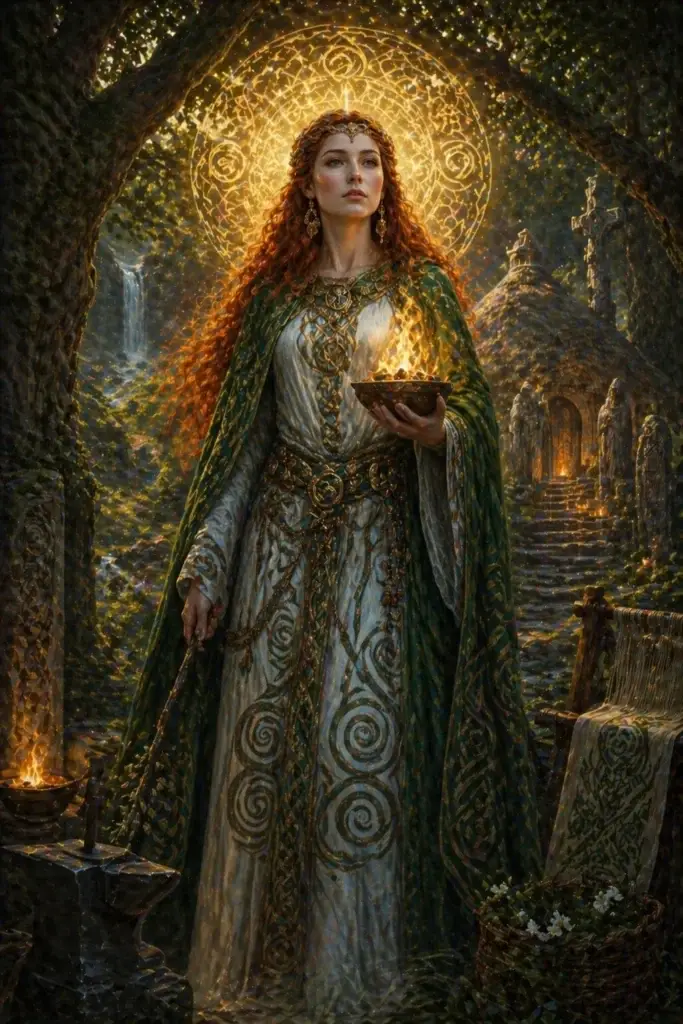
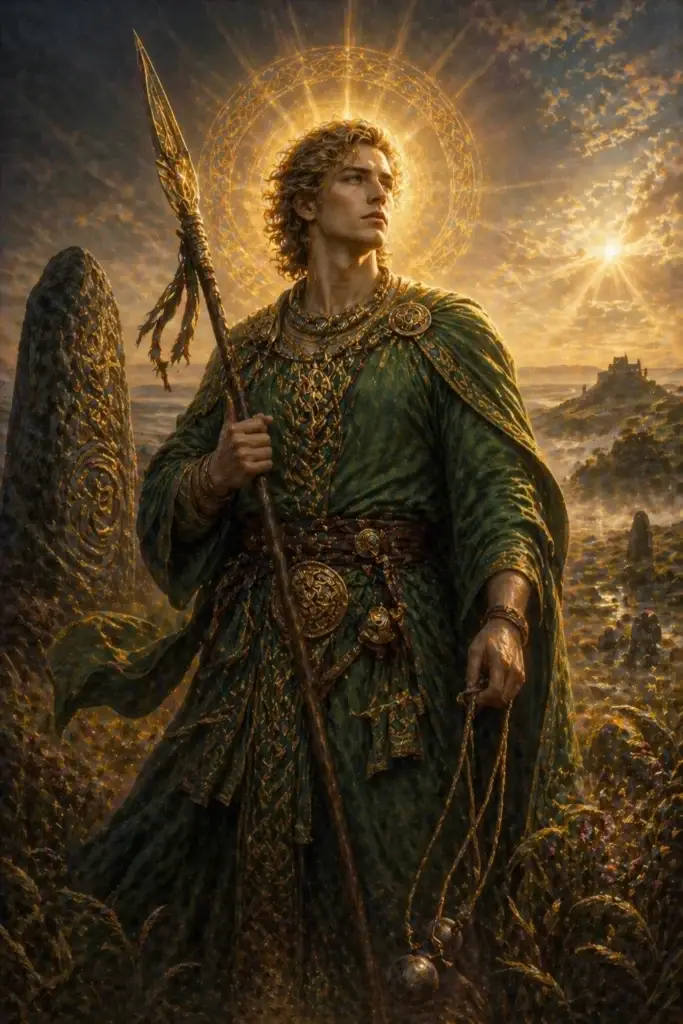
Lugh is portrayed as a youthful, radiant warrior with a golden gleam. He wears armour and carries a magical spear. His eyes shine like the sun. A hound, a raven and a swallow accompany him. The tools of the crafts are among his attributes. Light radiates from him.
Profile: Lugh
The Profile captures Lugh in six dimensions: his mytho-genealogical origin and position within the Tuatha Dé Danann, his circles of veneration and social roles, his iconography and magical attributes, his martial and artistic powers, as well as spiritual invocation practices and cultural correspondences. This traces the profile of this many-gifted culture god.
Lugh belongs to the Tuatha Dé Danann and is variously named as the grandson of Dian Cécht (god of the healing art) and son of Ethniu, or of more abstract powers.
He embodies younger divine generations (in contrast to the more aged Dagda). Geographically he is Ireland-centred, with possible Roman-Gaulish counterparts (Loucetius). His first literary attestation appears in texts of the 9th to 10th century, but it describes an older cult.
Lugh was venerated by warriors, craftsmen, artists, druid priests and royal families. His festival Lughnasadh was public and popular, connected with trade and combat games as well as legal proceedings. In the context of war, warriors invoked him for tactical genius and superiority. Craftsmen and artists honoured him as patron of their arts.
Lugh is depicted as youthful, radiant and artistic, often with light or radiance about him (his name can mean “light”). He carries typical war attributes: spear, sword or magical weapons.
Sometimes he is shown with a harp. In artistic depictions he is elegant, athletic, without the massiveness of the older Dagda. His features are fine and noble.
Lugh is benevolent and heroic. Warriors and artists invoked him for skill, the overcoming of obstacles and artistic genius. His festival Lughnasadh was an occasion for contests and the ritual affirmation of the community.
Lugh is not dangerous or harmful but protective and uplifting. Defensive practices do not apply; instead, invocation and sacrifice served to extend honour to him.
Comparable figures are Apollo (Greek) as god of the artistic and martial arts, of light and of music, Mercury/Hermes as universal artist and bringer of protection, the Germanic Wodan as god of the arts and of wisdom, and the Indian Indra as god of war and giver of blessing.
The “universal master” type is an Indo-European motif.
Lugh, Parallels in Other Cultures
Rituals and Veneration
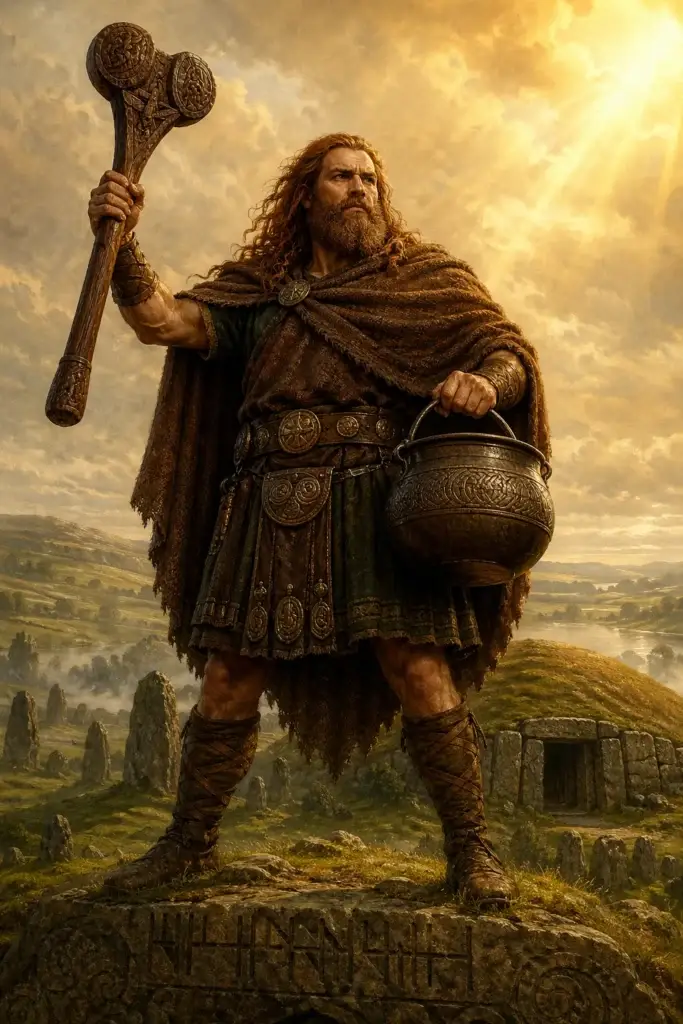
The Lughnasa festival (1 August) was the main sacrificial festival for Lugh; first-fruits sacrifices were presented on the summits of sacred mountains. At Tailtiu (Teltown), assemblies were held in which craftsmanship and martial arts competed against one another. Druids carried out consecrations of new warriors in Lugh’s honour.
Conjurations and Invocations
Invocations of Lugh were typically morning rites before battle or artistic work: “Lugh, light of all arts, illuminate my path.” Bards summoned him for inspiration in poetic contests. A classic invocation ran: “Samhildanach Lugh, master of all arts, give me wisdom and strength.”
Amulets and Protective Symbols
The sun wheel and the golden spiral were Lugh’s symbols. Warriors carried “Lugh’s spear” (symbolically, as a weapon amulet), artists carried sunstones and amber as carriers of inspiration. Gold jewellery with spiral patterns was regarded as a blessing of Lugh.
Jewish tradition: No direct correspondence. Distantly related are David as warrior king and musician (psalmist), or the figure of Solomon as universal sage and artist.
Greco-Roman world: Apollo as god of light, music, war and healing. Mercury/Hermes as artist, inventor (of the lyre) and universal protective god. Also Ares or Mars in their war aspect. The comparability is close.
Mesopotamia: Shamash as god of light and justice, Nabu as god of the arts and of knowledge, Adad as god of war. All share with Lugh aspects of combat, knowledge and divine radiance.
India/Asia: Indra as war hero and giver of blessing, Saraswati as goddess of the arts and of music. In the Buddhist context: Manjushri as god of wisdom and of the arts. These show culture-specific parallels to Lugh’s many talents.
Lugh in the Battle of Mag Tuired
The most important narrative about Lugh is the Cath Maige Tuired, the Battle of Mag Tuired, in which the Túatha Dé Danann face the Fomori.
Lugh’s appearance in it is among the best-known scenes of Irish saga literature. Lugh comes to the court of King Nuada and demands admittance. The doorkeeper turns him away, pointing out that anyone admitted must master an art.
Lugh then names one ability after another: he is a carpenter, smith, warrior, harper, poet, healer, cupbearer and more. To each naming the doorkeeper replies that they already have such a one. Finally Lugh asks whether anyone at the court masters all these arts at once. Since this must be denied, he is admitted.
From this episode comes one of Lugh’s best-known epithets, Samildánach, which means something like “the one skilled in many arts.” Lugh is not the specialist of a single skill but the one who unites them all.
In the battle itself he takes the lead and contributes substantially to the victory through his battle magic and his instructions.
A central moment is the killing of Balor, leader of the Fomori, who possesses a destructive eye. According to the tradition, Balor is Lugh’s grandfather, for a prophecy had said that Balor would die by his grandson.
Lugh strikes Balor’s deadly eye and thereby fulfils the prophecy. This combination of heroic and family history, the grandson who kills the grandfather, is an old narrative pattern that lifts the Battle of Mag Tuired beyond mere warfare.
Lugnasad: The Festival and the Name in the Landscape
One of the four great festivals of the Irish year is connected with Lugh, the Lugnasad, which was celebrated at the beginning of August.
The name means roughly “assembly of Lugh.” Medieval Irish texts explain the festival by saying that Lugh established it in honour of his foster mother Tailtiu, who had died after the clearing of a plain. The festival was thus originally a commemorative and assembly festival.
Lugnasad fell in the time of the beginning grain harvest and was associated with assemblies, contests, markets and legal gatherings. Such seasonally bound great assemblies had an important social and political function in Irish society.
That a god was regarded as the founder of such a festival shows how closely mythic narrative and lived social order were bound together in the tradition.
The name Lugh has, moreover, left traces in the European landscape. A number of place names formed with the element Lug- are associated in scholarship with a god corresponding to the Irish Lugh and to the hero known in Welsh as Lleu.
The best-known case is the city of Lyon in France, whose ancient name Lugdunum is often interpreted as “fortress” or “hill of Lugus,” even though the precise explanation of the first part of the name is debated in scholarship.
Such names suggest that a related deity was worshipped not only in Ireland but in the wider Celtic region.
Lleu Llaw Gyffes: The Welsh Relative
In the Welsh narrative material Lugh has a counterpart in the figure of Lleu Llaw Gyffes, whose story is told in the fourth branch of the Mabinogi, a collection of medieval Welsh tales.
Lleu is born under unusual circumstances and laid by his mother Arianrhod under three dooms: he is to receive no name, bear no weapons and take no wife of an earthly lineage.
The magician Gwydion outwits each of these dooms, gives Lleu a name through a ruse, procures weapons for him and, together with another magician, creates for him a wife made of flowers, Blodeuwedd.
The story takes a dark turn when Blodeuwedd turns to another man and, with his help, nearly kills Lleu.
Lleu can be wounded only under very particular conditions, and when these conditions are brought about by cunning, he is struck, transforms into an eagle and escapes gravely wounded. Gwydion finally finds him, restores his form and helps him to take his revenge.
Scholarship has long debated the relationship between Lugh and Lleu. The names are related in terms of linguistic history, and both figures share features such as the unusual birth and the connection with special conditions of their life and death.
At the same time the narratives are very different, and it would be mistaken to read Lleu simply as a Welsh version of the Irish Lugh.
It is more probable that both go back to a common older figure that took its own course in Ireland and in Wales respectively. Related figures of the Irish saga material are, for instance, the Morrígan and the Dagda.
Further Links
Scholarly Literature
Further standard works in the literature index.