Grannus, god of healing of the warm springs
By Ralf Ittermann · last reviewed on
Grannus is a god of the Gallic tradition.
Healing fire and warm springs, from Grand to Aachen. Grannus is the Gallic god of healing and fire, whose dual domain is described in the following sections.
Grannus is a Gallic god of healing springs and healing, warming fire, widely venerated in the Roman imperial period. The Romans equated him with Apollo; his cult sites lay at warm springs and thermal baths, including at what is now Aachen.
He appears in numerous Gallo-Roman votive inscriptions as Apollo Grannus. Cult centres included the sanctuary of Grand in Lorraine and the warm springs of Aquae Granni, present-day Aachen, whose ancient name derives from him.
Type: Healing sun and fire god, equated with Apollo
Origin: Gaul, native Celtic god
Texts: numerous votive inscriptions of the Gallo-Roman imperial period
Period: Gallo-Roman imperial period
Appearance: youthful god of healing and the sun, in the likeness of Apollo

Source context
Period of the Texts
Gallo-Roman imperial period: Grannus is attested by numerous votive inscriptions in which he appears as Apollo Grannus.
Area of Diffusion
Gaul, the Rhineland and the Danube region, especially the cult centres of Grand in Lorraine and Aquae Granni, present-day Aachen.
Sources
Good: richly attested epigraphically; drawn from Miranda Green’s lexicon and Maximilian Ihm’s study of Apollo Grannus.
Name and variants
Gallic: Grannus, a native Celtic divine name; it is associated with warmth and glowing embers. In the votive inscriptions the god appears as Apollo Grannus, and the ancient name of Aachen, Aquae Granni, derives from him.
Appearance
Appearance
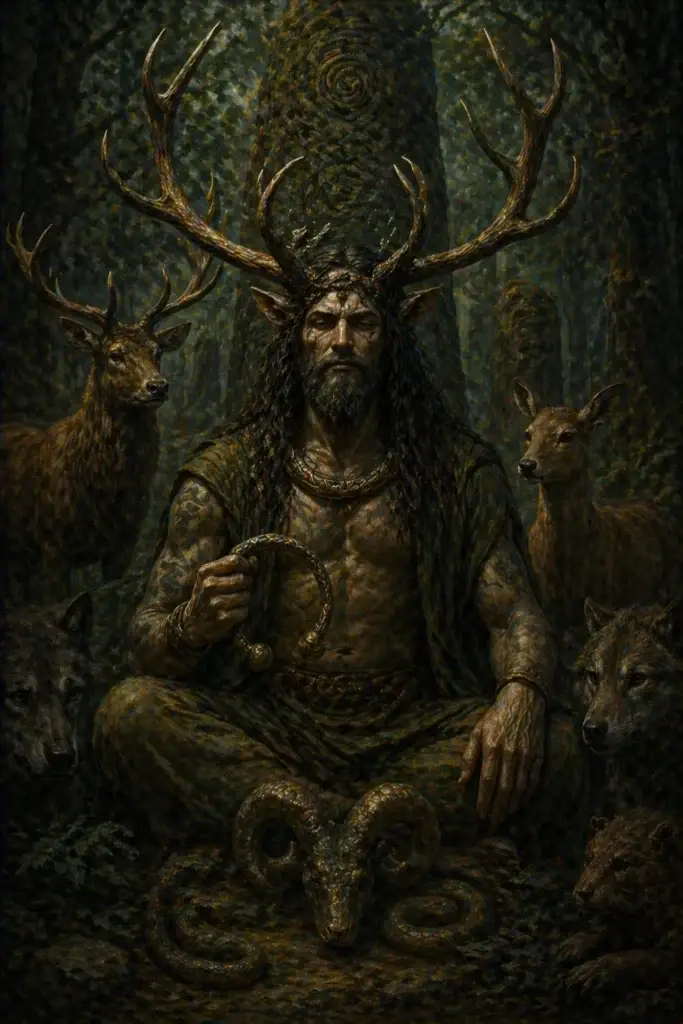
Through his equation with Apollo, Grannus is conceived as a youthful god of healing and the sun. His symbolism combines warming, healing fire with the healing water of springs; he represents recovery through warmth and light.
Effect
Grannus heals: at his warm springs and thermal baths, the sick sought recovery. He combines the power of fire and sun with that of healing water and was regarded as a giver of health and warmth.
Profile: Grannus
The key aspects of the healing god at a glance.
Native Celtic god of Gaul, equated with Apollo in the imperial period through the interpretatio romana.
Those seeking healing at springs and thermal baths: pilgrims sought recovery at Aquae Granni and at the sanctuary of Grand.
Youthful god of healing and the sun, in the likeness of Apollo, associated with warm spring water and inner fire.
Recovery through warmth and light: healing springs, thermal baths and the power of fire and sun.
Spring sanctuaries with votive inscriptions and offerings; often venerated together with the spring goddess Sirona.
The healing and sun god Apollo through the Roman equation; alongside other Celtic healing deities of springs.
From Grand to Aquae Granni
Grannus is a native Celtic god who appears in numerous Gallo-Roman votive inscriptions as Apollo Grannus. His name is associated with warmth and glowing embers.
Cult centres were the sanctuary of Grand in Lorraine and the warm springs of Aquae Granni, present-day Aachen, whose ancient name derives from him. He was venerated far beyond this, in Gaul, the Rhineland and the Danube region, wherever warm water and the search for healing came together.
Inscriptions, Aachen and classification
Grannus is well researched thanks to the rich body of inscriptions and is significant for the urban history of Aachen, whose ancient name Aquae Granni derives from him. He is little known to the wider public.
From a religious-studies perspective, Grannus shows the Celtic combination of fire, sun and healing water in a single healing deity. His equation with Apollo is a textbook example of the interpretatio romana, which equated native gods with Roman ones.
Spring sanctuaries and votive offerings
Well documented are the sanctuaries at warm springs, where votive inscriptions and offerings were deposited. Pilgrims sought healing at the thermal baths of Aquae Granni and at the sanctuary of Grand. Grannus was often venerated together with the spring goddess Sirona, underlining the dual reference to fire and water. A literary note also links the Emperor Caracalla to an invocation of Grannus, though this remains uncertain.
Apollo and the Celtic healers
Through the Roman equation, Grannus corresponds to the healing and sun god Apollo; as a god of healing warmth and springs, he stands close to other Celtic healing deities and, like some fire deities, combines fire with light and healing. Within the Celtic sphere of fire, his warming fire touches upon the Irish fire name Aed and the fire and hearth goddess Brigid.
Frequently asked questions about Grannus
Who was Grannus?
A Gallic god of healing springs and healing fire, equated by the Romans with Apollo.
What is his connection to Aachen?
The ancient name of Aachen, Aquae Granni, derives from Grannus and his warm springs.
With whom was he venerated?
Often together with the spring goddess Sirona, linking fire and water in the cult.
Further links
Further reading:
- Celtic – all beings of the Celtic cultural sphere
- Brigid – the fire and hearth goddess of Ireland
- Aed – the Irish fire name of mythology
- Protective candle, Smoke cleansing, Amulet – traditional protective means
- Protection Compass – protective means at a glance
Literature (selection)
Further standard works in the bibliography.
As a Gallic healing god, Grannus brings together what fire and healing springs meant to the Celts: warmth, light and water as a path to recovery, still tangible today in the ancient name of Aachen.