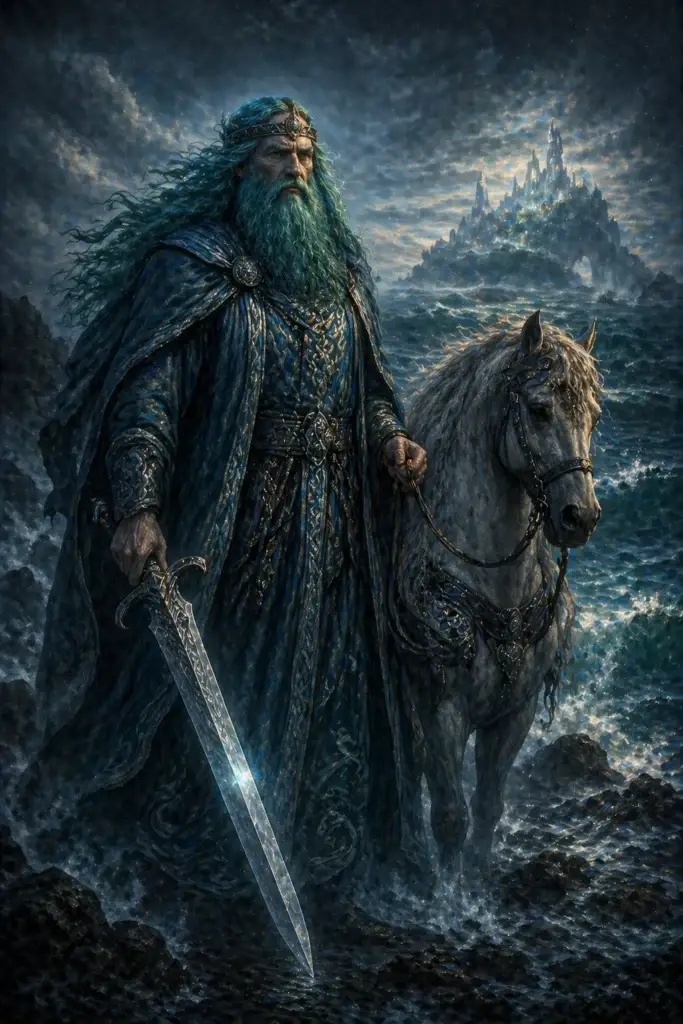
Dagda, God of the Celtic Tradition
By Ralf Ittermann · last reviewed on
Dagda is the god of the Celtic tradition, known as the »Good God«, father and lord of all things in mythological tradition. He represents a central god of the Tuatha De Danann and, in terms of the history of religion, is evidence for the Indo-European type of the »sovereign god« or »all-knowing« god.
Dagda
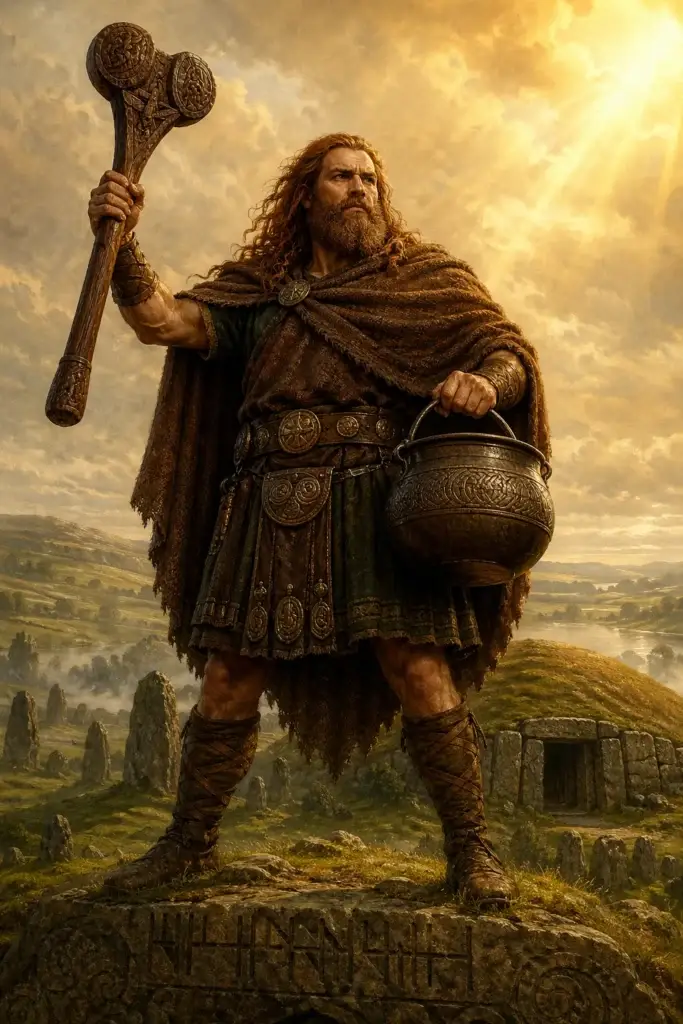
Dagda is depicted as an exceedingly strong, wealthy and knowledgeable god who masters music and magic. Central to him is his cauldron of abundance (Coire Ansic), from which all beings are satisfied, and his harp, which governs the seasons.
He is the father of many of the Tuatha De Danann and a leader in battle. In the Cath Maige Tuired he appears in the war against the Fomoire.
The primary texts are the Lebor Gabala Erenn (»Book of Invasions«), the Cath Maige Tuired (»Battle of the Plain of Mag Tuired«) and the Metrical Dindshenchas.
These medieval Irish texts, recorded between the 8th and 12th centuries, gather older divine material. Bernhard Maier and Proinsias Mac Cana have placed the figure as a primordial father god within Indo-European structures, comparable to Dyaus or the Zeus type.
Context
The tales about the Dagda were copied over the centuries from the early Irish Middle Ages onward; the Cath Maige Tuired survives in a manuscript of the 16th century, whose material is linguistically much older.
After Christianization, the scribes reinterpreted the Tuatha Dé Danann as a people of a bygone age, yet the club, cauldron and harp remained preserved as the Dagda’s distinguishing marks. In Irish folk tradition he lived on as a figure of the Síd mounds, to which, according to the texts, he was assigned as lord of Brú na Bóinne.
Dagda was not confined to a particular region or set of locations, but was known and venerated, or respectfully feared, throughout Ireland.
The Dagda was handed down primarily by Ireland’s learned classes. The filid, the trained poets who memorized genealogies and tales as part of their professional schooling, kept his stories in circulation through recitation, while monastic scribes from the eleventh century onward fixed them in manuscripts such as the Book of Leinster. His audience was therefore twofold: the noble households that employed the poets and heard the tales performed, and the clerical readers who studied the written compilations. Outside Ireland the figure remained largely unknown until modern scholarship and Celtic revival writing brought him to wider attention.
The epithets Eochaid Ollathair, the Allfather, and Ruad Rofhessa, the lord of great knowledge, assign the Dagda a paternal position over the Tuatha Dé Danann and thus over the mythical ancestors of Ireland. The Lebor Gabála places him in the line of ancestors that Irish royal dynasties invoked. His anchoring remained confined to Ireland; the material spread not through trade but through the copies made in the monasteries and the performance art of the filid, who made him known throughout the country.
Primary sources: Lebor Gabala Erenn (recorded in the 11th century, reworking older material), Cath Maige Tuired (medieval, but older versions can be reconstructed), Metrical Dindshenchas. Period: the myths reflect Iron Age or early medieval conditions (ca. 500 BCE to 800 CE), yet the records were produced between the 8th and 12th centuries. Scholars: Mac Cana (Celtic Mythology), Bernhard Maier (Die Religion der Kelten), Sjoestedt (Gods and Heroes of the Celts) treat Dagda systematically.
Designation and Spellings
Dagda is depicted in the various sources and artistic traditions with certain recurring iconographic elements that remain relatively constant over decades and across different geographical areas. These elements are not purely decorative or chosen at random, but are deeply encoded with symbolic meaning and carry great significance.
The Dagda’s three possessions form a coherent system of statements. The club, which kills with one end and revives with the other, shows his power over life and death. The cauldron, of which the Cath Maige Tuired says that no one ever went away from it unsatisfied, stands for abundance and hospitality. The harp, with which he orders the seasons and calls forth laughter, lament, and sleep, assigns him mastery over time and mood. His epithet Eochaid Ollathair, the Allfather, and the title of the good god fit this picture: anyone familiar with the Irish narrative tradition could read the god’s rank and sphere of responsibility from these objects.
The overall system is like a sacred script or an encoded image: it allows initiates or the culturally educated to grasp and correctly understand the essential, deeper meaning. Colors, sacred objects or weapons, physical attributes, specific accessories: everything is significant and traditionally handed down.
Description
Dagda was central to religious practice, everyday rituals and the daily understanding of the Celts. People turned to this entity in critical or specific life situations or at particular ritual seasons.
What is known about how the Dagda was treated comes from texts that Irish scholars and clerics of the Middle Ages recorded according to fixed rules. The Lebor Gabála and the Cath Maige Tuired were copied in monastic scriptoria by trained scribes who drew on the knowledge of the filid, the learned caste of poets. The transmission of the material thus lay with specialists who worked according to the conventions of their school tradition.
The continuity of these practices across many generations clearly shows that the practice was regarded as effective and necessary. Its functions were manifold: some were preventive (warding off potential misfortune), some healing (relieving illness or suffering), some transformative (accompanying transitions between stages of life).
Profile: Dagda
The profile illuminates Dagda across six dimensions: his mythological origin and position within the Tuatha De Danann, his circles of veneration and social contexts, his iconographic features and magical attributes, his cosmic and martial powers, as well as forms of invocation and cultural parallels. This offers an overall picture of this multifaceted primordial god.
Dagda belongs to the Tuatha De Danann, that mythological race of gods who settle Ireland in the Cath Maige Tuired. He is the son of the all-father or autochthonous; the genealogy is fragmentary.
His origin is pre-Celtic or early Indo-European. Geographically, Ireland is his heartland, especially the plains of Mag Tuired. The first literary attestations appear in texts of the 8th and 9th centuries.
Dagda was venerated by warriors, druids, craftsmen and royal families. As father and keeper of knowledge, he was the patron of learning. In the context of battles, warriors invoked him. Women turned to him in matters of fertility. His cauldron made him the patron of welfare and the distribution of abundance within society and clan.
Dagda is depicted as a portly, strong man, often with his characteristic cauldron (Coire Ansic) and his magical harp. In some descriptions he wears a garment of deerskin or simple clothing.
His appearance is dignified and archaic, less splendid than that of his sons. Sometimes he is shown with a club or weapon that is as deadly as it is healing.
Dagda is regarded as paternal and bestowing. Druids and kings invoked him for wisdom and blessing. In times of crisis his cauldron was invoked as a symbol of the return of abundance.
Dagda is not transmitted as harmful, but as a god of protection and blessing. Modern invocation is made for wealth, prudence and the protection of the family. Defensive practices do not apply, since he is benevolent.
Comparable figures are Jupiter (Roman) as father and ruler of the gods, Zeus (Greek) as all-father and keeper of order, the Indian Dyaus Pitar as the sky-father god, and the Germanic Wodan as the god of wisdom and power. The »good god« aspect parallels the title of the Roman Jupiter Optimus Maximus (»best and greatest«).
Defense in Everyday Life
Rituals and veneration
The Dagda was venerated on the four Celtic festival days, especially Samhain (1 November), when the boundary between life and death is permeable.
Conjurations and invocations
Invocations emphasized his versatility: Warriors conjured him with the club as a war symbol, the farmer with the harp as a guarantor of harmony.
Amulets and protective symbols
The Dagda club (as a wooden amulet or engraved) symbolized invincible strength. The harp was imitated in ritual instruments. The cauldron symbol (four pentagons within a circle) was an amulet of abundance. Golden cauldron replicas were kept in Celtic settlements as sanctuaries.
Dagda, Parallels in Other Cultures
Jewish tradition: Remotely related are metaphors of God as a paternal, caring force (Ps. 23) or the God of Zion as guarantor of welfare. There is no direct equivalent in a personified divine figure.
Greco-Roman world: Zeus as sky-father, ruler and god of knowledge, Jupiter as the Roman counterpart with an aspect of abundance and the conveyance of blessing. Kronos (father of the gods) and Hades (god of wealth, Plutus) show aspects of abundance and rule over the underworld.
Mesopotamia: Enlil as supreme god and keeper of order, Enki as bestower of wisdom and abundance. Both share Dagda’s role as an all-powerful and knowledgeable father figure.
India / Asia: Dyaus Pitar (Father Sky) as the Indo-European primordial all-father type. Brahman and Varuna as deities governing cosmic order. Indra as warrior king and bestower of blessing shows parallels to Dagda’s aspects of war and wealth.
The Dagda in the Irish Sources
The Dagda is one of the central figures of Irish mythology and belongs to the Tuatha De Danann, the race of gods of Irish tradition. Unlike with most mythologies, our knowledge of the Dagda comes from medieval Christian manuscripts in which monks recorded older narrative traditions and reshaped them in the process.
The most important sources are the Lebor Gabala Erenn, the Book of Invasions, a pseudo-historical account of the settlement of Ireland, and above all the narrative Cath Maige Tuired, the Battle of Mag Tuired, which describes the struggle of the Tuatha De Danann against the uncanny Fomoire.
In this narrative the Dagda emerges with particular vividness.
The Dagda appears there as a powerful but at the same time coarse and partly comical figure.
Before the decisive battle he goes to the camp of the Fomoire, who, out of mockery, set before him an enormous porridge of milk, flour, fat and whole pigs and force him to eat it all. The Dagda does indeed eat everything, until he can barely walk.
Scholarship sees in this episode no debasement, but a pointer to the nature of the Dagda as god of plenty and abundance.
His epithet, which can be read as the good god, refers, according to the sources themselves, not to moral goodness, but to capability: to the fact that he is good at everything and skilled in many things. Related figures of the Celtic pantheon are found in Lugh and Morrigan.
The Attributes of the Dagda: Club, Cauldron and Harp
The Dagda is characterized in the Irish sources by three distinctive possessions that vividly illustrate his functions. These attributes are so striking that they play a role in every depiction of the Dagda.
The first is a mighty club, so large that it must be transported on wheels. One end of the club kills when it strikes a person, while the other end can call the dead back to life.
In this dual function the club embodies power over life and death. The trace it draws on the ground resembles, according to the sources, a boundary furrow between territories.
The second attribute is a cauldron, regarded as one of the four treasures that the Tuatha De Danann brought to Ireland. No one departs from this cauldron unsated. It stands for inexhaustible nourishment and thereby for the abundance that the Dagda guarantees.
The third attribute is a harp, stolen by the Fomoire in an episode of the Cath Maige Tuired. The Dagda retrieves it and summons it by its name, whereupon it flies through the ranks of the enemy.
With this harp the Dagda can play the three strains of music that bring weeping, laughter and sleep, and thereby order the course of the seasons.
Scholarship interprets these three attributes as an expression of the Dagda’s manifold responsibility: for battle and death, for nourishment and fertility, for ordered time. The Dagda is thus not a specialized god, but a comprehensive power.
The Dagda and the Annual Festival of Samhain
One of the best-known episodes about the Dagda links him with the festival of Samhain, the Celtic turn-of-the-year and festival of the dead, which falls on the transition from autumn to winter.
The Cath Maige Tuired reports that, at the time of Samhain, the Dagda unites with a woman who stands astride a river, the Unius.
This woman is identified as the Morrigan, a figure associated with war, fate and in part with the sovereignty of the land.
After the union, the Morrigan promises the Dagda her help against the Fomoire and pledges to drain the blood of an enemy leader. The encounter is therefore not merely an erotic episode, but an alliance that helps decide the outcome of the battle.
Scholarship sees in such narratives a recurring pattern of Irish mythology, in which the union of a male deity with a woman who embodies the land or sovereignty is of central importance.
The timing of Samhain underlines this, for this festival was regarded as a threshold time in which the boundary between the human world and the Otherworld became permeable.
The Dagda is also connected with a concrete site of the Irish legendary landscape, the passage tomb of Bru na Boinne, present-day Newgrange. According to one tradition, this site was the dwelling of the Dagda, which he later lost through a ruse to his son Oengus.
That one of the most impressive prehistoric monuments of Ireland was mythologically assigned to the Dagda shows his outstanding position in the Irish pantheon.
Further Links
Sources and Literature
Further standard works in the literature index.
Frequently Asked Questions about Dagda
Who is the Dagda in Irish mythology?
The Dagda (Old Irish An Dagda, the good god) is one of the most important divine figures of Irish-Celtic mythology, the father god of the Tuatha De Danann, the mythical kindred of demigods who settled Ireland before the Irish.
His epithets Eochaid Ollathair (Horse All-Father) and Ruad Ro-fhessa (Red All-Knowing One) show his standing as a cosmic god of omnipotence.
He possesses three magical artifacts: a cauldron (Coire) from which no one need depart hungry; a huge club that kills with one end and revives with the other; and a harp that regulates the year.
What are the three treasures of the Dagda?
The three magical possessions of the Dagda symbolize his cosmic function. (1) The cauldron of the Dagda (Coire ansic, the never-empty one), emblem of inexhaustible plenty, presumably an early form of the Grail motif in the later Celtic-Christian tradition. (2) The club Lorg Mor, a tool of life and death that embodies the cosmic dual nature of the father god. (3) The harp Uaithne, which regulates the year: when the Dagda plays a particular melody, summer, winter, sleep or tears come over the world.