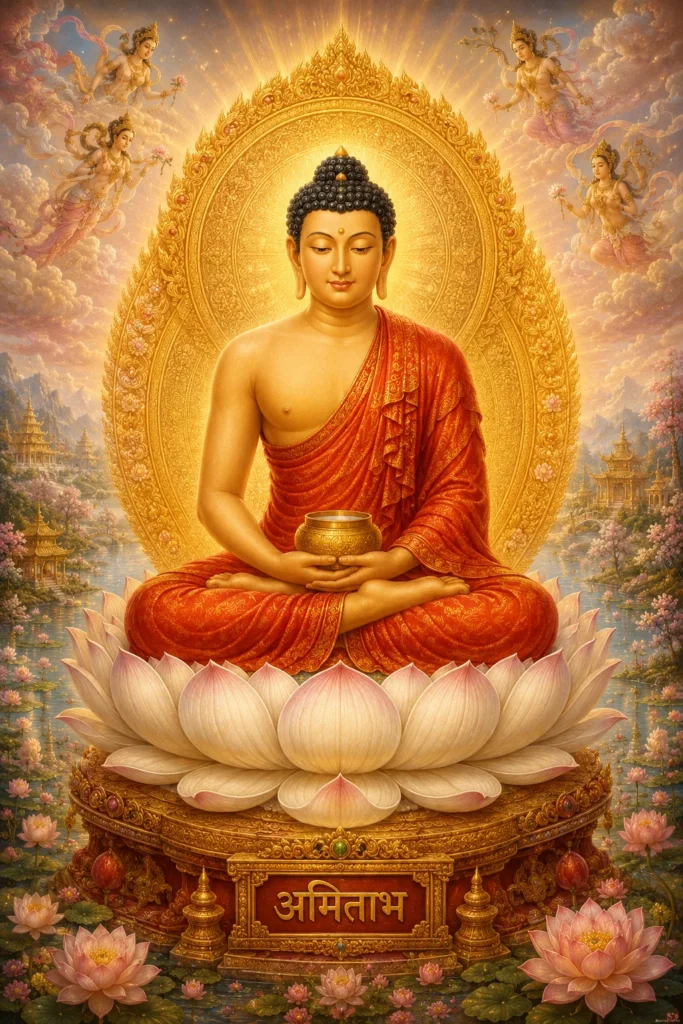
Khormusta, Buddhist-Tengrist supreme god of the Mongols
By Ralf Ittermann · last reviewed on
Khormusta (Mongolian Qormusta Tngri, Tibetan brGya-byin) is, within Mongolian Tengrism and its Buddhist overlay, the highest of the 99 Tengri celestials and leader of the 55 western “white” Tengris. In this Buddhist-Tengrist worldview he ranks as the supreme god of the Mongols, presiding over the celestial order.
Khormusta is regarded as the Buddhist-Tengrist supreme god in Mongolian and Tibetan syncretisms.

Classification and Brief Profile
Khormusta is a particularly well-documented figure in late Mongolian religion. He forms a connecting pillar between three layers: the Indo-Iranian Ahura Mazda (Pahlavi Hormizd), the Buddhist Indra (Sanskrit Sakra Devanam Indra), and the Old Turkic-Mongolian Tengri.
In later epic texts (the Geser Khan epic), he appears as the “Father of the 55 Gods in the West” and arbiter of heavenly disputes.
Within the Siberian-Tengrist tradition, he marks the transition from the unformed Tengri to the personalized Buddhist world of gods. From a history-of-religions perspective, he is an instructive case study in the workings of religious syncretism.
The scholarly literature on Khormusta is, compared to many other Tengri figures, unusually extensive. Walther Heissig’s Die Religionen der Mongolei (1970) is as indispensable here as the works of Klaus Sagaster and Christopher Atwood. This density is explained by his bridging function: to study Khormusta is to study Iranian, Indian, and Mongolian religion in contact.
Name and Etymology
The name derives from the Middle Persian Hormizd / Ohrmazd, the supreme god of Zoroastrian Iran (Ahura Mazda). The transmission occurred probably in the 7th to 9th centuries via the Sogdian trade routes into Inner Asia.
In the Mongolian language area, the name receives the Tengri suffix (Qormusta Tngri), thereby incorporating the Iranian supreme god into the Mongolian celestial system, a classic example of religious syncretism.
The exact linguistic and religious history is complex: Sogdian Manichaeans and Zoroastrians in the oasis cities of Inner Asia (Turfan, Khotan, Samarkand) were probably the intermediaries. Hans-Joachim Klimkeit reconstructed these transmission routes in detail in Die Seidenstraße (1988).
In Tibetan translations, Khormusta appears as brGya-byin or as dBang-po brGya-byin, which renders the Indian Sakra Devanam Indra, “Indra of the Hundred Sacrifices.” This identification definitively integrated him into the Buddhist system of gods.
Description and Iconography
In Mongolian art shaped by Buddhism, Khormusta appears as a crowned royal figure on a lotus throne, holding the thunderbolt (vajra, Mongolian otschir) in his right hand and the wish-granting tree in his left. He rides the three-headed elephant Airavata, which iconographically identifies him definitively with the Buddhist Indra.
In the pre-Buddhist Mongolian layers, insofar as they can be reconstructed, his depiction was less fixed; he appeared more as “king among the 99 Tengri” in oral tradition than in fixed pictorial types. The Buddhicization of Mongolia from the 13th century, and especially from the 16th and 17th centuries onward, established the now-standard tantric iconography.
A noteworthy observation is that Mongolian folk forms often display a mixed iconography: a crowned warrior with vajra, but on a white horse rather than an elephant, indicating popular adaptation of the Buddhist standard form.
Mythological Narratives
In the Geser Khan epic (Mongolian and Tibetan versions), Khormusta is the source from which the hero Geser is sent to earth to restore order to a world thrown out of balance by malevolent beings. Khormusta acts here as the heavenly commissioner and fulfills the function that would fall to Indra in Indian epics.
A second narrative describes the war between the western white 55 Tengri and the eastern black 44 Tengri under the black Khan Atai Ulan; Khormusta prevails through the creation of the thunderbolt, thereby securing the cosmic order. This dualistic battle narrative bears clear Zoroastrian traces.
In the Secret History of the Mongols (1240), Khormusta is not directly named; the later tradition, however, identifies the formula “Mongke Tengri” with him in several passages. Igor de Rachewiltz discussed this later identification critically in his Brill commentary (2004).
Cult and Veneration
The Khormusta cult was historically anchored at the Mongolian court since the Yuan period. It was systematically integrated by Khubilai Khan within the framework of the Tibetan-Buddhist court ritual. In the 17th and 18th centuries, under the influence of the Gelug school, he became the patron of the monasteries of several banners.
At the folk level, Khormusta appears in Ovoo rituals as the primary addressee of petitions; incense (Mongolian sang) is offered to him in the early morning hours, and the words “Qormusta Tngri oberoo” (“Khormusta himself”) open many invocations. Caroline Humphrey described this in detail in Shamans and Elders (1996).
In contemporary Mongolia, Khormusta is present above all in monastic Buddhism; some monasteries (Gandan in Ulaanbaatar) conduct annual Khormusta liturgies. He is also part of the repertoire of certain neo-Tengrist groups, who sometimes marginalize him as “too Buddhist.”
Protective Practices and Apotropaic Uses
Described from a religious-studies perspective: protective practice within the Khormusta complex is closely interwoven with the Buddhist concept of the “eight great gods” and Tantra protection mandalas.
Typical apotropaic elements include burning juniper incense, hanging khadag (blue blessing scarves), and reciting the Sang text. Khormusta is regarded here as a general source of light rather than a specialized protective god against specific ailments.
A particular form is the Khormusta-Sang, a liturgical text for the purification of house and homestead, attested in several Mongolian printed editions (Beijing, Urga) since the 17th century.
In folk practice, Khormusta appears in Ovoo rituals as the supreme addressee of requests; one also turns to his messengers or to the place-bound Yer-Sub powers. This mediating structure is typical of Mongolian religion and corresponds typologically to the Catholic practice of addressing saints in addition to God.
Parallels in Other Cultures
Directly linked to Ahura Mazda (Iran), Indra (India), and Sakra (Buddhism). Within Siberia itself, he is somewhat analogous to Ulgen, with the difference that Khormusta is distinctly personalized in Buddhist-tantric terms.
A particularly interesting parallel is the identification with the Chinese Yu-Huang Shangdi (Jade Emperor) from the Daoist tradition, encountered in several Mongolian-Chinese syncretisms. Christopher Atwood’s Encyclopedia discusses this identification as an example of the “multi-layered supreme deity.”
In a broader comparison, Khormusta is a typological model case for “migration gods,” who retain their own genealogy across multiple linguistic and religious boundaries. Such migration gods are rarely as clearly documented as Khormusta.
Contemporary Reception and Research
Khormusta is the subject of Mongolist scholarship in Walther Heissig, Klaus Sagaster, Christopher Atwood (Encyclopedia of Mongolia, 2004), and in the Russian school through N. L. Zhukovskaya.
In contemporary Mongolian Buddhism he remains very much alive; in neo-Tengrist writings, by contrast, he is sometimes marginalized as “too Buddhist.”
A dedicated line of research deals with the Khormusta-Geser tradition as both oral and written epic form. The Geser Khan epic has been systematically translated since 1839 (Schmidt); research by Walther Heissig has shed new light on its relationship to Khormusta.
In contemporary Mongolia, Khormusta was invoked again as “Mongolian supreme god” at official state ceremonies for the 800th anniversary of Chinggis Khan (2006), an example of how religious history and identity politics intertwine in the 21st century.
Research Debates and Open Questions
The most important scholarly debate concerns the sequence of layers: was Khormusta first the Iranian Hormizd, then incorporated into the Tengri system, and finally identified with Indra by Buddhism? Or is there an older autochthonous layer into which the Iranian name was subsequently woven?
A second debate revolves around the concept of the “99 Tengri”: is this number autochthonous Mongolian or imported from Buddhism? Walther Heissig argued for a pre-Buddhist origin; the Mongolist S. A. Kozin raises doubts.
Finally: how does Khormusta relate to Siberian shamanic religion? Among the Buryats he appears prominently, among the Tuvans and Altaians hardly at all. This geographical asymmetry is revealing from a history-of-religions perspective and awaits systematic investigation.
Khormusta in the Religion of Inner Mongolia
A special study is warranted for the position of Khormusta in Inner Mongolia (today an autonomous region of the People’s Republic of China). Here the Buddhist influence is strongest, while Chinese Daoist influences also come into play.
Khormusta is identified with the Daoist Yu-Huang Shangdi in several Inner Mongolian monasteries (such as Wudangzhao), a triple syncretism that is scarcely surpassed in the history of religions.
Christopher Atwood, in his Encyclopedia of Mongolia and the Mongol Empire (2004), reconstructed this multiple identification and showed how Khormusta became a bridge between three religious worldviews: Iranian-Zoroastrian, Indian-Buddhist, and Chinese-Daoist. This bridging function is unique in religious studies.
In contemporary Mongolian identity politics, Khormusta is sometimes celebrated as a “remarkable syncretist” and sometimes viewed critically as a “Buddhist overlay of the authentic Tengri.” Both assessments are traceable in the history of religions and are politically revealing.
Sources and Reference to the Culture Hub
Those wishing to study the Khormusta complex in its full breadth will find the most important cross-references to related figures on the overview page Siberian-Tengrist Tradition, including Tengri (older layer), Ulgen (southern Siberian parallel), and Asbuiga (lower helper-spirit layer).
Walther Heissig’s Die Religionen der Mongolei (1970) is the indispensable standard work. For the Geser Khan tradition, Walther Heissig’s Geser-Studien (Westdeutscher Verlag, Opladen 1983) are central.
N. L. Zhukovskaya’s Kategorii i simvolika tradicionnoj kul’tury mongolov (1988) offers the most important Russian synthesis. Caroline Humphrey’s ethnographic studies from the 1990s and 2000s complement the picture with contemporary depth.
Khormusta in the Geser Khan Tradition
A thorough study is warranted for Khormusta’s role in the Geser Khan epic, one of the most monumental oral heroic epics of Inner Asia. The epic exists in Mongolian, Tibetan, and Buryat versions; it typically spans several thousand verses and is performed over multiple evenings.
In all versions, Khormusta is the heavenly commissioner who sends the hero Geser to earth to bring order to a world thrown out of balance by malevolent beings. This narrative function corresponds typologically to the role of Indra in the Indian Avatara narratives.
Walther Heissig produced critical editions of the Geser Khan epic in several volumes; his Geser-Studien (Westdeutscher Verlag, Opladen 1983) are a study of the epic. In the 21st century, the epic is experiencing a renaissance in Inner Mongolia, where it is cultivated as a central element of Mongolian cultural identity.
Methodological Reflection
Khormusta research raises several methodological problems. First: the multiple religious layering (Iranian, Indian, Mongolian, Chinese) makes a clear genealogy difficult to establish. Historical linguistics offers some clues, but many transitions remain speculative.
Second: the Buddhist layer is well documented (monastic texts, iconography), whereas the pre-Buddhist layer can only be reconstructed indirectly. Walther Heissig’s layer model is partly revised today.
Third: contemporary Khormusta practice in Mongolia and Inner Mongolia operates within different political and religious contexts; a unified description is methodologically problematic.
Khormusta in Contemporary Mongolian Identity Politics
Contemporary Mongolian identity politics deliberately uses Khormusta as a “cosmopolitan supreme god” who symbolizes Mongolia’s bridging function between Iran, India, and East Asia. This reading has been propagated, among other places, in official publications of the Mongolian Ministry of Culture since the 2010s.
From a religious-studies perspective, this identity politics is revealing: it makes Khormusta the embodiment of a “Mongolian cosmopolis” in which religious plurality is seen not as a problem but as a strength. This view stands in contrast to monotheistic identity models.
Caroline Humphrey has pointed out in several essays that this political appropriation of Khormusta is itself a religious practice, a form of secular veneration that coexists with the monastic tradition.
Khormusta as a Methodological Case Study
For the study of religion, Khormusta is an exceptional methodological case study. He demonstrates how a religious concept can migrate across two millennia through three linguistic and three religious contexts without losing its core functions: supreme god, creator, guarantor of world order. Such stability is rare in the phenomenology of religion.
At the same time, his substance transforms: from the Iranian-Zoroastrian Hormizd to the Indian-Buddhist Indra equivalent Khormusta, who is finally merged with the Mongolian-Tengrist Tengri complex. This simultaneous stability-and-transformation dynamic is a first-rate case study in the anthropology of religion.
Christopher Atwood sharpened the findings in his Encyclopedia (2004). For young researchers, Khormusta is a rewarding object of study.
Khormusta in Mongolian Monastic Literature
A deeper study is warranted for Mongolian monastic literature of the 17th to 19th centuries, in which Khormusta appears in a wide range of liturgical texts. Printed editions from Beijing, Urga, and Lhasa contain Khormusta-Sang texts, Khormusta-mandala descriptions, and Khormusta-tantra translations from Tibetan.
The texts show how the originally Iranian-Buddhist Khormusta became, within the Mongolian monastic tradition, an independent figure with his own liturgies, practices, and iconographic conventions.
The Buddhist Transformation of an Ancient Sky Deity
The name Khormusta (Mongolian also Qormusta, Khurmasta) is among the clearest pieces of evidence that Mongolian religious history does not form a closed unity but instead layers strata of different origins on top of one another.
Linguistically, the name traces back to the Iranian Ahura Mazda, transmitted via Sogdian and Uyghur. Through the Manichaean and Buddhist texts of Central Asia, the designation reached the Turko-Mongolian world, where it attached itself to an already existing notion of the supreme lord of heaven.
In Mongolian Buddhist literature, Khormusta merges with Indra, the king of gods in the Indian pantheon, who there appears as lord of the Trayastrimsha heaven and protector of the teaching.
As a result, an independent deity became a divine sovereign fitted into the Buddhist cosmological model, who stands high but remains subordinate to the Buddha and the bodhisattvas.
This subordination was not an incidental outcome but was religiously and politically intended: the spread of Tibetan Buddhism from the 16th century onward required that older sky deities not be displaced but hierarchically subordinated.
From a source-critical perspective, it should be emphasized that almost all written testimonies about Khormusta come from Buddhist-influenced contexts, such as invocations in the Geser epic or ritual manuscripts. A pre-Buddhist form of the figure can only be inferred indirectly from these.
Scholars such as Walther Heissig have pointed out that the ninety-nine or thirty-three Tengri, headed by Khormusta and named in the epic, represent a secondary systematization that probably arose only through contact with the Indian-Buddhist scheme of divine numbers.
For understanding the Siberian-Tengrist tradition, this means: Khormusta shows exemplarily how Tengrism was not a static system but a permeable field that absorbed foreign names and concepts and combined them with its own ideas.
Anyone who interprets the figure in isolation as purely Mongolian overlooks the Central Asian transmission history that remains visible in its name to this day.
Selected Bibliography
- Walther Heissig: Die Religionen der Mongolei (1970)
- Christopher Atwood: Encyclopedia of Mongolia and the Mongol Empire (2004)
- Igor de Rachewiltz: The Secret History of the Mongols (Brill, 2004)
- N. L. Zhukovskaya: Kategorii i simvolika tradicionnoj kul’tury mongolov (1988)
- Caroline Humphrey: Shamans and Elders (1996)
- Roberte Hamayon: La chasse a l’ame (1990)
The myth surrounding Khormusta connects Tengrist sky beliefs with Buddhist layers; the most important sources are Mongolian chronicles, Geser epics, and Tibetan-influenced ritual texts.
Related key terms: Khormusta Qormusta Tngri Geser Khan Ahura Mazda Indra Mongolian supreme god.
iWell Guard and Protective Traditions
iWell Guard draws on the cultural-historical tradition of wearable protective objects, in the tradition of Siberia / Tengrism and many other cultures worldwide. 41 layers, real gold, platinum, silver, made in Germany. 30-day return policy.
Individual experiences may vary. Not a medical device. No health claims.