Viracocha, creator god and cosmic architect of the Andean world
By Ralf Ittermann · last reviewed on
Viracocha (Quechua: Wiraqucha) is, in the early chronicles of Spanish Peru, the supreme creator god of the Andes, who creates the world from Lake Titicaca and shapes humanity from stone. In the state theology of the late Inca Empire, he receded behind Inti, but remained prominent as a cosmological principle.
Viracocha, the Inca creator god, is regarded in the early chronicles as the supreme high deity of the Inca cosmology, but receded behind Inti in the late Inca empire.
Profile: Viracocha
Viracocha: the most important aspects at a glance. The following fields summarise origin, function, appearance, veneration, symbols and parallels.
Viracocha (Quechua Wiraqucha) is regarded in the early chronicles as the supreme creator god of the Andes. In the state theology of the late Inca Empire he receded behind Inti. Among the Aymara he was called Tunupa or Tonopa and is less clearly a creator there.
According to the myths, Viracocha creates a first humankind from stone on the Isla del Sol in Lake Titicaca, which he destroys in the flood. In Tiwanaku he forms a second from clay and assigns each people its language, dress and homeland. Then he wanders north, teaches agriculture, weaving and religion, and vanishes on the shore of the Pacific.
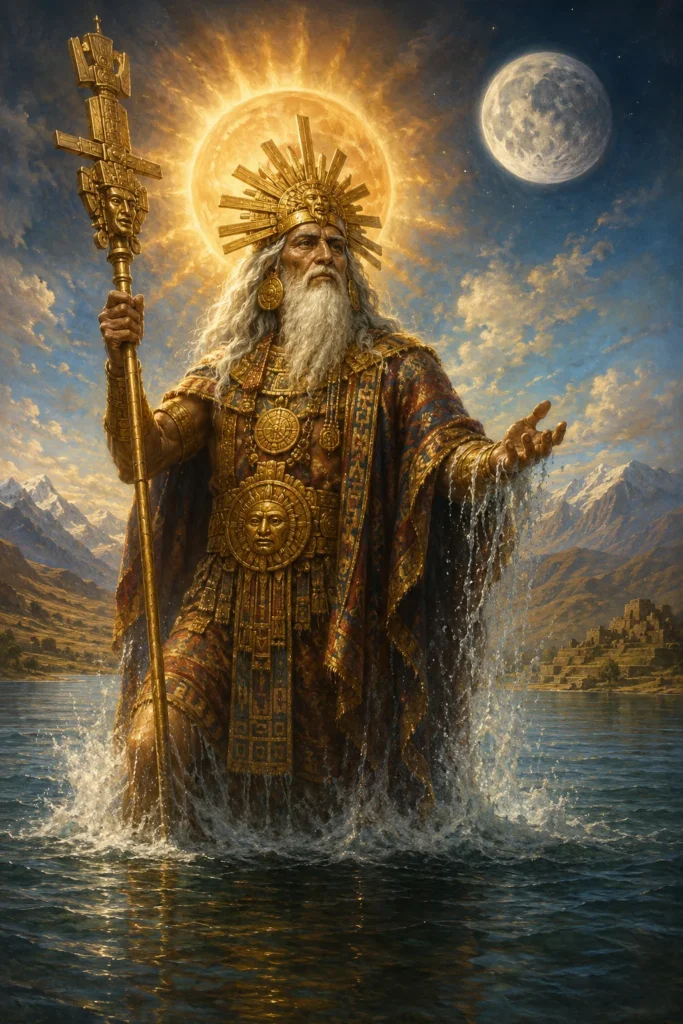
The sources describe Viracocha as a bearded old man with a long mantle, staff and sun crown. The figure with a radiate crown and two staffs on the Gate of the Sun at Tiwanaku is often identified with him, but the attribution is uncertain. According to Sarmiento, Pachacuti set up a golden statue of Wiraqucha in the Coricancha.
The cult was less institutionalised than the cult of Inti. Cult sites were a separate chamber in the Coricancha of Cusco as well as Pacaritambo, Tiwanaku and the Isla del Sol; Raqchi near Cacha is regarded as the temple of Pachacuti. Offerings were a white llama mare, maize leaves and coca leaves, along with chicha as a libation.
Connected with Viracocha are the staff and sun crown, Lake Titicaca as the place of creation and the white llama mare as sacrificial animal. Small stone figures, the conopa or illa, show connections with the theology around Viracocha. The Inca understood the Milky Way (Mayu) as a cosmic river steered by Wiraqucha.
As a deus otiosus, Viracocha can be compared with Nyame of the Akan, Io of the Maori and Baiame; similar is Wakan Tanka of the Lakota. Within the Andes he is closely related to Pachakamak, whom some chronicles describe as son or brother. Pierre Duviols classifies the theology as henotheism.
Classification within the Andean Pantheon
Viracocha is a theologically complex figure who appears in the chronicles under numerous epithets: Apu Qun Tiqsi Wiraqucha, Pachayachachiq (Teacher of the World), Illa Tiqsi Wiraqucha (Wiraqucha of the Light-Ground).
These aspect-names should, following Pierre Duviols’s observation, be read as evidence of a genuinely Andean, philosophically speculative theology that was operative beneath the surface of the personal-god-style high cult.
The early chronicles (Cieza de Leon, Sarmiento de Gamboa, Cristobal de Molina) present Viracocha as the supreme being above all other deities. Garcilaso de la Vega, writing later and more closely oriented toward the Inca-period elevation of Inti, describes the relationship in more complex terms: Inti is the visible ruler, Viracocha the invisible creator.
From a religious-studies perspective, a theological layering is discernible here, in which an older creator-god belief and a younger imperial solar theology coexist.
Notably, Viracocha was known in the Aymara-speaking region as Tunupa or Tonopa, a figure with its own mythological narratives, studied in depth by the religious ethnologist Therese Bouysse-Cassagne in Lluvias y cenizas (1988).
Among the Aymara, Tunupa is less clearly a creator than the Inca Viracocha; he also displays trickster-like traits and is closely linked to the region’s volcanism.
Name and Etymology
The etymology of the name Wiraqucha has long been contested. Garcilaso de la Vega derives it from wira (fat, cream) and qucha (lake), translating it as fat of the lake or foam on the water. This etymology fits well with the myth of the water-creator from Titicaca, but is not linguistically conclusive.
An alternative reading connects the first syllable to wila (Aymara: blood), yielding blood of the lake or the notion of a reddish, volcanic water.
Cesar Itier, in his linguistic studies (2008, 2013), has pointed to a possible third reading in which wira may derive from an archaic root wir- meaning radiance or glow of light, which would make Wiraqucha the radiance of the lake.
In colonial usage, wiraqucha was quickly adopted as a form of address for Spaniards, initially because the Inca regarded the bearded conquerors as manifestations of the bearded creator god, and subsequently as a general honorific that survives to this day in some Quechua-speaking regions with the meaning of lord or senor.
Appearance and Iconography
Viracocha is described in the sources with unusual frequency as a bearded old man who wanders the Andes wearing a long cloak, carrying a staff, and wearing a solar crown.
This description departs from the typical indigenous iconography of the Andes, in which bearded men are virtually unknown, and has given rise to earlier speculation that Viracocha might be a historical echo of a pre-Columbian visitor from Eurasia. Modern scholarship has rejected this speculation.
The principal iconographic source is the famous Sun Gate of Tiwanaku (c. 600 to 1000 CE), at the center of which a central figure appears with a radiate crown and symmetrically outstretched arms, in which it holds two staffs (often interpreted as spear-throwers).
This so-called Staff God figure is regularly identified in the archaeological literature with Viracocha, although the emic designation used by Tiwanaku culture for this figure has not been transmitted. Karen Wise and John Janusek have repeatedly urged caution in this identification in their Tiwanaku research.
Also widespread is the connection of Viracocha with the Inca capital Cusco and its central temple, the Coricancha. According to Sarmiento, the Inca Pachacuti had a dedicated statue of Wiraqucha installed in the Coricancha, a complete gold image that the Spanish still encountered in 1532.
Mythological Narratives
The principal myth begins in a phase of world-darkness. Viracocha appears on the Isla del Sol in Lake Titicaca and first creates a primordial humanity from stone, which he then destroys in a great flood on account of their disobedience.
According to Cristobal de Molina, he subsequently shapes a second humanity from clay at Tiwanaku, assigns each people its language, dress, and homeland, and sends them forth to journey through the Andes.
Viracocha himself then wanders northward through the Andes, teaching humanity agriculture, weaving, and religion, and finally departs from the world at the Pacific coast by striding across the water and disappearing in a westward direction.
This concluding episode was interpreted by some Inca theologians to mean that Viracocha would one day return from the west, a messianic expectation that was briefly projected onto the Conquistadors in the early years of the Spanish conquest, which partly explains the rapid military defeat of the Inca Empire.
The son of Viracocha appears in some sources as Imaymana Viracocha or as Tocapo Viracocha, figures who travel through the Andes as brothers or companions of the creator, establishing cosmic order.
This triad of the three Wiraquchas reminded the Spanish chroniclers of the Christian Trinity, giving rise to discussions of a possible pre-Christian Andean mission, which is not historically documentable.
A particularly important source is the myth of the Cacha Volcano, transmitted by Cieza de Leon (1553): according to it, Viracocha came to Cacha, where the inhabitants refused to believe him because of his strange appearance and attacked him.
The creator thereupon caused fire to fall from the sky and burned the land until the Cacha inhabitants recognized their guilt and implored his forgiveness.
The archaeological evidence of a volcanic lava field near Raqchi/Cacha has given the myth an explicable geological reference. Sarmiento de Gamboa reports that the Inca later erected at this site the great double temple with its tall adobe-brick walls, whose remains still dominate the valley today.
Cult and Veneration
The specific Viracocha cult was less institutionally developed than the Inti cult. The principal cult sites were located in the Coricancha of Cusco, where a dedicated Viracocha chamber existed, as well as in the pre-Inca sanctuaries of Pacaritambo, Tiwanaku, and the Isla del Sol.
The great cult complex of Pachacamac on the Peruvian Pacific coast was also attributed to Viracocha by some chroniclers, although it was more properly the oracular high god Pachakamak who was venerated there.
The Inca Pachacuti (r. 1438 to 1471) is described by Sarmiento de Gamboa as a major promoter of the Viracocha cult. Pachacuti is said to have heard the creator’s voice in a vision and thereupon to have erected temples both in Cusco and in the Cacha region.
The archaeological complex of Raqchi near San Pedro de Cacha, with its monumental adobe-brick walls, is traditionally identified as the great Viracocha temple of Pachacuti.
The ritual sacrifice practice for Viracocha included llama offerings (a white female llama was customary, in contrast to a brown female llama for Inti), burnt offerings of maize and coca leaves, and libations of chicha.
Unlike the Inti cult, no time of day was prescribed, since Viracocha was conceived as standing above the celestial bodies.
Protective Practices and the Apotropaic
A specific protective practice connected with Viracocha is barely traceable in the sources. In Inca-period theology, the creator god was too distant and too universal to be invoked directly in individual life situations.
Protective veneration was directed instead toward intermediary figures, Inti, Illapa, and the local mountain lords Apu, while Viracocha functioned as an underlying ordering principle.
However, the records of the extirpacion de idolatrias (17th century) repeatedly mention household amulets in the form of small stone figures called conopa or illa, which show connections to Viracocha theology.
These stone figurines, mostly shaped as small llamas, maize, or human figures, were regarded as embodiments of the creative force that would enter the household and protect it. They were kept in the lower layers of wall coverings or beneath the hearth and were sprinkled with llama fat and chicha on feast days.
From a religious-studies perspective, it is significant that this conopa practice was not conceived as magically compulsive, but as the cultivation of a relationship with the creative world-substance that was alive in the house, the field, and the flock.
The iWell Guard context describes this practice as a historical phenomenon, not as a recommended course of action.
In the contemporary folk-religious practice of Peruvian and Bolivian highland communities, conopa stone figurines continue in use in many cases under the new name illa.
They are used especially by herders, who keep small stone llamas or carved alpaca figurines under the doorstep or in the bedroom to safeguard the health of the flock. Olivia Harris documented the continued presence of this practice in the Aymara-speaking villages of Bolivia in To Make the Earth Bear Fruit (2000).
Parallels in Other Cultures
Structurally, Viracocha can be compared with other deus otiosus figures in the history of religion, with creator gods who recede into the background after creation and receive less direct cult than the younger specialized gods. Mircea Eliade described this pattern for African and Siberian religions; Pierre Duviols and Henrique Urbano applied it to Viracocha.
Related figures include the ancient African high god Nyame of the Akan, the Polynesian high god Io of the Maori, and the Australian Aboriginal religious figure Baiame. In all these cases we encounter a creator who rests withdrawn in the sky while everyday religious practice is directed toward younger, more accessible deities.
Within the Andes, Viracocha is closely related to the coastal god Pachakamak; in some chronicles the two are described as father and son or as brothers.
Comparable creator-god figures are found in the North American context in Wakan Tanka of the Lakota and in Tunkasila, the Grandfather Sky.
The specialist religious-studies discussion of Viracocha has also raised the question of the extent to which the creator theology of the Andes should be classified as monotheistic or polytheistic.
Pierre Duviols argued in Cultura andina y represion (1986) that Inca-period theology corresponds neither to classical monotheism nor to classical polytheism, but rather to a henotheism in which a high god remains in the background while numerous lower beings are venerated.
This category was introduced by Max Mueller in the 19th century for Vedic Hinduism and is transferable to Andean conditions.
The comparison with the ancient Persian Ahura Mazda, the Mesopotamian An, or the ancient Greek Ouranos has also left traces in the religious-studies literature. In all three cases we are dealing with creator figures who structurally recede behind younger principal gods (Mithra, Marduk, Zeus) yet remain central in theological-philosophical reflection.
Contemporary Reception and Research
The Viracocha cult largely ceased with the conquest. The Spanish mission quickly identified the creator god with the Christian God, which facilitated Christianization but at the same time caused independent Viracocha veneration to fade.
In modern Quechua-speaking highland communities, Wiraqucha is today no longer an independent cult object, but a designation for the Catholic Christian God (Dios Wiraqucha) or for a venerable, elderly man.
In academic research, Viracocha continues to hold significance as a figure of pre-imperial creator theology. Henrique Urbano (Wiraqocha y Ayar, 1981), Pierre Duviols, Therese Bouysse-Cassagne, and Cesar Itier have shown in recent decades how the Spanish chroniclers read the Andean theology concepts through Christian lenses and partially reshaped them.
It is therefore methodologically difficult to reconstruct the genuine pre-Inca and Inca-period Viracocha from behind the chronicle sources.
Archaeologically, the Staff God research at Tiwanaku, Chavin (with the famous Raimondi stele imagery), and Wari has provided new indications of a possibly far-reaching continuous creator-god tradition.
The arc from Chavin (c. 900 BCE) through Tiwanaku/Wari (c. 500 to 1000 CE) to the Inca (1438 to 1532) would, if confirmed, constitute one of the long arcs of Latin American religious history.
An important recent line of research is the archaeoastronomical investigation of Viracocha’s relationship with the night sky. Gary Urton showed in At the Crossroads of the Earth and the Sky (1981) that the Inca understood the Milky Way (Mayu) as a cosmic river guided through the sky by Wiraqucha.
This cosmological deep structure had remained under the radar during the Spanish mission and has only become accessible through modern ethnoastronomy.
Literature and Sources
The following selection lists key works in Andean ethnology and the history of religion concerning the Viracocha question, with particular attention to the theological-philosophical depth of Inca-period religion.
Viracocha in the Chronicles of the Sixteenth Century
Almost everything known about Viracocha derives from Spanish and mestizo chronicles composed after the conquest of the Inca Empire.
Among the most important sources are the works of Juan de Betanzos, who was married to a woman of Inca noble descent and wrote around 1551; of Pedro Cieza de León; of Cristóbal de Molina of Cusco; and the extensive work of Bernabé Cobo from the 17th century.
These texts agree in broad outline but diverge considerably in detail.
In the chronicles, Viracocha appears as a creator figure who brings forth the world, the sun, the moon, and the first humans from Lake Titicaca, and then travels through the land until he finally disappears over the sea.
Scholars noted early on that this narrative may have been strongly adapted to European conceptions. Some chroniclers tended to approximate Viracocha to a supreme, nearly monotheistic god, which served missionary interests in finding a point of connection for the Christian creator god.
Sabine MacCormack and others have shown that the chronicles partly stylized Viracocha into an abstract supreme being who may not have stood at the center of pre-colonial cult in that form.
A further complication is that Viracocha was also the name of a historical Inca ruler, and Spanish observers did not always clearly distinguish the two.
Any serious account must therefore emphasize that the transmitted image of Viracocha contains a colonial construct, whose pre-colonial foundation can only be reconstructed with uncertainty. For the regional religious practice of the Inca, see also Inti.
The Debate over Viracocha as High God
A long-standing debate in Andean studies revolves around the question of whether Viracocha was a high god in the pre-colonial Inca Empire who stood above the other deities.
In the late 19th and early 20th centuries, some scholars held that the Inca venerated, beneath the surface of the solar cult, an abstract creator god who came close to the Christian concept of God. This view accorded with theories that sought a tendency toward monotheism in advanced civilizations.
Later research substantially qualified this interpretation. Critics such as Pierre Duviols and R. T. Zuidema pointed out that the sources depicting Viracocha as supreme god are almost all shaped by missionary influence.
In the actually traceable cult of the Inca, the sun god stood at the center of state veneration, with the Coricancha in Cusco as the foremost sanctuary. Viracocha had a temple and a cult, but his purported superiority over all other deities is difficult to establish from the sources.
Current research tends toward a middle position. Viracocha was a significant creator and originator figure whose veneration was important regionally and in certain contexts, but did not form the center of a monotheistically conceived system.
The notion of Viracocha as high god is today regarded largely as a product of colonial theology, which sought a counterpart to its own image of God in Andean religion.
In the study of religion, the case is a frequently cited example of how missionary interests can shape the reconstruction of a vanished religion. For the representation of Viracocha, this means qualifying every assertion about his rank in the pantheon with due reservation.
Literature (Selected)
- Henrique Urbano: Wiraqocha y Ayar (1981)
- Pierre Duviols: La lutte contre les religions autochtones (1971)
- Therese Bouysse-Cassagne: Lluvias y cenizas (1988)
- Cesar Itier: Les Incas (2008)
- Pedro Sarmiento de Gamboa: Historia indica (1572)
- Cristobal de Molina: Relacion de las fabulas y ritos de los Incas (1575)
- John Janusek: Ancient Tiwanaku (2008)
In Andean tradition, Viracocha is regarded as the cosmic architect of order, who placed the sun, moon, and stars and brought humanity forth from the waters of Lake Titicaca; the Spanish chroniclers Cieza de León and Betanzos document the pantheon.
Related key terms: Viracocha Wiraqucha Tunupa Pachayachachiq Tiwanaku Staffgod Pacaritambo Raqchi Cacha.
iWell Guard and Protective Traditions
iWell Guard draws on the cultural-historical tradition of portable protective objects, in the tradition of Andes / Inca and many other cultures worldwide. 41 layers, real gold, platinum, silver, crafted in Germany. 30-day right of return.
Personal experiences may vary. Not a medical product. No healing claims.