Pachakamak, creator and oracle god of the central Andean Pacific coast
By Ralf Ittermann · last reviewed on
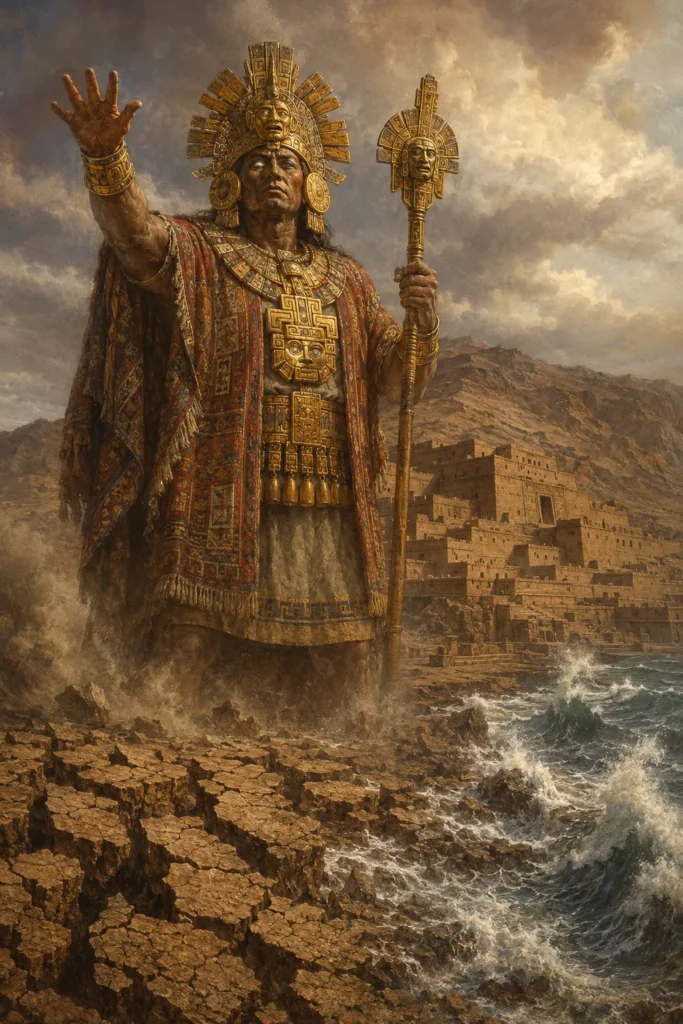
Pachakamak (Quechua Pacha Kamaq, World-Animater, World-Preserver) is the supreme god of the central Andean Pacific coast and patron of the most important pre-Hispanic pilgrimage site in the Andes. His temple south of present-day Lima served as an interregional oracle site for centuries.
Place within the Andean Pantheon
Pachakamak is the central supreme deity of the Lima region and the central Andean Pacific coast, whose history of veneration predates the Inca Empire.
His main temple, the monumental adobe complex of Pachacamac (today an archaeological zone south of Lima), already existed in the Lima culture (ca. 200 to 700 CE), was then expanded in the Wari phase (700 to 1000), enlarged in the Ychsma phase (1100 to 1470), and finally integrated by the Inca into their empire without losing its distinct character.
The Spanish chroniclers, above all Miguel de Estete, who visited the sanctuary in 1533 together with Hernando Pizarro and reported on it, describe Pachakamak as tan grande templo y tan reverenciado, the largest and most venerated sanctuary of the Andes.
His oracle was famous throughout the entire Inca Empire and was even consulted by the Inca ruler Huayna Capac. The classification of Pachakamak in religious studies as a Pan-Andean oracle sanctuary was systematically undertaken by Maria Rostworowski in her standard work Pachacamac y el Senor de los Milagros (1992).
Pachakamak stands in a complex theological entanglement with Viracocha: in some sources the two are equated, in others described as related, for example as father and son or as a dual aspect of a higher being.
This entanglement reflects the fact that the Inca had to integrate the older coastal theology of Pachakamak into their own highland theology without fully dissolving it.
The religion of the Lima region had its own identity before the Inca conquest, in which Pachakamak was not the only but the most powerful supreme deity. Alongside him, local huaca sanctuaries and pre-Inca deities such as Vichama, a son-avatar of Pachakamak, were venerated.
The conquest of the region by the Inca Tupac Yupanqui (ca. 1470) proceeded cautiously: unlike in other provinces, the local chief deity was not replaced by Inti; instead, a dual-theological solution was found in which Inti temples were erected alongside the Pachakamak temple.
Name and Etymology
The name Pacha Kamaq is a Quechua construction from pacha (world, time, space, as in Pachamama) and kamaq (animater, preserver, bringer-forth). Diego Gonzalez Holguin translates kamaq in his Vocabulario (1608) as el criador, the creator. Thus, Pacha Kamaq is structurally the World-Animater.
Noteworthy is the close linguistic proximity to kamay, the Quechua term for the animating energy that gives a thing its specific form.
The linguist and historian Gerald Taylor has shown in his works on Quechua theology (1974, 2001) that kamay does not mean a substantial creation in the Judeo-Christian sense, but rather a continuous act of informing, the ongoing animation of the world by a numinous force.
Pacha Kamaq is therefore not a one-time creator like the biblical God, but a permanent world-animater.
The Pachacamac region on the Peruvian Pacific coast took its name from the god. The Spanish name for the sanctuary was Pachacama or Pachacamac, depending on the chronicle.
In the local language of the Ychsma (an Aymaran substrate dialect of the Lima region), a separate designation may have been in use that has not been preserved.
A theologically particularly illuminating etymology was proposed by Marco Curatola in Adivinacion y oraculos en el mundo andino antiguo (2008): Pacha Kamaq as World-Compressor or World-Connector, drawing on the derived meanings of kamay as to give something form, to condense, to compress.
In this reading, Pachakamak would be the force that gives the world its concrete shape and holds it together, an interpretation that corresponds to the modern discussion of kamay as an Andean concept of energy.
Description and Iconography
The most important surviving cult image is the famous wooden double-figure idol of Pachacamac, which was excavated in 1938 from beneath the floor of the upper temple area and is today housed in the Museo de Sitio of Pachacamac.
It is an approximately 2.30 m tall carved wooden stele with two opposing faces in the upper third and a row of stylized anthropomorphic figures on the shaft. The double face has repeatedly given rise to speculation that Pachakamak was a Janus-like deity facing in two directions.
The archaeological dating of the wooden stele is disputed. The most recent radiocarbon examination (Eeckhout 2018) dates it to approximately 760 to 890 CE, that is, to the Wari phase.
Accordingly, the idol would not be of Inca-period production but would already have been present on site at the time of the Inca integration of the sanctuary and adopted by the Inca, a remarkable case of tolerance in Inca-period religious policy toward local high sanctuaries.
Miguel de Estete, who in 1533 was permitted to enter the innermost chamber (which constituted a religious sacrilege, since only the highest priests had access), describes the chamber as dark, with pictorial ornamentation on the walls and a crude wooden figure with a human face at its centre.
This description corresponds to the surviving double-figure stele.
Mythological Narratives
The most important source for Pachakamak mythology is the Huarochiri Manuscript (approx. 1608), written in Quechua, which the priest Francisco de Avila collected in the province of Huarochiri and which ranks among the most valuable surviving documents of indigenous Andean mythology.
It contains several Pachakamak myths, including the famous myth of Kuni Raya Wiraqucha, which is often read as a narrative about Pachakamak and his brothers.
A central myth recounts the rivalry between Pachakamak and his brother or double Kon. Both contend for dominion over the world; Pachakamak ultimately prevails and banishes Kon to the desert, which explains the coastal-Andean aridity.
Another narrative depicts Pachakamak as the violator of a divine woman whose daughter, in despair, transforms into a stream, a myth that illustrates the typical ambiguity of Andean supreme deities.
Particularly interesting from a religious-ethnological perspective is the narrative of the creation of the first humanity: Pachakamak creates a man and a woman, whom he leaves in the world without food. The man dies; the woman vows to take revenge on the creator by worshipping the sun.
From this worship a child is born, whom Pachakamak kills, but whose body he transforms into plants, which becomes the aetiology of Andean cultivation of maize, beans, and squash. Gerald Taylor examined the complexity of these myths systematically in Ritos y tradiciones de Huarochiri (1987).
The Huarochiri Manuscript is of particular interest because of its dual character as a religious-mythological text and as a Spanish pretext for persecution.
The priest Francisco de Avila collected the myths to use them as the basis for his extirpacion de idolatrias campaign; at the same time, the manuscript represents one of the few surviving documents of indigenous cosmology in the original language (Quechua).
Frank Salomon and George Urioste fully opened and annotated the text in their English edition (The Huarochiri Manuscript, 1991).
Cult and Pilgrimage
Pachacamac was the most important pilgrimage site in pre-Hispanic South America. Pilgrims traveled from throughout the Inca Empire, and even from preceding polities such as Chimu, to the Pacific coast to consult the oracle.
The pilgrims were required to ascend the temple pyramid through a multi-stage purification ritual, to perform increasingly rigorous fasting as they drew closer to the innermost sanctuary, and to present offerings: textiles, precious metals, Spondylus shells, llama sacrifices.
The oracle was mediated by a dedicated priestly class that received inquiries and conveyed the god’s response in a ritually prescribed form. The responses often took the form of a simple yes/no statement or an ambiguous prediction.
The oracle question posed by Huayna Capac regarding the outcome of the war against the people of Quito, answered in the negative, is famous, a response that was historically confirmed in retrospect by the death of Huayna Capac from the smallpox epidemic.
Surrounding the main temple stood a complex of secondary temples dedicated to other deities: Inti, Mama Killa, a moon temple specifically for the Acllacuna, as well as smaller sanctuaries for regionally important deities.
Maria Rostworowski described the Lordship of Pachacamac as a spiritual and political network that bound pilgrims to the sanctuary through kinship ties.
The Pachakamak temple complex comprised, alongside the main pyramid sanctuary, its own Acllahuasi (a women’s temple with a solar-virgin enclosure), a marketplace, several pilgrim accommodations, and a cemetery that has yielded over 1,300 mummies archaeologically.
These mummies indicate that the sanctuary also served as a place for pilgrims to die: those who had reached the pilgrimage destination were buried here after death, a pre-Hispanic equivalent of the wish to be buried in Jerusalem or Mecca.
Protective Practices and the Apotropaic
The specific protective practices in the Pachakamak context were directed primarily at two areas: protection from earthquakes and oracle safety.
Since the central Andean Pacific coast is seismically highly active, Pachakamak in his capacity as World-Shaker (one of his ambiguous dual functions) was regarded simultaneously as the cause of and the protector against earthquakes. Estete reports petition rituals by pilgrims against earthquakes, in which small clay figurines were buried in the ground.
Apotropaic protection against false oracle responses or against the god’s wrath in cases of insufficient purity was provided by Spondylus shells, worn as neck ornaments or chest amulets.
These red or orange shells from the warmer waters of Ecuador were the most important ritual exchange object in the coastal Andean cultures and were, according to the archaeological record, deposited in large quantities at the Pachakamak temple. Maria Rostworowski described this as the Spondylus economy.
Pachakamak had a special protective function as father of newborn children: he was invoked by families awaiting the birth of a child, with a request for protection against miscarriage. The associated offering practice involved hanging small carved wooden figurines at the temple, which is attested archaeologically in the area of the women’s temple.
Parallels in Other Cultures
Structurally, Pachakamak can be compared to other great oracle supreme deities in the history of religion. The closest parallel is the Greek Apollo of Delphi, whose oracle was consulted interregionally for centuries and was mediated through an institutional priestly hierarchy.
The Egyptian Amun oracle at Siwa, which was particularly renowned during the Hellenistic period, also belongs to this structural pattern.
Within the Americas, the Pachakamak cult shows similarities to the Aztec Quetzalcoatl oracle at Cholula and to the Maya divination institution of the chilam balam priests.
The comparison with the Mesoamerican Cholula pilgrimage site is particularly instructive, since there too a pre-imperial sanctuary was integrated by a subsequent empire (the Mexica) without losing its independent identity.
The double-face iconography of the Pachakamak stele has repeatedly led in the religious-studies literature to the suggestion that Pachakamak was an Andean variant of the Janus type, a supreme being capable of looking in two directions or across two temporal planes. Whether this parallel extends beyond a purely iconographic formal similarity remains disputed.
Contemporary Reception and Research
The archaeological complex of Pachacamac (Ministry of Culture of Peru, approx. 465 ha) is today one of the most important archaeological sites in South America.
The Belgian mission under Peter Eeckhout has systematically excavated large sections of the temple complex since the 1990s. The finds, including mummies, textiles, the famous wooden idol, Spondylus shell deposits, and a complete Acllahuasi enclosure, are accessible in part at the site museum and in part at the Museo de Antropologia in Lima.
From a religious-studies perspective, Maria Rostworowski demonstrated in Pachacamac y el Senor de los Milagros (1992) the remarkable continuity between the pre-Hispanic Pachakamak cult and the modern Senor de los Milagros cult of Lima.
The latter, which draws hundreds of thousands of pilgrims each October to Lima’s Christ procession, is, according to Rostworowski, structurally and topographically a successor to the Pachakamak cult: the same interregional pilgrim flow, the same purity requirement, the same earthquake-protection function, only in new Christian guise.
This functional continuity amid theological reassignment is one of the most impressive examples of religious syncretism in the Americas and is further developed in the more recent works of Peter Eeckhout, Krzysztof Makowski, and Marco Curatola. The religious-ethnological observation makes no claim of spiritual efficacy but describes a long-term cultural finding.
A current line of research concerns the construction-phase sequence of the temple complex. Eeckhout has identified seven major construction phases, ranging from the Lima culture through Wari, Ychsma, and Inca to the colonial phase.
This construction-phase history is a microcosm of central Andean cultural history and makes it possible to trace religious continuities and ruptures in the material record. In particular, the Inca phase (approx. 1470 to 1533) demonstrates a respectful integration of the older sanctuary that contrasts with the Inca’s forceful policies in other regions.
Literature and Sources
The following selection lists key works in archaeology and the history of religion relating to the Pachakamak sanctuary and the coastal Andean oracle tradition.
The Oracle of Pachacamac and Its Interregional Influence
The cult site of Pachacamac on the central Peruvian coast, south of present-day Lima, was a significant pilgrim and oracle sanctuary long before the Inca period.
Archaeological work, beginning with Max Uhle around 1896 and continued by later projects, has shown that the site was used for more than a millennium and exhibits construction layers of the Lima culture, the Wari, and finally the Inca.
The oracle of Pachakamak was regarded as so powerful that its authority extended far beyond the region.
Spanish sources, above all the accounts from the circle of the Pizarro expedition, describe how Hernando Pizarro sought out the sanctuary in 1533, expecting to find great gold treasures there.
The account of Miguel de Estete describes how the Spanish entered the innermost sanctuary and found there a wooden cult image they found unimpressive. This account is colored by disappointment and religious rejection but documents that there was a central, shielded idol to which only priests had access.
The oracle apparently operated through a network of subsidiary sanctuaries, so-called relatives or children of Pachakamak, which were established in distant regions and paid tribute to the main sanctuary. This system bound large parts of the coast and highlands to Pachacamac ritually and economically.
The Inca took over the sanctuary without destroying it and added a sun temple, a typical strategy of integrating foreign cults. The archaeological exploration of the site continues to this day and yields ongoing new findings on burials and construction phases.
The Creation Narrative in the Chroniclers and the Problem of Its Origins
Several colonial sources transmit creation myths in which Pachakamak appears as creator of the world or of humanity.
In a version attested in the chronicler Pedro Cieza de Leon and more fully in Antonio de la Calancha in the 17th century, Pachakamak creates a first human pair that nonetheless goes hungry; after the man’s death, the food plants arise from the buried body of a figure killed by Pachakamak.
Such narratives link the god with death, the earth, and the origin of cultivated crops.
From a source-critical standpoint, particular caution is warranted here. Calancha was an Augustinian friar who wrote with the aim of documenting the history of the missions; his rendering of Andean myths is shaped by Christian interpretive patterns, such as the search for parallels with biblical creation and Fall narratives.
It is not always possible to determine how much of a transmitted version represents pre-colonial tradition and how much the chroniclers added through harmonization or comparison.
There is also a linguistic problem. The name Pachakamak, often interpreted as the one who animates or orders the world, resembles a theological term that Christian missionaries deliberately seized upon in order to find a native expression for the Christian God. The colonial missionary literature thereby loaded the name with additional meaning.
Contemporary research, such as the work of Sabine MacCormack on the colonial perception of Andean religion, therefore cautions against reading the creation narratives uncritically as pure pre-colonial heritage, but rather as texts that arose at the intersection of indigenous tradition and missionary interest.
Literature (Selection)
- Maria Rostworowski: Pachacamac y el Senor de los Milagros (1992)
- Gerald Taylor: Ritos y tradiciones de Huarochiri (1987)
- Peter Eeckhout: Pachacamac et le Projet Ychsma (2003)
- Miguel de Estete: Relacion del viaje (1533/1534)
- Krzysztof Makowski: Senores de los Imperios del Sol (2010)
- Marco Curatola: Adivinacion y oraculos en el mundo andino antiguo (2008)
As the oracle god of the central Andean Pacific coast, Pachakamak was already the destination of major pilgrimages before the Inca period; his sanctuary south of Lima was regarded as one of the most significant oracles of the Andean world.
Related key terms: Pachakamak Pacha Kamaq Pachacamac Ychsma Wari Huarochiri Spondylus Kuni Raya Oracle.
iWell Guard and Protective Traditions
iWell Guard draws on the cultural-historical tradition of wearable protective objects, in the tradition of Andes / Inca and many other cultures worldwide. 41 layers, real gold, platinum, silver, crafted in Germany. 30-day return policy.
Personal experiences may vary. Not a medical product. No healing claims.