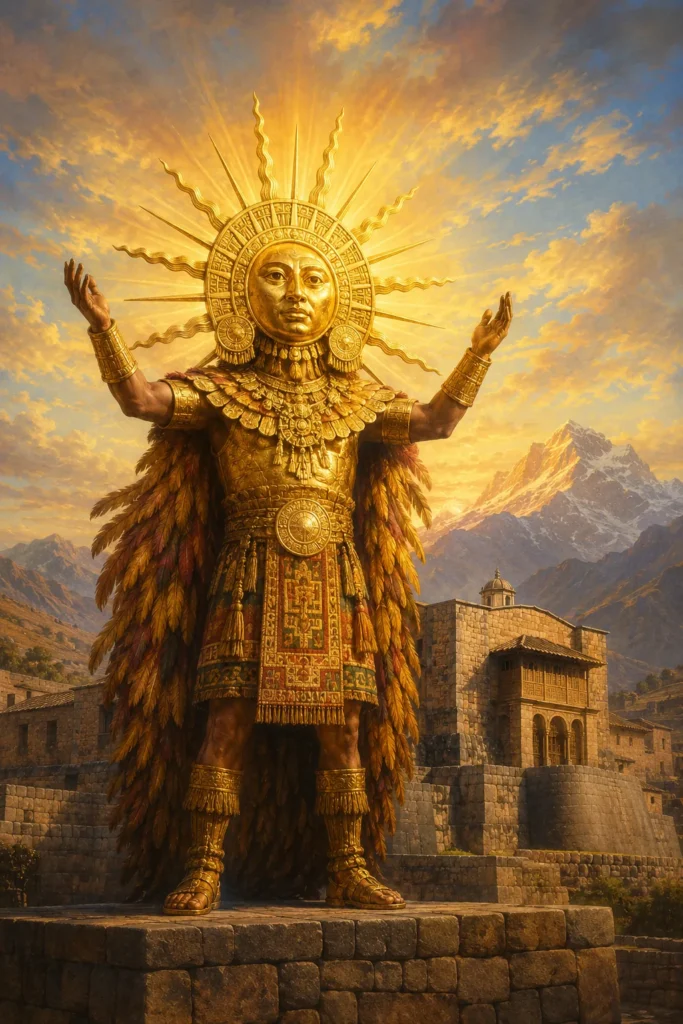
Inti, sun god of the Inca and ancestor of the ruling dynasty
By Ralf Ittermann · last reviewed on
Inti, the sun god of the Inca, is considered the father of the ruling dynasty and stands at the center of the great solar festival Inti Raymi. His cult is a central component of Andean religious history and was officially elevated to the state religion by the Inca Empire.
Inti is the Inca sun god and stands as a central figure in the pantheon of the Andean high civilization.
Classification in the Andean Pantheon
Inti (Quechua: inti, sun) forms one of the central supreme deities in the official pantheon of the Inca Empire (Tawantinsuyu, c. 1438, 1533) and appears regularly in the colonial-era chronicles alongside the creator god Viracocha and the moon goddess Mama Killa.
The Peruvian chronicler Garcilaso de la Vega describes him in his Comentarios Reales de los Incas (1609) as the visible face of the supreme being, who legitimized the Inca rulers and organized the empire economically as well as calendrically.
In terms of religious studies, Inti belongs to the group of dynastic solar theologies, as known in comparable form from the ancient Egyptian Re cult, the Japanese Amaterasu cult, or the Near Eastern solar cults.
Mircea Eliade describes in his History of Religious Ideas the tendency of later high civilizations to elevate a solar deity to the guarantor of political order; Inti fits into this pattern.
The Inca rulers bore the title Intip Churin (Son of the Sun) and derived from it their universal claim to rule over the Andean highlands and the Andes / Inca world.
Notably, Inti had no comparably prominent position in the pre-Inca high cultures of the Andes (Chavin, Moche, Tiwanaku, Wari). Only the state-building theology of the Inca Empire placed him at the top of the visible pantheon.
Catherine Allen notes in The Hold Life Has (2002) that the veneration of the earth mother Pachamama and the local mountain spirits Apu remains practically more important in many communities today than the higher solar theology of Inti, an indication that Inti functioned primarily as an imperial deity and that the concrete daily life of Andean religiosity was shaped more by the earth mother and the local mountain lords.
Name and Etymology
The name Inti has been attested since the earliest colonial Quechua dictionaries (Domingo de Santo Thomas 1560, Diego Gonzalez Holguin 1608) as a generic term for the sun as a celestial body as well as for the personified deity.
This dual meaning, physical celestial body and divine person, is typical of Andean religious thought, in which the separation between the natural and numinous planes is less sharply drawn than in European theologies.
Inti appears in the sources under several aspect names: Apu Inti (Lord Sun), Churi Inti (Son Sun), Wayna Inti (Young Sun), and Inti Illapa (Thunder Sun) each designate different manifestations, which the chronicler Juan de Betanzos describes in his Suma y narracion de los Incas (1551) as three persons of a triadic solar theology.
This triad has prompted caution from religious ethnologists such as Pierre Duviols: the Christian doctrine of the Trinity of the Spanish chroniclers may here be overlaying a genuine indigenous multiplicity of forms.
The highest festival name Inti Raymi is a Quechua compound of inti and raymi (festival, festival assembly). It designates the winter solstice festival of the Southern Hemisphere (June) and has been annually re-staged in Cusco since 1944 as a reconstructed folk festival, albeit without the historical practice of animal sacrifice.
The festival name has furthermore established itself as the designation for a distinct Andean calendar system in which years are counted from the mythical beginning of the empire.
Description and Iconography
The iconographic depiction of Inti is only fragmentarily accessible in pre-Hispanic sources, since the Inca Empire did not have a written pictorial tradition in the strict sense.
The primary source is the colonial-era secondary tradition as well as the famous gold sheet that is said to have been displayed in the sun temple Coricancha in Cusco: a round disc framed by rays with an anthropomorphic face, the so-called Punchao.
This cult image was confiscated by the Spanish at the conquest of Vilcabamba in 1572 and shipped to Spain, but has been lost ever since.
Garcilaso de la Vega describes the Coricancha sanctuary as an interior completely clad in gold plates. At the center stood the Punchao, flanked by the mummified bodies of the deceased Inca rulers (mallqui), who were regarded as eternally living embodiments of the Inti lineage.
The Spanish chroniclers Polo de Ondegardo and Cristobal de Albornoz confirm this arrangement in their inspection reports of the 1560s. The courtiers of the Inca appeared on festival days with golden ray crowns that formally echoed the Punchao.
On preserved Inca textiles, keros (drinking vessels), and colonial wall paintings (such as those of the Cusco School), Inti is usually depicted as a golden face with jagged rays, sometimes with a garland of maize or quinoa ears.
In the upper pictorial registers of colonial Andean paintings (e.g., Triumph of Saint Michael, Cusquena School, 17th century), the Inti iconography overlaps with Christian angel and Sol Iustitiae motifs, an iconographic trace of syncretism that the art historian Teresa Gisbert systematically traced in Iconografia y mitos indigenas en el arte (1980).
Mythological Narratives
The most important myth surrounding Inti is the Inca origin myth of Lake Titicaca, transmitted primarily through Garcilaso de la Vega and Juan de Betanzos.
According to this, Inti rises from Lake Titicaca after a phase of world darkness and sends out his children Manco Capac and Mama Ocllo to teach humanity agriculture, weaving, and religious order.
At the place where the golden staff of Manco sinks into the ground, the city of Cusco is to be founded, the later capital of Tawantinsuyu.
In a parallel tradition, recorded by Pedro Sarmiento de Gamboa in the Historia indica (1572), Manco Capac and his siblings appear instead from the cave system of Pacaritambo near Cusco.
These two origin traditions were already reconciled in Inca-era theology, with the Titicaca event interpreted as the cosmic phase and the Pacaritambo event as the earthly phase of the same mission.
A further mythological strand connects Inti with the creator god Viracocha. According to Cristobal de Molina (Relacion de las fabulas y ritos de los Incas, 1575), Viracocha creates the sun, the moon, and the stars at Titicaca and commands them to take their courses in the sky.
Inti here is a secondary creation of the higher creative principle. This cosmogonic hierarchy was reinterpreted by some Inca rulers, most notably Pachacuti (r. 1438, 1471), in favor of a stronger position for Inti, which shaped later state theology.
Mythologically connected with Inti are furthermore his sibling-consort Mama Killa (the moon) and the thunder god Illapa, who in some sources is understood as an aspect or brother of Inti. Inca priests interpreted lunar eclipses as an attack by a cosmic animal on Mama Killa, which had to be countered with noise and arrows.
Cult and Veneration in Tawantinsuyu
The state Inti cult was elaborately institutionalized in the Inca Empire. At its center stood the sun temple Coricancha (Quechua quri kancha, golden enclosure) in Cusco, whose foundations still form the base of the Dominican monastery of Santo Domingo today.
Here the mummies of the Inca rulers were maintained as living ancestors, fed daily, and carried in processions across the main square Huacaypata on festival days.
More than 4,000 priests and the Acllacuna, the chosen sun virgins, were assigned to the temple. The latter lived in enclosed women’s houses (acllahuasi), wove the finest cloths (cumbi) for the cult, and brewed the ritual maize beer chicha.
The sparse preservation of the acllahuasi in Cusco (today Santa Catalina) gives an impression of the material dimension of this female priesthood.
The high point of the cultic year was Inti Raymi, the winter solstice festival on June 21/24. The Inca himself sacrificed llamas and guinea pigs at the main square of Cusco, poured libations of chicha on a golden dish, and directed his prayer to the rising sun.
Polo de Ondegardo reports processional processions along the ceque lines, a system of lines and sanctuaries radiating radially from the Coricancha, comprising 41 straight lines and 328 so-called huaca sanctuaries, which Tom Zuidema first systematically reconstructed in The Ceque System of Cuzco (1964).
In addition to the main cult in Cusco, regional sun temples existed, among other places, in Vilcashuaman, Pachacamac (in syncretism with the older oracle god Pachakamak), on the Isla del Sol in Lake Titicaca, and in the northern Peruvian province of Cajamarca.
These regional sanctuaries were connected via the road network Qhapaq Nan and formed an imperial communication network in which solar theology and administrative control were inseparably intertwined.
Protective Practices and the Apotropaic
Where Inti acted imperially as a supreme deity, there existed alongside this an everyday solar practice that survives in part to this day in the villages of the Cusco and Bolivian highlands. It cannot be understood in terms of modern promises of efficacy, but rather documents a specific religious practice of perception.
Catherine Allen (The Hold Life Has, 2002) describes for the village of Sonqo that older women open the door to the east in the morning and stroke the first sunlight over their heads, accompanied by a Quechua murmur asking Inti for samay (breath of life).
In Inca-era practice, priests used golden mirrors to focus sunlight and ignite the ritual fire at the Coricancha altar. Cobo reports a corresponding device with polished concave mirrors.
Apotropaic against nocturnal dangers, in particular against the harmful spirits designated in myth as supay (see Supay), were solar amulets made of gold sheet, worn on the chest as chacana or as round Punchao replicas.
From a religious-studies perspective, it is significant that these practices were not understood as magical control, but as ayni, as a relationship of mutual obligation.
Whoever greets the sun in the morning places themselves in the reciprocal network that, according to Andean understanding, connects human beings, ancestors, mountains, and celestial bodies. The religious ethnologist Frank Salomon has shown in The Cord Keepers (2004) how this reciprocal logic extends into modern Quechua communities.
Parallels in Other Cultures
Comparative religious scholarship has repeatedly drawn parallels between Inti and other dynastic solar theologies since Eduard Seler and Konrad Theodor Preuss.
Particularly striking are the structural similarities to the ancient Egyptian Re or Aton cult, to the Japanese Amaterasu cult of the Yamato dynasty, and to the Roman Sol Invictus theology of the 3rd century.
In all these cases, the sun appears as the guarantor of a ruling dynasty, as the central calendrical principle, and as the iconographically dominant element of state art.
The Dutch historian of religion Henri Frankfort described in Kingship and the Gods (1948) the structural pattern of divine kingship in which Inti, Re, and Amaterasu occupy functionally comparable positions.
Frankfort’s pattern, however, does not imply a genealogical connection between the solar theologies; these are convergent developments under similar socio-structural conditions of an agriculturally based high civilization.
Within the Americas, Inti shows clear parallels to the Aztec Huitzilopochtli and to the Tonatiuh sun god of Mesoamerica, without any direct contact between the cultures before 1532 being demonstrable.
The Andean cultural complexes remained largely isolated. In the broader American context, the solar principal figure is less prominent: among the North American Lakota, Wakan Tanka constitutes a more comprehensive, less specifically solar supreme being.
Contemporary Reception and Research
After the conquest of 1532, 1572, the state Inti cult was systematically suppressed by the Spanish colonial administration. Archbishop Bartholome Lobo Guerrero and his visitor Francisco de Avila conducted major extirpacion de idolatrias campaigns in the 1610s and 1620s, in the course of which thousands of huaca sanctuaries were destroyed.
Nevertheless, the sun cult survived in popular religious forms, for example in the mountain processions of Qoyllur Riti near Cusco, where the last morning ice from the glacier (today significantly retreated due to climate change) is understood as a manifestation of Inti.
Since 1944, the Inti Raymi festival has been performed annually in Cusco on June 24 as a reconstructed folk festival at the Sacsayhuaman fortress.
The staging goes back to the Peruvian writer Faustino Espinoza Navarro and is based primarily on the accounts of Garcilaso de la Vega. It has a considerable tourist character but is at the same time an anchor of a rediscovered indigenous identity (movimiento indigenista).
In academic research today, the focus is less on the monolithic Inti cult than on the question of local religiosity.
Frank Salomon, Tom Zuidema, Catherine Allen, Sabine MacCormack (Religion in the Andes, 1991), and Brian Bauer (The Sacred Landscape of the Inca, 1998) have shown how the state solar cult was grafted onto a dense network of local huaca sanctuaries and apu mountain veneration and continued to operate in syncretic form after 1532. Current archaeoastronomical studies of stone sanctuaries such as Machu Picchu (Reinhard 2007, Ziegler 2015) continually refine this picture.
Literature and Sources
The following selection lists central historical sources and modern religious-studies investigations on the Inti cult in the Inca Empire. It ranges from the colonial-era chronicles of the 16th and 17th centuries to works of modern Andean ethnology and archaeology.
Inti Raymi as the State Festival of the Inca Empire
The most important transmitted festival of the solar cult was Inti Raymi, observed at the time of the winter solstice in June in Cusco.
It is known primarily through the description of the chronicler Cristobal de Molina from Cusco, who documented the Inca festivals in the 1570s, as well as through accounts by Garcilaso de la Vega and Bernabe Cobo.
The festival marked the beginning of a new annual cycle and connected the sun, the fertility of the land, and the rule of the Inca.
According to the chronicles, the nobility assembled on the central square of Cusco. Llamas were sacrificed, maize and maize beer were offered, and the sun was paid homage in a ceremony in which the Inca, as son of the sun, played a prominent role.
The festival thus served both religious veneration and the confirmation of the political order. The Spanish colonial administration banned the festival in the late 16th century as idolatry.
The contemporary Inti Raymi, performed annually in Cusco since 1944, is not an unbroken continuation but a modern reconstruction. It goes back to an initiative by the writer and indigenist Faustino Espinoza Navarro and draws primarily on the text of Garcilaso.
Scholarship classifies the modern festival within the Peruvian Indigenismo of the 20th century, a movement that emphasized the Inca heritage as the foundation of national identity. It thus represents a well-documented case in which a pre-colonial ritual was recreated from chronicles and became an element of modern identity, without any continuous cultic tradition existing.
The Coricancha and the Material Tradition of the Solar Cult
The central sanctuary of the sun god was the Coricancha in Cusco, whose name can be translated as golden courtyard or golden enclosure. The Spanish sources describe it as richly adorned with gold, with walls said to have been partially clad with gold plates.
After the conquest the gold was melted down, and the Spaniards erected the monastery of Santo Domingo on the foundations of the sanctuary. The massive Inca stone wall survives to this day and is visible in the cityscape of Cusco.
For religious-studies evaluation, the Coricancha is significant because it represents a rare case where written sources and architectural remains come together. The surviving architecture allows conclusions about the arrangement of the rooms, even though the precise function of individual areas remains disputed.
One topic of discussion is that the Coricancha housed not only the sun but also several deities and the embalmed bodies of deceased rulers.
The astronomer and anthropologist R. T. Zuidema has argued in a series of works that from the Coricancha radiated a system of imaginary lines, the so-called ceque, along which numerous sanctuaries lay in the vicinity of Cusco. These lines are said to have had both ritual and calendrical functions.
The thesis is influential but not uncontested, because it rests predominantly on the list of sanctuaries in Bernabe Cobo and the interpretation of that list remains disputed. The Coricancha thus remains a central but only partially accessible reference point for understanding the solar cult.
Literature (Selection)
- Garcilaso de la Vega: Comentarios Reales de los Incas (1609)
- Bernabe Cobo: Historia del Nuevo Mundo (1653)
- Catherine Allen: The Hold Life Has (2002)
- Tom Zuidema: The Ceque System of Cuzco (1964)
- Sabine MacCormack: Religion in the Andes (1991)
- Brian Bauer: The Sacred Landscape of the Inca (1998)
- Teresa Gisbert: Iconografia y mitos indigenas en el arte (1980)
As the founding ancestor of the Inca rulers, Inti legitimized the royal line of Cusco and connected the political center of the empire with a cosmic narrative of descent.
Related key terms: Inti Quechua Capac Inti Raymi Cusco Coricancha Pachakuti Punchao Tawantinsuyu.
iWell Guard and Protective Traditions
iWell Guard draws on the cultural-historical tradition of wearable protective objects, in the tradition of Andes / Inca and many other cultures worldwide. 41 levels, real gold, platinum, silver, made in Germany. 30-day return policy.
Personal experiences may vary. Not a medical device. No healing promises.