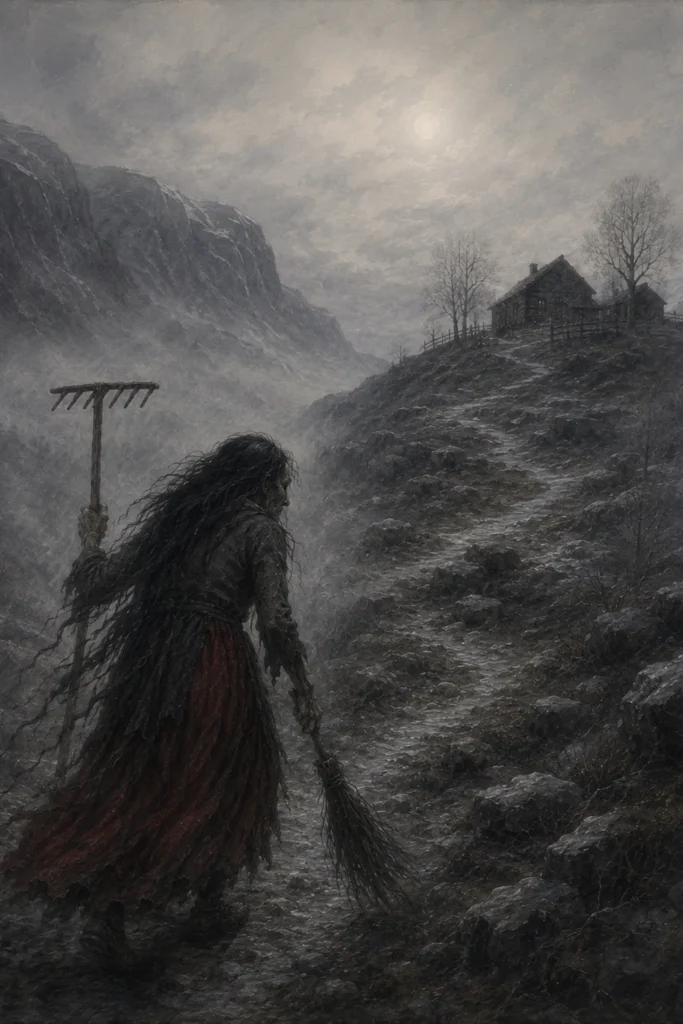
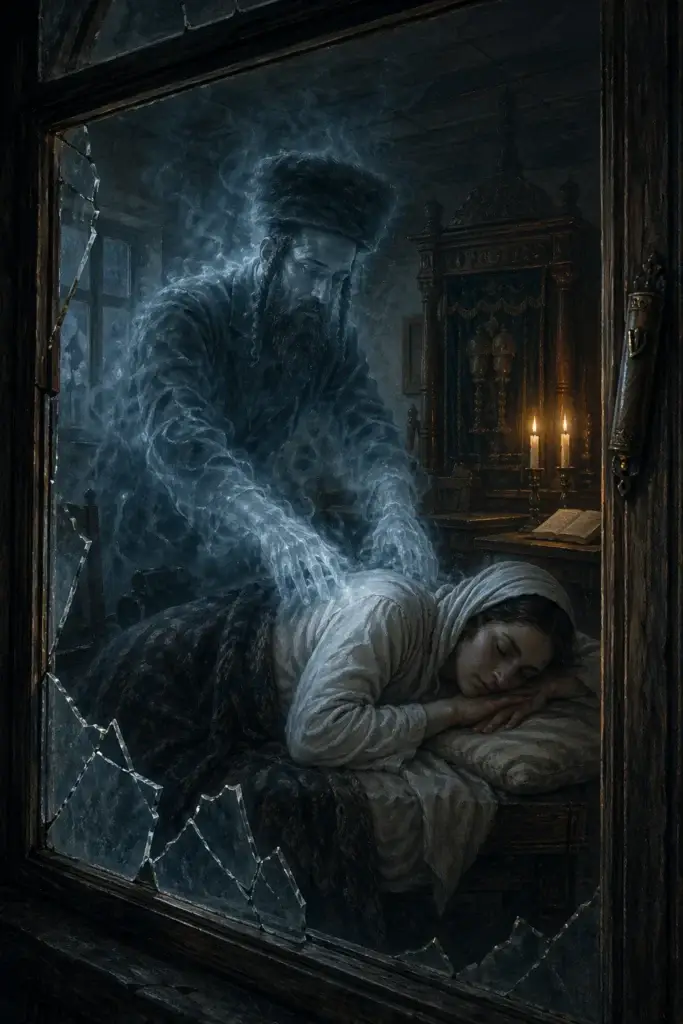
Supay, harmful spirits, lord of the underworld and mine demon of the Andean highlands
By Ralf Ittermann · last reviewed on
Supay (Quechua supay, Aymara supaya) refers in Andean tradition both to a class of harmful spirits and to a specific underworld figure. In the mining region of Bolivia he was transformed into the Tio, the tunnel demon of the silver mines of Potosi and Oruro.
Profile: Supay
Supay: the most important aspects at a glance. The following fields summarise origin, effect, appearance, function, protection and parallels.
Supay (Quechua supay, Aymara supaya) denotes in the earliest sources a class of harmful, incorporeal beings such as spirits of the dead, disease demons and nocturnal disturbers, as well as a ruler figure of the underworld. Holguin gives the meaning in 1608 as demonio o sombra. From the 16th century, missionaries equated supay with the Christian devil.
Supay haunts the living in sleep, in illness and at night. The condenados, dead souls without access to the afterlife, appear to travellers at night and try to drag them into death. Whoever fails to prepare the meal for the dead on All Souls’ Day risks deceased ancestors returning as Supays.
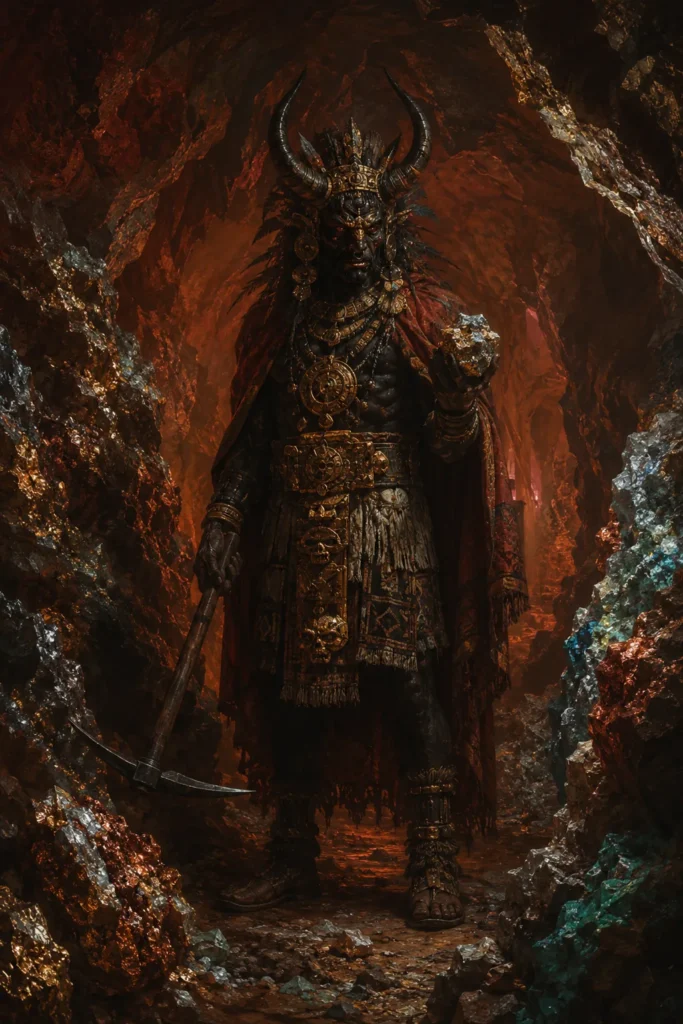
The early chronicles describe Supay as formless and invisible. In colonial painting he appears in a European, devilish form, with horns, long tail and goat’s legs. The Tio of the mines is a clay figure with golden eyes, horned head, cigarette in the mouth and erect phallus as a sign of the fertility of the earth.
Supay comprises several classes, including aya supay (spirits of the dead), chuqui supay (spear spirits) and llocsi supay (wandering haunting spirits). In the Bolivian mines he appears as Tio, as lord of the silver deposits, who grants silver in exchange for coca, liquor and occasionally a human life. The miners ask him to keep the tunnels safe.
Means of protection are a red woollen thread on the wrist, especially for small children, a small cross above the front door, fumigating the house with eucalyptus and muna, and garlic or rue around the neck. On All Souls’ Day the meal for the dead protects against the retribution of the dead. In Cusco the cleansing festival Citua drove Supays out of the city.
Structurally comparable are the Greek Hades, the Germanic Hel, the Mesoamerican Mictlantecuhtli and the Vodou Baron Samedi. Further parallels are the Jewish Lilith, the African Eshu and the Japanese oni. In the mines, Tio and Pachamama form a complementary pair (yanantin).
Classification in the Andean Pantheon
Supay is a figure in Andean religion that is difficult to categorize. Unlike the state-imperial high deities Inti, Viracocha and Mama Killa, Supay is neither a personified creator nor a clearly defined individual god.
In the earliest Quechua sources he designates a class of harmful, bodiless beings, spirits of the dead, disease demons, nocturnal disturbers, and in parallel a personified ruling figure of the underworld.
The Spanish missionaries used supay from the sixteenth century onwards as the Quechua equivalent for the Christian devil (diablo).
This identification has substantially distorted the original meaning: whereas the Christian devil is conceived as a purely evil power, supay in pre-Hispanic Andean theology was a morally ambivalent figure, dangerous but under certain circumstances also helpful, certainly not pure evil.
The Peruvian anthropologist Manuel Marzal systematically described the supay/diablo distortion in El mundo religioso de Urcos (1971).
In the classification of religious studies, Supay belongs to the broad category of chthonic numinosities, beings of the depths, of the interior of the earth, of caves and shafts.
Structurally comparable figures are the Greek Hades, the Germanic Hel, the Mesoamerican Mictlantecuhtli, and to some extent also the Vodou Baron Samedi. In all these cases we are dealing with beings connected to the world of the dead and to the subterranean realm.
Notable is the early Spanish observation that the Quechua-speaking Inca had no unified concept of an absolutely evil being. Polo de Ondegardo noted in 1559 that the Inca knew many harmful beings but no unified embodiment of evil comparable to the Christian Satan.
This observation was initially interpreted by the missionaries as a theology deficit and rectified through the supay/diablo identification, a process that continues to engage historians of religion to this day.
Name and Etymology
The Quechua term supay is attested from the earliest colonial dictionaries. Diego Gonzalez Holguin gives its meaning in 1608 as demonio o sombra, demon or shadow.
This dual meaning is revealing: sombra refers not only to the optical shadow but to a kind of insubstantial being that can attach itself to the living. The plural supaykuna denotes the multitude of such shadowy beings.
In the Aymara language area the equivalent is supaya or saxra. The latter is today the more common term in the Bolivian Aymara villages and denotes harmful spirits that dwell in certain natural phenomena (whirlpools, rock fissures, caves).
In the modern Quechua-speaking villages, supay has undergone a differentiated conceptual history.
Catherine Allen distinguishes in The Hold Life Has (2002) three semantic fields: first, supay as a pejorative designation for Christian demons (in the sense of the missionary identification), second, supay as a generic designation for a shadowy harmful spirit, and third, supay as an honorific epithet for certain mountain lords (Apu) or ancestral mummies (mallqui) that call for reverential caution.
The etymological proximity of supay to the Quechua verb supay- (to be blown away by the wind, to be carried off) has led some linguists to the conjecture that the basic meaning is a wind-blown spirit, a being carried back into the world of the living by the wind after death.
This linguistic-historical hypothesis is not definitively established but fits well with the ethnographically observed conception of supay as a wind spirit.
Description and Iconography
In the early chronicles Supay is described as formless, an invisible, fleeting being that afflicts the living in sleep, in illness, or at night. This iconographic absence is characteristic of the old Andean conception of harmful spirits; they were not depicted in fixed form but feared as an invisible presence.
With the Spanish mission and the identification with the Christian devil, the iconography changed radically. In colonial Cuzco and Potosi painting Supay appears increasingly in a European-diabolical form: horned, with a long tail, goat-legged, sometimes surrounded by sulphurous vapour.
The famous Triumph of Saint Michael painting (Cuzco school, 17th century) shows several such Supays under the feet of the archangel.
In the Bolivian mining region a distinct Tio iconography has developed since the seventeenth century: male figures modelled from clay with golden eyes, a horned head, a tobacco cigarette in the mouth, and a prominent erect phallus, an expression of the fertility of the earth that gives birth to silver.
These Tio figures stand to this day in almost every mine tunnel of the Potosi-Oruro region. June Nash documented them extensively in We Eat the Mines and the Mines Eat Us (1979).
Mythological Narratives
The mythological tradition surrounding Supay is fragmentary. In the Huarochiri manuscript (c. 1608) several supay beings appear as antagonists of heroic figures; they are usually defeated by cunning or repelled by ritual measures.
Cristobal de Albornoz describes in his Instruccion para descubrir todas las guacas (c. 1581) various supay classes, including the aya supay (spirits of the dead), the chuqui supay (spear spirits, i.e. warrior demons), and the llocsi supay (those who emerge, i.e. wandering haunting spirits).
A widespread motif in the narratives of Quechua-speaking villages concerns the condenado (the condemned): a dead soul that, because of incest, murder, or other grave crimes, finds no entry into the afterlife and wanders as a roaming Supay.
These condenados roam mainly in the highlands at night, appear to travellers as a sorrowful but uncanny companion, and attempt to drag the living into death. Catherine Allen recorded several such condenado narratives for the village of Sonqo.
In the mining mythology of the Bolivian Andes, Supay/Tio appears as the lord of silver deposits. A central narrative describes how the first miner encountered a Tio statue and questioned it: the Tio promised abundant silver but demanded coca, spirits, and occasionally a human life in return.
Though legendary, this story reflects very precisely the actually observed accident risk in the tunnels, which is ritually processed through the Tio cult.
Another important narrative class concerns the pishtaco beings, a specific form of Supay kinship that has received particular attention in more recent Andean village studies. Pishtacos are pale-skinned, fat-sucking beings that are said to extract the fat of their victims for use in industrial machinery.
This narrative is attested since the late sixteenth century and is reactivated in every phase of economic upheaval. Mary Weismantel showed in Cholas and Pishtacos (2001) how this narrative processes the structural tensions between the indigenous population and non-indigenous powers in religious terms.
Cult and Mining Ritual
The Inca-period Supay cult existed only in negative form: Supays were not recipient deities but spirits whose harm had to be warded off by ritual measures.
The most important example is the annual Citua purification festival in Cusco (September), in which warriors marched through the city with torches, drove out all illnesses, all known supay beings, and all disturbances, symbolically washing them away in the four cardinal directions.
Since the seventeenth century an independent Tio cult has developed in the Bolivian mining regions, going far beyond mere warding off and passing into an active cultivation of the relationship with the tunnel demon.
The miners make offerings to the Tio every Tuesday and Friday by placing coca leaves on his lap, pouring spirits into his mouth, inserting burning cigarettes into his mouth, and asking him to release the silver and keep the tunnels safe.
The annual highlight is the Carnaval Minero (Miners’ Carnival) in Oruro, listed as UNESCO intangible cultural heritage since 2001. At its centre stands the Diablada dance, which depicts the defeat of the Tio by the Archangel Michael, a choreographic fusion of pre-Hispanic Supay theology with Catholic demon doctrine.
The famous silver Diablo masks of the Oruro Carnival are at once an art-historical and a religious-historical phenomenon.
The mining region of Potosi was the economic centre of Spanish colonial economy since the discovery of its silver deposits in 1545. The city of Potosi had over 160,000 inhabitants in the seventeenth century and was one of the largest cities in the world.
The enormous death tolls among the indigenous Mita workers, with thousands of miners dying annually from mercury poisoning, accidents, and exhaustion, shaped the Tio theology and gave it a bloody backdrop that remains present to this day in the Oruro-Bolivian carnival narratives.
Protective Practices and Apotropaic Measures
The protective practices against Supays constitute one of the richest chapters of Andean folk religion. Catherine Allen, Joseph Bastien, and Olivia Harris have systematically described these practices in the villages in their ethnographic works.
Central means of protection include: wearing a red woollen thread at the wrist (especially for young children), placing a small cross combination above the house entrance door, fumigating the house with eucalyptus and muna leaves (a wild mint of the highlands), and wearing pieces of garlic or rue herb at the neck.
These practices have been syncretically co-influenced in detail by European folk-medicinal traditions.
A specific protective practice concerns the almas-en-pena (souls in torment) and the condenados: whoever does not prepare the ritually correct meal for the dead on All Souls’ Day (1st/2nd November) risks the deceased ancestors returning as Supays.
The elaborate practice of the Todos Santos meal, with specially baked bread figurines (t’antawawas), choclo, maize sweets, and coca leaves, is at once a veneration of the dead and a protective practice against the retribution of poorly treated spirits.
Parallels in Other Cultures
The supay/Tio constellation has received much attention in the religious studies literature because it constitutes a paradigmatic example of the phenomenon of religious inversion: a fundamentally terrifying figure becomes in mining practice a relationship that is actively cultivated, because the economic situation of survival forces an instrumental approach to what is perceived as evil.
Structurally parallel phenomena are found in the Mesoamerican Tlazolteotl and Mictlantecuhtli theology, in the West Asian Lilith tradition (which can be both a harmful spirit and a protective spirit), and in African Eshu theology.
June Nash explicitly described the Bolivian Tio in We Eat the Mines (1979) as an example of a working-class theology that can be read in both Marxist and religious-ethnological terms.
Specific to the Andean sphere is the entanglement of the Supay/Tio complex with the Pachamama complex. In the Bolivian mines Tio and Pachamama are understood as a complementary pair: Tio inside the tunnel, Pachamama outside at the tunnel entrance. This complementarity corresponds to the general Andean yanantin principle of dual pairs.
An important parallel is provided by the Jewish Lilith tradition, which likewise represents a double-faced figure between harmful spirit and, under certain circumstances, an accessible mediator.
The Japanese oni concept is also related, since oni beings too are depicted not as unambiguously evil but as morally ambivalent. These structural parallels should not, however, lead to a typological equation: the historically and culturally specific nature of each tradition remains central.
Current Reception and Research
The Tio cult of the Bolivian mines is today one of the most closely observed religious practice complexes in the world.
The works of June Nash (1979), Tristan Platt (1982) and Pascale Absi (2003) have described in detail the continuities and changes in the cult since the Spanish colonial period.
Remarkable is the history of the identification of Supay with the Christian devil: a spirit complex that was initially rather shadowy and morally ambivalent was transformed by the Spanish missionary strategy into a prominent anti-god, who in mining practice paradoxically became again a recipient figure in a reciprocal offering relationship.
This ironic turn is a classic example of the religious creativity of indigenous cultures under colonial conditions.
From a religious studies perspective Supay/Tio remains an important reminder against the simple identification of indigenous harmful spirits with the Christian devil.
The category diablo, which is of colonial provenance, obscures the genuinely Andean moral ambivalence of the supay complex and renders it unusable for religious studies analysis. The iWell Guard context describes this finding in terms of the history of religion, not with promises of efficacy.
Current research additionally links the Supay complex to the question of indigenous conceptions of justice. Where the traditional state justice apparatus fails, the supay-condenado conception serves in the villages as a moral compensatory mechanism: whoever has incurred guilt will return in death as a wandering Supay and enact their own punishment.
This ethical dimension of Supay theology has been described by Allen, Bastien, and Salomon in their works as the moral ecology of Quechua-Aymara religiosity.
Literature and Sources
The following selection lists central works on the supay/Tio tradition of the central Andes, with particular focus on Bolivian mining ethnography.
Supay between Pre-Colonial Conception and Christian Reinterpretation
The term supay belongs to the words whose meaning shifted fundamentally through Spanish colonisation.
In the early Quechua dictionaries, such as the Lexicon of Domingo de Santo Tomás (1560) and the vocabulary of Diego González Holguín (1608), supay appears as a designation for a spirit or shadow being connected to the realm of the dead and the underworld.
A clearly negative moral evaluation cannot be securely reconstructed for the pre-colonial period.
The Christian missionaries, however, consistently translated supay as devil and demon. As a result, an ambiguous being of the Andean world became a figure of Christian evil.
This equation is already found in the catechisms that the Third Council of Lima published in Quechua and Aymara from 1583 onwards. Research, including works by Sabine MacCormack and Gerald Taylor, has shown that the colonial texts thereby created a category that had not previously existed in this form.
The picture becomes complex because the Andean population partly accepted and partly subverted this reinterpretation. The underground realm remained in the collective imagination connected with wealth and the mines, and so supay simultaneously became the lord of the mines.
The figure of the tio, the lord underground, to whom miners in Potosi and other mining centres continue to offer gifts to this day, stands in this lineage.
He is not a simple Christian devil but a being one must engage with because he controls the treasures of the mountain. Related ambivalence characterises the treatment of Pachamama, who likewise receives offerings.
The Diablada and the Dance of the Devils
A context in which the Supay conception remains visibly alive to this day is the Diablada, the devil dance associated above all with the Carnival of Oruro in Bolivia.
At this festival, whose present basic form is attested in the eighteenth century, groups of dancers in elaborate devil masks parade through the city. The mask-wearers represent an army of supay figures that is symbolically defeated at the end by the figure of the Archangel Michael.
The religious studies interpretation sees in the Diablada a combination of two layers. The outer form follows the Christian scheme of the victory of good over evil, as conveyed by Spanish missionary plays.
At the same time the subterranean reference is retained: Oruro was a mining city, and the central pilgrimage site, the shrine of the Virgen del Socavon, the Virgin of the Mine Shaft, is located at the entrance to a mine tunnel.
The dance is offered to the Virgin but takes place at a site belonging to the lord of the mines.
Researchers such as Thomas Abercrombie have pointed out that the participants themselves interpret this ambiguity differently. For some the dance is an act of penance, for others an obligation towards the mountain. UNESCO included the Carnaval de Oruro on the list of intangible cultural heritage in 2001, which led to greater standardisation and commercialisation.
Research records that the touristic upgrading has partly overlaid the ritual significance without entirely displacing it. The Diablada is thus a well-documented example of how a colonially reinterpreted figure lives on in a public festival and in doing so takes on new meanings.
Research Debate on the Duality of Upper and Lower Worlds
A contested question in Andean research concerns the relationship of supay to an assumed pre-colonial model of the world.
Some accounts organise Andean cosmology into three realms: an upper world, the middle world of the living, and a lower world connected with the interior of the earth and the dead. Supay is in this view understood as an inhabitant or lord of the lower world.
Research is divided on how old and how widespread this three-tier model actually was. Critics such as Bruce Mannheim have pointed out that the sources from which it is reconstructed are almost all of colonial origin and may already contain Christian concepts of heaven, earth, and hell.
There is a risk of back-projecting a Christian scheme onto the pre-colonial period and then presenting it as indigenous heritage.
Other researchers, for instance in the context of work on the Huarochiri manuscripts, a collection of local traditions recorded in Quechua around 1600, do see indications of a pre-colonial significance of the subterranean realm, without this having corresponded to the Christian concept of hell.
Supay would accordingly have originally been a neutral or ambiguous being of the realm of the dead.
The debate is not closed, because it depends on the fundamental difficulty of reconstructing pre-colonial Andean religion from predominantly colonial texts. For a rigorous account this calls for restraint: what can be considered established is the shift in meaning in the colonial period, not the precise pre-colonial finding.
Literature (Selection)
- June Nash: We Eat the Mines and the Mines Eat Us (1979)
- Tristan Platt: Estado boliviano y ayllu andino (1982)
- Pascale Absi: Les ministres du diable (2003)
- Catherine Allen: The Hold Life Has (2002)
- Manuel Marzal: El mundo religioso de Urcos (1971)
- Cristobal de Albornoz: Instruccion para descubrir todas las guacas (c. 1581)
Supay is regarded in Andean religious history as a lord of the underworld and simultaneously as a mine demon, to whom miners in the colonial silver mines of Potosi brought offerings to avert tunnel collapses and illness.
Related key terms: Supay Saxra Tio Condenado Citua Diablada Oruro Potosi Aya Supay Tantawawa.
iWell Guard and Protective Traditions
iWell Guard draws on the cultural-historical tradition of wearable protective objects, in the tradition of Andes / Inca and many other cultures worldwide. 41 layers, real gold, platinum, silver, made in Germany. 30-day return policy.
Individual experiences may vary. Not a medical device. No promise of healing.