Ved-ava, the Water Mother between blessing and drowning
By Ralf Ittermann · last reviewed on
Ved-ava is a spirit of the Finno-Ugric (Volga) tradition.
She grants fertility, yet her sight foretells drowning.
Ved-ava is the Water Mother of the Mordvins, a female water spirit who rules over the waters and their abundance. She promotes fertility and fishing, yet her sight foretells misfortune, usually drowning. Her name literally means Water Mother.
As a Finno-Ugric water deity, she is found among several peoples of the region dependent on fishing, for instance as the Estonian Vete-ema or the Finnish Water Mother. In Erzya and Moksha mythology she is firmly woven into narrative material, for instance the courting of the water goddess by the underworld and earth god Mastorpaz.
Type: Ambivalent Water Mother, mistress of the waters and their abundance
Origin: Mordvin nature religion, Erzya and Moksha along the Volga
Texts: Well documented ethnographically, worked into the Erzya epic Mastorava
Period: Folk tradition, scholarly researched into the present
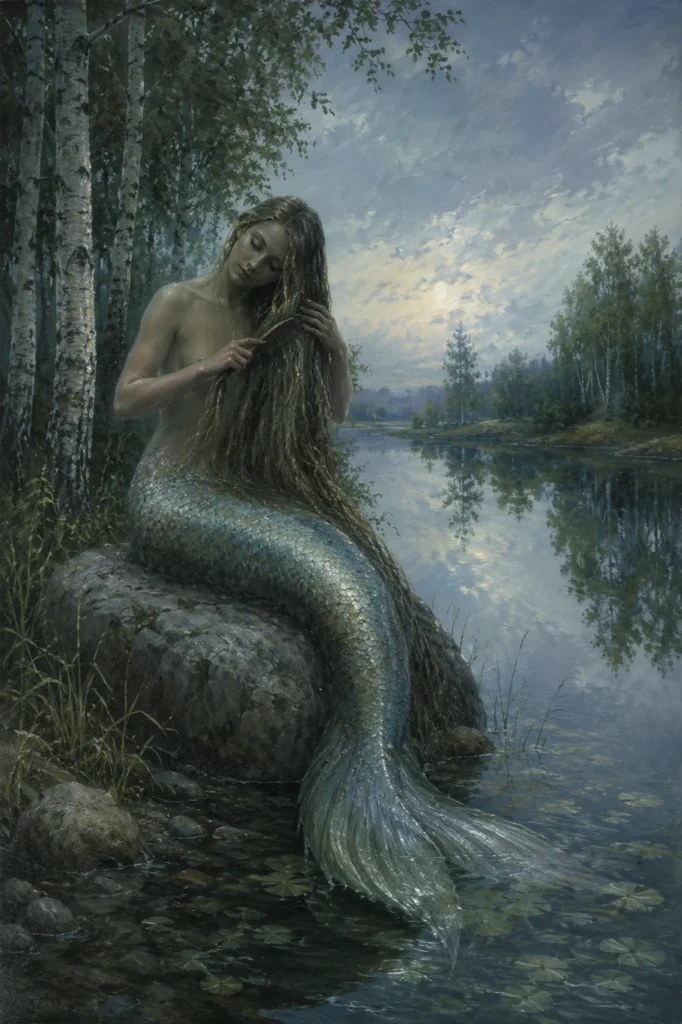
Appearance: Mermaid type with long hair and a fish-like lower body
Source context
Period of the Texts
Ved-ava belongs to Mordvin folk tradition, which is well documented scholarly, and lives on into the present in the modern Erzya epic Mastorava.
Area of Diffusion
Ved-ava is found among the Mordvins, the Erzya and Moksha, in the region of western Russia along the Volga.
Sources
Among the Finno-Ugric water mothers, the source situation for Ved-ava is the most reliable, with its own encyclopaedia entry and scholarly articles such as those by Harva and Sharonov.
Name and variants
Mordvin: ved means water, ava mother: Ved-ava literally means the Water Mother, a name that the Finno-Ugric peoples of the Volga use for their respective mistress of the waters.
Appearance and symbolism
Appearance
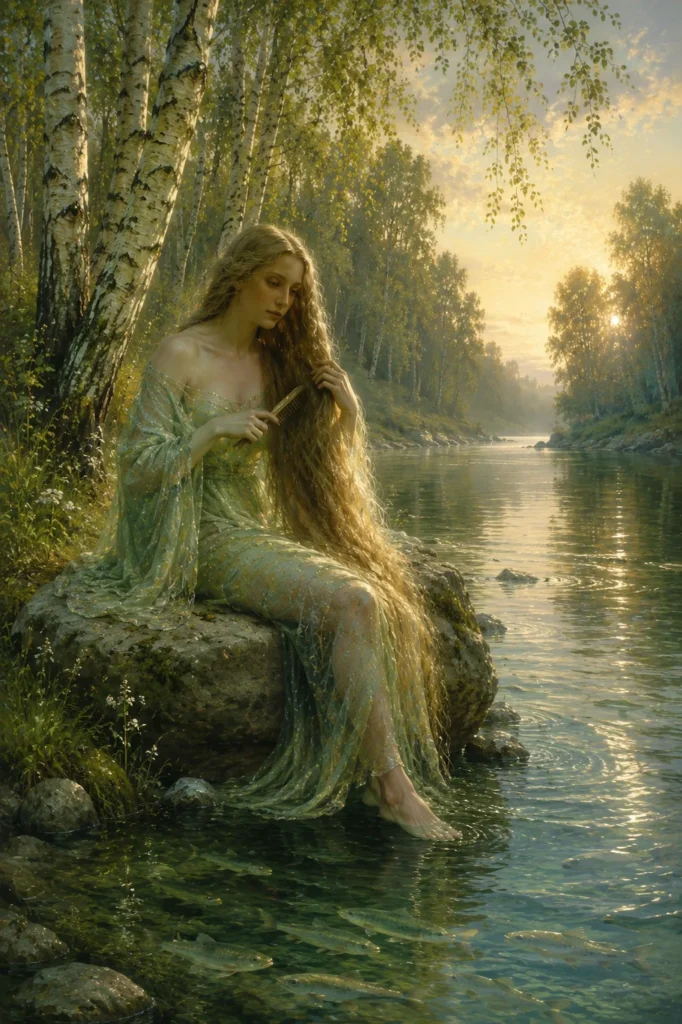
Ved-ava belongs to the mermaid type: long hair, which she is shown combing while sitting on a stone, large breasts and a fish-like lower body with a tail. She sings or plays music and thereby seduces people. Symbolically she stands for the dual nature of water, for fertility and sustenance on the one hand, for death by drowning on the other.
Effect
Ved-ava promotes fertility among people and livestock and determines the success of fishing. Yet her sight foretells misfortune, usually drowning. She is thus ambivalent, a nurturing mistress and a deadly danger at once. Her relationship with people depends on the right conduct, for the fishermen rely on her favour.
Profile: Ved-ava
The key aspects of the Water Mother at a glance.
Water Mother of the Mordvins in the Ava type of Finno-Ugric water deities, attested in Erzya and Moksha narrative material.
Fertility among people and livestock as well as fishing, over which she rules as mistress of the waters.
Mermaid type with long hair, which she combs while sitting on a stone, and a fish-like lower body.
Ambivalent power of water: blessing for catch and fertility, yet her sight usually foretells drowning.
First-catch fish offerings and fishing-related taboos as an expression of the reverent handling of her favour.
Direct sister figure of Vedava (Mari), with whom she shares the Ava type of the Volga-Finnic water mothers.
Water Mother between Mastorpaz and Mastorava
Ved-ava is the Water Mother of the Mordvins, a spirit who rules over the waters and their abundance. The name literally means Water Mother, from Mordvin ved, water, and ava, mother. She is a Finno-Ugric water deity, as found among several Finno-Ugric peoples traditionally dependent on fishing, and corresponds to the Estonian Vete-ema and the Finnish Water Mother. She is interpreted partly as the spirit of a drowned person, partly as a simple personification of water.
In Erzya and Moksha mythology she is woven into narrative material; in a central tale the underworld and earth god Mastorpaz courts the water goddess. The great modern Erzya epic Mastorava collects such material and records Ved-ava as a fixed part of the mythological cast.
Well documented, often wrongly classified
In scholarly literature on Finno-Ugric religion, Ved-ava is the best-known of the Volga-Finnic water mothers and is therefore well documented in encyclopaedias. In the modern Erzya epic Mastorava she is a fixed part of the mythological cast. One clarification is important: some popular websites wrongly classify Ved-ava under Slavic mythology. Correct is the Finno-Ugric, Mordvin classification, evidenced by the Mordvin linguistic root of the name and her integration into Erzya and Moksha narrative material.
In terms of the study of religion, Ved-ava belongs to the class of nature spirits typical of Finno-Ugric cultures dependent on fishing. The interpretation as the spirit of a drowned person or as a personification of water reflects two explanatory models within the study of religion, the ancestor and spirit-of-the-dead model and the nature personification model. The Ava type connects the Mordvins with the other Baltic-Finnic and Volga-Finnic mother figures.
First-catch offerings and fishermen's taboos
Fishermen offered Ved-ava their first catch and observed numerous fishing-related taboos. The first-catch fish offering and the observance of taboos are the well-attested core of the protective practice; she is appeased as a personification of the fishermen’s worries. A worn amulet served as a protective sign for journeys on the water, incense and offering practices formed part of the veneration of the Water Mother, and salt was the old purifying and protective means for dealing with the powers of water. Protection thus lies in reverent, balanced conduct towards the water and its mistress.
Ved-ava among the circle of Water Mothers
Ved-ava is the direct sister figure of Vedava (Mari); both share the Ava type with the Estonian Vete-ema and the Finnish Water Mother. Among the functionally related water mistresses is the Finnish Vellamo, and in the neighbouring Russian tradition the Slavic Rusalka. As a mermaid she stands alongside the Sirens, and as a seductive, deadly water spirit alongside the Germanic Nix.
Frequently asked questions about Ved-ava
Is Ved-ava a goddess or a spirit?
Both, depending on perspective. In encyclopaedias she is listed as a water deity, in folk tradition as a female water spirit and Water Mother, sometimes interpreted as the spirit of a drowned person.
Why is her sight dangerous, even though she grants fertility?
Because she embodies the ambivalent nature of water. Whoever sees her usually faces drowning; whoever honours her properly, through first-catch offerings and taboos, receives catch and blessing.
Is Ved-ava Slavic?
No. She is Finno-Ugric, Mordvin. The Slavic classification found on some websites is an error.
Further links
Further reading:
- Vedava (Mari) – her direct sister figure among the Mari on the Volga
- Vellamo – the Finnish mistress of water as a functionally related water mistress
- Amulet, Smudging, Salt – traditional protective means
- Protection Compass – protective means at a glance
Literature (selection)
Further standard works in the bibliography.
Describing Ved-ava merely as the water mother of the Mordvins falls short: Mordvin mythology knows her as its best-documented water mother, a mistress whose blessing and danger lie in the same gaze.