Vörsa, the forest lord of the Komi hunters
By Ralf Ittermann · last reviewed on
Vörsa is a spirit of Komi tradition.
The forest lord who grants hunting luck and punishes hunting offences.
Vörsa (also spelled Vorsa) is the forest spirit of the Komi in the far north-east of Europe and the local counterpart of the Russian Leshy. He is regarded as lord of the forest, who allots hunting luck and watches over the observance of hunting morality. Among the Komi-Permyaks, the same figure bears the name Voris’.
According to tradition, the sky god En divided forest and water between humans and spirits; humans were allowed to use their share only with the permission of the respective lords. The bear was regarded as the living embodiment of the forest spirit.
Type: forest lord and guardian of hunting morality, master of the animals
Origin: tradition of the Komi (Zyryans and Permyaks) in the north-east of European Russia
Texts: ethnographic records of the 19th and 20th centuries (Nalimov, Sidorov, Konakov)
Period: documented from the second half of the 19th century
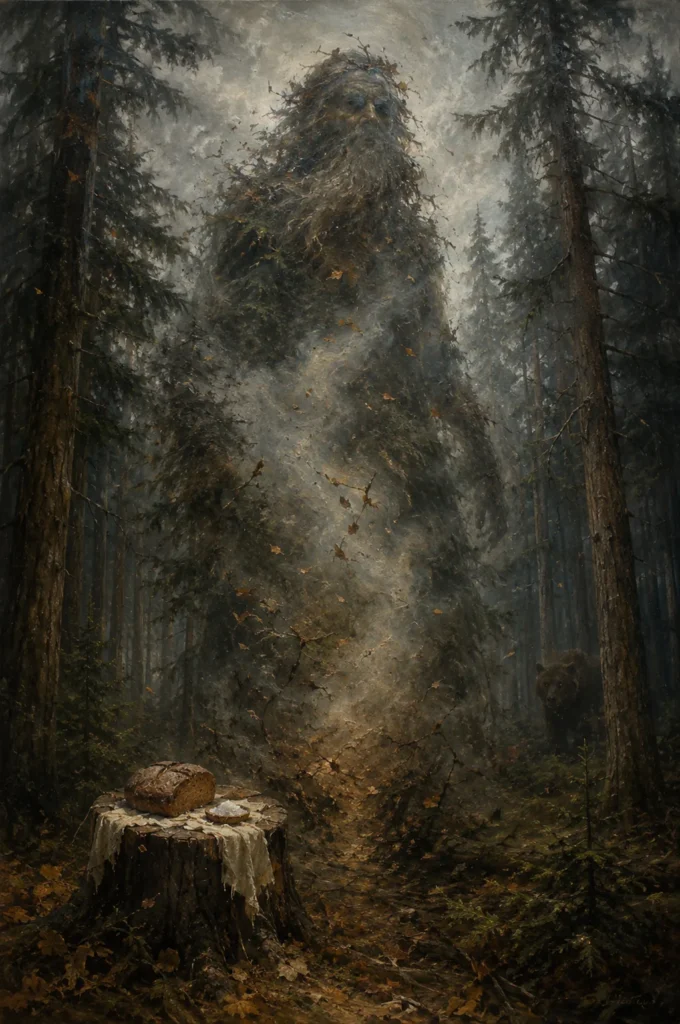
Appearance: invisible, as a whirlwind or as a man; the bear as living embodiment
Source context
Period of the Texts
The figure becomes documented in writing only with the ethnography of the second half of the 19th century (Popov, later Nalimov and Sidorov); the state of research is summarised in the Encyclopedia of Uralic Mythologies (Russian 1999, English 2003).
Area of Diffusion
The Komi settlement areas along the Vychegda and Pechora in the north-east of European Russia, divided into Zyryans and Permyaks.
Sources
Honestly to be described as thin: folkloristic-ethnographic records (Nalimov, Sidorov, Konakov), strongly overlaid by the Russian Leshy tradition.
Name and variants
Komi: Vörsa, derived from vör, forest: the one belonging to the forest. Among the Komi-Permyaks, the same figure is called Voris’. People were reluctant to call the forest lord by name and used circumlocutions such as uncle or old man instead, to avoid unintentionally summoning him.
Description
Appearance
The Komi knew no fixed image. Vörsa could remain invisible, sweep through the forest as a whirlwind or appear as an ordinary man; other accounts give him striking features that set him apart from humans. The bear, the highest-ranking animal of the Komi forest, was regarded as his living embodiment. The formlessness is itself the symbol: the forest as an alien domain never fully reveals itself to humans.
Effect
Vörsa was the guarantor of hunting morality. Whoever broke the rules, for instance by emptying another’s traps or speaking disparagingly of the catch, had their hunting luck withdrawn; the punishment struck success, rarely life or limb. The two Komi groups assessed him differently: among the Zyryans he came close to an evil spirit, while the Permyaks treated their Voris’ with respect and invoked him in times of epidemics.
Profile: Vörsa
The key aspects of the Komi forest lord at a glance.
Forest lord of the Komi within the dualistic worldview of En and Omöl; beneath him a hierarchy of spirit lords of individual animal species.
Hunters, trapmakers and villagers: game is not taken but granted by him, in exchange for gifts and adherence to the rules.
Invisible, as a whirlwind or as a man with striking peculiarities; the bear, the highest-ranking animal of the Komi forest, is regarded as his living embodiment.
Granting and withdrawal of hunting luck, guarding hunting morale; among the Permyaks also health for humans and livestock.
Gifts before the hunting season (furs, bread, salt, tobacco), surrendering the first catch, and reverent, euphemistic speech in the forest.
The pact between hunters and forest lords
The Komi are a Finno-Ugric people on the Vychegda and Pechora rivers; the Zyryans were christianised by Stephen of Perm at the end of the 14th century, the Permyaks in the 15th century. Belief in the spirit lords of nature outlasted the mission by centuries. According to tradition, the sky god En divided the riches of forest and water between humans and spirits; humans received their share only with the consent of the respective lords.
Among the forest lords there was a hierarchy: a supreme forest spirit and, beneath him, spirit lords of individual animal species, such as squirrels or hares. The name Vörsa derives from Komi vör, forest, and denotes the one belonging to the forest. Before the start of the hunting season, gifts were brought to him, said to include furs, bread, salt and tobacco, and the first catch was surrendered to him.
Reception and classification
Beyond the borders of the region, Vörsa became known chiefly through the scholarly encyclopedia of Uralic mythologies. In the Komi Republic, the forest spirit is part of the region’s cultural heritage; illustrators such as Arkadi Moshev shaped his visual image in the 20th century. In popular online bestiaries, Vörsa usually appears as a mere name variant of the Leshy, which only partially does justice to the distinct Komi tradition.
From a religious-studies perspective, Vörsa embodies the north Eurasian type of the master of animals within a pronounced hunting culture: game is not taken but granted, and the spirit safeguards the community’s economic ethic. Notable is the dualistic framing of the Komi worldview with the creator pair En and Omöl. Christianisation shifted the assessment: from the hunters’ contractual partner, he became in many places a demon, whereas Permyak tradition preserved the older, respectful attitude for longer. The dual character of the sources thus reflects the history of religion, not any inconsistency in the being itself.
Gifts, hunting rules and reverent speech
Traditional protection consisted of correct conduct, not banishing spells. This included gifts before the hunting season and surrendering the first catch, observance of hunting rules, and reverent, euphemistic speech in the forest. Anyone wishing to spend the night under a tree asked the tree for permission. Certain trees were regarded by the Komi as warding off spirits, said to include rowan, juniper, willow and alder. Before eating in the forest, the fire was fed with breadcrumbs; the fire was neither to be spat on nor trampled out with feet.
Leshy, Vasa and the lords of life's domains
The closest equivalent is the Russian Leshy, whose image has strongly shaped the Vörsa tradition; in the Baltic region his counterpart is the Estonian forest elder Metsavana. Within the Komi spirit world, Vörsa stands alongside the water spirit Vasa and the bathhouse spirit Pyvsyansa, the counterpart of Bannik; the house spirit Domovoi also belongs to this field of lords of individual life domains. The Mordvin forest mother Vir-ava is the female neighbouring figure on the Volga, but classified differently: she is a deity of a pantheon, whereas Vörsa is a spirit lord of the hunt.
Frequently asked questions about Vörsa
Is Vörsa an evil spirit?
According to the older tradition, no. He is the hunters’ lord and contractual partner, who punishes rule violations with failure and rewards good conduct with game. Only under Christian influence, chiefly among the Zyryans, did he move closer to the devil; the Permyaks even asked their Voris’ for health and protection.
How does Vörsa differ from the Leshy?
Hardly at all in function; both are forest lords with power over game and paths. However, the Komi figure is more strongly embedded in contractual thinking: the god En handed the riches of the forest over to the spirits, and humans receive their share only in exchange for gifts and adherence to the rules.
What role does the bear play?
The bear was regarded as the living embodiment of the forest spirit and as the son of the sky god En, who came down to earth. The hunting of bears was therefore strictly regulated.
Further links
Literature (selection)
Further standard works in the bibliography.
As Komi forest spirit and guardian of hunting morale, Vörsa stands for a way of thinking in which game is granted rather than taken; anyone wishing to understand Komi mythology does best to begin with this quiet contractual partner of hunters.