Metsavana, the forest elder in birch-bark clothing
By Ralf Ittermann · last reviewed on
Metsavana is a spirit of Estonian tradition.
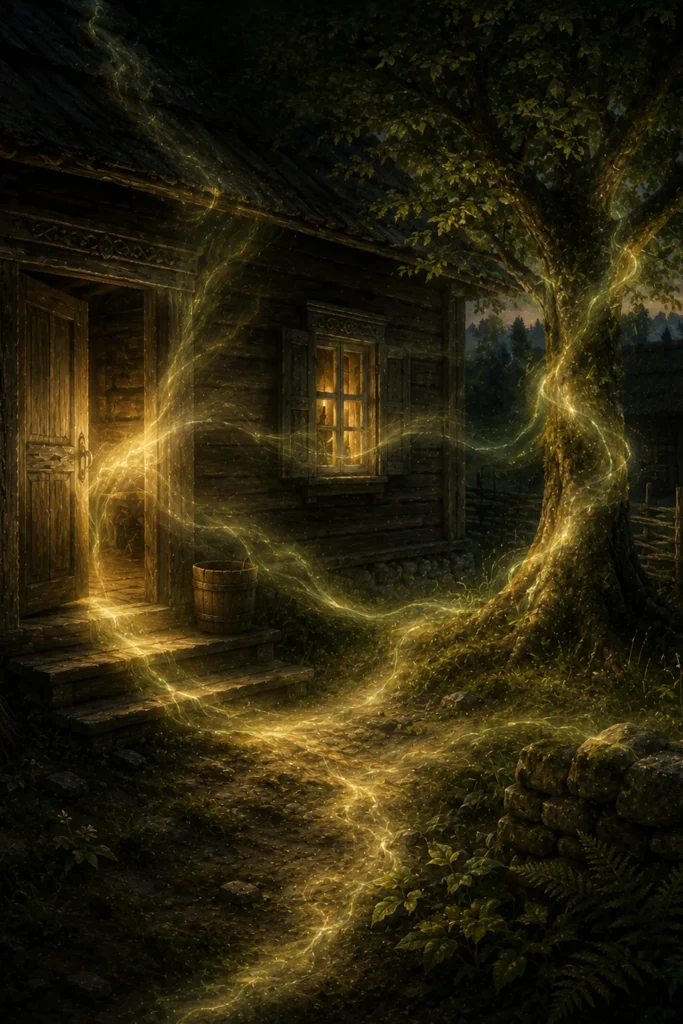
The moss-bearded elder who apportions the hunters their quarry. The entry pictures Metsavana as a moss-bearded elder wrapped in birch-bark clothing, who allots the hunters their quarry.
Metsavana, the forest elder, is in Estonian folk tradition the male lord of a forest. He is also called metsataat or metsaisa, meaning forest father, and appears as a moss-bearded old man who governs the game and apportions the hunters their share.
Anyone who approached him with respect had little to fear; the careless he could lead astray or send home empty-handed. According to folk belief, every forest has its own forest elder.
Type: Male lord of a forest, guardian of wild animals
Origin: Estonia
Texts: folkloristic collections by Kreutzwald, Loorits and Paulson
Period: recorded in the 19th and 20th centuries, isolated attestation 1854
Appearance: tall old man with a moss beard and clothing made of birch material

Traditional context
Period of the Texts
Pre-Christian written sources are lacking; the figure only becomes tangible through the collections of Estonian folklore studies in the 19th and 20th centuries, systematised by Oskar Loorits and Ivar Paulson.
Area of Diffusion
Estonia. Since every forest has its own forest elder, he is a local authority: one always dealt with the lord of precisely that particular tract of forest.
Sources
Thin, predominantly folkloristic collections; in Estonia female forest beings are more frequently attested, yet the forest elder is nonetheless firmly anchored in the narrative tradition.
Name and variants
Estonian: a compound of metsa, forest, and vana, old. The variant forms metsataat and metsaisa emphasise the paternal role. Metsavana belongs to the broad family of Estonian forest beings, which also includes the forest mother Metsaema and the metsahaldjas, the forest guardian spirit.
Appearance and manifestation
Appearance
The records describe Metsavana as a tall old man with a wild, moss-covered beard. His clothing is made of birch material, including a large birch hat and boots of birch bark. The lord of the forest is thus literally made from the substance of his domain and barely distinguishable from it; the fact that he can speak with birds and other animals underscores his position as mediator. He carries no fearsome attributes; his age stands for experience and precedence.
Effect
Metsavana decides how rich the hunters’ spoils will be; hunting luck is his currency. He is regarded as the protective lord of wild animals, among them the bear, wolf, snake and fox. Estonian forest beings show trickster traits: they are considered fundamentally benevolent, yet they tease people who stray from the path or offend against the forest. Getting lost, a lack of quarry and eerie noises were seen as his response to disrespect; lasting harm is scarcely attributed to him.
Profile: Metsavana
The key aspects of the old man of the forest at a glance.
Estonian forest spirit from the family of forest beings around Metsaema and the metsahaldjas; related to the forest lords of the eastern neighbours.
Hunters, forest workers and hikers: whoever enters his domain has to deal with the lord of precisely that forest.
A tall old man with a moss-covered beard, a large birch hat and boots of birch bark, conversing with birds and animals.
He apportions their quarry to hunters and protects the wild animals of his domain; hunting luck is his currency.
Greeting upon entering, asking permission before felling wood or hunting, gifts such as bread and salt left on a tree stump; his name was not called aloud.
The Russian Leshy and the Komi forest spirit Vörsa share his role and behavioural patterns; in Estonia itself, Metsaema is the female counterpart.
The lord of each individual forest
Metsavana belongs to the broad family of Estonian forest beings, which also includes the forest mother Metsaema and the metsahaldjas, the forest guardian spirit. Pre-Christian written sources are lacking; the figure only becomes tangible through the collections of Estonian folklore studies in the 19th and 20th centuries, systematised by Oskar Loorits and Ivar Paulson. In 1854 Friedrich Reinhold Kreutzwald sought to identify the straw figures of the metsiku tegemine custom as embodiments of the forest mother and forest father; Ergo-Hart Västrik showed in 1998 that this naming may in fact go back to Kreutzwald himself.
Notable is the closeness to the forest lords of the eastern neighbours: the Russian Leshy and the Komi forest spirit Vörsa share their role and behavioural patterns with Metsavana, pointing to an old Finno-Ugric-Slavic zone of contact (Löfstedt 1993). On the whole: in Estonia, female forest beings are more frequently attested; the old man of the forest is nonetheless firmly anchored in the narrative tradition.
From legend to cultural heritage
Kreutzwald’s collections and national romanticism turned the old man of the forest into a fixed figure of Estonian cultural heritage. Today he appears in children’s books, in nature tourism and in popular depictions of Estonian mythology; the image of the moss-bearded old man in a birch cloak has remained remarkably stable.
From the perspective of religious studies, Metsavana belongs to the North Eurasian type of the lord of animals: an authority who regulates human access to wildlife and demands hunting morality; in this worldview, quarry is not taken but granted. Important clarifications: within Estonian systematics he stands between a personal deity and a haldjas protective spirit, and folklore studies class him as a forest spirit. The attribution of Kreutzwald’s straw figures to the forest father and forest mother may in fact be Kreutzwald’s own interpretation. And in more recent fantasy, the figure merges into the international figure of the tree being, which overlays the older, considerably more human tradition; the trickster traits of many tales show the typical downgrading of once seriously regarded beings into legend and entertainment.
Greeting, gift and the unspoken name
What has been handed down are rules of conduct, not protective spells in the strict sense. One greeted the forest upon entering and asked permission before felling wood or hunting; small gifts such as bread and salt, or a share of the first quarry, were left on a tree stump. Making noise, cursing and boasting about one’s quarry were considered risky. In the Finno-Ugric world it is also widely attested that forest lords were not called by name but addressed with circumlocutions such as ‘old man’ or ‘uncle’ (Paulson 1965, for the Komi). Anyone who had lost their way turned a piece of clothing inside out or swapped their shoes to find the way home again.
Forest lords between the Baltic Sea and the Volga
The closest equivalent is the Russian Leshy, the forest lord of Slavic folk belief; he too is lord over game and paths and punishes hunting transgressions. In Komi mythology his counterpart is Vörsa, and in Finland the forest lord Tapio of the Kalevala tradition. The female counterpart in Estonia itself is the forest mother Metsaema; in the sources the two appear independently of one another and do not form a fixed divine pair. Functionally comparable as a house lord on a smaller scale is the Slavic Domovoi, whose goodwill likewise depends on respect and gifts.
Frequently asked questions about Metsavana
How do Metsavana and Metsaema differ?
Both are protective lords of the Estonian forest, but with different emphases. The old man of the forest is above all lord of the hunt and of wild animals, while the forest mother stands more for care, protection of herds and the yield of the forest. They do not form a fixed divine pair.
Is Metsavana dangerous?
According to tradition, only to people who behave disrespectfully. He leads mockers and wrongdoers astray or makes their hunt fruitless; fatal attacks are scarcely attributed to him. In the tales, the trait of the strict but fair house lord predominates.
Where does the image of the moss beard come from?
From the folkloric records of the 19th and 20th centuries, which describe the old man of the forest as an elderly man with a moss-covered beard and clothing made of birch material. The motif vividly conveys the fusion of the lord with his domain.
Further links
Literature (selection)
Further standard works in the bibliography.
As an Estonian forest spirit, Metsavana remains the strict but fair house lord of his domain. The figure shows how strongly the forest father has shaped Estonian mythology and narrative tradition: a lord of the forest who looks like the forest itself.