Beaivi: Sun Goddess and Giver of Life in the Sami Religion
By Ralf Ittermann · last reviewed on
Beaivi, also written Beaivvi or in the Northern Sami standard form Beaivi, is the sun as a personified deity of the Sami tradition. She was regarded as the giver of life, mother of the reindeer and a central religious figure, whose veneration Håkan Rydving and Juha Pentikäinen have reconstructed in detail.
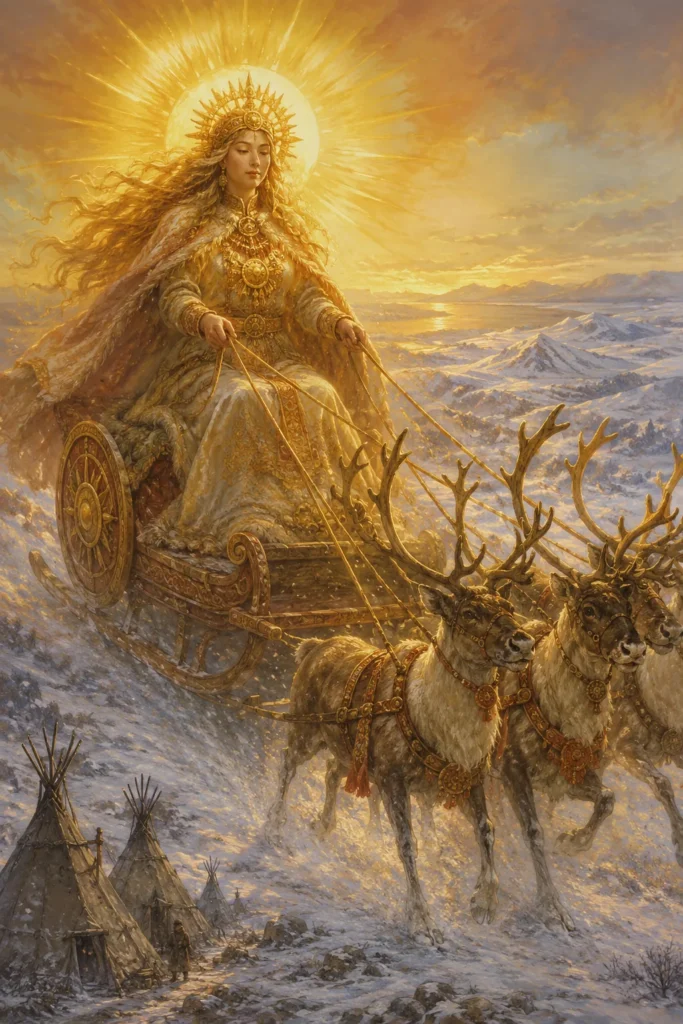
Profile: Beaivi
Beaivi: the most important aspects at a glance. The following fields summarise origin, function, appearance, veneration, symbols and parallels.
Beaivi is the sun as a personalised deity of the pre-Christian Sami religion and is among the most densely attested figures. She is female and regarded as a giver of life and mother of the reindeer. The sources range from drum paintings of the 17th and 18th centuries to records of the 19th century.
Beaivi stands for fertility, reindeer stocks, health and cosmological order. Her rays warm the land and make grow the moss the reindeer need. In some traditions she was invoked to preserve one’s sanity.
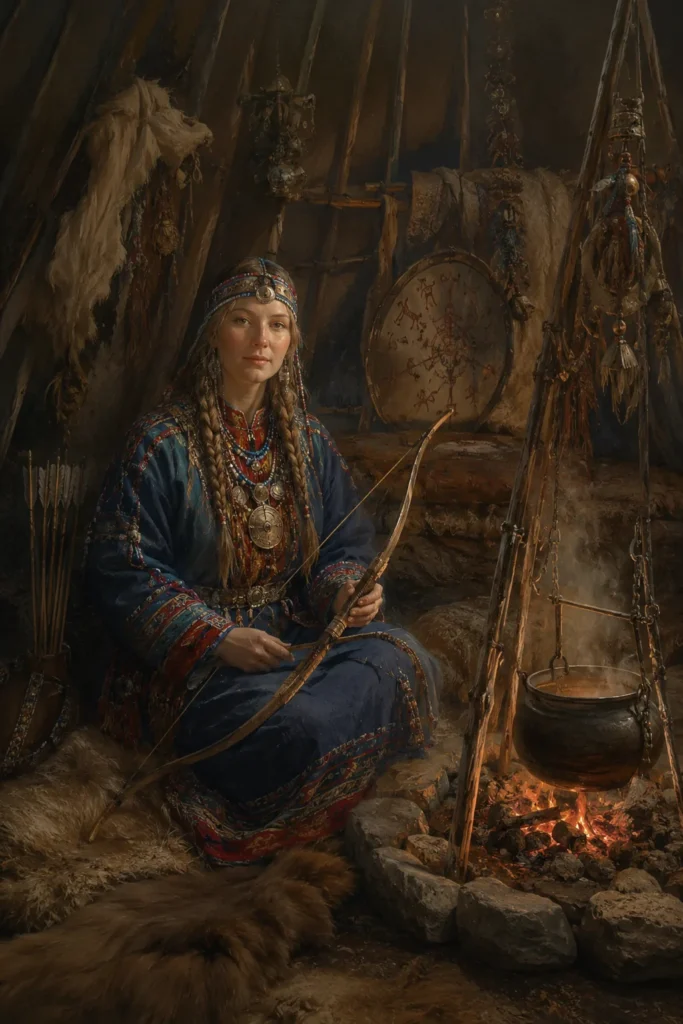
The sources describe Beaivi as a kind mother who is conceived as the sun itself and sends out her rays like arms or legs. On the shaman drums, the goavddis or gievrie, she is often depicted as a central wheel or cross in the upper area.
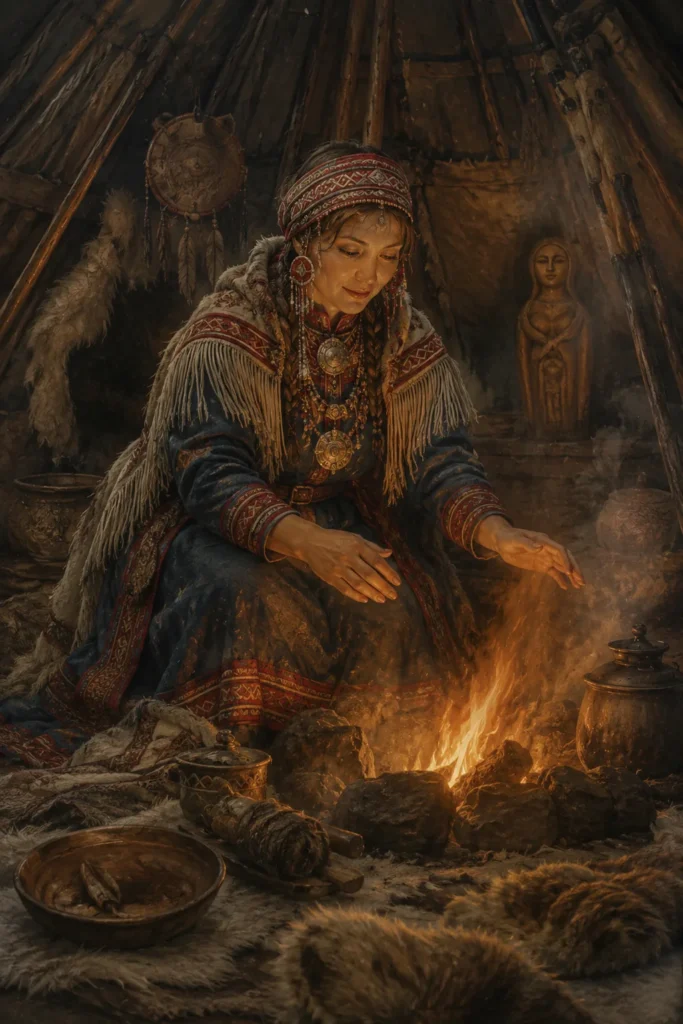
The main festival was tied to the solstice. On midsummer night Beaivi was honoured with offerings, in some regions with white or light-coloured reindeer, in others with dairy products and butter. Shamans, the noaidi, invoked the sun in trance, and offerings were made at holy stones, the sieidi.
Associated with Beaivi are the reindeer, white or light-coloured sacrificial animals, dairy products and butter, and the moss of the summer meadows. On the drums she is represented by a wheel or cross. At the winter solstice, plaited rings of twigs played a role, associated with the returning sun.
Comparable are female solar deities such as the Germanic Sól, the Baltic Saulė, Päivätär, the Japanese Amaterasu, the Nenets Khaer and the Inuit sun goddess Malina. Unlike Helios, the northern female sun emphasises more strongly the life-giving, fertility-related function.
Overview and Short Profile
Beaivi is the central light deity in the Sami religious universe and is among the most richly documented figures of the pre-Christian Sami religion.
Unlike many Mediterranean sun cults, Beaivi is female, which places her within the broad circumpolar and Northern European tradition of female sun deities. In terms of religious studies, she shares the same gender assignment as the Germanic Sól, the Baltic Saulė and the Japanese Amaterasu.
The sources for Beaivi are richer than for many other Sami deities.
They include the shamanic drum paintings of the 17th and 18th centuries, the accounts of the scholar Johannes Schefferus and of the Lutheran missionaries Knud Leem and Jens Kildal, as well as the ethnographic records of Lars Levi Læstadius from the 19th century. This breadth of sources makes Beaivi well accessible to religious studies.
From a religious-studies perspective, Beaivi is not merely an astronomical phenomenon but a comprehensive deity of life. She stands for fertility, the reindeer stock, health and cosmological order. This functional breadth is typical, in terms of religious phenomenology, of Arctic sun goddesses, whose significance is tied to the vitally important polar-day and polar-night dichotomy.
The sun goddess Beaivi in particular shows how much more sharply recent scholarship has honed its methods: ethnographic precision, critical examination of the linguistic tradition and the comparative perspective now interlock.
Sami scholars themselves play an essential role in this, examining older Western interpretations of Beaivi and correcting them where they were colored by colonial patterns of thought.
As a female sun deity, Beaivi fits into a circumpolar religious topography that remains remarkably uniform across the entire Arctic region. That such structures remain stable over thousands of kilometers is regarded by comparative religious studies as one of its most striking findings, and it is still discussed controversially today.
Name and Etymology
The name Beaivi belongs to the basic Sami vocabulary and denotes both the sun as a celestial body and as a deity.
Dialectal variants are biejjie in the Southern Sami area, päivi in Inari Sami, päiʹvv in Skolt Sami. This variety corresponds to the dialectal differentiation of Sami, which consists of several mutually only partially intelligible language varieties.
Etymologically, Beaivi belongs to the Uralic sun root, which also appears in the Finnish päivä, the Estonian päev and in more distant relatives of this Uralic language family.
From a religious-studies viewpoint, this linguistic-historical depth is notable because it points to a very old layer of religious concept formation, reaching back at least to the Proto-Uralic period.
In religious usage, the honorific form Beaivvi-Áhčči or Beaivvi-Eadni often appears, literally Sun Father or Sun Mother, depending on regional gender assignment. The dual presence of both forms in different regions is instructive for religious studies and points to a flexible gender assignment of the sun.
From the perspective of religious sociology, one may ask what role Beaivi played within the fabric of the traditional Sami community. Since the sun cult was bound up with the reindeer stock, health and the rhythm of polar day and polar night, the religious here was never separated from everyday life.
This close interweaving forms a distinct field of religious anthropology, which Håkan Rydving and Konsta Kaikkonen in particular have worked through systematically.
There is also the present-day significance of Beaivi for Sami identity politics. With the expansion of Sami self-government and the recognition of indigenous rights under international law, figures such as the sun goddess are again entering public consciousness more strongly.
How religious research and political self-assertion interact in this is a field of its own, to which scholarship has recently devoted considerably more attention.
Description and Iconography
In the ethnographic sources Beaivi is described as a benevolent, life-giving mother whose rays warm the land and make the reindeer thrive. As a rule she is not described as an anthropomorphic figure but as the sun itself, which sends out its rays like arms or legs in all directions.
Iconographically, Beaivi is frequently depicted on the Sami shaman drums, the goavddis or gievrie, in the upper half as a central wheel or cross.
The famous studies of the drum images by Ernst Manker in the 20th century have shown that Beaivi is present on nearly every surviving drum and is usually placed in the center or upper part of the upper register of reality.
This iconographic centrality corresponds to her theological significance. For religious studies, drum iconography is one of the most important sources for the Sami religion, because it derives from the pre-Christian tradition itself and is not shaped by missionary filters.
It supplements the written accounts with an indigenous visual source, which is especially valuable in methodological terms.
Beaivi and Reindeer Herding
Beaivi’s central economic significance lay in her relationship to reindeer herding. Beaivi was the guarantor of the summer meadows where the reindeer herds grazed, and her rays made the moss grow that the reindeer needed. The reciprocity between Beaivi and the Sami reindeer herders was fundamental in terms of religious economy.
The great summer festival, which in many regions was connected with midsummer night, honored Beaivi with offerings.
In some regions white or light-colored reindeer were sacrificed, in others milk products and butter. These sacrificial practices are documented in detail in the accounts of the Lutheran missionaries, though often in pejoratively colored language.
For religious studies, the interlocking of sun and reindeer herding is a paradigmatic case of ecologically anchored theology, comparable to the interlocking of Sedna and sea animals among the Inuit. Religion was not an abstract belief system but a direct regulation of subsistence practice through sacred reciprocity.
Sun Festival and Midsummer
Beaivi’s main festival was bound to the solstice. On midsummer night, when the sun does not set in the northern Sami areas, Beaivi was especially honored. The winter solstice, too, when the sun returns after the long polar night, was a religiously charged moment.
Shamans, called noaidi in Sami, could invoke the sun in trance and ask for warmth. The cultic practice was carried out at sacred stones, sieidi, where offerings were presented. This sieidi practice is well documented in religious ethnology and is one of the most important components of the pre-Christian Sami religion.
The rivalry with Christian festal semantics was noticed by the missionaries and led to targeted bans on the sun festivals. For religious studies, this history of conflict is a field of its own and an example of the religious-political disputes of the Northern European mission.
Beaivi and Sara-Akka
In pre-Christian Sami theology, Beaivi is closely connected with the family of the Akkas. The birth goddess Sara-Akka in particular is regarded in Sami tradition as a daughter of the primal mother Máttaráhkká, not of the sun Beaivi.
Sun and birth are theologically closely linked in the Sami tradition, because the newborn child arrives in the light and is committed to the principle of light.
For religious studies, this interweaving of sun and birth is a phenomenon in its own right, attested several times in circumpolar religion. The Inuit sun goddess Malina has similar functions in the sphere of women’s practice. These structural correspondences are instructive in terms of religious phenomenology.
The relationship between Beaivi and the Akkas is accentuated differently from region to region. In some regions Beaivi is the mother of all the Akkas, in others an independent figure who stands in a cooperative but not genealogical relationship with the Akkas.
This variation cannot be resolved by religious studies but is to be respected as a regional peculiarity.
Beaivi in Circumpolar Comparison
Beaivi belongs to the broad class of female sun deities of the circumpolar and Northern European region. Structurally comparable are the Germanic Sól, the Baltic Saulė, the Finno-Ugric Päivätär, the Japanese Amaterasu, the Nenets Khaer and the Inuit sun goddess Malina. This gender assignment of the sun forms a distinct region in religious phenomenology.
Unlike the Greek Helios-Sol tradition, the northern female sun emphasizes the astronomical-cosmological aspect less and the life-giving, fertility-related function more. In religious phenomenology this corresponds to a mother theology, which is widespread in the Northern European tradition and differs from Mediterranean father-sun conceptions.
The history-of-religions debate about the genesis of this layer is old and not conclusively settled. While Marija Gimbutas postulated a pan-Eurasian mother-goddess layer, current scholarship is more cautious and points to structural correspondences without necessary historical mediation.
Christian Mission and Suppression
The Christian mission among the Sami began in the Middle Ages but intensified in the 17th and 18th centuries under the Swedish crown, to which Finland also belonged, and the joint crown of Denmark and Norway. Lutheran missionaries such as Thomas von Westen, Knud Leem and especially Lars Levi Læstadius in the 19th century took a hard line against the pre-Christian Sami religion.
Beaivi was in part reinterpreted in Christian terms as Mary, the mother of light, and in part persecuted as a pagan idol. Shaman drums were publicly burned, sieidi stones destroyed, shamanic practices criminalized. This repression largely displaced the pre-Christian religion from the public sphere without eliminating it entirely.
For religious studies, this missionary history is a field of its own, which has been reworked in recent decades from a postcolonial perspective. The present-day Sami cultural revitalization partly invokes Beaivi and other pre-Christian figures without claiming an unbroken continuity.
Present-Day Reception and Research
Religious-studies research on Beaivi is broadly based today. Håkan Rydving’s The End of Drum-Time (1993) and his later works have placed the Sami religion on a new methodological footing. Juha Pentikäinen, Anna Lia Berthelsen and Konsta Kaikkonen have investigated further aspects.
In contemporary Sami culture, Beaivi is present in art, literature and music. Joik chants take her up, artists such as Britta Marakatt-Labba have given her visual form. This cultural renaissance is a significant contribution, in terms of religious phenomenology, to making the tradition visible.
The institutional recognition of the Sami religion is largely given today. Beaivi is taught in Sami schools and is part of the academic curricula in Tromsø, Umeå and Helsinki. In terms of religious studies, Beaivi research is in a phase of productive reassessment.
Lexicon Cross-References
Beaivi connects with Mánnu, Ráhka, Stallo, Sara-Akka, Uksakka, Juksakka, Madderakka, Jabmiidaibmu and Saivo. The culture hub Sami tradition frames the solar theology. Comparable sun goddesses are found in the Inuit series of entries under Malina.
Beaivi in the Sami Annual Cycle and the Winter Solstice Offering
Beaivi, the sun, held a prominent position in the pre-Christian Sami religion, which is explained by the living conditions of the far north.
In the winter months, the sun disappears entirely across large parts of the Sami settlement area or rises only just above the horizon. Its return in spring was therefore not a matter of course but an event of existential significance.
Early modern sources, above all accounts by missionaries and officials of the 17th and 18th centuries, record that the Sami made an offering to Beaivi at the time of the winter solstice.
Among other things, the presentation of female animals is mentioned, as well as a custom in which braided rings of twigs played a role, associated with the returning sun. These accounts must be read with caution, because their authors described the Sami religion from the outside and often with the aim of conversion.
Beaivi was regarded as the giver of light, warmth and thus of fertility, both for the reindeer herds and for the plants on which they feed. The idea of mental health was also associated with the sun; in some traditions she was invoked to preserve the mind.
The most important early sources, such as the writings of Johannes Schefferus, whose work Lapponia appeared in 1673, as well as later missionary records, have been intensively analyzed in scholarship. They show Beaivi as a central figure of a faith closely bound to the extreme annual cycle of the polar region.
The Sun on the Sami Magic Drums
The most important surviving pictorial testimonies of the pre-Christian Sami religion are the magic drums, designated in the Sami language as goavddis or by related terms.
These drums were used by the religious specialist, the noaidi, to enter trance or to interpret omens through the movement of a pointer across the painted drumhead. On the membrane of many drums the sun is depicted, often as a central motif.
The sun sign typically appears as a rhombus or square with four rays pointing in the four cardinal directions. The sun is often placed in the center of the drum, with other figures, deities, animals, landscapes arranged around it or along its rays.
This central position is interpreted in scholarship as an expression of Beaivi’s significance for the entire worldview, with the sun ordering and structuring space.
Most of the surviving drums were confiscated by missionaries and authorities in the 17th and 18th centuries and ended up in European collections; many were also destroyed.
Their study is associated with the name of Ernst Manker, who in the mid-20th century documented a comprehensive corpus of the known drums and systematically recorded their pictorial motifs.
The interpretation of the individual figures remains difficult, because the knowledge of their precise meaning was largely lost with the last noaidi, and the written explanations often come from ecclesiastical outsiders.
The drums are nonetheless indispensable, because they are the only extensive pictorial self-testimonies of the old Sami religion, and Beaivi occupies a visibly central place within them.
Source Criticism of the Sami Sun Religion
The study of Beaivi faces a fundamental methodological problem: there are no written self-testimonies of the pre-Christian Sami religion.
The Sami long had no written tradition of their own, and their faith was described almost exclusively from the outside, by Christian missionaries, by clergymen, by state officials. These authors had their own premises and aims, often the suppression of what they understood as paganism.
This has a direct effect on the image of Beaivi. The early accounts frequently ordered the Sami deities on the model of Greco-Roman mythology or according to Christian categories, and may thereby have created a more systematic pantheon than the lived religion actually knew.
The names and responsibilities of the deities also vary considerably between the sources and between the various Sami regions. Sami culture was never uniform; it encompassed several languages and different ways of life, from coastal fishing to reindeer nomadism.
Recent scholarship, such as the work of Håkan Rydving and others, therefore stresses the need for rigorous source criticism. In studies of religious change among the Sami, Rydving has shown how strongly the transmitted accounts are shaped by the perspective of missionization.
For Beaivi this means that the central role of the sun in Sami faith is well attested, through the drums, through concurring accounts and through the comprehensible logic of the polar annual cycle, but that many details of the cult and of the conceptions remain uncertain.
Anyone writing about Beaivi must name these limits of knowledge openly.
Literature (Selection)
- Håkan Rydving: The End of Drum-Time. Religious Change Among the Lule Saami, 1670s-1740s (Uppsala 1993)
- Juha Pentikäinen: Saamelaiset. Pohjoisen kansan mytologia (Helsinki 1995)
- Ernst Manker: Die Lappische Zaubertrommel (Stockholm 1938-1950)
- Johannes Schefferus: Lapponia (Frankfurt 1673)
- Lars Levi Læstadius: Fragmenter i lappska mythologien (Manuscript ca. 1840)
- Veli-Pekka Lehtola: The Sami People. Traditions in Transition (Fairbanks 2004)
Related key terms: Beaivi Päivi Peivve Sami sun goddess Goavddis Sieidi Noaidi midsummer.
iWell Guard and Protective Traditions
iWell Guard draws on the cultural-historical tradition of wearable protective objects, in the tradition of the Sami and many other cultures worldwide. 41 layers, solid gold, platinum, silver, made in Germany. 30-day right of return.
Personal experiences may vary. Not a medical device. No healing claim.