Mánnu - Moon God and Companion of the Nocturnal Hours in Sámi Religion
By Ralf Ittermann · last reviewed on
Mánnu, known in some dialects as Aski or Manno, is the personified form of the moon in Sámi religion.
In a complementary relationship with Beaivi, the sun goddess, he structures the nocturnal cycle of time and the lunar-cycle calendars of the Sámi. From a religious-studies perspective, he belongs to the broad class of circumpolar moon gods with his own regional specificity.
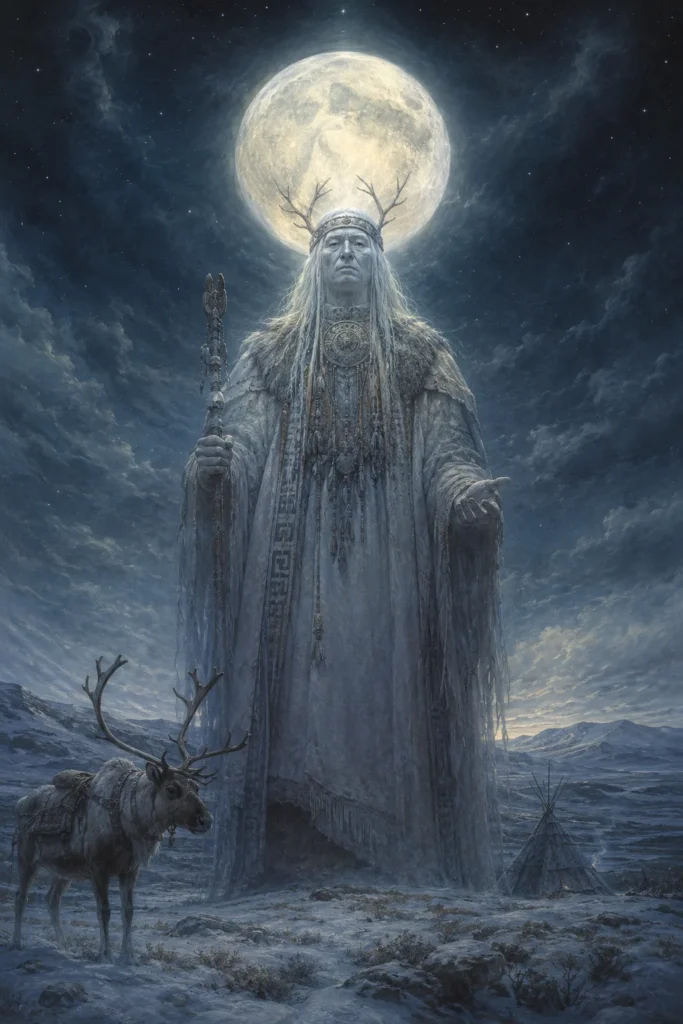
Mánnu, the moon god of the Sámi, acts as the Guardian of the Night over sleep, dreams, and nocturnal protective practice.
Classification and Brief Profile
Mánnu is the moon in personified male form, corresponding to the female sun Beaivi. This gender distribution is instructive from a religious-studies perspective, as it corresponds to the circumpolar and northern European configuration in which the sun is mostly female and the moon male.
In the religious hierarchy of the Sámi, Mánnu stands somewhat below Beaivi, but has his own functions not covered by her. While Beaivi shapes the summer day and the reindeer summer season, Mánnu is associated with the night, winter, female physiology, and the lunar-cycle calendar.
The sources on Mánnu are less abundant than those on Beaivi. The drum iconography usually depicts him as a smaller disc beside Beaivi, and the missionary reports mention him more briefly than the sun goddess.
This asymmetry of source material is phenomenologically typical of Arctic and subarctic religions, in which the sun as life-giver takes priority.
The moon god Mánnu has also been examined in recent decades with an expanded methodological toolkit that combines ethnographic care, source criticism of the linguistic tradition and comparative classification. The Sámi knowledge community actively participates in this research today and revises earlier Western attributions, which in some cases reflected colonial perspectives.
As a male moon alongside the female sun, Mánnu fits into the recurring pattern of circumpolar religious topography. The fact that this pattern retains its basic structure across thousands of kilometres is counted by comparative religious studies among its most remarkable observations, the interpretation of which remains openly debated.
Name and Etymology
The name Mánnu belongs to the Uralic core vocabulary for the moon, which also includes the Finnish kuu, the Estonian kuu, and the Hungarian hold. The variant Aski occurs in the Southern Sámi region and appears to represent an independent linguistic layer. Manno is a grammatically declined form in Inari Sámi usage.
Etymologically, the Uralic root points to a very ancient layer of religious concept formation. The moon as a timekeeper has been personified in the Uralic cultural sphere for millennia. This depth of linguistic history is instructive from a religious-studies perspective.
In religious usage, the honorific form Mánnu-Áhčči frequently appears, literally Moon-Father, which linguistically cements the gender assignment. The father designation is phenomenologically a distinct phenomenon and distinguishes Mánnu from the mother connotation of Beaivi.
From a sociology-of-religion perspective, one must ask what role Mánnu played in the order of traditional Sámi society. Since the moon as timekeeper structured winter, night, and the lunar calendar, its religious significance was directly linked to lived everyday practice.
This intertwining of belief and social life constitutes its own religious-anthropological field of research, systematically explored in particular by Håkan Rydving and Konsta Kaikkonen.
A further dimension concerns the contemporary role of the moon god in Sámi identity politics. In the course of Sámi self-governance and the international legal recognition of indigenous rights, transmitted figures such as Mánnu are regaining visibility.
The interplay between religious research and political recognition forms an independent field of inquiry that has received increasing attention in recent years.
Description and Iconography
Mánnu is described in the sources as a settled, calm moon that governs the night and the winter months. In contrast to the radiant Beaivi, Mánnu is a cooler, quieter power that casts the land into the moonlit half-light of the Arctic winter nights.
On the shamanic drums, the goavddis, Mánnu is usually depicted as a crescent or smaller disc beside Beaivi. Ernst Manker, in his studies of the drum imagery, showed that Mánnu appears explicitly on roughly one third of the preserved drums, often in spatial proximity to Beaivi.
Visual depictions from the pre-Christian tradition are rare. In contemporary Sámi art, Mánnu is present, often in combination with Beaivi as a complementary dyad. This diptych representation is phenomenologically a distinct phenomenon and points to the paired structuring of Sámi celestial mythology.
Lunar Cycle and Calendar
Mánnu is the primary timekeeper of the Sámi lunar calendar. The months had their own names, usually alluding to hunting, climatic, or pastoral phenomena: the reindeer calving month, the thaw month, the mosquito month, the caribou month. These designations are well documented in Swedish and Norwegian ethnographic records.
The lunar cycle also structured women’s lives. Menstruation was connected religiously to the lunar cycle, without any direct mechanical causality being postulated. From a phenomenological perspective, this intertwining is a distinct constellation, attested in many religions worldwide.
For reindeer husbandry, the lunar calendar was less important than the solar calendar, since reindeer movements were primarily determined by the position of the sun and the phases of vegetation. This hierarchy of calendars is a distinct phenomenon from a religio-economic perspective.
Mánnu in Women's Practice
Young women and pregnant women had particular connections to Mánnu. In some regions, warnings were given against gazing at the moon for too long, as this could disturb the child in the womb. This idea is phenomenologically typical of moon gods with a fertility connection.
Apotropaic practices against unfavourable lunar influences included wearing certain amulets, observing moon taboos during pregnancy, and speaking ritual words at the first sighting of a new crescent moon. These practices are well documented ethnographically.
From a religious-studies perspective, the intertwining of moon, the female body, and fertility is a comparatively fruitful phenomenon. It is found in numerous religions and is not specific to the Sámi. The Sámi specificity lies in the personification as the male Mánnu, in contrast to the female moon goddesses of many other traditions.
Shamanic Practice and Mánnu
The noaidi, the Sámi shamans, counted Mánnu among several addressees. During weather forecasting, on journeys during the polar night, and in certain healing rituals, Mánnu could be invoked. Trance practice was bound to the drum, whose imagery visualised the pathways of invocation.
Concrete invocation practices are documented in the accounts of Schefferus and the later missionaries. The noaidi beat the drum, sang the joik-invocation and, in trance, allowed his soul to travel to the moon. These shamanic journeys were less dramatic than journeys to the powers of the underworld, but are phenomenologically distinct.
In comparison to the Inuit tradition, in which the shaman‘s moon journey is well documented (see Igaluk), the Sámi moon journey is described in less detail. This asymmetry of the tradition must be methodologically reflected upon.
Mánnu and the Night
Mánnu is not only the moon, but also the personified ruler of the night. In the Arctic world, the night is not a trivial time but a distinct religious sphere, in which certain spirits become active and a particular taboo system applies.
Certain activities were forbidden at night, such as speaking loudly, carving sharp tools, or singing certain joiks. These taboos were connected to Mánnu and were intended not to disturb or offend him.
In the polar winter, when night persists for weeks, Mánnu was a constant presence. From a phenomenological perspective, this existential depth of the night in Arctic religion is a distinct phenomenon and makes Mánnu a more significant figure than in temperate religions.
Comparison with Other Moon Gods
Mánnu belongs to the class of male moon gods widespread in the northern European, Baltic, and Uralic traditions. Structurally comparable are the Germanic Máni, the Baltic Meness, the Finnish Kuu-Ukko, and the Inuit moon god Igaluk.
This gender assignment of male-moon / female-sun is not coincidental, but constitutes a distinct phenomenological region. The religio-historical discussion about the genesis of this layer is long-standing and has not been conclusively resolved.
Unlike the Inuit Igaluk, who shares an incestuous myth with his sun-sister, the Sámi Mánnu-Beaivi constellation features no comparably dramatic myth. This difference is instructive from a phenomenological standpoint.
Mission and Displacement
Christian mission attacked Mánnu less than Beaivi, because his function as a lunar timekeeper did not directly conflict with Christian teaching. Nevertheless, the ritual invocation of Mánnu was suppressed by the mission.
In the contemporary Sámi cultural revitalisation, Mánnu is less visible than Beaivi, but appears in joik texts, Sámi literature, and the visual arts. The religious-studies reappraisal of Mánnu is ongoing.
Concrete research gaps remain in the precise regional differentiation of Mánnu and in his relationship to other male deities of the Sámi tradition. These gaps should be addressed in further research.
Lexicon Cross-References
Mánnu connects with Beaivi, Ráhka, Stallo, Sara-Akka, Uksakka, Juksakka, Madderakka, Jabmiidaibmu, and Saivo. The culture hub Sámi Tradition frames the lunar theology. Comparable moon gods are found in the Inuit lemma series under Igaluk.
Moon and Timekeeping in the Sámi Annual Cycle
Männu is the Sámi word for the moon, and the ideas associated with it can only be understood in the context of Sámi timekeeping.
Unlike societies with arable farming, the year of the reindeer-herding and hunting Sámi groups was oriented around animal migrations, light, and lunar phases. The moon offered one of the few reliable time markers during the long, sun-scarce polar night of the north.
The Sámi month names, insofar as they are known from later records, refer to concrete events in nature and in reindeer husbandry, such as the calving of young animals, the rut, or particular snow conditions.
The lunar cycle thus structured not an abstract calendar order but a practical sequence of activities. Researchers have pointed out that the personification of the moon as Männu cannot be separated from this function: a celestial figure embodying the change of light is simultaneously a principle of order for everyday life.
How far Männu was regarded as an independently venerated figure and how far the term simply designates the celestial object is difficult to distinguish from the sources. The recorders of the 17th and 18th centuries tended to interpret every celestial phenomenon immediately as a deity, because they expected a complete pantheon.
What is certain is only that the moon held a prominent position in the Sámi perception. Whether dedicated offerings were made to him varies regionally and is not consistently attested. The moon’s connection to timekeeping remains the best-secured aspect of the tradition.
Sun and Moon as an Opposing Pair in Drum Cosmology
On many Sámi magic drums, sun and moon appear together, often in the middle or upper area of the membrane. The sun, Sámi beaivi or related forms, is frequently depicted as a diamond-shaped figure with radiating lines or arms, in whose fields further signs are placed.
The moon usually stands as a separate, smaller figure beside it. This pairing suggests that the two celestial bodies were conceived in Sámi cosmology as a complementary counterpart.
The precise meaning of this pair cannot be read from the drums alone. The contemporary annotations of the recorders are, as with the drum tradition as a whole, imposed from the outside and are not uniform.
Some interpreters assigned the sun a superior, life-giving role and saw the moon as a subordinate force of night and the dark season. Whether this hierarchy actually corresponded to the Sámi conception or represents a projection of European ordering ideas remains open.
What is certain is that Sámi religion was strongly connected to the observation of the sky and that sun and moon are among the few figures that recur on drums from different regions. For Männu, this means a relative stability of tradition compared to more local figures.
Even here, however, it remains true that the visual material gives no direct access to myths or rites. It shows a place in the cosmological structure, not a narrated biography. Current research therefore treats the drum figures as structural testimonies rather than illustrated mythology.
Literature (Selected)
- Håkan Rydving: The End of Drum-Time (Uppsala 1993)
- Juha Pentikäinen: Saamelaiset. Pohjoisen kansan mytologia (Helsinki 1995)
- Ernst Manker: Die Lappische Zaubertrommel (Stockholm 1938-1950)
- Johannes Schefferus: Lapponia (Frankfurt 1673)
- Knud Leem: Beskrivelse over Finmarkens Lapper (Kopenhagen 1767)
Mánnu appears in Sámi religion as the moon god and companion of the nocturnal hours, who was at the same time understood as the guardian of travellers, herders, and wayfarers during the long polar winter.
Accounts from the 17th and 18th centuries connect him with pregnancy, fertility, and timekeeping. On shamanic drums he is occasionally depicted as a moon disc beside the sun symbol Beaivi.
Related key terms: Mánnu Aski Manno Sámi moon god lunar cycle drum goavddis noaidi.
iWell Guard and Protective Traditions
iWell Guard draws on the cultural-historical tradition of wearable protective objects, in the tradition of Sámi and many other cultures worldwide. 41 levels, real gold, platinum, silver, crafted in Germany. 30-day return policy.
Personal experiences may vary. Not a medical device. No healing promises.