iWell Guard

Sara-Akka - Birth Goddess and Guardian of Pregnancy in Sámi Religion

Sara-Akka, also written Sarakka, is the birth goddess of Sámi religion. She belongs to the triad of Akka goddesses Madderakka, Juksakka and Uksakka and is one of the most densely attested female deities in the pre-Christian Sámi tradition.

Household GoddessSámiGuardian of Birth and Pregnancy

Table of Contents

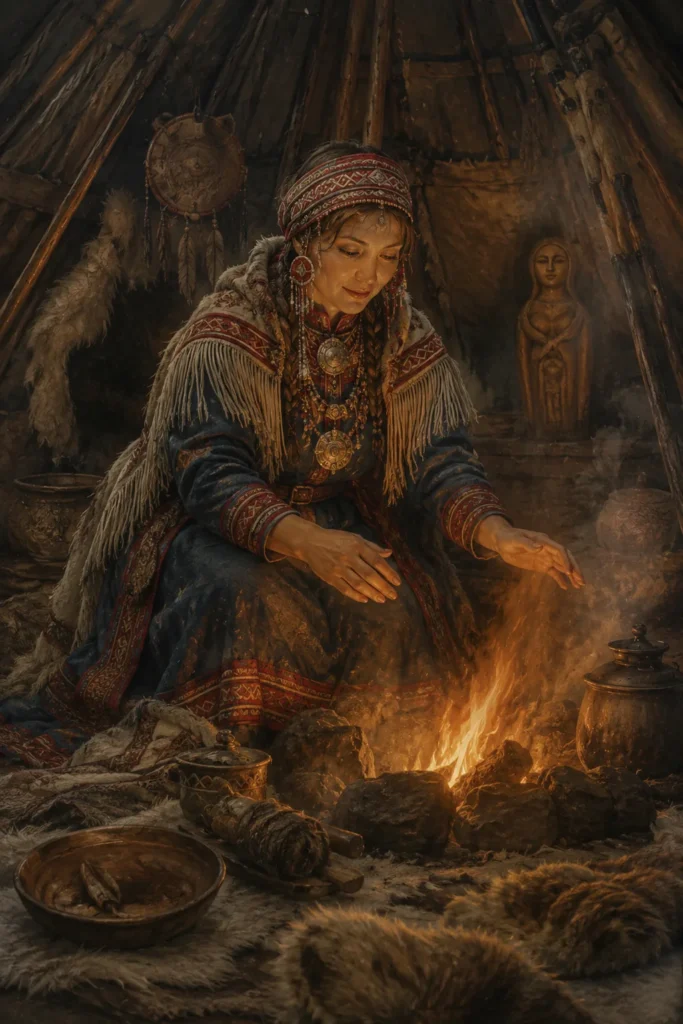
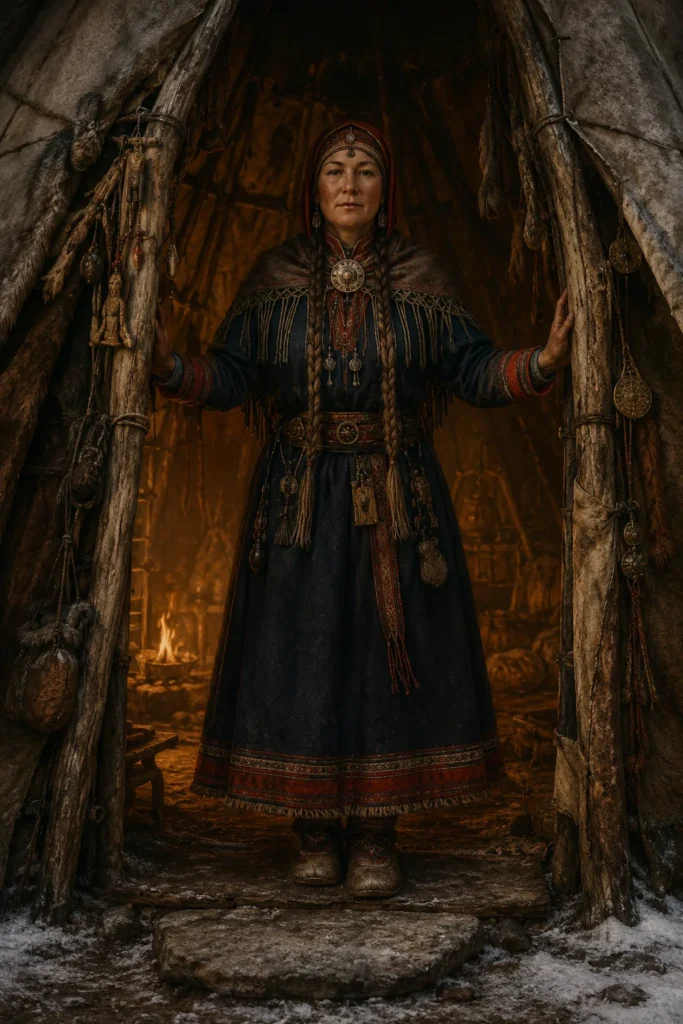
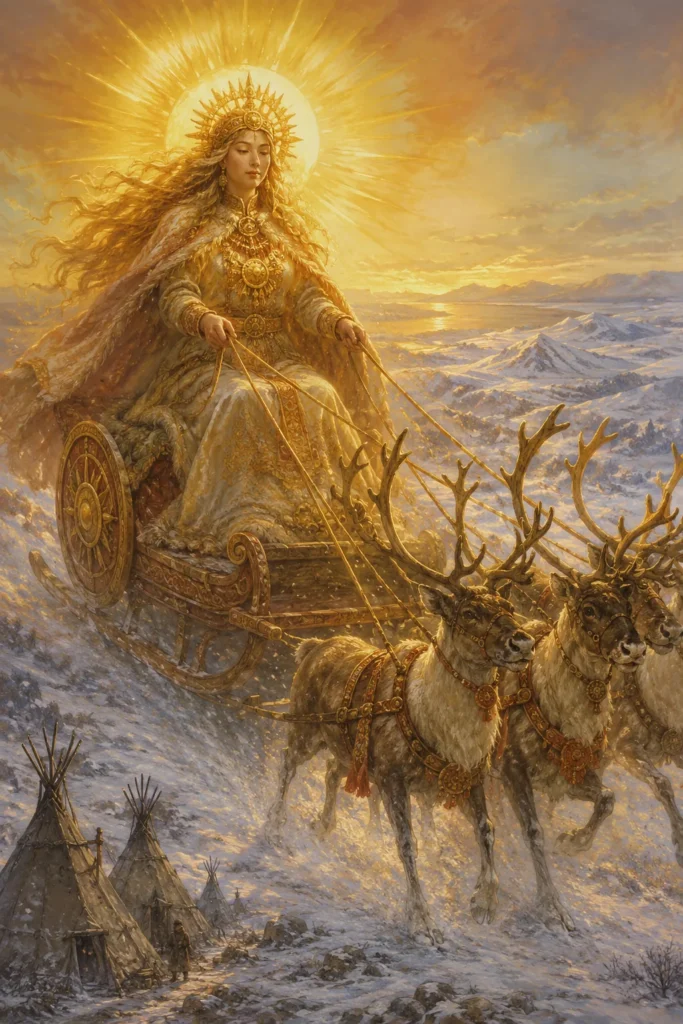
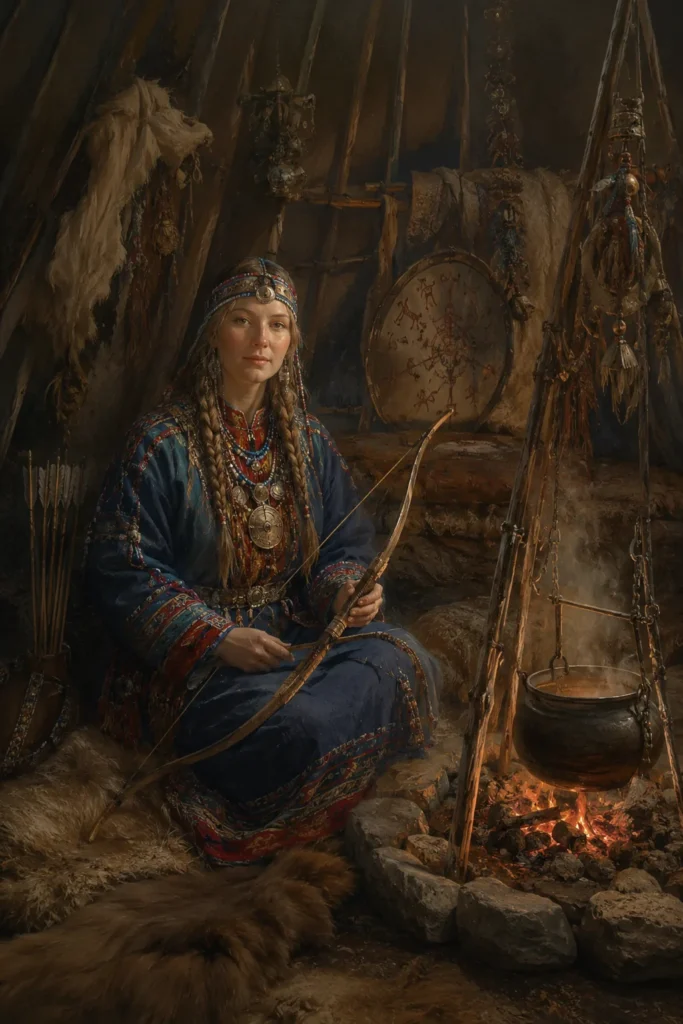
Sara Akka - Gods from the Sámi tradition, historical illustration

Classification and Brief Profile

Sara-Akka is the most important of the Akka goddesses for the moment of birth itself. While Madderakka as ancestral mother receives the soul, Sara-Akka provides assistance during the actual birth.

Juksakka is responsible for boys, Uksakka for the threshold guardian. This four-part constellation of the Akkas represents a distinct structural pattern in the phenomenology of religion.

The sources for Sara-Akka are plentiful. Johannes Schefferus’ Lapponia (1673), Knud Leem’s Beskrivelse over Finmarkens Lapper (1767), Lars Levi Læstadius’ Fragmenter i lappska mythologien (c. 1840) and the drum images of the shamanic tradition are the primary sources.

From a religious-studies perspective, Sara-Akka belongs to the class of specialized birth goddesses represented in many indigenous religions. Her particular function is assistance during birth itself, including the separation of the placenta and the handover of the newborn to its relatives.

The birth goddess Sara-Akka has been studied in recent scholarship using expanded methods that combine ethnographic precision, linguistic source criticism, and comparative perspective. Sámi researchers are themselves now part of this work, critically examining older Western attributions that sometimes carried colonial imprints.

As a specialized birth goddess within the Akka constellation, Sara-Akka fits into a circumpolar religious topography whose basic features recur across vast distances. This structural persistence across thousands of kilometres is among the most striking findings of comparative religious studies and continues to be discussed to this day.

Name and Etymology

The name Sara-Akka is composed of Sara, possibly derived from an old Sámi root meaning to separate or divide, and Akka, which in many Finno-Ugric languages means old woman, grandmother, or protective goddess. The Akka root is attested jointly in Finnish, Estonian, Hungarian, and Sámi usage.

The etymology of Sara is disputed. One hypothesis connects it with Old Norse sarpa, meaning to create or split, which could allude to the midwifery function. Another hypothesis sees in Sara a Uralic stratum.

Dialectal variants are Saaraahkka in Southern Sámi, Sarakka in Ume Sámi, and Sárahkká in Northern Sámi usage. This variety is typical in the phenomenology of religion and reflects the dialectal differentiation of the Sámi language.

From a sociology of religion perspective, the question arises as to what function Sara-Akka fulfilled in the social order of the traditional Sámi community.

Since her midwifery task set in directly at the beginning of life, the religious was not separated from everyday practice but closely interwoven with it. This entanglement forms a distinct field of religious anthropology, which Håkan Rydving and Konsta Kaikkonen in particular have systematically examined.

Added to this is the contemporary significance of Sara-Akka for Sámi identity politics. With Sámi self-governance and the recognition of indigenous rights under international law, the transmitted protective goddesses are once again gaining greater visibility.

How religious research and political recognition intertwine in this process constitutes a distinct field to which scholarship has recently paid markedly more attention.

Description and Iconography

Sara-Akka is described in ethnographic sources as a kind, middle-aged or older woman who is present in the family’s living space, especially at the hearth. She is not an outer-world goddess like Beaivi, but a household and hearth goddess.

On shamanic drums Sara-Akka is usually depicted in the middle worldly level, often as a woman with raised arms or holding a child. Ernst Manker’s drum studies have systematically documented her iconographic position.

Symbolically Sara-Akka is associated with the hearth, the cauldron, soup, and bread. This interweaving of cult and everyday life is typical in the phenomenology of religion for indigenous household goddesses.

The Birth Cult

At every birth Sara-Akka was invoked ritually. The midwife or older female relatives spoke certain words calling on Sara-Akka’s aid. After the birth a small offering, often a food item or a piece of cloth, was presented to Sara-Akka.

Concrete practices are documented in the accounts of Knud Leem and Schefferus. Sara-Akka was particularly sensitive to violations of taboo during childbirth. Anyone who spoke or acted incorrectly, or omitted the ritual words, risked difficulties during birth or weakness of the newborn.

From a religious-studies perspective, this birth practice is a paradigmatic case of an everyday religiosity that was not confined to ritual islands but permeated the life cycle. Sara-Akka’s significance lay precisely in this closeness to everyday life, which is a distinct phenomenon in the phenomenology of religion.

Sara-Akka and the Sara-Akka Drink

A particular ritual practice was the Sara-Akka drink, a brandy or other alcoholic libation consumed after the birth in honour of the goddess. This practice is independently attested by several sources and is of interest from a phenomenological perspective.

The drink was shared by the midwife and the women present. Men were excluded from this practice, which underscores the gender-specific structuring of birth religion. The gender separation in religious practices was pronounced in the pre-Christian Sámi tradition.

From a religious-studies perspective, the Sara-Akka drink is an example of the ritualised consolidation of the female religious sphere. The mission attacked such practices with particular aggression because they contradicted the Lutheran gender order.

Taboos Surrounding Pregnancy and Birth

Sara-Akka was the addressee of numerous taboos that governed pregnancy, childbirth, and the first months of the child’s life. The woman giving birth was not permitted to eat certain foods, speak certain words, and had to withdraw for several days.

This taboo structure is documented in ethnological detail. Specific prohibitions included eating bear meat during pregnancy, singing loudly during birth, and speaking certain divine names in the lying-in room.

From a religious-studies perspective, this taboo structure is a distinct ritual configuration that structured female life religiously. It is comparable to the taboo structures of other indigenous birth goddesses, such as the Inuit birth guardian Pinga.

Sara-Akka in the Akka System

The four-part constellation of the Akkas, Madderakka, Sara-Akka, Juksakka, Uksakka, is a distinct structural pattern in religious studies. Madderakka receives the soul, Sara-Akka assists at birth, Juksakka cares for boys, Uksakka guards the threshold.

This functional differentiation is elaborated in the phenomenology of religion. It distinguishes the Sámi tradition from many other indigenous traditions in which midwifery is not divided into such clear specialisations.

From a religious-studies perspective, the question has been discussed whether the Akka four-theology is a late systematisation by missionaries or an independent Sámi configuration. Håkan Rydving and Konsta Kaikkonen tend toward the second reading, which underscores the independence of Sámi theology.

Comparison with Other Birth Goddesses

Sara-Akka belongs to the class of specialised birth goddesses represented in numerous cultures. Structurally comparable are the Finnish Synnytäjätär, the Greek Eileithyia, the Egyptian Tauret, the Japanese Konohanasakuya-hime, and the Inuit birth guardian Pinga.

The specificity of Sara-Akka lies in her embedding within the Akka system with a clear division of functions. This specialisation is elaborated in the phenomenology of religion and distinguishes the Sámi tradition from traditions with only one birth goddess.

Within the Finno-Ugric tradition the Akka configuration is related to the Finnish Lampi-Akka, the Hungarian Boldogasszony, and other protective goddesses. This structural kinship points to an ancient Finno-Ugric stratum of religious conceptual formation.

Mission and Modern Reception

The Christian mission partially identified Sara-Akka with Mary, which facilitated the transitional theology of the missionised Sámi. This identification is, from a religious-studies perspective, a colonially shaped reinterpretation that obscured the specific Sámi birth theology.

The birth practices surrounding Sara-Akka were persecuted by Lutheran missionaries as pagan, which largely broke the ritual tradition. Remnants of the tradition have survived in family practice and in orally transmitted sayings.

In the contemporary Sámi cultural revitalisation, Sara-Akka is a significant figure. Women’s rights movements within the Sámi community invoke her as an example of female religious authority in traditional religion. This appropriation is productive from a phenomenological perspective.

Lexicon Cross-References

Sara-Akka connects with Madderakka, Juksakka, Uksakka, Beaivi, Mánnu, Ráhka, Stallo, Jabmiidaibmu and Saivo. The culture hub Sámi Tradition frames the birth theology. Structurally similar birth goddesses are found in the Inuit lemma series under Pinga.

Sarakka at the Hearthfire: the Birth Deity at the Centre of the Tent

Sarakka, written in the sources also as Sáráhkká, is among the Sámi Akka deities the one most directly connected with birth and the hearthfire.

While Maderakka as the overarching ancestral mother gives the child its body and Uksakka guards the door threshold, Sarakka’s sphere of activity belongs to the centre of the tent, the place where the fire burns and where birth took place.

The name is generally connected in scholarship with a Sámi verb meaning “to split” or “to divide,” interpreted as an allusion to the process of birth. This etymology is plausible but not conclusively established.

Sarakka was regarded as the one who stood by the woman in labour and, as it were, brought the child into the visible world. Sources report that special offerings were made to her, for instance portions of food, and that a woman giving birth or the women assisting her would turn to Sarakka.

Noteworthy is Sarakka’s connection with the hearth. The fire at the centre of the tent was a ritual focal point of domestic life, and Sarakka as the deity assigned to it embodied the protection that emanated from this centre.

Her veneration was close to everyday life, tied to concrete situations, and borne above all by women. Precisely because this piety was unobtrusive and embedded in daily life, it is recorded only briefly in the missionary accounts that were focused on public cults.

What the Missionary Accounts Conceal and Distort about Sarakka

The transmission concerning Sarakka faces the same fundamental problem as that of all Sámi deities: it derives almost entirely from the writings of Christian missionaries and pastors of the 17th and 18th centuries, who were combating the indigenous religion.

In the Norwegian sphere these include accounts from the circle of missionary endeavours under Thomas von Westen; in the Swedish sphere, records by pastors such as Pehr Högström.

These sources distort the picture of Sarakka in several respects. First, the recorders regarded her as a pagan idol and had no interest in an empathetic portrayal.

Second, the area to which Sarakka was assigned, that is, birth, nursing, and women’s knowledge, was partly inaccessible to the male observers and met with particular displeasure on their part, because old practices persisted here with particular tenacity.

Some rites in honour of Sarakka were explicitly persecuted by the mission. What the accounts transmit is therefore a selection filtered through rejection and restricted access.

Critical Sámi religious scholarship, for example in the work of Håkan Rydving, has shown that the Christian mission could not fully grasp and suppress the domestic, women-carried piety for a long time, because it evaded public control.

This is important for the assessment of Sarakka: on the one hand, her veneration is only incompletely documented because of this concealment; on the other hand, it is likely that it persisted longer precisely for that reason than many a public cult.

What is considered well established is Sarakka’s basic association with birth and hearth; the details of the rites dedicated to her, however, are marked by uncertainty and in part can only be inferred from hostile descriptions.

Selected Bibliography

  • Johannes Schefferus: Lapponia (Frankfurt 1673)
  • Knud Leem: Beskrivelse over Finmarkens Lapper (Copenhagen 1767)
  • Lars Levi Læstadius: Fragmenter i lappska mythologien (Manuscript c. 1840)
  • Håkan Rydving: The End of Drum-Time (Uppsala 1993)
  • Juha Pentikäinen: Saamelaiset (Helsinki 1995)
  • Konsta Kaikkonen: Sami Pre-Christian Religion (Helsinki 2020)

In Sámi religion Sara-Akka is counted among the Akka goddesses, the female protective powers of the household and the life cycle. As guardian of pregnancy she accompanied, according to traditional belief, mother and unborn child from conception to birth.

Offerings at the hearth, regarded as her dwelling place, were meant to secure her presence; her role as guardian linked her closely to the transition rites surrounding birth.

Related key terms: Sara-Akka Sarakka Sárahkká Sámi birth goddess Akka system Schefferus Læstadius.

iWell Guard and Protection Traditions

iWell Guard draws on the cultural-historical tradition of wearable protective objects, in the tradition of the Sámi and many other cultures worldwide. 41 levels, real gold, platinum, silver, crafted in Germany. 30-day return policy.

Personal experiences may vary. Not a medical product. No healing claims.