Bannik, spirit of the Slavic tradition
By Ralf Ittermann · last reviewed on
Bannik (банник) is the house spirit of the Slavic tradition, who presides over the bathhouse or steam room.
He is feared and respected as an ambivalent spirit who brings both protection and danger, and is closely connected with water, heat, and purification.
Bannik in the Banya Ritual
Bannik is the house spirit of the Slavic bathhouse (Russian banya, Ukrainian laznja, Polish łaźnia).
He inhabits the fourth sauna round, the final, dangerous session after midnight. The first three rounds belong to the people; the fourth belongs to Bannik.
Anyone who enters the bathhouse at that time risks scalding, suffocation, or death from hot steam. Protective practice: leave water and food offerings (bread, salt, honey) on the bench, avoid making the sign of the cross (it angers him), and never speak loudly.
The banya birth ritual tradition (especially in northern Russia and the Tver region) presents newborns to Bannik for their first cleansing as an act of acknowledgment. Related figures of the Slavic household spirit world: Domovoi (hearth spirit), Ovinnik (drying-barn spirit), Dvorovoi (yard spirit), Polevoi (field spirit), Leshii (forest spirit).

Bannik
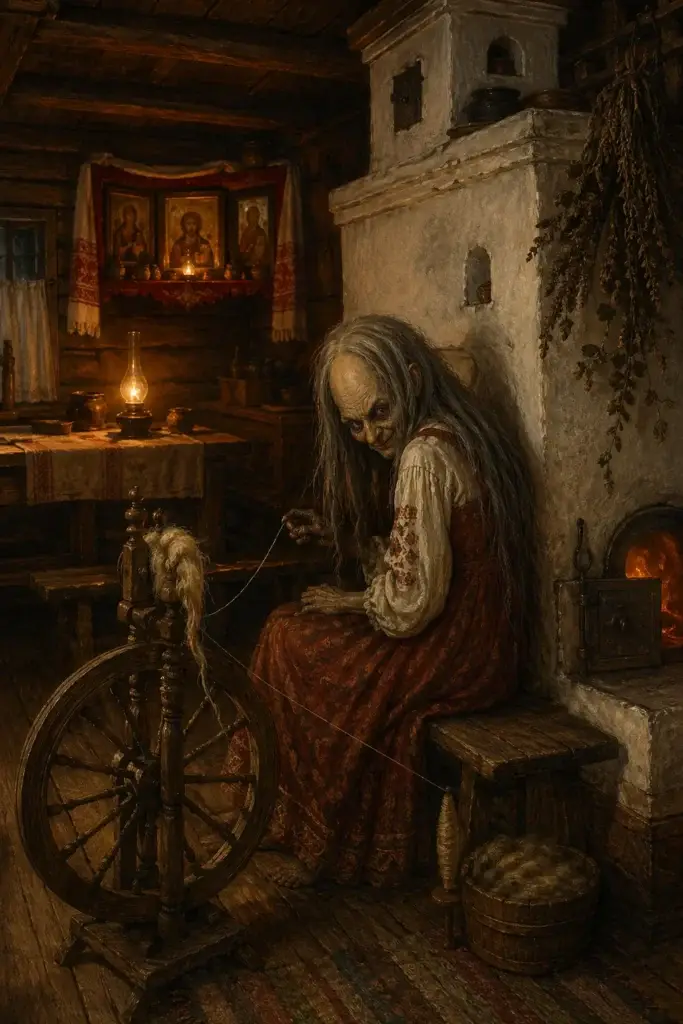
Bannik is described as a shaggy, grey-haired spirit who lives in the hot water and steam of the bathhouse. He can help the bather, warn them, or scalp them and pull them into the steam, depending on how he is treated.
Unlike malevolent demons, Bannik is not an inherently harmful being but a household spirit with clear rules: those who are polite and observe etiquette are rewarded; those who disrespect or defile him are punished. His nature is neutral; his actions are context-dependent.
Profile: Bannik
Bannik is documented in ethnographic collections of Slavic folklore (Afanasyev), though less so in literary primary sources. Russian travellers and chronicles do mention him, but with scepticism, as “pagan superstition“.
His distribution lies in the East Slavic area: Russia, Belarus, Ukraine. Folklorist Linda J. Ivanits documents Bannik cults well into the 20th century. Unlike Christian saints, Bannik is a pre-Christian entity that persisted in folk practice.
Distinction from the Draugr: Unlike the Draugr of the Germanic-Nordic tradition, who appears as a corporeal revenant, Bannik is a house spirit, a protective being of the Slavic Banya (Russian sauna), who interacts with the bather according to clear behavioural rules.
Classification
Bannik is a figure of living folk tradition, less well documented in writing than major deities, yet equally real in lived practice. His origins probably lie in shamanic steam bath rituals shared by the Slavs with other northern and Siberian peoples.
The banya itself is an ancient institution, older than Christianity, and with it Bannik survived. Ethnographic records from the 19th and 20th centuries document belief in Bannik in vibrant, living form.
Bannik was widespread wherever banyas were built, throughout the entire East Slavic world, from north to south. The banya is not merely a building but a social and spiritual institution. Bannik was its invisible operator and guardian. In Finland and Scandinavia, parallel figures such as the Saunatonttu exist, pointing to an ancient, cross-cultural origin.
Written sources are sparse; the main sources are folk tradition, ethnographic collections, and oral accounts. Christian clergy mention Bannik critically as an example of pagan delusion. The best evidence, however, is the continuous practice of the banya itself: a spirit without institutional anchoring would not have survived.
Designations and Spellings
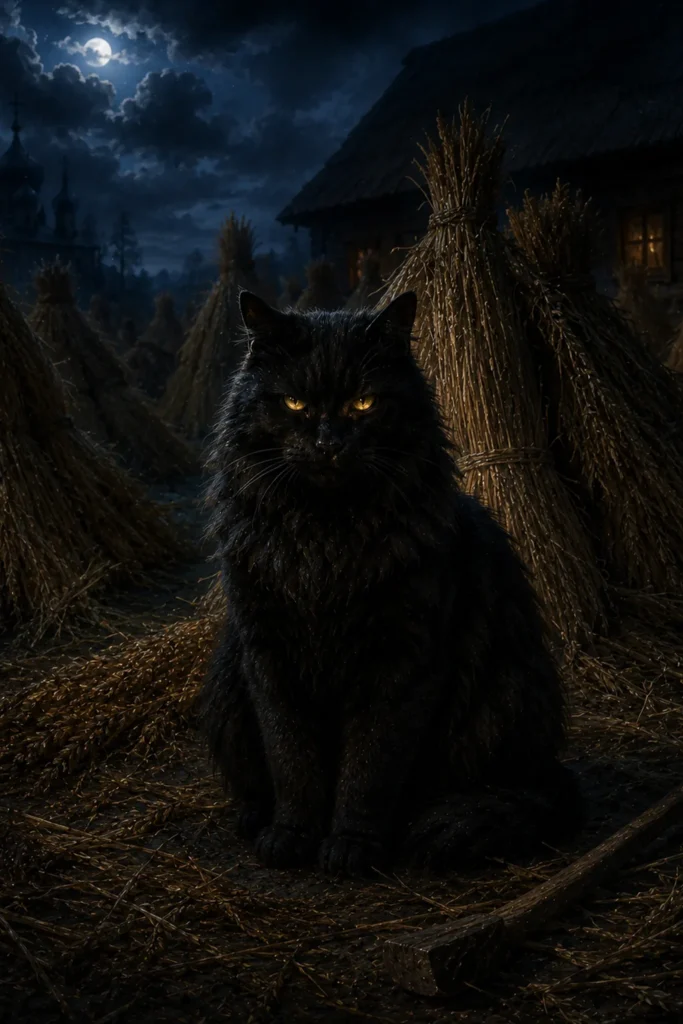
Bannik is depicted as a powerful, broad figure with a reddish or black face drenched in sweat, often naked or covered only with tree leaves. His eyes are intense and sometimes wild like an animal’s. He can appear as a human man, as an animal (cat, bear), or as pure steam and mist.
The sacred symbol is the birch-branch whisk, with which one strikes oneself in a ritual manner, an act of respect and an invitation of his power.
Characteristics
Bannik was not simply a house spirit but an actively working healer and purifier. One entered the banya with care and with respectful words addressed to Bannik. Too rapid a shift from heat to cold could be fatal; people said Bannik had punished the person.
Those who used the heat wisely and respectfully could be healed of illness. Women called on Bannik during difficult births. The striking with the birch whisk was no mere pastime but a ritual, a way of speaking with Bannik and activating his healing power.
Fact Sheet: Bannik
The profile presents Bannik from six perspectives: his cultural origin as a house spirit, the social groups who venerated him (bathers, families), his physical form and attributes, his ambivalent protective and harmful practices, and parallels in other cultures. These dimensions reveal his role as a threshold guardian and purification entity.
Bannik is geographically tied to the Slavic bathhouse (banya), which was widespread in Eastern Europe. His cultural origin is proto-Slavic, probably prehistoric, since the bathhouse played a central hygienic and ritual role in Slavic cultures.
Written evidence is late and mostly disparaging (Christian chronicles). In the history of religions, Bannik is understood as a specialisation of a general house spirit cult, differentiated toward the specific function of the bathhouse as a liminal–magical space.
Bannik was venerated and feared by bathers, especially women and midwives. The banya was a place of birth, healing, and ritual purification; Bannik was the guardian spirit of these functions.
Occasions included newborns’ first visits to the bathhouse, healing baths, and purifications before important events (weddings). Veneration was practical: offerings before bathing, respect toward the spirit, and observance of taboos (e.g. no cursing). Banya masters and midwives had special rituals involving Bannik.
Bannik is depicted as an old man or shaggy creature with grey hair, a soot-blackened body, and a wild appearance. His attributes are birch twigs (for striking in the bathhouse), hot stones, and water. He is sometimes shown surrounded by fire or wisps of steam.
In a few pictorial representations he wears rough linen clothing or is completely naked. The iconography is eerie but not directly malevolent, more ragged wildness than wickedness. Colours are grey, black (soot), and red (heat).
Sphere of influence: The Bannik (Russian баенник, банник) is, in East Slavic folk belief, the guardian spirit of the banya, the traditional Russian sauna. He is considered ambivalent: benevolent toward those who respect the banya and observe its rules, dangerously unpredictable toward the presumptuous.
Ethnographic records of the 19th century (e.g. Maksimov, Nečistaja, nevedomaja i krestnaja sila, 1903) attest to his central role in peasant healing rituals, in midwifery (women traditionally gave birth in the banya, making Bannik a silent birth attendant), and in divinatory practices, especially during the holy nights between Christmas and Epiphany (svjatki).
The fourth steaming session (after the three “regular” banya rounds) was considered Bannik’s own; anyone who entered at that point risked encounters with spirits.
Bannik is ambivalent: protection through respect, harm through disregard. Veneration takes the form of offerings (bread, beer, oil) before bathing, polite address, and adherence to rules (no cursing in the banya, no slamming the door).
Protective rituals consisted of fumigation and ritual offerings. Against Bannik’s wrath there were apotropaic practices such as wearing an amulet or prayer. Midwives held ritual negotiations with Bannik to ensure safe births. Veneration was pragmatic and transactional: fair treatment in exchange for safety.
Comparable figures include other house spirits: the Slavic Domovoi (general house spirit), the Germanic poltergeist or kobold (household spirit with ambivalent deeds), the Japanese Tengu (forest spirit, ambivalent and wild), and the Celtic Banshee (warning spirit). Common to all is the bond to a specific place, the ambivalent nature, and the need for ritual negotiation.
Bannik: Parallels in Other Cultures
Bannik corresponds to the Finnish Saunatonttu (sauna elf), the Scandinavian bathhouse spirit, and, more distantly, the Japanese onsen kami (hot spring spirit). The universality of this figure in cultures with strong steam bath traditions points to an archetypal anchoring in immediate physical experience.
Jewish tradition: Judaism has no direct equivalent to Bannik. The Kabbalah does, however, know of Shedim (demons/spirits) and Maziqim (harmful spirits) that are bound to certain places. These are, however, more destructive than ambivalent-transactional like Bannik. There is no cultural parallel to the bathhouse specialisation.
Greco-Roman world: The household spirits of Roman religion (Lares, Penates) are functionally similar to Bannik as guardian spirits of places. However, the Lares are less ambivalent and less wild. The Roman river deity (e.g. the Naiads in baths) might be a remote parallel, though not specialised in bathhouse dwelling like Bannik.
Mesopotamia: The Akkadian and Sumerian tradition includes house spirits (udug), but these are less specialised toward bathing. Mesopotamian baths were less ritually central than Slavic banyas. There are no direct functional parallels to Bannik.
India and Asia: In Hinduism, Preta and Bhuta are similar spirits with ambivalent powers, bound to specific locations. The Japanese Tengu is likewise wild and ambivalent like Bannik. In Feng Shui and Chinese spirit belief there are local house spirits, though less raw and wild than Bannik.
Bannik in the Domestic Spirit Hierarchy of the East Slavs
Bannik is not an isolated spirit but part of a graded system of house spirits that East Slavic folk religion laid over the peasant farmstead. At the apex stood the Domovoi, the spirit of the dwelling and the family unit.
Subordinate to him were spirits of individual farm buildings: the Ovinnik of the grain-drying kiln, the Khlevnik of the stable, the Gumennik of the threshing floor, and Bannik of the bathhouse. This division mirrors the spatial and functional organisation of the farmstead, as documented by 19th-century ethnographers.
Within this order, Bannik occupied a special position because the banya was considered an impure and dangerous place. It often stood apart, at the edge of the property or near water, and was associated with birth, illness, death, and rites of passage.
The spirit who dwelled there was accordingly regarded as more irritable and hostile than the comparatively good-natured Domovoi. While one set out bread and milk for the Domovoi and treated him almost like an invisible family member, one approached Bannik with caution and appeasement.
Research, for example in the works of Dmitry Zelenin and later Levkievskaya, has noted that Bannik stands structurally between the house spirit and the wild nature spirit.
He belongs to the farmstead but is not fully domesticated. This intermediate position explains why narratives depict him sometimes as a protector of bathers, sometimes as a deadly threat.
In some regions a female counterpart was placed alongside him, the Bannaya Babushka or Obderiha, suggesting the notion of a spirit pair in the bathhouse. The household spirit grouping was therefore not a rigid scheme but varied considerably by region. Related beliefs can be found among the other Slavic farmstead spirits.
The Banya as Ritual Space and Bannik as its Master
To understand Bannik’s position, one must appreciate the significance of the Russian bathhouse. The banya was far more than a place for bodily cleansing. It served as a birthing room, since it could be heated, was secluded, and had an ample supply of hot water.
Women gave birth there, the sick were treated there, and parts of wedding rites took place there, such as the ritual bath of the bride on the eve of the ceremony.
This concentration of transitional situations made the banya, in the logic of folk religion, a threshold space where the boundary with the other world became permeable.
Bannik was the master of this space, and the rules for dealing with him derived from his role as the lord of the house. One never bathed too late in the evening or after midnight, because Bannik himself would then be bathing, sometimes together with other impure spirits.
The fourth steaming round was widely considered to be his; anyone still in the banya at that point risked being suffocated by hot steam, doused with boiling water, or having their skin stripped off. Such narratives explained real accidents from carbon monoxide, heat stroke, and fainting in the village world.
On leaving the banya one thanked Bannik and left him water, a piece of soap, and a birch whisk so that he could wash himself. When building a new banya, an offering was made under the threshold or in the foundation, typically a black hen that was suffocated without salt and buried.
This purchase secured the goodwill of the spirit who was to take up residence in the new space. These foundation offerings are attested from several Russian guberniyas and show how closely Bannik was conceived as bound to the material construction of the building.
Divination in the Bathhouse: Bannik as an Oracle Spirit
A distinct narrative and practical layer connects Bannik with divination, especially within the framework of the Christmas fortune-telling rites of the Svjatki, the twelve days between Christmas and Epiphany.
Marriageable girls would seek out the dark bathhouse during this period to ask Bannik for a sign about their future husband. The best-known form involved stretching the bare hand or the exposed back through the open door or the mouth of the stove into the banya.
The interpretation followed a fixed pattern: if the person was touched by a rough, hairy, or cold hand, it signified a poor or unkind man or a difficult marriage. A smooth, warm touch promised prosperity and a kind husband.
If no touch came at all, no marriage was in store for the coming year. This practice is recorded in numerous ethnographic collections of the 19th and early 20th centuries and belongs to the most widely documented Bannik rites of all.
The appeal of this divination lay precisely in its danger. The banya was at night the domain of the spirit, and to expose oneself there was regarded as a bold, boundary-transgressing act.
Some accounts warn that Bannik might hold the hand fast or pull the person inside. With this came the notion that genuine knowledge of the future could only be gained through direct, risky contact with the other world.
Scholarship has classified these rites as part of a larger East Slavic complex of threshold and mirror divination, in which impure locations such as the bathhouse, the barn, and the crossroads were regarded as preferred contact zones.
Bannik appears here not merely as a harmful spirit but as a knowing spirit, whose knowledge could be acquired at personal risk.
Source Base and Ethnographic Tradition
What we know about Bannik comes almost entirely from the ethnographic collecting work of the 19th and early 20th centuries, not from medieval texts.
Unlike Greek or Egyptian deities, Bannik left no high-culture written tradition. He is a figure of oral peasant religion, and his image is therefore reconstructed from interviews, collections of folk beliefs, and recorded folktales.
Foundational are the works of Dmitry Konstantinovich Zelenin, whose East Slavic Ethnography (German edition 1927) treats Bannik systematically in the context of house spirits.
As early as the 19th century, collectors such as Alexander Afanasyev in his studies on the Slavs’ views of nature, and Sergei Maksimov in Nečistaja, nevedomaja i krestnaja sila, had gathered material.
For more recent research, the encyclopaedia Slavjanskie drevnosti under Nikita Tolstoi is authoritative, as are the studies by Yelena Levkievskaya on Slavic mythology of the impure spirits.
This source base has methodological consequences. The accounts come from different regions, primarily from northern Russia, Belarus, and Ukraine, and they contradict one another on details.
Sometimes Bannik is a small, naked, long-haired old man; sometimes a formless, black figure; sometimes only a perceptible presence. Some informants did not know the name at all and spoke only generally of the “master of the banya”.
Scholarship therefore assumes that “Bannik” designates less a sharply defined individual figure than a functional role: the spirit assigned to a specific dangerous farm building.
Those who work with the tradition should resist merging the regional variety into a smooth composite picture, and instead take the spread of the evidence as a characteristic feature of the oral tradition.
Christianisation and the Continuation of Belief
The Christianisation of the East Slavs from the 10th century onward did not extinguish belief in house spirits like Bannik but transferred it into a peculiar coexistence with Orthodox Christianity. The banya remained a particularly delicate location in this respect, since it was considered impure in the ecclesiastical view.
Tellingly, icons and the pectoral cross were removed before entering the bathhouse. The space was withdrawn from the consecrated sphere, and for precisely that reason Bannik could and had to reign there.
This division of the world into a church-protected area and an area exempted from it was not a contradiction that the faithful failed to notice; it was a conscious spatial ordering.
In the house, icons stood in the “beautiful corner”; in the banya, different rules applied. Clergy and church-aligned texts condemned the superstition, but village practice held on to the appeasement rites because they corresponded to experience with a genuinely dangerous location.
In the 20th century, belief weakened considerably with the disappearance of the traditional peasant way of life, collectivisation, and urbanisation.
Where the old wooden banya was replaced by other forms of bathing, Bannik lost his place. Nevertheless, sayings, warnings, and individual customs survived into the present, partly as folkloristic knowledge, partly as precautions still taken seriously.
In modern Russian popular culture, in fantasy literature and games, Bannik reappears, but usually as a picturesque figure only loosely connected with the ethnographic record. From a religious-studies perspective, he remains a good example of how a pre-Christian spirit belief was not replaced but displaced to the margins of Christianised space.