iWell Guard

Zduhać, the sleeping guardian of the weather

The Zduhać is a human weather-protector of the South Slavic tradition, whose soul departs as a spirit in the storm.

The human whose soul fights against the hail while they sleep.

SpiritSlavic

Table of Contents

Zduhać, the weather man of the South Slavs
Zduhać

The Zduhać, in simplified spelling Zduhac, also called Vetrovnjak or Vjedogonja, is in South Slavic, particularly Serbian, folk belief a human with a supernatural soul that departs during sleep to control weather, hail and wind.

He defends harvest and village against hostile Zduhaci and demons and is a benevolent protective being: not a demon, but a living human whose true nature is the soul that departs during sleep.

At a glance: Zduhać

Type: Human weather-protector with a departing soul
Origin: South Slavic folk belief
Texts: ethnographic collections by Đorđević, Čajkanović and Kulišić
Period: documented ethnographically in the 19th and 20th centuries
Appearance: unremarkable human whose soul departs in the storm

Historical Background

Period of the Texts

The Zduhać belongs to South Slavic folk belief; it was documented by ethnography of the 19th and 20th centuries.

Area of Diffusion

Serbia, Montenegro and Herzegovina: There, the Zduhaci of the regions fought each other in the storm over harvest and yield.

Sources

Well documented: the works of Tihomir Đorđević, Veselin Čajkanović and Špiro Kulišić, alongside the comparative study by Éva Pócs.

Name and variants

South Slavic: The etymology is disputed: either related to Old Slavic stuhia, connected to Greek stoicheíon, element, or derived from Albanian stuhí, storm. The form zduhać is probably folk etymology through association with duh, spirit and breath.

Form and Activity

Appearance

Zduhaci are outwardly unremarkable people, usually men, often deep sleepers who are hard to wake, with a bloated face, clever and prosperous. Leaders of the related Vjedogonja have a tail or excessive body hair. Their true nature is the soul that leaves the body during sleep.

Effect

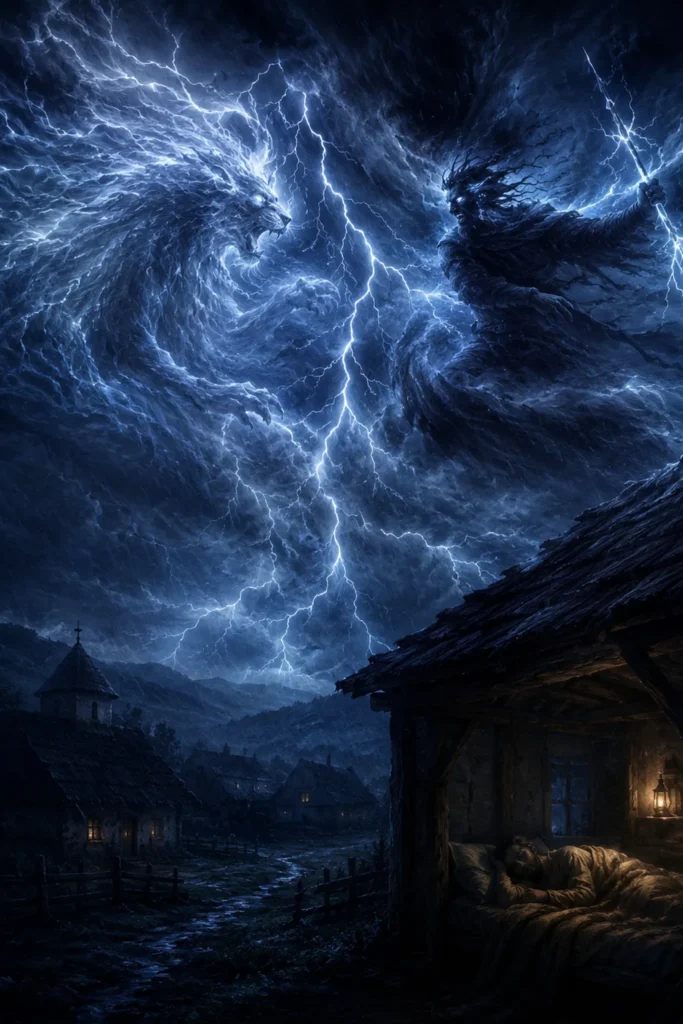
During sleep the soul leaves the body and enters the winds; it steers wind and clouds, wards off hail and fights against hostile Zduhaci from other regions, often in animal form as a bull, boar or ox. Spindles, beech buds, uprooted trees and charred pinewood serve as weapons. The victor captures the harvest and milk yield of the enemy; afterwards the Zduhać wakes exhausted, sometimes wounded.

Profile: Zduhać

The key aspects of the weather man at a glance.

Cultural Context

South Slavic folk belief: a shamanistic dual-soul concept in which a living person fights in the weather as a guardian of the village.

Responsible for

Village and harvest: the Zduhać wards off hail, steers wind and clouds and defends the yield against hostile Zduhaci.

Depiction

An unremarkable person, often a deep sleeper who is hard to wake, with a bloated face; in combat the soul often appears as a bull, boar or ox.

Function

Weather control and hail defence; one becomes a Zduhać through birth with the caul, through a birthmark, or through inheritance.

Handling

No defence needed: Zduhaci were considered a blessing. People did not throw stones into the wind, so as not to strike a Zduhać’s eye out.

Parallels

The Croatian and Slovenian Kresnik or Krsnik, the Hungarian Táltos and the Friulian Benandante; its demonic opponent is the Ala.

Caul, soul flight and the fight for spoils

The etymology is disputed: either related to Old Slavic stuhia, connected to Greek stoicheíon, element, or derived from Albanian stuhí, storm; the form zduhać is probably folk etymology through association with duh, spirit and breath. The Zduhać is documented by Tihomir Đorđević, Veselin Čajkanović and Špiro Kulišić.

One becomes a Zduhać through birth with the caul, through a birthmark, or through inheritance. During sleep the soul leaves the body and enters the winds: it wards off hail and fights against hostile Zduhaci from other regions, using spindles, beech buds, uprooted trees and charred pinewood as weapons. The victor captures the harvest and milk yield of the enemy; afterwards the Zduhać wakes exhausted, sometimes wounded.

Research and Classification

The Zduhać is firmly rooted in Serbian folklore and academic literature and lives on in a Serbian film as well as in Slavic-inspired fantasy and folklore blogs.

From a religious-studies perspective, the Zduhać is not a demon but a living person with a soul that leaves the body, a shamanistic dual-soul concept. And a clarification regarding the name: the derivation from duh, spirit, is a popular folk etymology; the origin lies in stoicheíon or stuhí.

Protective rules around the village guardian

Zduhaci were considered a blessing and village guardians, against whom there was no defence. Protective rules concerned others: people did not throw stones into the wind, so as not to strike a Zduhać’s eye out. A wounded Zduhać was healed through confession and a smoke ritual; leaving the role behind was achieved through confession and the promise not to fly anymore.

Kresnik, Táltos and the network of weather fighters

The Zduhać corresponds to the Croatian and Slovenian Kresnik or Krsnik, the Hungarian Táltos and the Friulian Benandante; all are born with the caul and send their soul out to fight for fertility and weather control. Éva Pócs is the leading comparative authority for this Central European network. Its classic opponent on the demonic side is the Ala, who brings hail over the fields.

Frequently asked questions about the Zduhać

What is a Zduhać?

A living person whose soul leaves the body during sleep to control the weather and protect the village.

How does one become a Zduhać?

Through birth with the caul, a birthmark, or inheritance.

Is the Zduhać a demon?

No. He is a benevolent weather man, not a demon.

Further links

Recommended internal links:

Literature (selection)

A selection of key sources and studies:
  • Đorđević, Tihomir: Veštica i vila u našem narodnom verovanju i predanju. Belgrade 1953.
  • Čajkanović, Veselin: Stara srpska religija i mitologija. Belgrade 1994.
  • Pócs, Éva: Stoikheion, Stuha, Zduhač. In: Magic, Ritual, and Witchcraft 15. 2020.

Further standard works in the bibliography.

As a Serbian weather man, the Zduhać is one of the most unusual figures of Slavic belief: a fighter in the storm who lives unremarkably in the village by day and whose soul keeps hail away from the fields by night.

Classification & Protection

ILEVEL
The Protection Compass assigns this being to influence level I, Minor influence.

Against its influence, cross-cultural tradition names these protective means:

Compare in the Protection Compass →

Recommended protective means

iWell Guard

The simplest protective means in this collection: 41 layers of fine gold 999, platinum, silver and silicon, manufactured in Ruhla, Thuringia. It requires no activation, is bound to no person, and is effective within a radius of around 50 meters, even without being worn.

All protective means at a glance →