Nav, the soul of the unbaptised, deceased child
By Ralf Ittermann · last reviewed on
Nav is a spirit of Slavic tradition.
Souls of the dead of unbaptised children, appearing as a girl or a wailing bird.
Nav, also Nawia, denotes in Slavic tradition the souls of the dead, above all the souls of children who died unbaptised or before their time. As Navki and Mavki, they appear as beautiful girls or as wailing black birds. Unlike the vampire undead of the neighbouring Slavic traditions, they are pure spirits of the dead, not blood-drinkers.
The belief is widespread across the Slavic world: in the East Slavic tradition the spirits appear as Navka and Mavka, in the South Slavic tradition predominantly in bird form. According to East Slavic belief, a child who died unbaptised wanders for seven years, begging for baptism; if it finds no mercy, it finally becomes one of these spirits.
Type: soul of the dead, especially of unbaptised or prematurely deceased children
Origin: Slavic folk belief concerning death, baptism, and the souls of the dead
Texts: common Slavic tradition, fundamentally described by Jan Máchal
Period: common Slavic to the present day
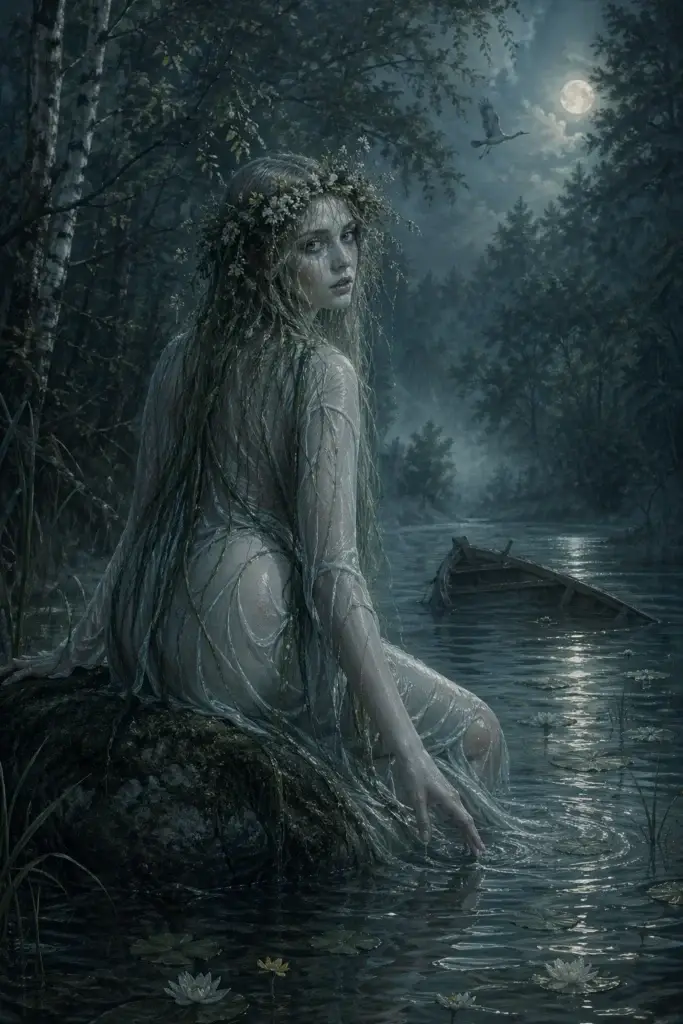
Appearance: beautiful girls in white shirts or black, wailing birds

Context of the tradition
Period of the Texts
Common Slavic: the word root is attested in Proto-Slavic, so the belief reaches back into the shared early period of the Slavic peoples and remains alive today in art and modern paganism.
Area of Diffusion
The entire Slavic region. In the East Slavic tradition, the belief appears as Navka and Mavka, in the South Slavic tradition predominantly in bird form.
Sources
Good: the belief is widely attested across the common Slavic tradition, fundamentally described by Jan Máchal and classified by Perkowski and Ivanits.
Name and variants
Slavic: the Proto-Slavic root navь means dead or a dead person. Nav denotes the souls of the dead; Navka and Mavka are the common diminutive forms. Nawia as an underworld under the guardianship of the god Veles is not attested in old sources but is a construction of modern Rodnovery.
Form and effect
Appearance
The Nav shows two main images: as beautiful, half-naked girls with long hair in white shirts, swinging on tree branches at night, or, in the South Slavic tradition, as large black birds lamenting over their baptism. The bird motif links the figure to the older notion of the soul as a bird.
Effect
The Navki lure young people by imitating a child’s crying or laughing, lament over the missed baptism and sometimes cause harm. Whoever mocks or whistles at the lamenting bird-Navje draws their wrath upon themselves; whoever shows pity and symbolically baptises them becomes their benefactor. In some accounts they are also credited with influence over weather and harvest.
Profile: Nav
The key aspects of the Slavic spirit of the dead at a glance.
Common Slavic belief in spirits of the dead, known in the East Slavic tradition as Navka and Mavka, and in South Slavic tradition in bird form.
Unbaptised or prematurely deceased children, as well as young people lured by the Navki.
Beautiful girls in white shirts swinging on tree branches, or, in the South Slavic tradition, large black lamenting birds.
Luring, lamenting over the baptism and sometimes causing harm; some traditions also credit them with influence over weather and harvest.
The belated baptism redeems the child; as prevention, correct burial, timely baptism and avoiding mockery are considered important.
The root navь and the souls of the dead
The name derives from the Proto-Slavic root navь, meaning dead or a dead person. In Slavic belief, Nav denotes the spirits of the dead; Navka and Mavka are the common diminutive forms for the individual spirits. Nawia as an underworld under the care of the god Veles is not attested in old sources but is a construction of modern Rodnovery.
Their origin is said to lie in the souls of children who died unbaptised, were stillborn or were killed by their own mother. According to East Slavic tradition, such a child wanders for seven years, begging for the belated baptism; if it finds no pity, it becomes one of these spirits for good. This notion is documented, among others, in Jan Máchal’s account of Slavic mythology.
Mavka between stage, film and neopaganism
The Mavka became internationally known through Lesya Ukrainka’s drama The Forest Song of 1911 and the Ukrainian animated film Mavka of 2023, the related Rusalka through Dvořák’s opera of the same name from 1901. Nav and Nawia are a firm part of modern Slavic neopaganism and fantasy reception.
In the study of religion, Nav is a pure expression of the bad death without any vampire blood motif: the person who died prematurely, unbaptised or unclean remains in the intermediate realm because the ritual transition is missing. Redemption through baptism shows the Christian overlay of an older Slavic belief in spirits of the dead.
Redemption through baptism and domestic protection
Unlike the undead vampires, ritual redemption is central to the Nav: the symbolic, belated baptism of the unbaptised child redeems the spirit and ends its wandering. As prevention, correct burial and the timely baptism of children are considered the most important protection. In the home, the threshold was protected as the transition between inside and outside, while salt and herbs such as mugwort, taken from the context of the related Rusalka, served as a defence. Mocking or whistling at the lamenting spirits should be strictly avoided, as this draws their wrath.
Nav alongside Vukodlak and Upiór
Within the Slavic belief world, the Nav is clearly distinct from the blood-suckers: the Vukodlak of South Slavic tradition and the Upiór of West Slavic-Polish tradition are undead vampires with a pronounced blood motif, whereas the Nav, as a pure spirit of the dead, lacks this motif. The Scandinavian Myling is considered a further related being.
Frequently asked questions about the Nav
Is the Nav or Navka a vampire?
No, it is rather regarded as the spirit of the dead of drowned or unbaptised deceased and is related to the Rusalka and the Mavka, not to the blood-sucking undead.
Why do they appear as birds?
In the South Slavic tradition, the Navki are regarded as black birds lamenting over the baptism, following the old motif of the soul as a bird.
How are they redeemed?
Through the symbolic, belated baptism of the unbaptised child; this is the central act of redemption in the tradition.
Further links
Literature (selection)
Further standard works in the bibliography.
In Slavic folk belief, Nawia refers to the spirit of the dead of an unbaptised child, the navki spirit of the dead, who wanders between the worlds until the missed baptism is carried out for it.